

Quick Answer: Progressive overload means making your training harder over time so your muscles have a reason to keep growing. You can do this by lifting heavier, adding reps or sets, improving range of motion, slowing tempo, or moving to a harder exercise variation. Any method works, as long as the challenge keeps increasing.
- Key Takeaways
- Why Does Progressive Overload Matter?
- What Does Progressive Overload Look Like?
- The 7 Methods of Progressive Overload
- How To Track Progressive Overload?
- How Much Weight Should You Add?
- How Often Should You Progressive Overload?
- Progressive Overload for Specific Exercises
- Can You Progressive Overload While Cutting?
- When To Deload
- Common Mistakes To Avoid
- Frequently asked questions
- References
Key Takeaways
- Progressive overload works through any variable that increases training demand — not just heavier weight
- Double progression (adding reps first, then weight) is the most reliable system for intermediate lifters
- Research shows rep progression and load progression produce comparable muscle growth when effort is consistent
- Track every session — without a log, progressive overload becomes guesswork
- Deload every 4–6 weeks to let connective tissue recover and prevent overuse injuries
Progressive overload is the principle of gradually increasing the demand placed on your muscles over time. Without it, your body adapts to whatever you’re doing and stops changing — no matter how many sessions you put in.
Your muscles grow and strengthen only when forced to handle more than they’re used to. Same weight, same reps, same sets every week? That’s maintenance. Not progress. This applies whether you’re training with a barbell, dumbbells, a medicine ball, or your own bodyweight. The method changes. The principle doesn’t.
Why Does Progressive Overload Matter?
Your body is designed to adapt. That’s the entire point of the stress-recovery-adaptation cycle — you apply a training stimulus, your muscles sustain microtears, you recover, and the tissue rebuilds slightly stronger. But adaptation has a ceiling. Once your muscles can comfortably handle the current demand, the stimulus disappears. Progress plateaus. No new stimulus, no reason to grow.
If you’re still getting clear on the basics, what reps and sets actually mean and how the numbers work, start there. Progressive overload is what happens after you understand the structure.
A 2022 study by Plotkin, Schoenfeld et al., published in PeerJ, compared load progression versus repetition progression across 43 trained participants over eight weeks. Both groups saw comparable increases in muscle thickness ranging from 6.7% to 12.9% across measurement sites, even though the two groups used completely different progression strategies.
This is where most training programs fail. People find a routine that feels hard in week one and repeat it unchanged for months. By week four, the same workout that once challenged them barely registers as effort. The stimulus is gone. The results follow.
What Does Progressive Overload Look Like?
Progressive overload can look different depending on your exercise, training goal, and experience level.
A simple example using the squat:
| Week | Exercise | Weight | Sets × Reps |
|---|---|---|---|
| 1 | Barbell Squat | 80 kg | 3 × 8 |
| 3 | Barbell Squat | 80 kg | 3 × 10 |
| 5 | Barbell Squat | 82.5 kg | 3 × 8 |
The weight stayed the same for two weeks while reps climbed. Then the load went up and reps dropped back down.
Another example using dumbbell shoulder press:
- Week 1: 15 kg dumbbells — 3 sets × 8 reps
- Week 4: 15 kg dumbbells — 3 sets × 12 reps
- Week 6: 17.5 kg dumbbells — 3 sets × 8 reps
Both situations represent progressive overload. Adding repetitions, improving control, increasing range of motion, or performing a harder variation all increase the challenge placed on your muscles, not just heavier plates.
If you’re new to resistance training and want a structured week-by-week plan for applying this, see our progressive overload guide for beginners.
The 7 Methods of Progressive Overload
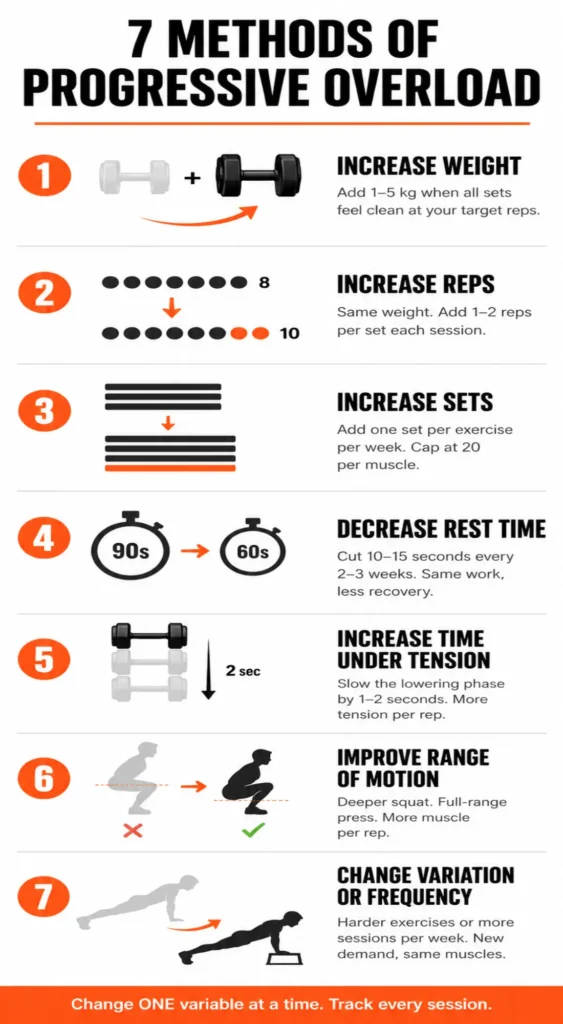
There’s more than one way to force adaptation. Picking the right method depends on your training experience, your goal, and which variable has room to move.
1. Increase the Weight
When you can finish all prescribed sets at your target rep ceiling with clean form, add weight and drop back to the bottom of the range. Upper body compounds (bench press, overhead press) — increase by 1–2.5 kg. Lower body compounds (squats, deadlifts), increase by 2.5–5 kg. Smaller increments prevent form breakdown.
2. Increase the Reps
Same weight, add 1–2 reps per set each session until you hit the top of your range. Useful when load increases aren’t available, home training with fixed dumbbells, for example, or when recovering from injury.
Rep progression works, but it has a ceiling. Past a certain point, adding reps at the same weight builds endurance, not strength or muscle size. If your max hasn’t moved despite climbing reps, the reason is specific — and so is the fix.
3. Increase the Sets
One extra set per exercise per week increases total training volume. Works well for intermediate lifters who’ve maxed out their rep range at a given weight. Volume drives hypertrophy — but past 20 sets per muscle per week, returns diminish rapidly. A 2022 systematic review in the Journal of Human Kinetics examining resistance training volume and hypertrophy found that adding more sets doesn’t guarantee more growth — especially for trained lifters who already have adequate volume.
4. Decrease Rest Time
Cut 10–15 seconds off your rest period every 2–3 weeks. Same work, less time. Effective for endurance training, fat loss, and conditioning, not ideal during strength blocks where full recovery between sets is critical. If you’re unsure whether your training goal should prioritize strength adaptations or muscle size, our hypertrophy vs strength training guide breaks down the programming differences.
5. Increase Time Under Tension
Slow the eccentric (lowering) phase by 1–2 seconds. Same weight, same reps, more mechanical tension per set without heavier load. Our guide on time under tension covers tempo manipulation in detail.
6. Improve Range of Motion
A deeper squat recruits more muscle than a quarter squat. A full-range bench press activates more chest than a half-rep. More range under load is overload most people overlook.
7. Change Exercise Variation or Training Frequency
Bodyweight squats to goblet squats. Standard push-ups to deficit push-ups. Dumbbell press to barbell press. Or increase how often you train a muscle group per week, twice instead of once provides more stimulus without changing the exercises.
One caution: changing exercises should serve a clear training purpose, not just create the feeling of a harder workout. Randomly rotating exercises every session is the basis of muscle confusion, and research shows it does not outperform consistent, structured training.
When basic progression stalls, advanced set techniques like drop sets, rest-pause sets, and supersets extend the overload without increasing weight. And if adding weight isn’t practical at all, limited equipment, home training, or injury recovery, our complete guide on progressive overload without adding weight covers five non-load methods in depth.
How To Track Progressive Overload?
Progressive overload only works when you know what you previously achieved. Before each session, check what you did last time. During the session, record what you completed. After the session, note whether it’s time to move up.
A training log entry for one exercise looks like this:
| Week | Exercise | Weight | Sets × Reps | Notes |
|---|---|---|---|---|
| 1 | Bench press | 60 kg | 3 × 8 | Last 2 reps hard. Hold weight. |
| 2 | Bench press | 60 kg | 3 × 10 | All reps clean. Ready to increase. |
| 3 | Bench press | 62.5 kg | 3 × 8 | Dropped back to 8 reps with new weight. |
| 4 | Bench press | 62.5 kg | 3 × 9 | Building back up. |
This is called double progression — increase reps at a given weight until you hit the top of your range across all sets, then increase weight and start the rep climb again. It’s the most reliable method for intermediate lifters because it provides a clear, measurable progression path that doesn’t depend on feeling or guessing.
The decision rule is simple. All reps completed with 1–2 reps in reserve (RIR)? Increase next session. Failed the target reps on 2+ sets? Hold the weight. Missed reps across all sets? The load is too heavy, drop back. If you’re unfamiliar with using RPE and RIR to regulate training intensity, start there — it makes progression decisions far more precise than going by feel alone.
A gym notebook, your phone’s notes app, or a dedicated tracking app all work. The best system is the one you’ll open before your first set.
How Much Weight Should You Add?
Not all exercises progress at the same rate. The muscles involved, the lever lengths, and the stability demands all affect how much you can increase per session.
| Exercise Type | Recommended Increase | Example |
|---|---|---|
| Lower body compound (squat, deadlift) | 2.5–5 kg per session | 80 kg → 82.5 kg |
| Upper body compound (bench press, overhead press, rows) | 1–2.5 kg per session | 60 kg → 61.25 kg |
| Isolation (curls, lateral raises, flyes) | 1–2 kg every 2–3 sessions | 8 kg → 9 kg |
| Bodyweight exercises | Add 1–2 reps or progress to harder variation | Push-ups → decline push-ups |
Fractional plates (0.5 kg and 1.25 kg) are worth owning. Most commercial gyms stock 2.5 kg as the smallest plate. For upper body lifts — especially overhead press and bench — jumping 5 kg at a time is too aggressive for most people past the beginner stage.
The ACSM’s 2009 Position Stand on Progression Models in Resistance Training recommends that novice lifters use loads corresponding to 8–12 RM and increase weight as technique and tolerance allow. For compound upper body lifts, this usually means smaller jumps than most people attempt.
How Often Should You Progressive Overload?
The rate depends on your training age. The 2026 ACSM Position Stand on Resistance Training, synthesizing over 137 studies and 30,000+ participants, makes this clear: progression rate should scale with how long you’ve been training and how well you recover.
Beginners (0–12 months): Can increase weight nearly every session thanks to neural adaptation — your brain learning to recruit more motor units before muscle growth even begins. For the exact week-by-week progression, starting weights, and signs it’s time to slow down, see our complete beginner progressive overload guide.
Intermediates (1–3 years): Progress every 1–2 weeks. Double progression (reps first, then weight) works well here because session-to-session load increases start stalling.
Advanced (3+ years): Progress over 4–8 week training blocks. Periodization becomes necessary — cycling through different rep ranges and intensities to accumulate enough stimulus for adaptation. At this stage, training to failure becomes a strategic tool used sparingly rather than a default approach.
Progressive Overload for Specific Exercises
How To Progressive Overload Bench Press
The bench press responds best to small, consistent load increases. Add 1–2.5 kg when you can complete all working sets at your prescribed rep ceiling. If load progression stalls, switch to rep progression — hold the weight and add 1 rep per set per week.
When that stalls, try a pause at the bottom of each rep (1–2 seconds) to increase time under tension without changing the weight. Tempo manipulation is one of the most underused overload tools on bench.
Another variable worth auditing before changing exercises entirely is your grip width. Narrowing or widening by even two finger widths shifts the strength curve and can restart progress without changing the exercise.
How To Progressive Overload Push-Ups
Bodyweight overload follows a different path. You can’t add external load easily, so progression comes from exercise variation and rep manipulation. Start with standard push-ups at a target rep range (say, 3 × 12). When that’s comfortable, progress to a harder variation: diamond push-ups, decline push-ups, archer push-ups, or deficit push-ups on parallettes.
Looping a resistance band across your back adds external load without needing a weight vest. Each progression makes the exercise harder without touching a dumbbell.
How To Progressive Overload Abs
Core training responds to the same overload principles — but most people never apply them. If you’ve been doing 3 × 20 bodyweight crunches for months, nothing will change. Progression for abs means adding resistance (a plate, a medicine ball, a cable), slowing the tempo, or switching to a harder variation: hanging leg raises, ab wheel rollouts, weighted planks.
Treat your core like any other muscle group. If it’s not being challenged progressively, it’s not growing.
Can You Progressive Overload While Cutting?
Yes — but the expectations shift. During a calorie deficit, your recovery capacity is reduced. Strength gains slow or stall. The goal of progressive overload during a cut is not to set personal records — it’s to send a strong enough signal that your body preserves muscle tissue instead of breaking it down for energy.
In practice, this means maintaining the weight on the bar. If you were squatting 100 kg for 3 × 10 before the cut, your job during the cut is to keep squatting 100 kg for 3 × 10. Load may not go up. That’s fine. Holding your strength during a deficit is overload relative to what a non-training body would do — which is lose muscle.
If load maintenance isn’t possible, shift to rep or tempo progression. Add a rep. Slow the eccentric. These smaller overload signals still tell your body the muscle is in use. For the complete programming approach during fat loss, read how many reps and sets for fat loss.
When To Deload
Progressive overload doesn’t mean pushing harder indefinitely. Fatigue accumulates across weeks of training, and at some point the accumulated load exceeds your recovery capacity. Your connective tissue — tendons, ligaments, joint capsules — adapts slower than muscle. Push past what they can handle and you’re looking at muscle strains, stress fractures, or chronic tendon issues that take months to resolve.
Signs you need a deload:
- Weights that used to feel moderate now feel heavy
- Sleep quality is declining despite consistent habits
- Joint soreness that doesn’t resolve between sessions
- Motivation drops noticeably for 2+ consecutive sessions
A deload week reduces training volume by 40–50% while keeping intensity moderate. Lighter weights, fewer sets, same exercises. One week every 4–6 weeks is the standard recommendation. After a deload, most people come back stronger — not despite the rest, but because of it.
Sleep quality directly affects your recovery capacity. If your sleep is consistently poor, no amount of deloading will fully compensate.
Common Mistakes To Avoid
Changing too many variables at once. Add weight OR reps OR sets — not all three in the same session. One change creates a clear signal. Multiple changes create noise and make tracking impossible.
Chasing weight increases on every exercise every session. Isolation exercises like curls and lateral raises use small muscles that fatigue quickly. Expecting the same rate of progression on curls as on squats sets you up for frustration and form breakdown.
Skipping the deload. Training through accumulated fatigue doesn’t build toughness. It builds overuse injuries, tendinopathy, and burnout. Planned recovery is part of the progression — not a break from it.
No training log. Without a record of what you lifted last session, progressive overload is guesswork. Memory is unreliable across weeks of training. Write it down.
Skipping the warm-up. Distinguishing between warm-up sets and working sets matters. Five minutes of light movement and ramping sets before your first working set reduces injury risk and primes your nervous system to perform. Cold muscles under heavy load is how avoidable injuries happen.
Confusing soreness with progress. DOMS is not a reliable indicator of an effective session. You can have a productive workout with minimal soreness — and a terrible one that leaves you unable to move for days. Track performance, not pain.
Frequently asked questions
Does progressive overload work the same for men and women?
The principle is identical. Hormonal differences — primarily testosterone levels — affect the rate of strength and muscle gains, but the progression strategy doesn’t change. Women can and should follow the same overload methods: add weight, reps, sets, or difficulty at whatever rate their recovery supports.
Can you progressive overload on machines?
Yes, and machines sometimes make it easier. Cable stacks and plate-loaded machines often allow smaller weight jumps (1–2.5 kg) than free weight setups. Pin-loaded machines also remove stabilization demands, so you can isolate the progression variable without form being the limiting factor.
How long does it take to see results from progressive overload?
Strength improvements show up within 2–4 weeks — that’s neural adaptation, not muscle growth. Visible changes in muscle size typically take 8–12 weeks of consistent progressive training with adequate protein and sleep. The timeline gets longer as your training experience increases.
Should you progressive overload every exercise in your workout?
Focus on your main compound lifts first — squat, bench, deadlift, overhead press, rows. These respond best to structured progression and have the biggest impact on overall strength and growth. Isolation exercises (curls, lateral raises, flyes) can progress at a slower, less rigid pace.
Can progressive overload cause injury?
The principle itself doesn’t cause injury — progressing too fast does. If your form breaks down when you add weight, the jump was too big. Progressive overload includes the word “gradual” for a reason. Matching your progression rate to your recovery capacity is what keeps training sustainable long-term.
Fitness Disclaimer: If you have an existing injury or medical condition, check with your doctor before starting or modifying a resistance training program.
References
- Plotkin D, Coleman M, Van Every D, Maldonado J, Oberlin D, Israetel M, Feather J, Alto A, Vigotsky AD, Schoenfeld BJ. Progressive overload without progressing load? The effects of load or repetition progression on muscular adaptations. PeerJ. 2022;10:e14142. https://peerj.com/articles/14142/
- American College of Sports Medicine. Progression Models in Resistance Training for Healthy Adults. Medicine & Science in Sports & Exercise. 2009;41(3):687-708. https://pubmed.ncbi.nlm.nih.gov/19204579/
- American College of Sports Medicine. Resistance Training Prescription for Muscle Function, Hypertrophy, and Physical Performance in Healthy Adults (2026 Update). https://acsm.org/science-spotlight-acsm-releases-new-position-stand-on-resistance-training/
- Baz-Valle E, Balsalobre-Fernández C, Alix-Fages C, Santos-Concejero J. A Systematic Review of The Effects of Different Resistance Training Volumes on Muscle Hypertrophy. Journal of Human Kinetics. 2022;81:199-210. https://pubmed.ncbi.nlm.nih.gov/35291645/

12 Comments
Pingback: Dumbbell Sumo Squat: Form, Muscles & Benefits
Pingback: Average Squat Weight: Standards for Men and Women
Pingback: Is Muscle Confusion Real? What 3 Studies Actually Found
Pingback: Eccentric vs Concentric: Difference and When to Use Each
Pingback: How to Bench Press? Setup, Descent, and Press
Pingback: EZ Curl Bar Weight: Standard & Olympic Sizes (2026)
Pingback: Hex Bar Weight: Open, Closed and Olympic Trap Bars
Pingback: How Much Does a Barbell Weigh? All Common Bar Types
Pingback: Sumo vs Conventional Deadlift: Differences & Which to Use
Pingback: Dumbbell RDL: Form, Muscles Worked, and Benefits
Pingback: How to Deadlift for Beginners Without Hurting Your Back
Pingback: Cable Chest Exercises: 10 Best Moves and a Full Workout