

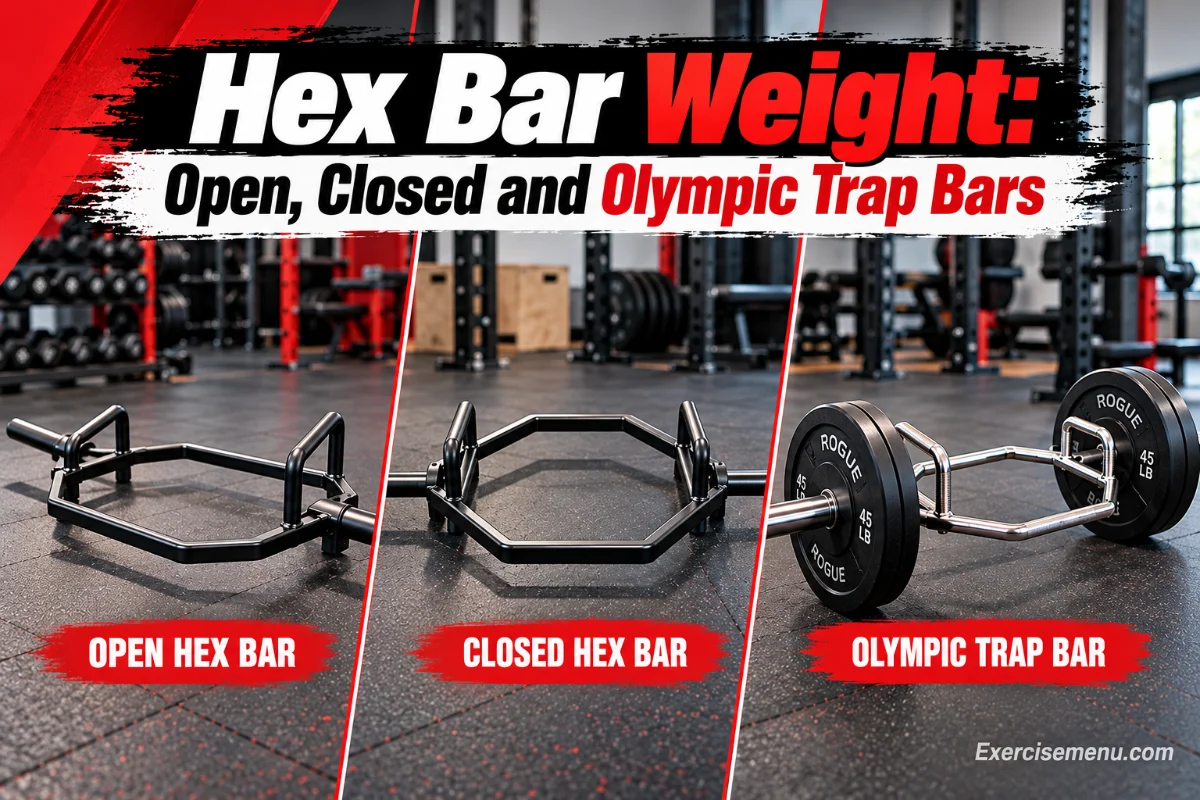
Quick Answer: Most hex bars weigh between 45 and 65 lbs (20–29 kg). A standard closed-frame hex bar weighs 45–55 lbs. An open trap bar with a gap in the rear frame weighs 55–70 lbs. Rackable hex bars run 55–65 lbs, and budget models can drop as low as 35 lbs.
Hex bars — also called trap bars — are heavier than standard Olympic barbells. A straight bar weighs 45 lbs (20 kg) every time. A hex bar can weigh anywhere from 35 to 70 lbs depending on the frame shape, sleeve length, and brand. That range is wider than most lifters expect.
The weight gap matters for anyone tracking their lifts. If you switch from a barbell to a hex bar without adjusting your log, every set you’ve recorded could be off by 10–20 lbs. Over weeks of progressive overload, that error compounds into misread progress and poorly calibrated training percentages.
Quick Reference Table
| Bar Type | Weight Range (lbs) | Weight Range (kg) | Frame Design |
|---|---|---|---|
| Standard Closed Hex Bar | 45–55 lbs | 20–25 kg | Full hexagonal frame, step in from above |
| Open Trap Bar | 55–70 lbs | 25–32 kg | Gap in rear, walk in/out from behind |
| Rackable Hex Bar | 55–65 lbs | 25–29 kg | Longer sleeves, fits across rack J-cups |
| Budget/Compact Hex Bar | 35–50 lbs | 16–23 kg | Smaller frame, thinner steel |
| Olympic Trap Bar | 55–77 lbs | 25–35 kg | Tighter tolerances, competition-grade steel |
How Much Does Each Type of Hex Bar Weigh?
Standard closed hex bars sit at 45–55 lbs, open trap bars at 55–70 lbs, and rackable models at 55–65 lbs. The weight difference comes down to how much steel the frame uses and how long the sleeves are.
Standard Closed Hex Bar: 45–55 lbs (20–25 kg)
The most common design. A fully enclosed hexagonal frame surrounds the lifter, with two sleeve ends extending from opposite sides for plate loading. You step into the frame from above and stand in the center.
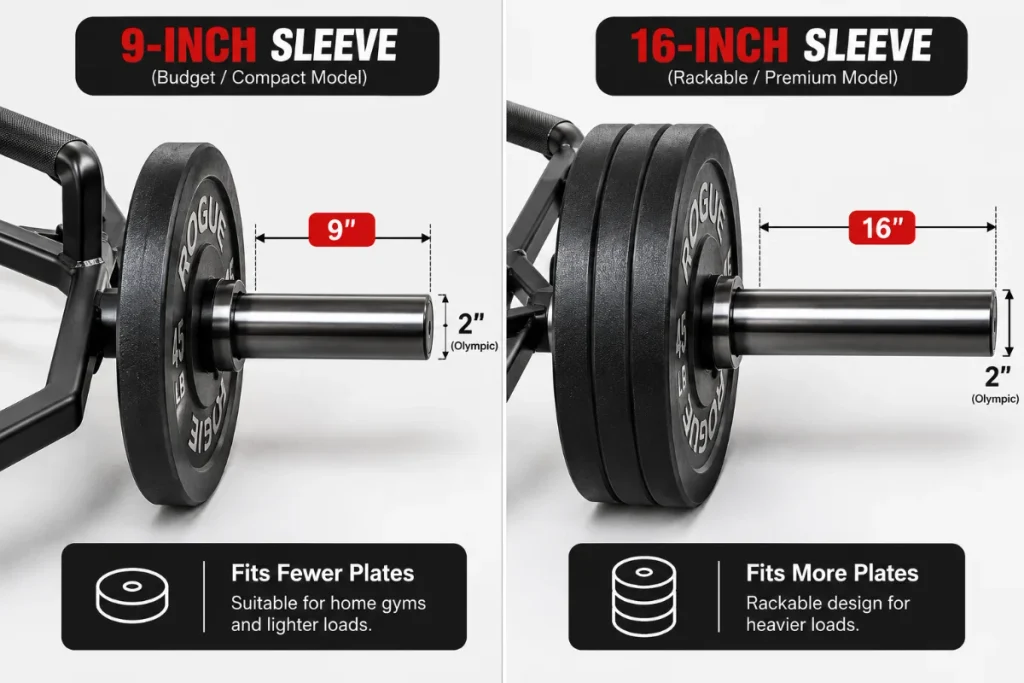
These bars use fixed high/low handles inside the hex, Olympic-compatible 2-inch sleeves, and a frame thickness that varies by manufacturer. Sleeve length typically runs 10–16 inches. A shorter-sleeved, thinner-framed closed hex bar (like the CAP Barbell at 45 lbs) weighs roughly the same as a standard Olympic barbell. A thicker-framed model with longer sleeves (like the REP Fitness at 55 lbs) tips heavier.
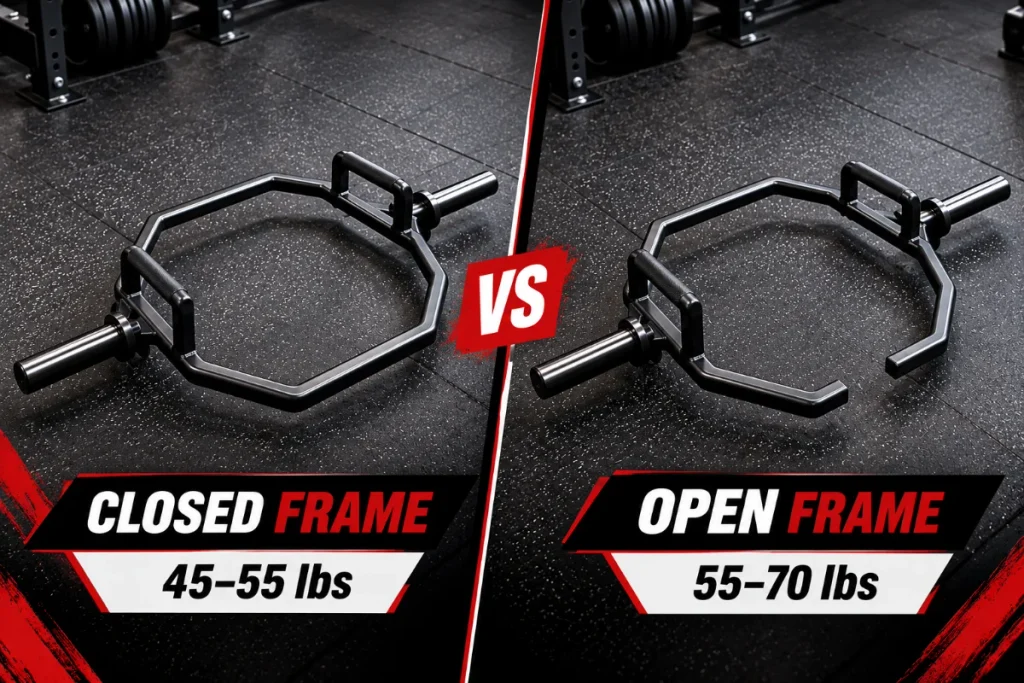
Open Trap Bar: 55–70 lbs (25–32 kg)
Open trap bars have a gap at the rear of the frame instead of a complete hexagon. That open design lets you walk into and out of the bar without stepping over the frame, which enables farmer carries, split squats, and lunges that a closed hex bar blocks.
The trade-off: removing the rear crossbar requires extra bracing and thicker frame tubing to keep the bar rigid under load. That reinforcement adds steel and weight. Many open models also include built-in deadlift jacks for easier plate loading, which pushes the bar weight higher.
Rackable Hex Bar: 55–65 lbs (25–29 kg)
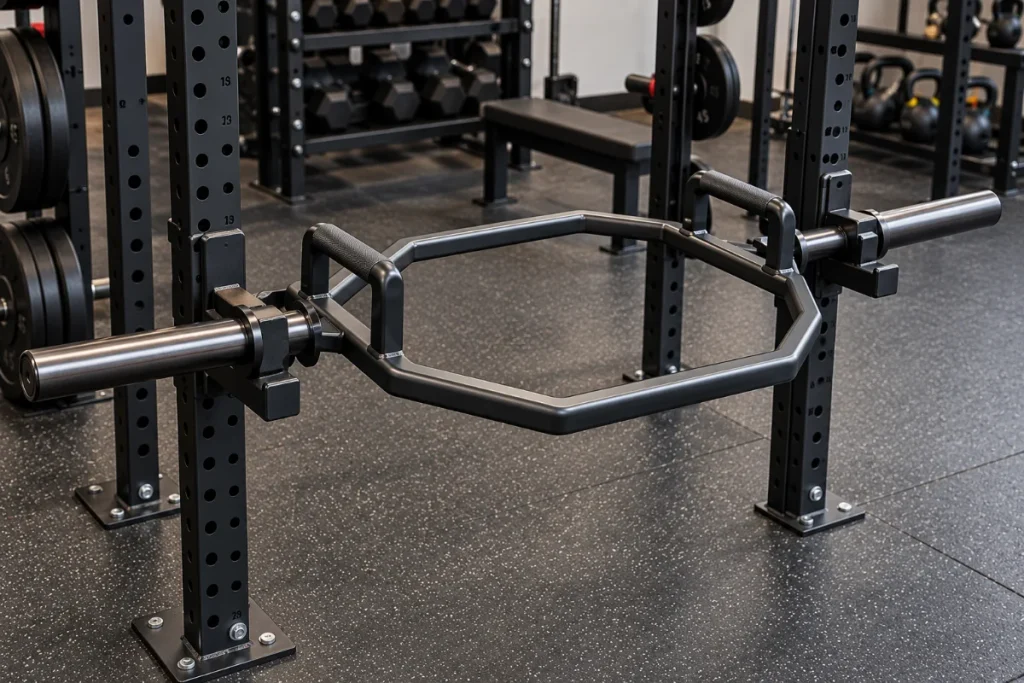
Rackable hex bars have longer sleeves designed to fit across the J-cups of a power rack, like a standard barbell. The extra sleeve length adds steel, which puts the weight in the 55–65 lb range.
If you want to do rack pulls, block pulls, or elevated deadlifts inside a squat rack, this is the bar you need. A non-rackable hex bar is too narrow to span the J-cups.
Budget/Compact Hex Bar: 35–50 lbs (16–23 kg)
Budget models use thinner steel tubing, shorter sleeves, and a smaller overall frame to keep costs and weight down. They work for general training and home gyms but typically max out at 500–600 lbs of capacity. Expect these in the 35–50 lb range.
Olympic Trap Bar: 55–77 lbs (25–35 kg)
Built to tighter tolerances with higher-grade steel, Olympic trap bars sit at the heavy end. These are the bars used in serious strength training facilities and military fitness testing. The ACFT (Army Combat Fitness Test) uses a 60 lb hex bar for the 3-repetition maximum deadlift event.
Hex Bar Weight by Brand
Weights vary across brands even within the same bar type. The table below pulls manufacturer-listed specs from popular models, sorted lightest to heaviest.
| Brand | Type | Weight | Sleeves | Max Load |
|---|---|---|---|---|
| Titan Olympic Hex Bar | Closed | 44 lbs / 20 kg | 9 in | 500 lbs |
| CAP Barbell Olympic Hex | Closed | 45 lbs / 20 kg | 10 in | 750 lbs |
| Bells of Steel Hex Bar | Closed | 47 lbs / 21 kg | 12 in | 700 lbs |
| Alphafit Hex Bar | Closed | 50 lbs / 23 kg | 13 in | 600 lbs |
| Elite FTS Hex Combo | Closed | 50 lbs / 23 kg | 12.5 in | 600 lbs |
| REP Fitness Trap Bar | Closed | 55 lbs / 25 kg | 16 in | 500 lbs |
| Eleiko Öppen Deadlift Bar | Open | 55 lbs / 25 kg | 16 in | 1,100 lbs |
| Titan Rackable Hex V3 | Rackable | 60 lbs / 27 kg | 16 in | 1,000 lbs |
| Rogue TB-2 Trap Bar | Closed | 60 lbs / 27 kg | 16 in | 1,000 lbs |
| Vulcan Prime Hex Bar | Closed | 60 lbs / 27 kg | 16 in | 750 lbs |
| Hammer Strength Hex Bar | Closed | 60 lbs / 27 kg | N/A | Commercial |
| Fringe Sport Midas | Open | 60 lbs / 27 kg | 16 in | 1,000 lbs |
| Titan Open Trap Bar | Open | 65 lbs / 29 kg | 16 in | 1,000 lbs |
| Force USA Walkthrough | Open | 66 lbs / 30 kg | 16 in | 800 lbs |
| Kabuki HD Trap Bar | Open | 65 lbs / 29 kg | 16 in | 1,500 lbs |
A Titan at 44 lbs and a Kabuki HD at 65 lbs are both labeled “hex bar.” That’s a 21 lb gap from one label. The brand and frame design determine the weight, the name doesn’t.
How Do You Identify Which Hex Bar Your Gym Has?
Most commercial gyms don’t label their hex bars with weight. Here’s how to find it.
Check the frame or sleeve. Some manufacturers stamp or engrave the weight on the end cap of one sleeve or on the frame near the handle. Look at both sides, a small engraving is easy to miss.
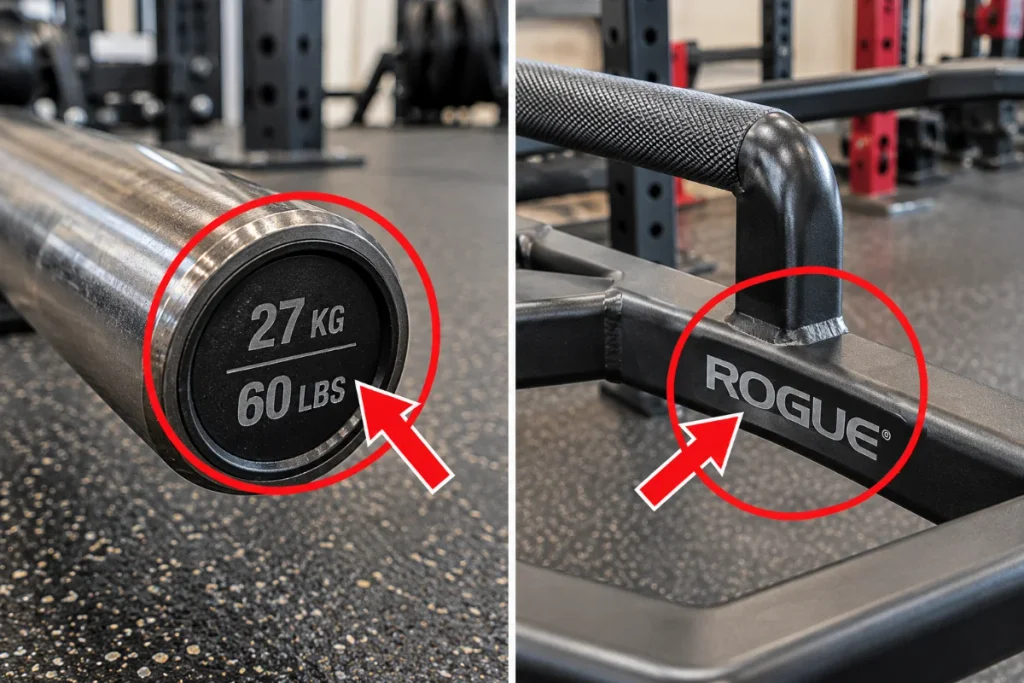
Find the brand, then look it up. Nearly every hex bar has a brand name or logo somewhere on the frame, a sticker, a stamp, or a laser-etched mark. Search that brand’s website for the specific model and check the product specs for listed weight.
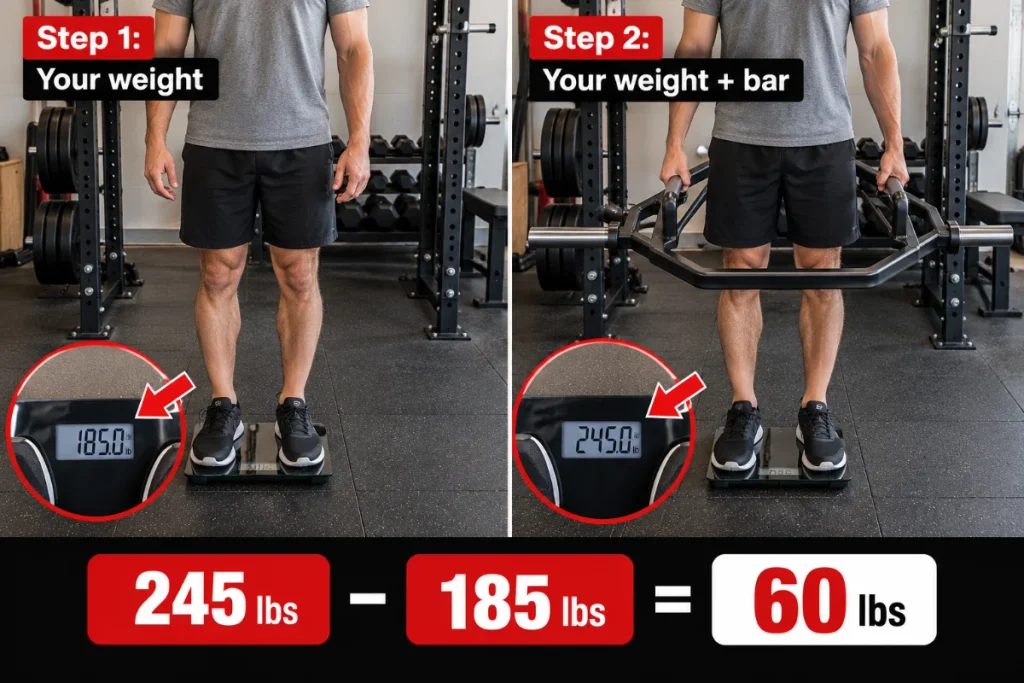
Weigh it on a bathroom scale. Step on the scale alone. Note your weight. Pick up the bar in a farmer carry position and step on again. Subtract. This gives you the bar weight within a pound or two.
Ask the gym staff. Larger gym chains track equipment specs. The front desk or a trainer can usually pull up the model number and weight.
Don’t assume every hex bar matches your barbell. Most commercial gym hex bars weigh 55–60 lbs, not 45. That 10–15 lb difference throws off your training log if you’re comparing your trap bar deadlift to your conventional pull.
Why Does Hex Bar Weight Matter for Programming?
A 15 lb error in bar weight creates two problems in your training log: wrong totals and broken comparisons between lifts.
It throws off your volume load. If you think your hex bar weighs 45 lbs but it actually weighs 60 lbs, every set you’ve logged is 15 lbs heavier than recorded. Your actual strength is higher than your log shows, and the weight jumps you plan may be smaller than you realize.
It breaks your lift-to-lift comparisons. Research by Swinton et al. (2011) found that lifters can pull roughly 5–10% more weight on a hex bar compared to a straight barbell at the same effort level, partly because the hex bar positions the load around your center of gravity instead of in front of it (Swinton et al., 2011). That shifts demand away from the lower back and onto the quads.
If you pull 315 lbs on a conventional deadlift with a 45 lb barbell, that’s 270 lbs of plates. Those same 270 lbs of plates on a 60 lb hex bar gives you a 330 lb total. The bar weight changed and the biomechanics changed. Without tracking both, you can’t compare the two lifts honestly.
A separate study by Lake et al. (2017) confirmed that hex bar deadlifts produce greater peak force, faster bar velocity, and higher power output compared to conventional straight bar pulls at the same relative intensity (Lake et al., 2017). These aren’t the same movement, and their bar weights shouldn’t be treated as interchangeable.
FAQ
Does the handle height on a hex bar change its weight?
No. High and low handles are built into the same frame. Flipping the bar over to switch between the two doesn’t add or remove steel, the bar weighs exactly the same in either position. The only thing that changes is your starting hip and knee angle, which affects range of motion and muscle emphasis.
Do you count the hex bar weight when logging deadlifts?
Yes. The bar is part of the load your body moves. If your hex bar weighs 60 lbs and you load two 45 lb plates (one per side), your total is 150 lbs, not 90. Leaving out the bar weight means your training log, your percentages, and any PR you hit are all based on the wrong number.
Why do two hex bars in my gym weigh different amounts?
Probably different brands or models. One might be a budget closed-frame at 44 lbs and the other a rackable model at 60 lbs. Frame thickness, sleeve length, handle construction, and whether the bar includes a built-in jack all affect the final weight. Even bars that look similar from across the gym floor can differ by 10–15 lbs.
How much weight can you load on a hex bar?
Weight capacity ranges from 500 lbs on budget models to 1,500 lbs on premium bars like the Kabuki HD. The brand table above lists max load per model. For most lifters, a 500–750 lb capacity covers years of training. You only need 1,000+ lbs of capacity if you’re pulling 500+ lbs regularly or plan to get there.
Is a trap bar deadlift the same as a hex bar deadlift?
Same exercise, different name. “Trap bar” and “hex bar” describe the same piece of equipment. The bar was named “trap bar” after the trapezius muscles it was originally designed to train through shrugs. “Hex bar” refers to its hexagonal shape. The movement, mechanics, and bar weight are identical regardless of which name you use.
If you have a lower back injury or joint issues that affect your deadlift mechanics, check with a doctor or physiotherapist before loading a hex bar for the first time.
