

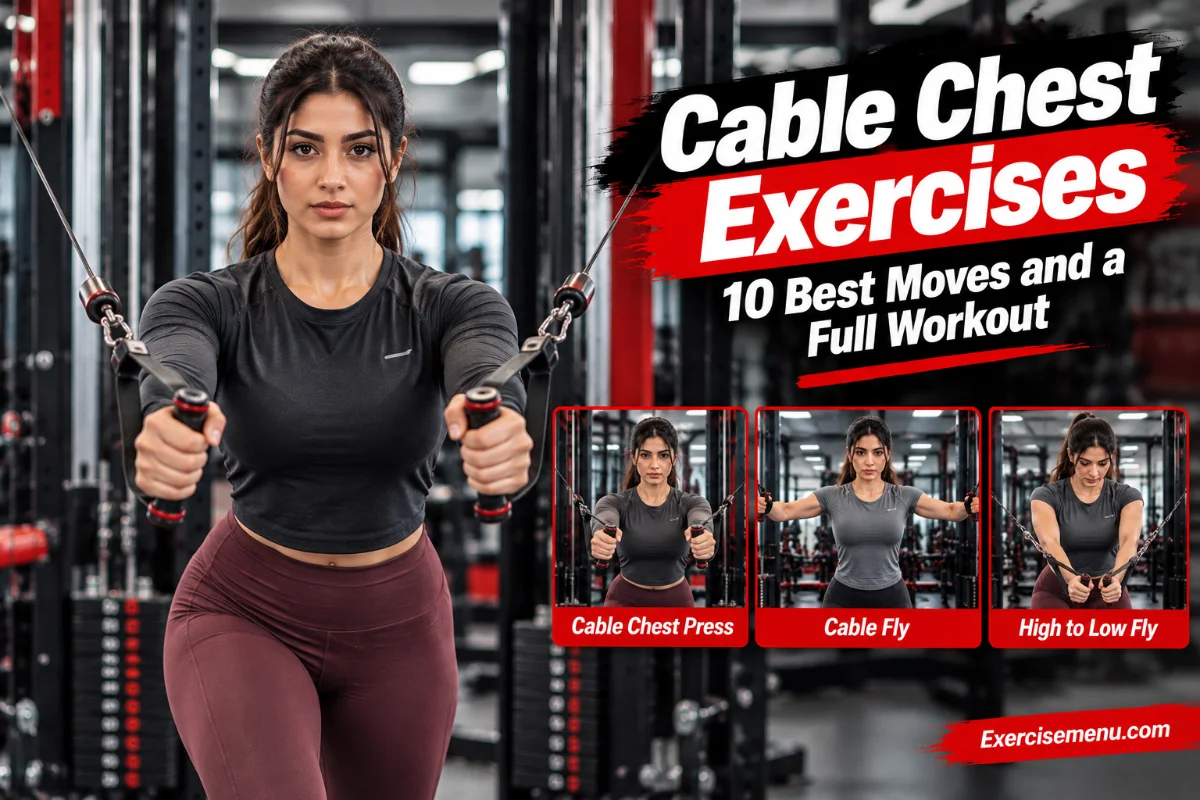
Quick Answer: Set the pulley low for upper chest, at shoulder height for mid chest, and high for lower chest. The best cable chest exercises are the low-to-high fly, standing cable press, cable crossover, and high-to-low fly. Train chest twice weekly with 10 to 16 total sets.
Cables build chest muscle as well as free weights do. A 2023 systematic review comparing machine-based and free-weight training found no measurable difference in hypertrophy between them, which removes the main reason lifters treat the cable station as an afterthought. What cables add is control over the angle of resistance, something a barbell cannot give you.
Below are ten cable chest exercises grouped by the part of the pec they load, each with its pulley setting, stance, and rep range. After the exercises you get a muscle-by-pulley-height reference table, the setup errors that cost most people their chest day, two ready-made workouts, and the research behind the cables-versus-free-weights question.
What Are the Best Cable Chest Exercises?
The best cable chest exercises are the ones matched to the part of the pec you want to load, and pulley height is what decides that. A low pulley drives the upper chest, shoulder height hits the mid chest, and a high pulley loads the lower chest. The ten below are grouped that way so you can build a session around whichever region needs work.
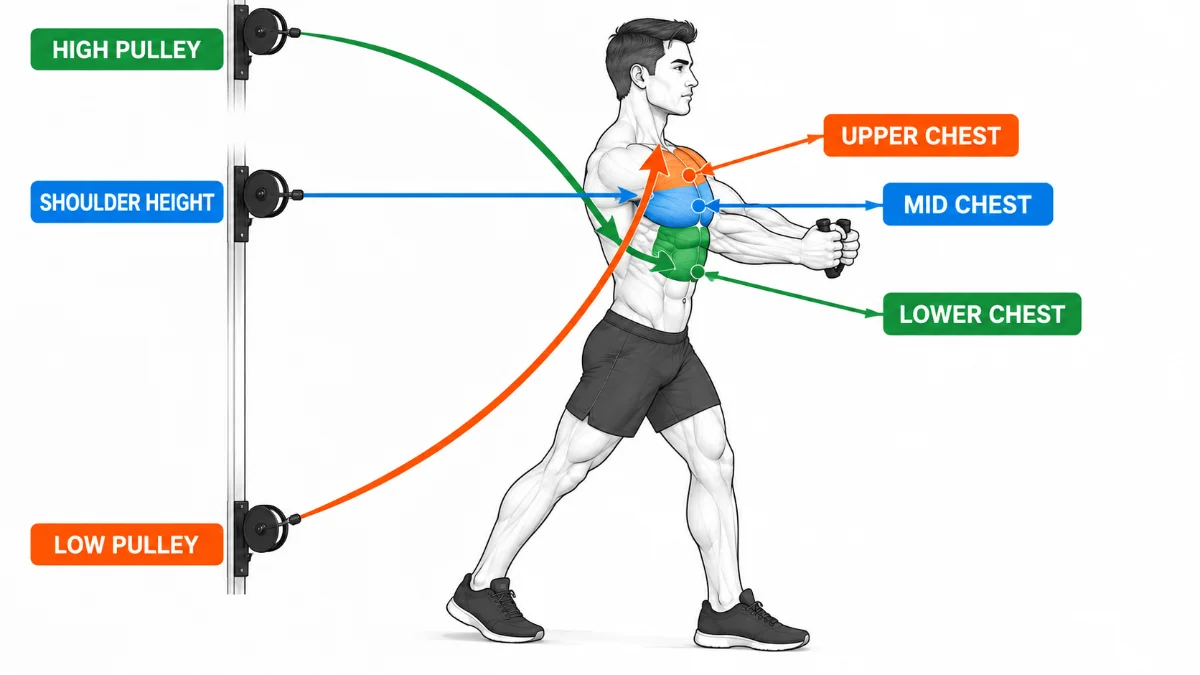
[Image placeholder: Cable machine with three pulley positions marked, low, shoulder height, high — with arrows showing the movement path for each. Alt: “cable chest exercises pulley height positions for upper mid and lower chest”]
Upper Chest — Low Pulley
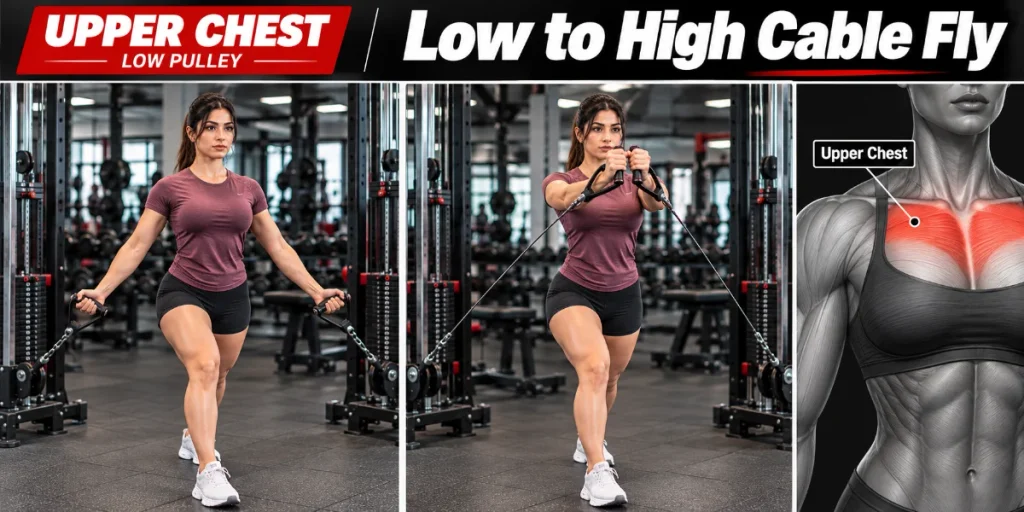
1. Low-to-High Cable Fly
Setup: Both pulleys at the lowest setting, D-handles attached. Stand in the centre with a split stance, one foot forward, torso upright. Hold the handles with palms facing forward and arms down at your sides.
- Step forward until the cables are taut and you feel light tension across your chest with your arms down.
- Keep a soft bend in the elbows and sweep your hands up and in, as though scooping something toward your collarbones.
- Finish with your hands together at upper-chest height, wrists slightly higher than your elbows.
- Lower under control until you feel a stretch across the front of your shoulders, then repeat.
3 sets of 12 to 15 reps. Stop the upward sweep at collarbone height, pushing higher turns the movement into a front raise and hands the work to your delts.
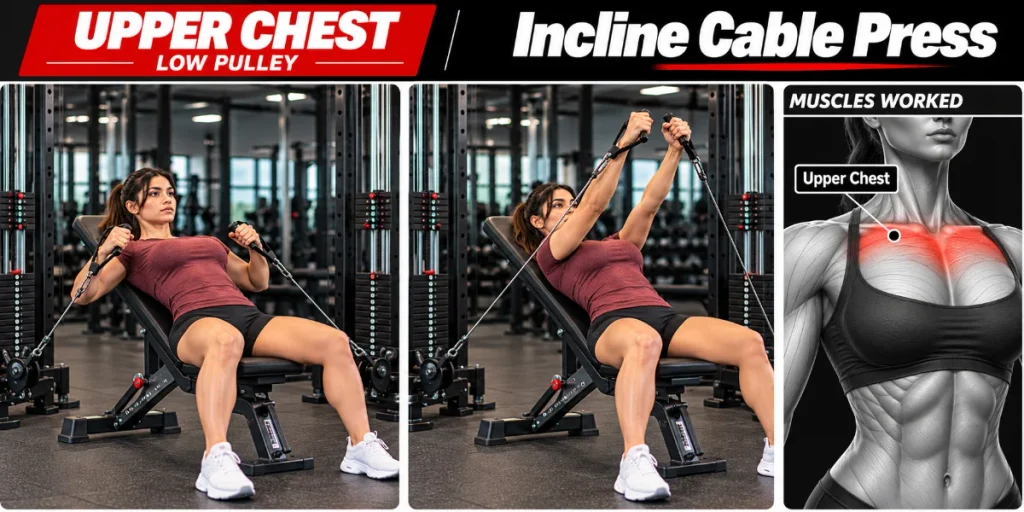
2. Incline Cable Press
Setup: Adjustable bench set to 30 to 45 degrees, positioned between the uprights. Pulleys just below bench-seat height, D-handles attached.
- Sit back on the bench and take a handle in each hand at chest level, elbows tucked to roughly 45 degrees from your torso.
- Press up and slightly inward, following the angle of the bench rather than straight overhead.
- Stop just short of locking the elbows, with the handles close together but not touching.
- Lower until your hands are level with your upper chest.
3 sets of 8 to 12 reps. A bench angle past 45 degrees shifts the load to your front delts, 30 degrees is enough for most lifters.
Mid Chest — Shoulder Height
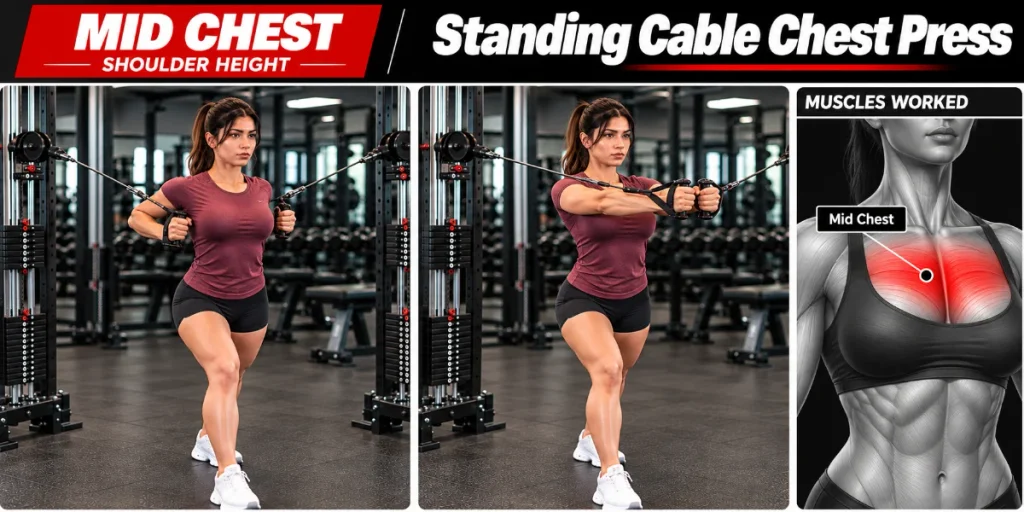
3. Standing Cable Chest Press
Setup: Both pulleys at shoulder height, D-handles attached. Split stance, one foot forward, core braced.
- Take a handle in each hand with the cables running just behind your shoulders, elbows bent and flared to about 45 degrees.
- Press both hands forward and together until your arms are nearly straight.
- Hold the squeeze for a beat with your hands close in front of your sternum.
- Return until your hands are level with your chest and you feel the stretch.
3 sets of 8 to 12 reps. Your front foot controls the whole lift, if you are rocking forward on each rep, the stance is too narrow.
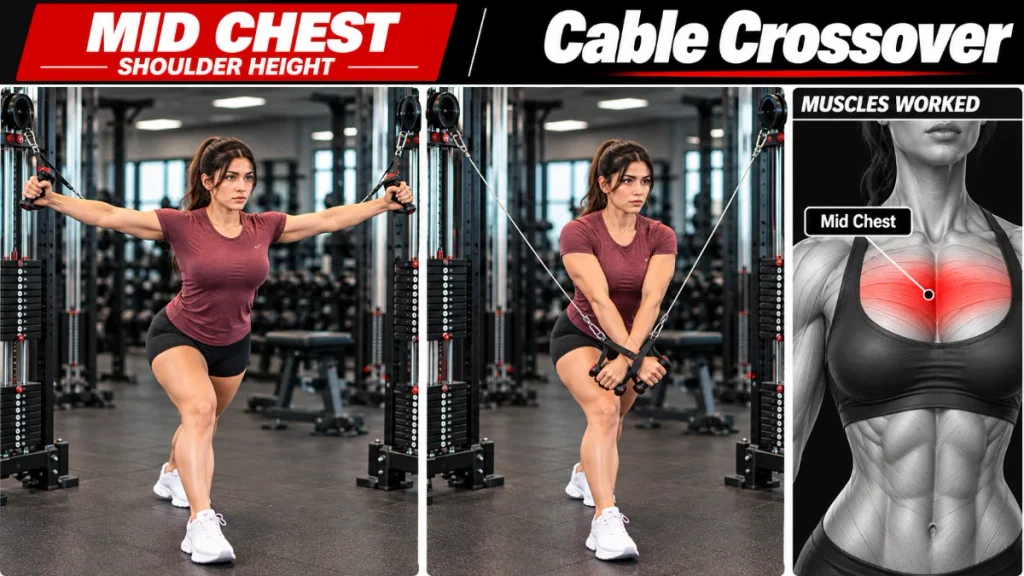
4. Cable Crossover
Setup: Both pulleys slightly above shoulder height. Split stance, torso leaning forward about 15 degrees from vertical.
- Hold a handle in each hand with arms wide and a fixed soft bend at the elbow.
- Bring your hands down and across your body so one forearm crosses over the other at the bottom.
- Pause for a count with the pecs fully shortened.
- Open back out until your hands are level with your shoulders.
3 sets of 12 to 15 reps. Alternate which arm crosses on top between sets so both sides get the same range.
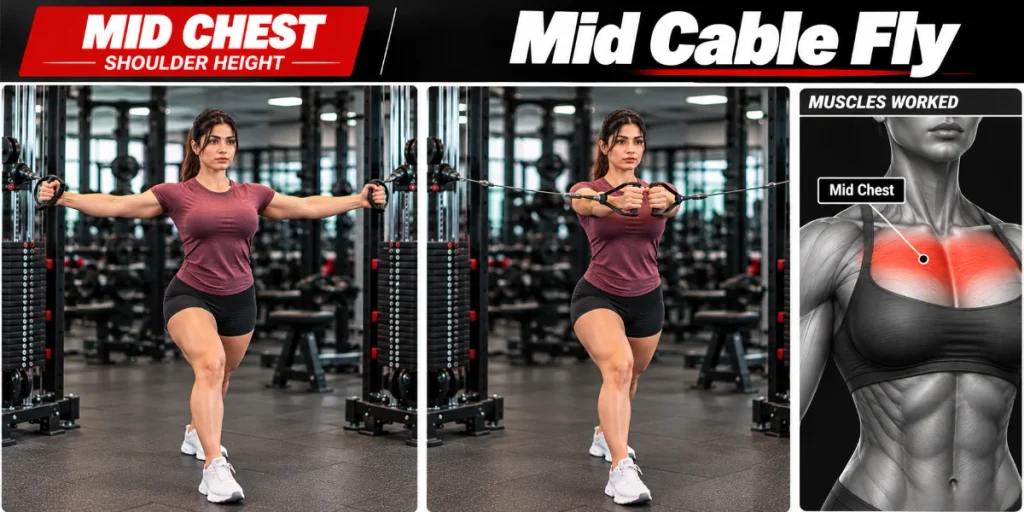
5. Mid Cable Fly
Setup: Both pulleys at exact shoulder height. Upright torso, feet staggered.
- Start with arms out wide at shoulder level, elbows softly bent.
- Bring your hands together in a flat arc directly in front of your chest, no upward or downward path.
- Touch the handles together and hold briefly.
- Open back out to the start under control.
3 sets of 12 to 15 reps. This differs from the crossover in two ways: your torso stays upright and your hands meet rather than cross, which keeps tension on the mid pec instead of shifting it down.
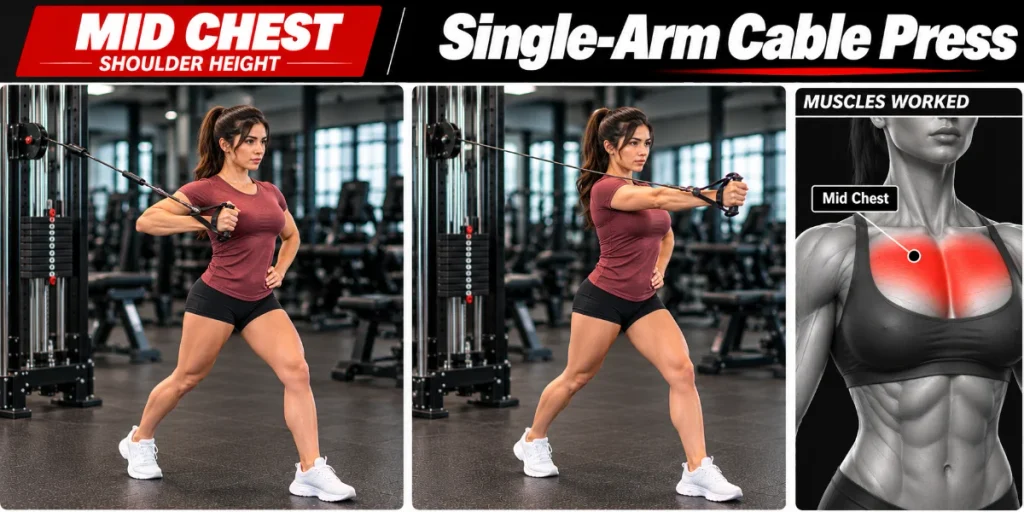
6. Single-Arm Cable Press
Setup: One pulley at shoulder height, D-handle attached. Stand side-on to the machine in a split stance, working arm furthest from the column.
- Hold the handle at chest level with your elbow back and your free hand on your hip.
- Press forward across your body, finishing with your hand in line with your sternum.
- Resist the pull that wants to rotate your torso toward the machine.
- Return slowly to the start.
3 sets of 10 to 12 reps per side. The anti-rotation demand is the point, if your hips are turning, drop the weight.
Lower Chest — High Pulley
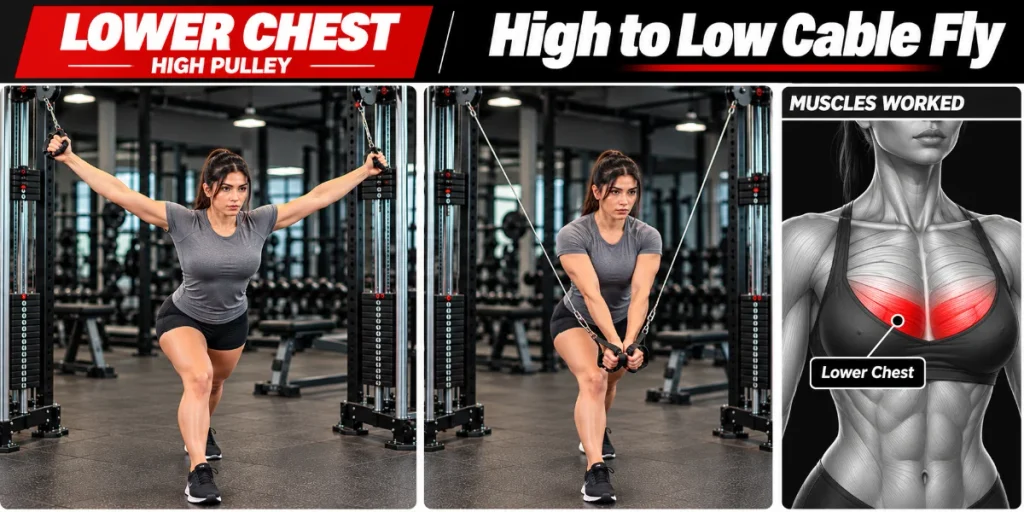
7. High-to-Low Cable Fly
Setup: Both pulleys at their highest setting, D-handles attached. Split stance, slight forward lean.
- Hold the handles above shoulder height with arms wide and elbows softly bent.
- Sweep your hands down and in until they meet in front of your hips.
- Squeeze for a count with the lower chest fully contracted.
- Let your arms travel back up until you feel the stretch across your chest.
3 sets of 12 to 15 reps. Keep the elbow angle locked for the whole set, if it opens and closes, you have turned the fly into a pressdown and handed the work to your triceps.
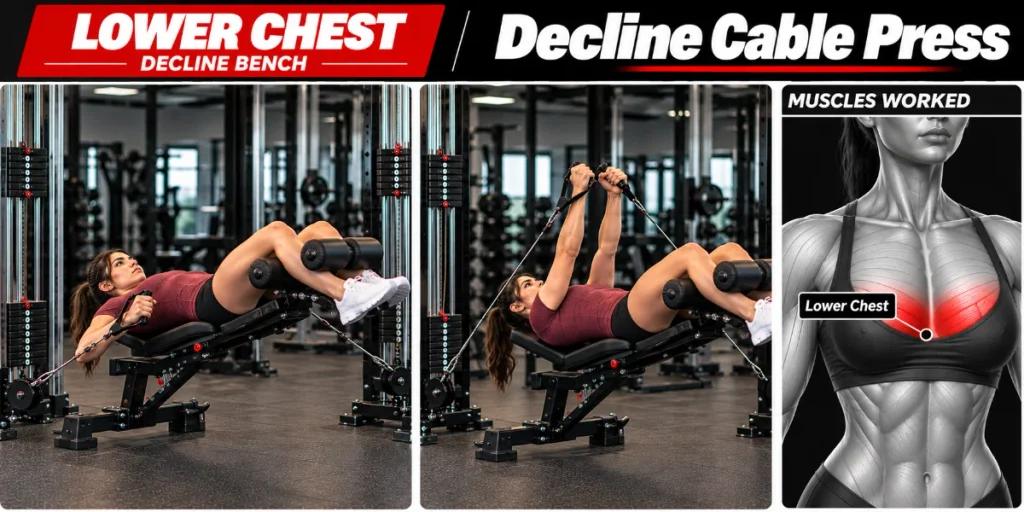
8. Decline Cable Press
Setup: Bench set to a 15 to 30 degree decline between the uprights. Pulleys at roughly shoulder height relative to your pressing position.
- Lie back and take a handle in each hand at mid-chest level.
- Press up and in along the line of the decline.
- Bring the handles close together at the top without locking out.
- Lower until your hands are level with your lower chest.
3 sets of 8 to 12 reps. Secure your feet before you start, a decline bench plus cable tension pulls you up the pad on every rep.
Full-Pec Movements
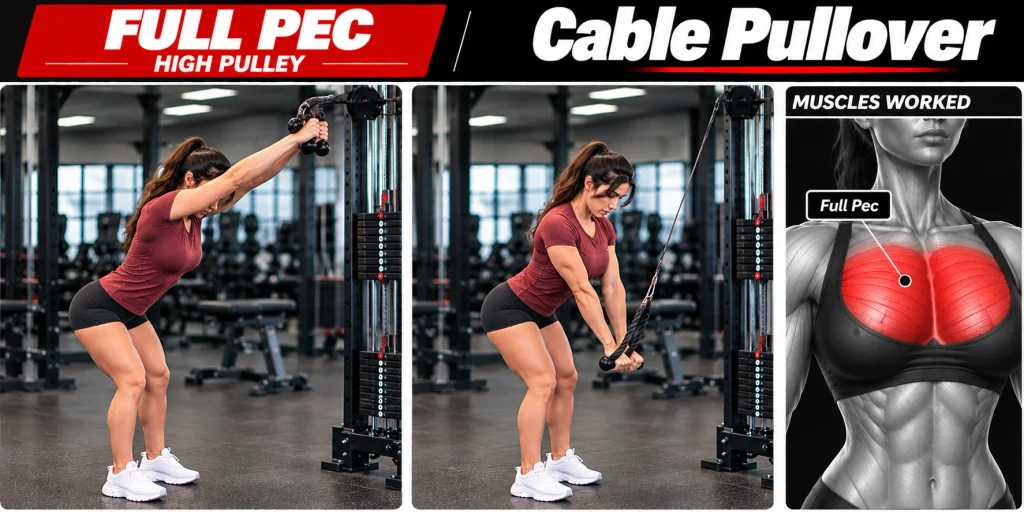
9. Cable Pullover
Setup: Single high pulley with a rope or straight bar. Stand facing the machine, arms overhead, hips hinged slightly back.
- Grip the attachment with arms nearly straight and a fixed soft elbow bend.
- Pull down in a wide arc until your hands reach the front of your thighs.
- Keep your elbows locked at the same angle for the entire rep.
- Let your arms rise back overhead until you feel the stretch through your lats and lower chest.
3 sets of 10 to 15 reps. This works the chest and lats together, so expect your back to fatigue alongside your pecs.
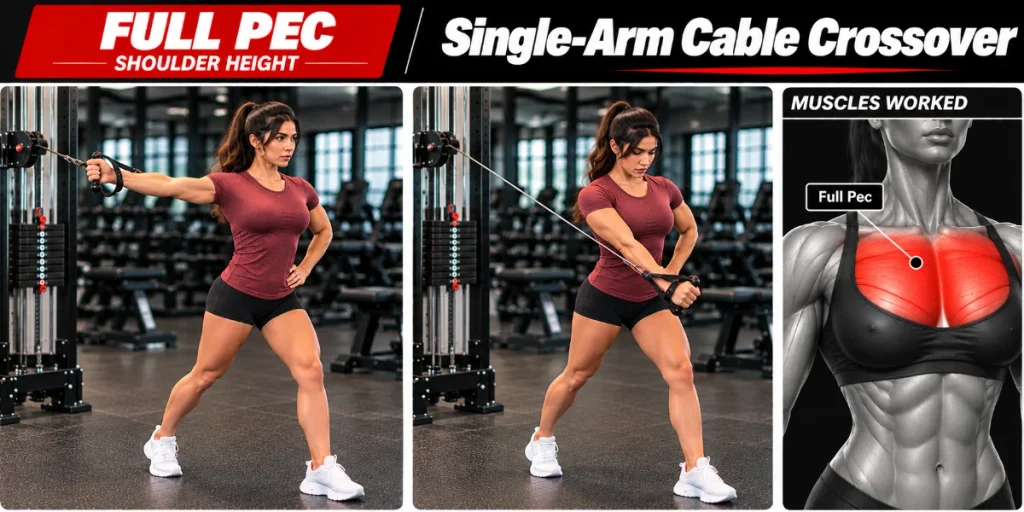
10. Single-Arm Cable Crossover
Setup: One pulley at shoulder height, D-handle attached. Stand side-on, working arm furthest from the column, torso braced.
- Start with the working arm out wide and a soft elbow bend.
- Sweep your hand across your body, past your midline, toward the opposite hip.
- Hold at full contraction for a count.
- Return slowly to the stretched position.
3 sets of 12 to 15 reps per side. Crossing past the midline gives you range a two-arm fly cannot reach, which is what makes this worth including even after the standard crossover.
Which Muscles Do Cable Chest Exercises Work?
Cable chest exercises work the three regions of the pectoralis major, with the anterior deltoid, serratus anterior, and triceps assisting depending on the movement. Pulley height is the variable that shifts emphasis between those regions, because it changes the direction your arm travels against resistance.
The pec major is one muscle with three sets of fibres that run at different angles. The clavicular head runs from the collarbone and pulls the arm up and across. The sternocostal head runs from the sternum and pulls the arm straight across. The abdominal head runs from the lower ribs and pulls the arm down and across. Match the cable path to the fibre direction and that region does most of the work.
| Muscle | Role in cable chest work | Pulley height that loads it hardest | Best exercise |
|---|---|---|---|
| Upper pec (clavicular head) | Pulls the arm up and across the body | Low — at or below knee | Low-to-high cable fly |
| Mid pec (sternocostal head) | Pulls the arm straight across the body | Shoulder height | Standing cable chest press |
| Lower pec (abdominal head) | Pulls the arm down and across | High — above shoulder | High-to-low cable fly |
| Pectoralis minor | Stabilises the shoulder blade against the ribcage | All heights (works isometrically) | Every variation |
| Anterior deltoid | Assists shoulder flexion in pressing and upward sweeps | Low pulley loads it most | Incline cable press |
| Serratus anterior | Holds the shoulder blade flat during the press | All heights | Cable pullover |
| Triceps | Extends the elbow in press variations | All press variations | Standing cable chest press |
Use the table like this: pick one exercise from each pulley height for a complete chest session, or two from a single row when you want to bring one region up. Flyes isolate the pec; presses bring in the triceps and front delt, which is the practical difference between compound and isolation movements.
Knowing which fibres you are loading only helps if the setup lets them do the work. Most of the chest tension people lose on cables is lost before the first rep.
What Mistakes Should You Avoid?
The most common cable chest mistake is starting a set with slack in the cable, which skips the stretched position where the pec is under the most tension. Five more setup errors follow close behind, and all six are fixed before the weight ever moves.
Starting With Slack in the Cable
If the weight stack is already resting when your arms reach the stretched position, the first part of every rep is unloaded. Step out until the cable is taut and the stack has lifted slightly before you begin. You should feel tension across your chest while standing still.
Standing Too Close or Too Far From the Column
Too close and the cable goes loose at the stretch, which removes the hardest part of the movement. Too far and the tension at the stretch exceeds what the pec can handle, so your shoulder absorbs it. The distance is right when you feel a stretch across the chest, not a pull at the front of the shoulder joint.
Shrugging Into the Press
When the load climbs, the traps tend to take over and the shoulders rise toward the ears. Set your shoulder blades down and back before the first rep and keep them there. If they creep up mid-set, the set is finished.
Overextending at the Stretch
Letting the arms travel far behind the torso on a fly adds range the pec cannot contribute to and loads the front of the shoulder capsule instead. Stop when your hands reach roughly the plane of your torso. More range is not more chest work past that point.
Chasing the Number on the Stack
On a dual-pulley machine the load in your hand depends on the pulley arrangement, so the plate number does not translate directly to resistance and varies between machines. Judge your progress by reps, control, and the same machine over time rather than by matching a number you used elsewhere.
Using the Same Pulley Height Every Session
Training only at shoulder height leaves the upper and lower pec under-stimulated. Rotate the pulley position across your sessions, or cover all three heights within one workout using the table above.
With the setup sorted, the remaining question is how to arrange these exercises into a session that actually fits your week.
What Does a Full Cable Chest Workout Look Like?
A complete cable chest workout covers all three pulley heights across four to five exercises, totalling 12 to 16 working sets. Use the first workout below when the cable station is your whole chest day, and the second when cables finish a session that began with pressing.
Workout A — Cable-Only Chest Day
| Exercise | Sets × Reps | Rest |
|---|---|---|
| Standing Cable Chest Press | 4 × 8–10 | 2 min |
| Low-to-High Cable Fly | 3 × 12–15 | 90 sec |
| High-to-Low Cable Fly | 3 × 12–15 | 90 sec |
| Single-Arm Cable Press | 3 × 10–12 each side | 90 sec |
| Cable Pullover | 2 × 15 | 60 sec |
Workout B — Cables After Barbell or Dumbbell Pressing
| Exercise | Sets × Reps | Rest |
|---|---|---|
| Low-to-High Cable Fly | 3 × 12–15 | 90 sec |
| Cable Crossover | 3 × 12–15 | 90 sec |
| Single-Arm Cable Crossover | 2 × 15 each side | 60 sec |
Presses sit at the start of Workout A because they carry the most load and deserve your freshest sets. Flyes follow, where the lighter weight and longer range suit a fatigued muscle better. Add a rep or a small increment once you reach the top of a rep range on every set with clean form — that steady climb is what progressive overload means in practice. The 8 to 12 range on presses and 12 to 15 on flyes reflects standard hypertrophy guidance, covered fully in how many reps and sets build muscle.
How Often Should You Train Chest With Cables?
Twice per week suits most lifters, with 10 to 16 hard sets for the chest spread across those two sessions. Cables place less systemic fatigue on you than heavy barbell pressing, so the limit is usually local pec recovery rather than whole-body tiredness.
Two sessions beat one because each one raises muscle protein synthesis for roughly a day and a half. Training chest once a week leaves several days where nothing is driving growth. Splitting the same total volume across two days keeps the stimulus coming and keeps per-session quality higher. The specific numbers by training age are set out in how many sets per muscle group per week.
If cables are your only chest work, lean toward the upper end of that set range. If they follow barbell or dumbbell pressing, three to six cable sets is usually enough on top.
Can You Build a Chest With Cables Alone?
Yes. A 2023 systematic review and meta-analysis by Haugen and colleagues, published in BMC Sports Science, Medicine and Rehabilitation, compared free-weight and machine-based training and found no meaningful difference in muscle growth between them (standardised mean difference −0.055, 95% CI −0.397 to 0.287, p = 0.751). Their conclusion was that the choice comes down to preference and goals rather than results.
That finding applies to hypertrophy specifically. Maximal strength gains proved more specific to the equipment trained, so a lifter whose goal is a bigger bench press still needs to bench press. For chest size, the cable station holds its own.
What the EMG Research Actually Shows
A frequently cited 2017 study by Signorile and colleagues in the Journal of Strength and Conditioning Research is often presented as evidence that cables activate the chest more than other machines. The study does not report that.
Comparing cable and selectorized machines across the biceps curl, chest press, and overhead press, the researchers found that during the cable chest press, activation was higher in the biceps brachii, anterior deltoid, and external obliques. Pectoralis major activation was higher on cables during the biceps curl — a different exercise entirely. Their conclusion was that the machine changes which muscles are recruited and through what range, so the two types suit different training goals.
The practical reading: cables raise the stabilising demand on your shoulders and trunk, and they let you load the pec through angles a fixed machine cannot. Neither of those is the same as activating the chest harder, and a guide claiming otherwise is misreading the data.
Frequently Asked Questions
Why Does the Cable Chest Press Feel Harder Than the Bench Press at the Same Weight?
Standing cable presses give you no bench to brace against, so your legs and trunk have to resist the cable pulling you backward while your chest does the pressing. That stabilising work is why the same number on the stack feels heavier than it does lying down.
Should I Do Cable Chest Exercises Standing or Seated?
Standing adds core and lower-body stabilising demand; seated removes it so you can focus purely on the chest and usually handle slightly more weight. Pick seated when the chest is the only target, standing when you want the trunk involvement as well.
Do I Need a Dual-Pulley Machine, or Will a Single Functional Trainer Work?
A single adjustable column handles every unilateral movement here and can cover the two-arm exercises by running one side at a time. You lose the ability to train both arms at once, which lengthens the session, but the training effect per arm is unchanged.
Can You Do Cable Chest Exercises at Home Without a Cable Machine?
Resistance bands anchored at the right height reproduce the movement paths closely enough for flyes and presses. The resistance profile differs — bands get harder as they stretch, while cables stay constant — so expect the hardest point of each rep to land in a different place.
Are Cable Flyes Safe If I Get Shoulder Discomfort?
Shortening the range so your hands stop at the plane of your torso removes the deep stretch position where most discomfort shows up, and many lifters find that change enough. Discomfort that persists or worsens is a reason to see a physiotherapist rather than to adjust the exercise again.
Pick one exercise from each pulley height, set your distance from the column so the cable is taut before you start, and keep the same elbow angle through every fly. Those three habits matter more than which ten exercises you choose. Start with Workout A this week and add a rep per set before you add weight.
If you have an existing shoulder injury or are returning from one, check with your doctor or physiotherapist before adding loaded chest work.
