

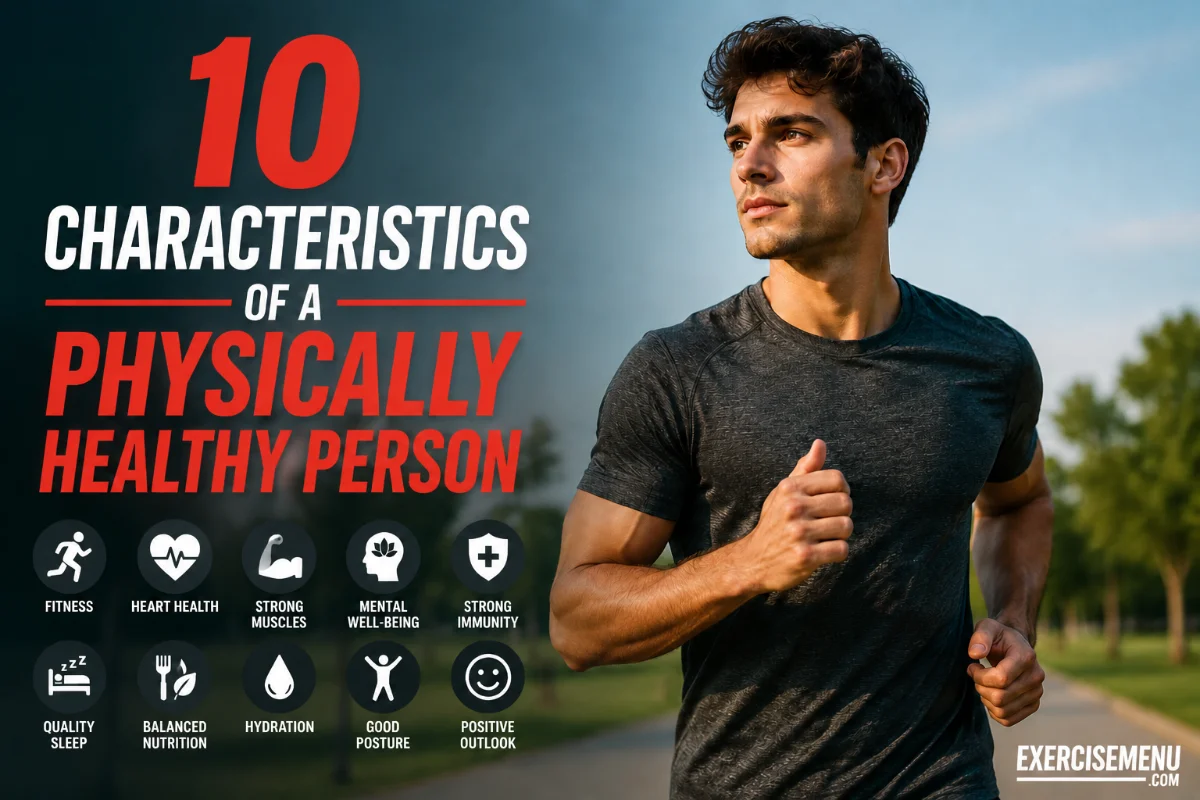
Quick Answer: A physically healthy person shows 10 measurable characteristics. They eat a balanced diet, exercise regularly, avoid harmful habits, and can perform daily activities without unusual fatigue. Their resting heart rate stays between 60 and 100 bpm, blood pressure remains below 120/80 mmHg, body composition falls within healthy ranges, joints move through full range of motion, energy stays consistent, sleep lasts 7–9 hours, and immune function keeps illness rare.
Your body tells you whether it is healthy. Not through vague feelings, but through numbers you can measure and patterns you can track — resting heart rate, how far your joints move, how long you can sustain effort before fatigue takes over.
The World Health Organization defines health as a state of complete physical, mental, and social well-being — not merely the absence of disease. To identify the characteristics of a physically healthy person, you need to look at how the body performs, recovers, and regulates itself — not at how someone looks or what diet trend they follow.
At the most basic level, a physically healthy person eats healthy food, exercises regularly, avoids harmful habits like smoking and excessive alcohol, prevents injuries, and gets adequate rest each day. But these habits produce specific, measurable outcomes in the body. Ten measurable signs define physical health.
The first five come from what exercise science calls the health-related components of physical fitness — cardiovascular endurance, muscular strength, muscular endurance, flexibility, and body composition.
The remaining five are the physiological and lifestyle markers that show those fitness foundations are working — consistent energy and mental clarity, quality sleep and stress management, strong immune response, healthy digestion and skin, and stable blood sugar supported by balanced nutrition and hydration.
- What Are the Core Characteristics of a Physically Healthy Person?
- 1. Cardiovascular Endurance and Stable Vital Signs
- 2. Muscular Strength
- 3. Muscular Endurance
- 4. Flexibility, Mobility, and Good Posture
- 5. Healthy Body Composition
- 6. Consistent Energy, Mental Clarity, and Proper Hydration
- 7. Quality Sleep, Recovery, and Stress Management
- 8. Strong Immune Response
- 9. Healthy Digestion, Skin, Hair, and Eyes
- 10. Stable Blood Sugar, Balanced Nutrition, and Adequate Hydration
- How to Self-Assess Your Physical Health: A Quick Checklist
- FAQs
- Health Disclaimer
What Are the Core Characteristics of a Physically Healthy Person?
A physically healthy person shows 10 measurable characteristics. The first five are the health-related fitness components — cardiovascular endurance, muscular strength, muscular endurance, flexibility, and a healthy body composition.
The remaining five are physiological and lifestyle markers — consistent energy with mental clarity, quality sleep with effective stress management, a strong immune response, healthy digestion reflected in skin and hair, and stable blood sugar supported by balanced nutrition and adequate hydration.
Physical health is not one thing — it is these 10 characteristics working together. The American College of Sports Medicine (ACSM) defines the fitness foundation through five health-related components that directly predict your risk of chronic disease and your ability to perform daily tasks without excessive fatigue (ACSM Guidelines for Exercise Testing and Prescription).
The other five characteristics reflect how well those fitness foundations translate into everyday health — allowing you to carry out daily activities with energy, recover efficiently, and resist illness. Here is what each characteristic looks like, how to measure it, and what the healthy benchmarks are.
1. Cardiovascular Endurance and Stable Vital Signs
Cardiovascular endurance is the ability of the heart, lungs, and blood vessels to deliver oxygen to working muscles during sustained physical activity. A healthy resting heart rate falls between 60 and 100 beats per minute, blood pressure stays below 120/80 mmHg, and respiration rate remains steady at 12–20 breaths per minute. A physically healthy person can sustain moderate-intensity exercise for at least 20–30 minutes without excessive breathlessness.
This is the single most studied predictor of long-term health. A 2024 overview of meta-analyses published in the British Journal of Sports Medicine, covering over 20.9 million observations from 199 cohort studies, confirmed that higher cardiorespiratory fitness is consistently and strongly associated with lower risk of all-cause mortality, cardiovascular disease, and cancer (Lang et al., 2024, BJSM).
How to Assess It
- Resting heart rate: Place two fingers on your wrist first thing in the morning. Count beats for 60 seconds. Healthy range: 60–100 bpm. Well-trained individuals often fall between 40–60 bpm.
- Respiration rate: Count your breaths for one minute while seated and relaxed. A healthy rate falls between 12 and 20 breaths per minute. Rates consistently above or below this range may signal respiratory or cardiovascular issues.
- The talk test: During moderate exercise (brisk walking, light jogging), you should be able to hold a conversation without gasping. If you cannot speak in full sentences, the intensity exceeds your current cardiovascular capacity.
- 3-minute step test: Step up and down on a 12-inch platform for 3 minutes at a steady pace. Measure your heart rate one minute after stopping. A faster recovery indicates better cardiovascular fitness.
Healthy Vital Sign Benchmarks
| Marker | Healthy Range |
|---|---|
| Resting heart rate | 60–100 bpm (lower is generally better) |
| Blood pressure | Below 120/80 mmHg |
| Respiration rate | 12–20 breaths per minute |
| Recovery heart rate | Drops 20+ bpm within 1 minute of stopping exercise |
| Fasting blood sugar | 70–100 mg/dL |
| Body temperature | 36.1–37.2°C (97–99°F) |
Regular aerobic exercise — 150 to 300 minutes of moderate activity per week, as recommended by the World Health Organization — builds and maintains cardiovascular endurance. Walking, cycling, swimming, and jogging all count. If you are looking to structure a workout that includes cardio alongside resistance training, placing cardio after your strength work tends to be more effective for both goals.
2. Muscular Strength
Muscular strength is the maximum force a muscle group can produce in a single effort — lifting a heavy box, pushing open a stuck door, or catching yourself when you trip.
What makes this characteristic stand out is its direct connection to longevity. A systematic review and meta-analysis of data from approximately 2 million men and women, published in Archives of Physical Medicine and Rehabilitation, found that higher muscular strength was consistently associated with lower all-cause mortality risk in apparently healthy populations (García-Hermoso et al., 2018, Arch Phys Med Rehabil).
Grip strength alone has become one of the most reliable single markers of overall physical health. A healthy grip strength for adult men ranges from 35–55 kg, and for adult women from 25–35 kg, measured with a hand dynamometer.
How to Assess It
- Grip strength test: Squeeze a hand dynamometer as hard as possible. This correlates strongly with total body strength and predicts cardiovascular disease risk independently of other factors.
- Bodyweight benchmarks: Can you perform a full push-up? Stand up from a seated position on the floor without using your hands? These basic tests reveal functional strength levels.
- Relative strength: A common baseline is the ability to deadlift your own bodyweight and bench press 60–70% of it. These are not competitive standards — they reflect baseline functional capacity.
Why It Declines
Adults lose approximately 3–8% of muscle mass per decade after age 30, accelerating after 50 — a process called sarcopenia (Volpi et al., 2004, Curr Opin Clin Nutr Metab Care). Without resistance training, this decline compounds. The characteristic of muscular strength requires maintenance through consistent loading. Progressive overload — gradually increasing the demand on muscles over time — is the primary mechanism through which strength is built and preserved.
3. Muscular Endurance
Muscular endurance is the ability of a muscle group to perform repeated contractions against resistance over time without fatiguing. Where strength is about maximum force in one effort, endurance is about sustaining effort across many repetitions.
A physically healthy person can carry grocery bags up multiple flights of stairs, hold their posture through an 8-hour workday, or perform 15–20 bodyweight squats without their legs giving out. These are not athletic feats — they are baseline markers of functional muscular endurance.
How to Assess It
- Push-up test: Perform as many push-ups as possible with proper form until failure. Adult men averaging 20–30 and women averaging 10–20 fall within healthy ranges, according to ACSM norms.
- Plank hold: Maintaining a front plank for 60 seconds or more indicates adequate core endurance. Core endurance also supports upright posture throughout the day.
- Bodyweight squat test: Performing 20+ consecutive bodyweight squats without needing to rest.
How to Build It
Muscular endurance develops through higher-rep, moderate-load training. Working in the 12–20 rep range with controlled rest periods builds the capacity of muscles to resist fatigue over time. This differs from pure strength training, which uses heavier loads for fewer reps.
4. Flexibility, Mobility, and Good Posture
Flexibility is the ability to move a joint through its full range of motion without pain or restriction. A physically healthy person can touch their toes, rotate their shoulders freely, and maintain upright posture without conscious effort.
Good posture, standing tall with aligned spine, shoulders back, and head neutral, is closely tied to flexibility and muscular balance. When muscles on one side of a joint are tight and the opposing muscles are weak, posture breaks down. Rounded shoulders, forward head position, and excessive lumbar curve are common signs of imbalanced flexibility and strength.
This characteristic is joint-specific, having flexible hamstrings does not mean your shoulders are mobile. Each joint has its own range, and limitations in one area often create compensations and injury risk elsewhere.
How to Assess It
- Sit-and-reach test: Sit on the floor with legs straight. Reach forward toward your toes. Reaching past your toes indicates good hamstring and lower back flexibility. Stopping well short of your toes signals tightness.
- Shoulder mobility test: Reach one hand over your shoulder and the other behind your lower back. If your fingers touch or overlap, shoulder mobility is adequate.
- Overhead squat: Squat fully with arms extended overhead. If your heels lift, your chest drops forward, or your arms fall, mobility restrictions are present.
- Posture check: Stand with your back against a wall. Your head, upper back, and glutes should all touch the wall comfortably. If your head does not reach the wall without straining, forward head posture is present.
Why It Matters
Maintaining functional range of motion allows you to move through daily and exercise movements safely. Stretching, yoga, and mobility work integrated into your training routine preserve flexibility over time. The ACSM recommends flexibility exercises for each major muscle-tendon group at least 2–3 days per week for adults (ACSM Exercise Guidelines). Strength training through full range of motion also improves flexibility — resistance exercise and stretching are complementary, not competing strategies.
5. Healthy Body Composition
Body composition refers to the ratio of fat mass to lean mass (muscle, bone, organs, water) in the body. A physically healthy person maintains a body fat percentage within ranges that support metabolic function, hormone production, and physical performance — while remaining free of obesity-related disease risk.
This characteristic goes beyond what a bathroom scale shows. Two people at the same weight can have vastly different body compositions — one with high muscle mass and low fat, the other with low muscle and high fat. The second carries significantly higher health risk despite the same number on the scale.
Healthy Ranges
| Measure | Men | Women |
|---|---|---|
| Body fat percentage | 10–20% | 18–28% |
| BMI (general screening) | 18.5–24.9 | 18.5–24.9 |
| Waist circumference | Below 94 cm (37 in) | Below 80 cm (31.5 in) |
| Waist-to-hip ratio | Below 0.90 | Below 0.85 |
BMI has well-documented limitations, it cannot distinguish between muscle and fat. A person with significant muscle mass can register as “overweight” by BMI while having a healthy body composition. Waist circumference and waist-to-hip ratio are more reliable indicators of metabolic health risk, as visceral fat around the midsection is strongly linked to cardiovascular disease and type 2 diabetes (WHO Waist Circumference Guidelines).
How to Improve It
Body composition changes through the combination of resistance training (which builds lean mass) and nutritional adjustments (which influence fat storage). Exercise alone without attention to energy balance, or dieting without strength training, each produces less favorable composition changes than combining both.
6. Consistent Energy, Mental Clarity, and Proper Hydration
Stable energy and sharp mental focus from morning to evening — without crashes, caffeine dependency, or midday collapses, is a sign that multiple body systems are functioning well. Blood sugar regulation, sleep quality, cardiovascular efficiency, hydration, and nutritional intake all converge into this single observable characteristic.
A physically healthy person wakes up feeling rested, sustains focus and productivity through the day, makes decisions without brain fog, and still has enough capacity for physical activity in the evening. Mental clarity, the ability to concentrate, remember, and process information efficiently, is not separate from physical health. It depends directly on blood flow to the brain, stable glucose levels, adequate hydration, and quality sleep.
Hydration plays a larger role than most people realize. Even 2% dehydration impairs both cognitive and physical performance. A physically healthy person drinks enough water throughout the day to maintain pale straw-colored urine — a simple but reliable indicator of adequate fluid intake. The general recommendation is 1.5–2 liters per day, adjusted upward for exercise, heat, and body size.
Persistent fatigue or brain fog, despite adequate sleep, often points to underlying issues with nutrition, hydration, cardiovascular fitness, or stress management.
What Disrupts It
- Poor sleep quality (under 7 hours consistently)
- Blood sugar spikes and crashes from processed carbohydrates
- Dehydration — even 2% dehydration impairs cognitive and physical performance
- Low cardiovascular fitness — the heart works harder to supply oxygen to tissues, creating a baseline of fatigue
- Iron deficiency, particularly common in women of reproductive age
How to Maintain It
Pairing protein or healthy fat with each meal slows glucose absorption and prevents energy spikes. Staying hydrated (aiming for pale straw-colored urine), sleeping 7–9 hours, and maintaining baseline cardiovascular fitness through regular exercise all contribute to steady energy. If fatigue persists despite these habits, a blood test to check iron, vitamin D, and thyroid function is a reasonable next step.
7. Quality Sleep, Recovery, and Stress Management
Sleep is where the body repairs muscle tissue, consolidates memory, regulates hormones, and restores immune function. A physically healthy person falls asleep within 15–20 minutes, sleeps 7–9 hours, wakes feeling rested, and does not experience excessive daytime drowsiness.
Stress management is inseparable from sleep and recovery. Chronic psychological stress elevates cortisol, which impairs glucose metabolism, reduces muscle recovery, weakens immune response, disrupts sleep, and accelerates fat storage around the midsection. A physically healthy person does not avoid stress entirely, that is impossible, but manages it through regular physical activity, adequate rest, social connection, and deliberate recovery practices.
The combination of poor sleep and unmanaged stress creates a cycle that degrades nearly every other characteristic on this list. Addressing both together produces the fastest improvement across all health markers.
How Sleep Connects to Fitness
A controlled crossover study published in Annals of Internal Medicine found that when participants slept 5.5 hours per night instead of 8.5 hours during a calorie deficit, they lost 55% less fat and 60% more fat-free body mass compared to the adequate sleep condition — despite losing the same total weight (Nedeltcheva et al., 2010, Annals of Internal Medicine). Sleep directly influences whether your training leads to favorable or unfavorable body composition changes.
Recovery between training sessions, including rest days and active recovery — depends heavily on sleep quality. The body cannot adapt to training stimulus if recovery is compromised.
Signs of Healthy Sleep
- Falling asleep within 20 minutes of lying down
- Sleeping through the night with minimal waking
- Waking at a consistent time feeling refreshed
- No reliance on caffeine to function before midday
8. Strong Immune Response
A physically healthy person gets sick infrequently, recovers from illness quickly, and heals from minor wounds without prolonged inflammation. A disease-free or largely disease-free state is one of the most fundamental characteristics of physical health.
Regular moderate exercise strengthens immune function. A 2019 review in the Journal of Sport and Health Science confirmed that each session of moderate-intensity exercise (under 60 minutes) enhances immune surveillance and circulation of immune cells, and that habitual physical activity is linked to fewer upper respiratory infections and lower systemic inflammation over time (Nieman & Wentz, 2019, JSHS). However, prolonged high-intensity exercise without adequate recovery can temporarily suppress immune function.
What Supports Immune Health
- Consistent moderate exercise (150+ minutes per week)
- Sleep of 7–9 hours per night
- Adequate vitamin D, zinc, and vitamin C intake
- Effective stress management — chronic stress suppresses immune cell production
Avoiding Harmful Habits
A physically healthy person avoids substances that directly damage immune function and overall health. Smoking, excessive alcohol consumption, and recreational drug use each independently increase disease risk.
This is not a lifestyle preference, it is a measurable health characteristic. Smokers have significantly higher rates of respiratory infection, slower wound healing, and elevated cardiovascular risk compared to non-smokers. Limiting or eliminating these habits is one of the most impactful changes a person can make for physical health.
What Weakens It
- Chronic sleep deprivation
- Overtraining without sufficient recovery
- Persistent psychological stress
- Poor nutritional intake, particularly protein deficiency
- Sedentary lifestyle — absence of regular physical activity reduces immune surveillance capacity
9. Healthy Digestion, Skin, Hair, and Eyes
These external and internal signs reflect the state of deeper body systems. Digestion, skin, hair, and eyes are among the first areas to show changes when nutrition, hydration, circulation, or hormonal balance shifts.
A physically healthy person has regular, comfortable digestion, bowel movements that are consistent, pain-free, and well-formed. Digestive regularity signals that the gut is processing nutrients efficiently, hydration is adequate, and the gut microbiome is balanced. Persistent bloating, constipation, or irregular bowel habits often point to dietary gaps, dehydration, or stress-related disruption.
Clear, elastic skin with even tone indicates adequate hydration, balanced nutrition, and functional circulation. Healthy hair maintains consistent texture, minimal breakage, and natural shine — reflecting adequate protein, iron, and B-vitamin intake. Hair loss or brittleness beyond normal shedding (50–100 strands per day) often signals nutritional deficiency or hormonal disruption.
Eyes free from persistent redness, dryness, or puffiness indicate good cardiovascular function and adequate sleep. Yellowing of the whites can signal liver issues, while persistent dark circles often correlate with sleep deprivation or iron deficiency.
The Fitness Connection
Exercise improves circulation, delivering oxygen and nutrients to skin cells more efficiently. It also promotes lymphatic drainage and supports toxin clearance through sweat. People who exercise regularly tend to show better skin elasticity and slower age-related skin decline compared to sedentary individuals.
These external characteristics tie back to every internal marker covered above — a person with strong cardiovascular endurance, balanced body composition, quality sleep, and adequate nutrition will almost always display healthier skin, hair, and eyes as a visible result.
10. Stable Blood Sugar, Balanced Nutrition, and Adequate Hydration
Blood sugar stability prevents energy crashes, mood swings, and long-term metabolic damage. A physically healthy person maintains fasting blood sugar between 70–100 mg/dL without medication, eats a balanced diet that provides all required nutrients, stays adequately hydrated, and avoids prolonged periods of nutritional deficiency.
Balanced nutrition is the fuel system underlying every other characteristic on this list. Cardiovascular endurance, muscular strength, immune function, sleep quality, digestion, and body composition all depend on consistent nutritional intake. A person who exercises regularly but eats poorly will show deficits in recovery, energy, and immune function, and will struggle to carry out daily activities without unusual fatigue.
Both blood sugar and blood pressure respond directly to exercise. Resistance training improves insulin sensitivity, and regular aerobic exercise reduces systolic blood pressure by an average of 5–7 mmHg in adults with elevated blood pressure, according to the American Heart Association (AHA Physical Activity Recommendations).
When to Check
Annual blood pressure screenings and fasting glucose tests (particularly after age 35) catch early shifts before they become clinical problems. Regular health checkups are a habit shared by physically healthy people, they allow tracking of trends over time, not just one-off numbers.
How to Self-Assess Your Physical Health: A Quick Checklist
You do not need a lab to get a baseline picture of where you stand. Use this checklist to identify which characteristics are strong and which need attention:
| Characteristic | Self-Test | Healthy Benchmark |
|---|---|---|
| Cardiovascular endurance | Brisk walk 20 min without breathlessness | Sustain moderate effort 20–30 min |
| Resting vital signs | Measure HR and count breaths at rest | HR 60–100 bpm, 12–20 breaths/min |
| Muscular strength | Grip strength or bodyweight push-ups | Men: 20+ push-ups, Women: 10+ |
| Muscular endurance | Plank hold | 60+ seconds |
| Flexibility & posture | Sit-and-reach + wall posture check | Fingers reach past toes, head touches wall |
| Body composition | Waist circumference | Men <94 cm, Women <80 cm |
| Energy, clarity & hydration | Sustained alertness + urine color | Consistent focus, pale straw urine |
| Sleep & stress | Time to fall asleep + recovery quality | Asleep in <20 min, 7–9 hours |
| Immune function | Frequency of illness per year | Fewer than 2–3 colds annually |
| Digestion, skin & hair | Regularity + visual assessment | Regular bowel habits, clear skin, strong hair |
If three or more of these markers fall outside healthy ranges, a structured exercise program targeting the weakest areas, combined with nutritional adjustments — is the most effective starting point. You do not need to overhaul everything at once. Improving cardiovascular fitness and sleep quality alone tends to create a positive cascade across most other characteristics.
FAQs
What are the 10 characteristics of a physically healthy person?
Cardiovascular endurance, muscular strength, muscular endurance, flexibility, healthy body composition, consistent energy, quality sleep, strong immune response, healthy skin and hair, and stable blood sugar with balanced nutrition.
How can I test my physical health at home?
Measure resting heart rate, count breaths per minute, check waist circumference, do max push-ups, and try a sit-and-reach test. The self-assessment checklist above covers all 10 characteristics with benchmarks.
How many of these characteristics do I need to be considered healthy?
There is no pass/fail cutoff. The more characteristics you meet at healthy benchmarks, the lower your risk of chronic disease. If three or more fall outside healthy ranges, that is a clear signal to start addressing the weakest areas first.
Can you improve these characteristics at any age?
Yes. Cardiovascular fitness, muscular strength, flexibility, body composition, and sleep quality all respond to training regardless of age. The rate of improvement slows with age, but measurable gains are possible at 60, 70, and beyond with consistent effort.
Why is grip strength considered an important health marker?
A meta-analysis of approximately 2 million people found it independently predicts all-cause mortality and cardiovascular disease risk — making it one of the simplest single tests of overall physical health.
Can a person be physically healthy without a gym?
Walking, bodyweight exercises, yoga, swimming, and active daily movement all build these characteristics. Consistent physical activity matters — the setting does not.
Health Disclaimer
This article is for informational purposes. If you have an existing injury or medical condition, check with your doctor before starting a new exercise program.

1 Comment
WOW just what I was looking for.