

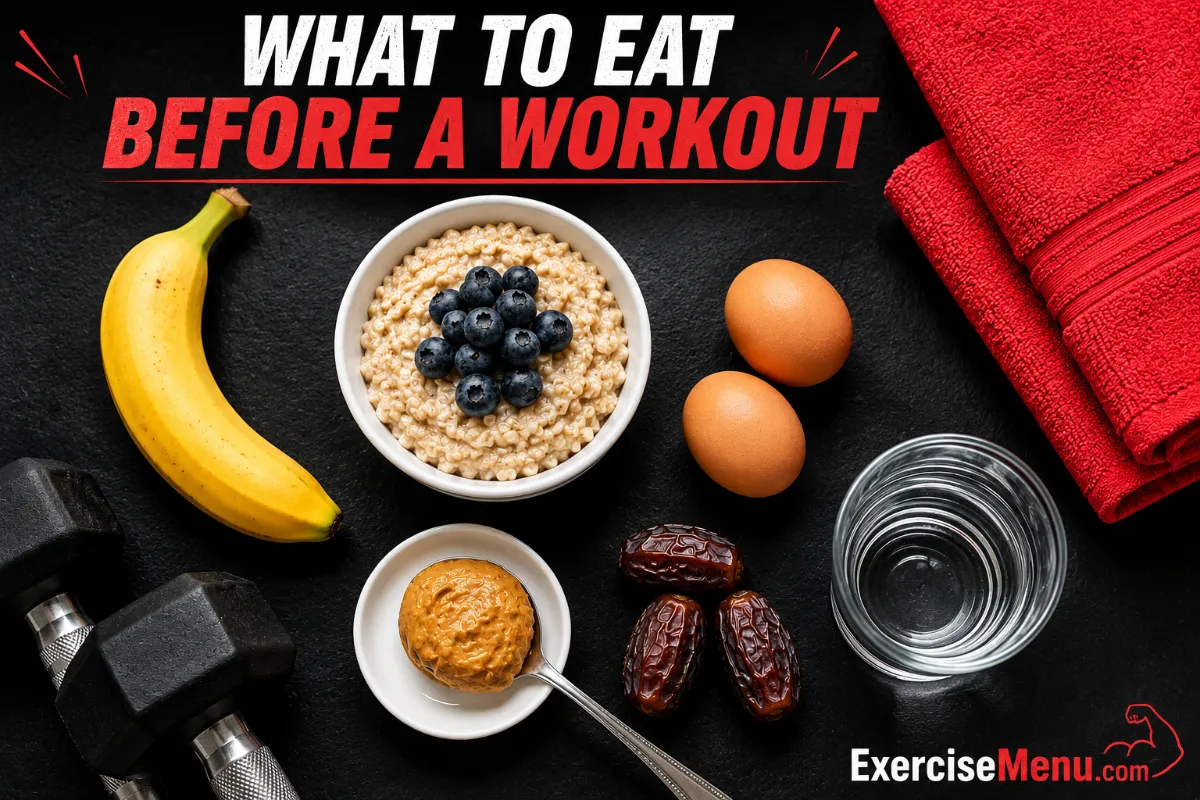
Quick Answer: Eat a mix of carbohydrates and protein 1–3 hours before training. A banana with peanut butter, oatmeal with fruit, or chicken with rice all work. Adjust your portion based on how much time you have smaller and simpler when you’re closer to your workout, fuller meals when you have 2–3 hours.
Key Takeaways:
- Eat a mix of carbohydrates and protein before training. Carbs fuel the session through glycogen, protein reduces muscle breakdown while you work.
- Timing matters more than food choice. A full meal works 2 to 3 hours before, a light snack works 30 to 60 minutes before, and a few bites of fast carbs work 15 to 30 minutes before.
- How much you eat depends on when you last ate, session length, intensity, and digestive tolerance, not just body weight.
- Skip high-fat, high-fibre, and heavily processed sugary foods within 1 to 2 hours of training. They slow digestion and can cause discomfort under load.
- Hydration is as important as food. Drink 350 to 500mL of water at least 2 hours before your session and sip steadily until your warm-up.
What you eat before training directly affects your performance in the gym. The wrong food leaves you sluggish or bloated mid-session. No food at all means you’re running on half a tank and your results will reflect that.
This guide covers specific pre-workout foods, how to eat based on your training schedule, portions based on your body weight, and what to avoid before the gym. Everything here is focused on what to eat before a workout — not after.
About the Author: This article is written by Rimsha Shahid — Registered Dietitian, DDNS MS HND, Certified Diabetes Specialist (USA), Certified Pediatric Nutritionist.
- Why Does Pre-Workout Nutrition Matter?
- What Are the Best Pre-Workout Foods?
- When Should You Eat Before a Workout?
- How Much Should You Eat Before a Workout?
- What Should You NOT Eat Before a Workout?
- Should You Work Out on an Empty Stomach?
- Does Pre-Workout Nutrition Change by Workout Type?
- Pre-Workout Hydration — How Much Water Do You Need?
- Pre-Workout Meal Ideas — Ready-to-Eat Combinations
- Frequently Asked Questions
Why Does Pre-Workout Nutrition Matter?
Your body stores carbohydrates as glycogen in your muscles and liver. Glycogen is your primary fuel source during moderate-to-high intensity exercise. Training on low glycogen means you fatigue faster, lift less weight, and can’t sustain the same output you’d hit on a full tank.
Protein consumed before exercise provides amino acids that support muscle protein synthesis (MPS) the process your body uses to repair and build muscle tissue. Pre-workout protein also reduces muscle breakdown during the session itself, which matters during longer or higher-intensity training.
Timing is just as important as food choice. Eating too close to your workout diverts blood to your digestive system instead of your working muscles, which can cause nausea and bloating. Eating too early means your glycogen stores start depleting before you even pick up a weight. According to the ISSN Position Stand on Nutrient Timing (Kerksick et al., 2017), the timing and ratio of macronutrients around exercise can enhance recovery, tissue repair, and muscle protein synthesis.
What Are the Best Pre-Workout Foods?
The best foods before a workout combine fast-absorbing or sustained carbohydrates with a moderate amount of protein and minimal fat if you’re eating within an hour of training.
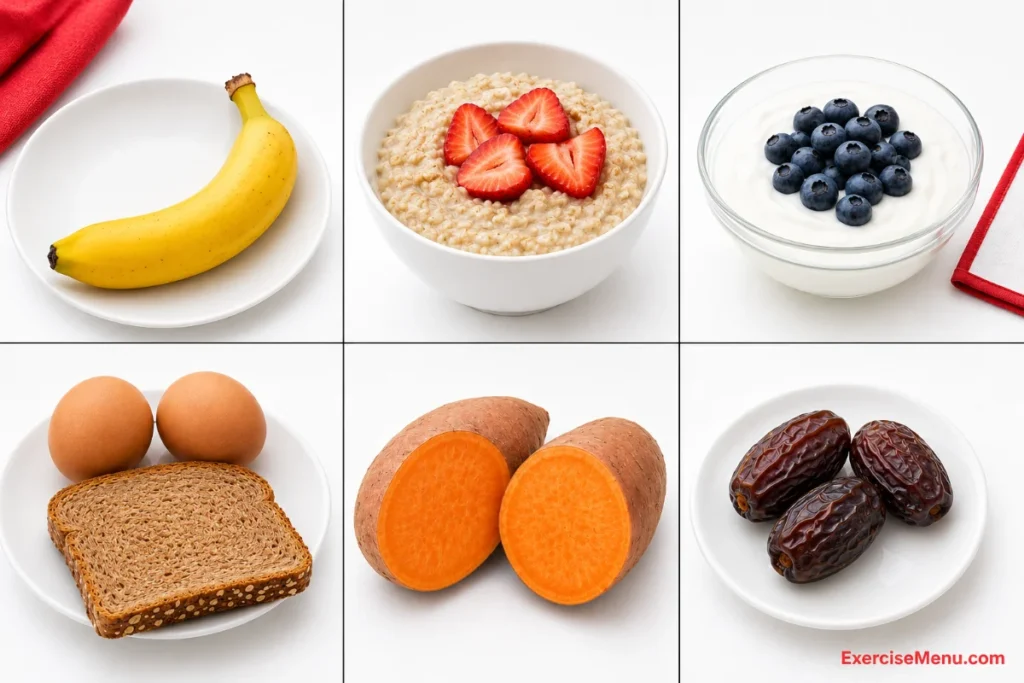
Quick Reference Table — Best Pre-Workout Foods
| Food | Best For | When to Eat | Why It Works |
|---|---|---|---|
| Banana | Quick energy | 30-60 min before | Fast-digesting carbs, potassium |
| Oatmeal | Sustained energy | 1-2 hours before | Low-GI complex carbs, steady blood glucose |
| Greek Yogurt + Berries | Carb-protein combo | 1-2 hours before | 15-20g protein, fast carbs from fruit |
| Chicken Breast + Brown Rice | Full meal fuel | 2-3 hours before | Lean protein, complex carbs |
| Fruit Smoothie + Protein Powder | Fast digestion needed | 30-60 min before | Liquid form clears stomach faster |
| Dates (2-3) | Instant energy boost | 15-30 min before | Fast-acting natural sugars, potassium |
Carbohydrate-Rich Foods
Carbohydrates are the main fuel for any workout above a casual walking pace. Your body breaks them down into glucose, which gets stored as glycogen in muscles and the liver. The more intense the session, the more glycogen you burn.
Simple carbohydrates — high glycemic index (GI) foods like bananas, dates, white rice, and fruit juice digest quickly and deliver energy fast. These work best 30–60 minutes before training when you need fuel in a hurry.
Complex carbohydrates — low-GI foods like oatmeal, sweet potato, whole grain bread, and brown rice release energy gradually and keep blood glucose steady over a longer session. These are your go-to 1–3 hours before training. The ISSN recommends consuming 1–4g of carbohydrates per kilogram of body weight in the 1–4 hour window before exercise, depending on how close you are to your session.
Protein Sources
Pre-workout protein serves two roles: it provides amino acids that stimulate muscle protein synthesis, and it reduces the rate of muscle breakdown during exercise. Both of these matter whether your goal is muscle gain, fat loss, or general fitness.
A practical target is 20–30g of protein in your pre-workout meal. Good sources include Greek yogurt, eggs, chicken breast, a whey protein shake, or cottage cheese. The branched-chain amino acids (BCAAs) in these foods — especially leucine — are the primary drivers of MPS.
A 2020 review published in Nutrients (Ormsbee et al.) found that pre-exercise nutrition directly influences metabolic and performance responses, with protein availability playing a key role in supporting training adaptations.
Where Do Fats Fit In?
Fats provide sustained energy during longer, moderate-intensity sessions. Once you’re past the 20-minute mark of steady-state work, your body increasingly relies on fat oxidation as a fuel source.
Fats slow gastric emptying, though, so they work best in meals eaten 2–3 hours before training. Within 60 minutes of your session, they’re more likely to cause stomach discomfort. Avocado, nut butters, and a small handful of nuts all fit well in a full pre-workout meal just keep the total fat moderate when you’re eating closer to go-time.
What About Coffee Before a Workout?
Caffeine is the most-studied ergogenic aid in sports nutrition. It lowers your perceived effort during training, which means the same workout feels less demanding. Research also supports its ability to increase power output in both strength and endurance sessions.
One to two cups of black coffee 30–60 minutes before training is a practical dose for most people. The ISSN recommends 3–6 mg of caffeine per kilogram of body weight for performance benefits. One downside: caffeine on an empty stomach can cause jitters, GI discomfort, or anxiety. If you’re sensitive, pair it with a small carb-based snack rather than drinking it alone.
Caffeine is not a food substitute. It enhances performance but does not replace glycogen. It works best alongside carbohydrates, not instead of them.
When Should You Eat Before a Workout?
The right pre-workout food depends less on what you eat and more on when you train. A chicken and rice meal works perfectly 2.5 hours before a session but it’s a terrible choice 30 minutes before. Timing changes everything.
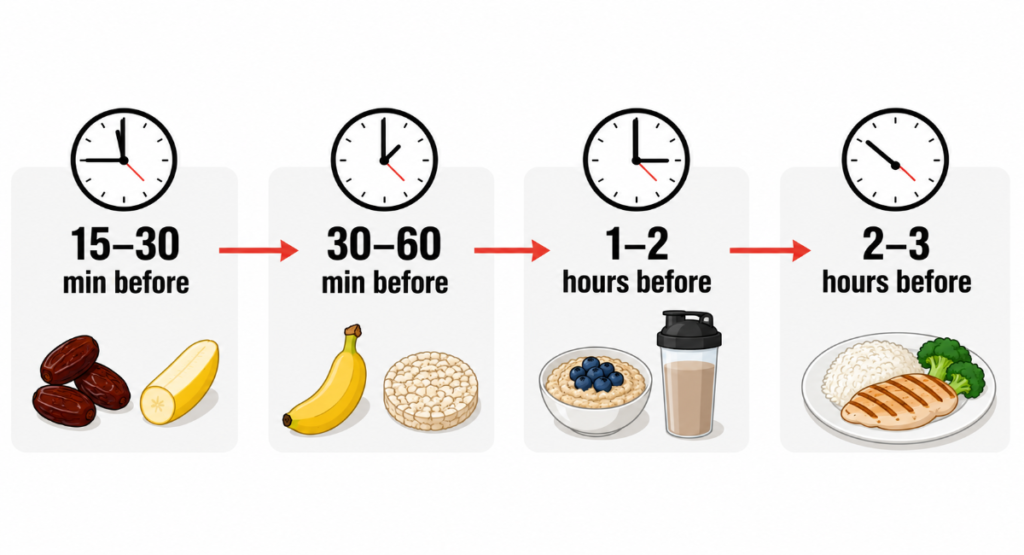
Quick Reference Table — Timing Matrix
| Time Before Workout | What to Eat | Portion Size | Example |
|---|---|---|---|
| 2–3 hours | Full meal — carbs + protein + small fat | 400–600 cal | Chicken breast + brown rice + roasted vegetables |
| 1–2 hours | Smaller meal — carbs + protein, low fat/fiber | 200–400 cal | Oatmeal + banana + scoop of whey protein |
| 30–60 minutes | Light snack — fast carbs, minimal fat/fiber | 100–200 cal | Banana + rice cake OR fruit smoothie |
| 15–30 minutes | Quick bite — simple sugars only | 50–100 cal | 2–3 dates OR half a banana OR small juice |
If You Train Early Morning (5–7 AM)
You woke up 20–40 minutes ago. Your stomach can’t handle a full meal. But you’ve been fasting for 8+ hours overnight, so glycogen is partially depleted.
Go with fast-digesting carbohydrates 15–30 minutes before your session. Half a banana, two or three dates, a small glass of juice, or a few bites of rice cake with honey. These digest quickly, top off blood glucose, and won’t sit heavy in your stomach.
If you have 60 or more minutes before training, you can handle something more substantial oatmeal with a banana, toast with peanut butter, or Greek yogurt with berries. For people who genuinely cannot eat anything early in the morning, start with liquids.
A diluted smoothie or small glass of juice is easier on the stomach than solids. Most people can train their gut to tolerate small pre-workout snacks within 2–3 weeks of consistent practice.
If You Train at Lunch (12–2 PM)
Breakfast was 4–5 hours ago. Your glycogen stores aren’t empty, but they’re partially used. Without a bridge snack between breakfast and your session, you’ll feel flat midway through.
Eat a small snack at 10–11 AM to top off your fuel: Greek yogurt with fruit, a banana with a handful of almonds, or a small protein bar. That bridge snack means you don’t need to eat again right before your lunchtime session.
If You Train After Work (5–7 PM)
Lunch was 4–5 hours ago. This is the window where most people skip the snack, train on depleted glycogen, and wonder why every set feels harder than it should.
Eat a snack 1–2 hours before: toast with peanut butter, a banana with oatmeal, rice cakes, or a smoothie. This is the most common training window and the one where fueling properly makes the biggest difference in how you perform.
If You Train Late Night (8–10 PM)
You need fuel, but eating heavily before bed isn’t comfortable. Keep it light: Greek yogurt with berries, a small smoothie, toast with an egg, or cottage cheese with fruit. These give you enough carbohydrates and protein to train without loading your stomach before sleep.
How Much Should You Eat Before a Workout?
Generic advice like “eat a snack before the gym” doesn’t tell you much. How much you eat depends on when you last ate, how long and hard your session will be, and how your stomach handles food before exercise. Body weight is one factor a 55 kg person generally needs less than someone weighing 100 kg but it’s not the only one.
Quick Reference Table — Portions by Body Weight
The ISSN recommends 1–4g of carbohydrates per kilogram of body weight in the hours before exercise but that range was developed for moderate-to-high intensity sessions lasting 60 minutes or longer, particularly endurance and competition settings. For a standard 45–60-minute gym session, most people do well at the lower end of that range.
Approximate Carb Targets by Body Weight
| Your Weight | Light session or <60 min (1g/kg) | Intense or 60+ min session (2–3g/kg) |
|---|---|---|
| 55 kg / 120 lbs | ~55g | ~110–165g |
| 70 kg / 155 lbs | ~70g | ~140–210g |
| 85 kg / 185 lbs | ~85g | ~170–255g |
| 100 kg / 220 lbs | ~100g | ~200–300g |
These are starting points, not prescriptions, and the higher end of these ranges applies primarily to endurance athletes and competition-level training, not standard gym sessions.
If your goal is fat loss and you’re in a calorie deficit, your pre-workout meal comes from your daily calorie budget not on top of it. Scale to the lower end and prioritize protein to preserve muscle while cutting.
What Should You NOT Eat Before a Workout?
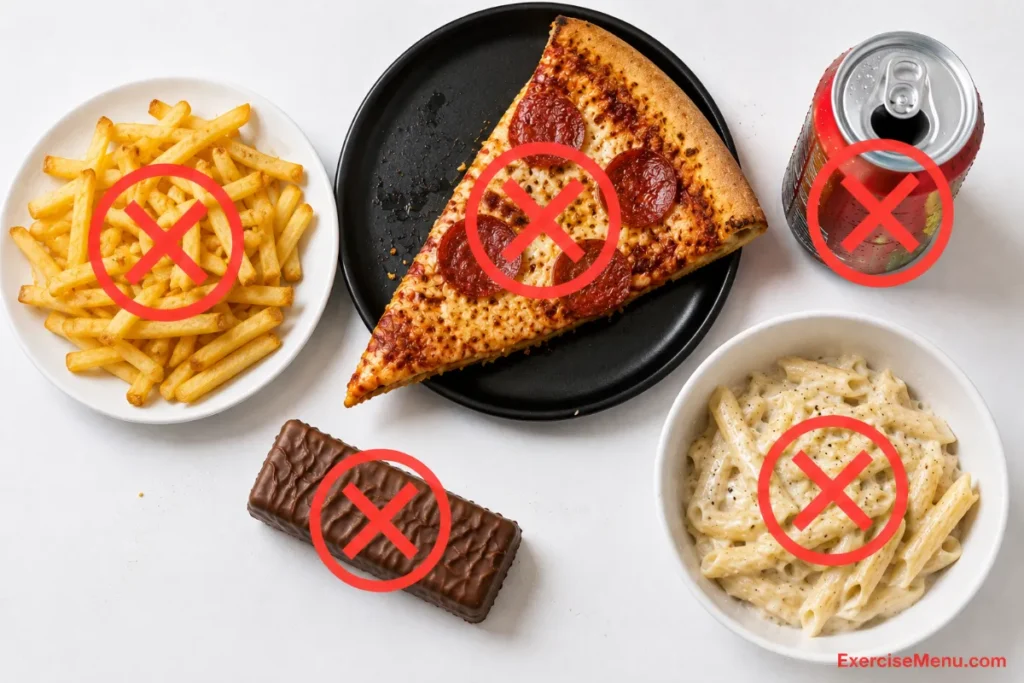
The foods below won’t just fail to help — they’ll actively work against you during a session.
High-Fat and Fried Foods
Burgers, fries, pizza, creamy pasta, cheese-heavy dishes. Fat slows gastric emptying dramatically, and blood gets diverted to your digestive system instead of your working muscles. You end up sluggish, heavy, and nauseous mid-set. Save high-fat meals for 3+ hours before training or keep them for after.
High-Fiber and Gas-Producing Foods
Beans, lentils, broccoli, cauliflower, Brussels sprouts, large raw salads. Fiber slows digestion and produces gas. That means mid-workout bloating, cramping, and GI distress — especially during any movement involving your core or heavy bracing.
Fiber is healthy at other meals. Just not within 1–2 hours of training.
Sugary Snacks and Processed Foods
Large amounts of concentrated sugar immediately before exercise can cause digestive discomfort or a reactive drop in blood glucose in some people, particularly when consumed on an empty stomach.
Possible symptoms include lightheadedness, sudden fatigue, shakiness, or difficulty concentrating. However, this response varies between individuals, and pre-exercise carbohydrate does not automatically cause an energy crash or reduce performance.
Whole-food carbohydrate sources such as bananas and dates also provide fibre, potassium, and other micronutrients. Many people tolerate them well before exercise, but no food guarantees a completely steady blood-glucose response. Choose a familiar carbohydrate source based on your timing, portion size, and digestive tolerance.
Should You Work Out on an Empty Stomach?
It depends on what you’re doing and how long it’s been since you last ate. Light-to-moderate cardio under 45 minutes generally works fine fasted. Strength training and HIIT perform better with fuel glycogen powers muscle contractions under load, and running low mid-session reduces both output and safety.
On fat loss specifically, research shows no significant difference in body composition between fasted and fed training when total daily calories are controlled. Fat oxidation is higher during fasted sessions, but the body rebalances over 24 hours.
The should you work out on an empty stomach guide covers who benefits from fasted training, who should avoid it, and how to transition.
Does Pre-Workout Nutrition Change by Workout Type?
The same general principles apply — carbs for fuel, protein for muscle — but the ratio shifts depending on what kind of training you’re doing.
Before Cardio or Running
Prioritize carbohydrates and keep fat low. Longer cardio sessions (45+ minutes) need more fuel than a quick 20-minute run. For steady-state running, simple carbs 30–60 minutes before are enough. For longer or more intense sessions, a full meal 2–3 hours before keeps your energy consistent.
For HIIT-specific fueling, the demands are different from steady-state cardio — see what to eat before a HIIT workout for a detailed breakdown.
Before Strength Training
Carbs plus protein is the priority. Protein intake matters slightly more here — aim for 20–30g to support muscle protein synthesis during resistance work. A full meal 2–3 hours before heavy lifting gives your body time to digest while keeping glycogen topped off.
If you train for a visible pump, certain foods can support nitric oxide production and blood flow to working muscles. The best foods for a pre-workout pump guide covers which ones work and why.
Before Yoga or Light Exercise
A light snack or nothing at all. Sessions under 45 minutes at low intensity don’t require significant fuel. A small piece of fruit or a few crackers is enough if you feel hungry. Don’t overcomplicate it.
Pre-Workout Hydration — How Much Water Do You Need?
Even a 2% drop in body water reduces your ability to perform. Dehydration affects your strength output and your ability to sustain effort across a full session. Most people don’t drink enough before training.
The American College of Sports Medicine (ACSM) recommends 5–7 mL per kilogram of body weight at least 4 hours before exercise. For a 70 kg person, that’s roughly 350–500 mL — about 1.5 to 2 cups of water. Sip another cup in the hour before your session. Don’t chug right before — that leads to sloshing and discomfort.
Signs you’re under-hydrated: dark yellow urine, headache, early fatigue, or dizziness during your warm-up.
Electrolytes matter beyond just water. Potassium (found in bananas and dates), sodium, and magnesium all support muscle contraction and nerve function during training. If you’re a heavy sweater or training in heat, add a pinch of salt to your water or eat a salty snack beforehand to help your body retain fluid.
Do You Need Pre-Workout Supplements?
A balanced meal or snack before training covers fuel and protein for most people. Supplements are not a replacement for food, but some have research support for specific performance benefits.
Caffeine is covered above. Beyond caffeine, three supplements appear most often in sports nutrition research:
Creatine monohydrate supports short-burst power and strength. It works through daily loading over weeks, not acute pre-workout timing. Taking it before or after training makes no meaningful difference as long as you take it consistently. The ISSN recommends 3 to 5g daily.
Beta-alanine buffers acid buildup in muscles during high-rep or high-intensity work. Like creatine, the benefit comes from consistent daily use (3.2 to 6.4g per day), not from taking it 30 minutes before a session.
Citrulline malate may support blood flow and reduce fatigue during resistance training. Studied doses are typically 6 to 8g taken 60 minutes before exercise. Food sources like watermelon contain citrulline but at much lower concentrations than supplement doses.
If your training is moderate and your nutrition is consistent, supplements add marginal benefit. If you are pushing high-volume or high-intensity work and want a performance edge, these three have the strongest evidence base. Consult a healthcare professional before starting any supplement.
Pre-Workout Meal Ideas — Ready-to-Eat Combinations
Below are four practical combinations, one for each timing window with approximate macros. Pick the one that matches your schedule.
30–60 minutes before: 1 medium banana + 1 tbsp peanut butter (~35g carbs, 7g protein, 8g fat)
1–2 hours before: 1 cup oatmeal + 1 banana + 1 scoop whey protein (~55g carbs, 28g protein, 5g fat)
2–3 hours before: 150g chicken breast + 1 cup brown rice + roasted vegetables (~65g carbs, 40g protein, 8g fat)
Plant-based: 1 banana + 1 scoop plant protein + ½ cup oat milk + berries, blended (~45g carbs, 22g protein, 5g fat)
A full meal 2 to 3 hours before heavy lifting gives your body time to digest while keeping glycogen topped off. The pre-workout meals for muscle gain guide covers full plates organised by timing.
Frequently Asked Questions
Should I eat before or after a workout?
Both matter, and they serve different purposes. Pre-workout food fuels the session itself. Post-workout food supports muscle repair and replenishes glycogen. Skipping one doesn’t compensate for the other.
What if I feel nauseous when I eat before training?
Start with liquids — a diluted smoothie or small glass of juice. Some stomachs need 2–3 weeks to adapt to pre-exercise food. Begin with 50–100 calories and increase gradually. If solid food never works for you, liquid calories are a permanent solution, not a compromise.
Does pre-workout nutrition differ for men and women?
The macronutrient principles are identical. Portions scale by body weight, not gender. Some research has examined whether hormonal fluctuations across the menstrual cycle affect fuel use during exercise, but results are mixed and no firm dietary recommendation exists yet. Stick with the same body-weight-based approach outlined above.
Is a protein bar a good pre-workout option?
Check the label, not the branding. Bars with 15–25g carbs and 10–20g protein work well 30–60 minutes before training. Avoid bars with more than 15g of fat or heavy fiber content — they digest too slowly and can cause stomach discomfort during your session.
Can I eat the same pre-workout meal every day?
Yes. Consistency is fine if the food works for you. Your body adapts to familiar foods and digests them more efficiently over time. Change your pre-workout meal only if your workout type, duration, intensity, or timing shifts significantly.
Should I count pre-workout food toward my daily calorie goal?
Yes. Your pre-workout meal is part of your total daily intake, not extra. If you’re in a calorie deficit for fat loss, your pre-workout snack comes from your existing budget. You eat less at another meal to accommodate it — you don’t eat more overall.
Want a Nutrition Plan Built Around Your Training?
Generic meal plans don’t account for your training schedule, health history, or goals. Rimsha Shahid — Registered Dietitian, Certified Diabetes Specialist (USA), and Certified Pediatric Nutritionist — builds personalised nutrition plans that work alongside your programme, not against it.
Free initial consultation — no commitment required.
