


Quick Answer: RPE rates how hard a set felt on a 1–10 scale. RIR counts how many clean reps you had left. RPE 8 equals 2 RIR — both describe the same effort. RIR works better for rep-based lifting, RPE fits conditioning and low-rep strength work. Most lifters use both.
Key Takeaways
- RPE and RIR measure the same thing — proximity to failure — from opposite directions.
- RPE 8 = 2 RIR = roughly 73–92% of your 1RM depending on the rep count.
- For sets of 5–15 reps, RIR is easier to estimate. For heavy singles, triples, and conditioning work, RPE captures effort better.
- Most hypertrophy gains come from sets taken to 1–3 RIR. Strength improves across a wider RIR range.
- RIR accuracy improves with practice, is better on heavier sets closer to failure, and does not differ between men and women.
RPE and RIR both answer one question: how close did that set get to failure? The difference is which side of the question each one measures.
RPE asks, “How hard did that feel?” RIR asks, “How many clean reps did I have left?” For most rep-based lifting, these give you the same information packaged differently. Where they diverge is context, low-rep maximal work, timed conditioning, or high-rep isolation sets each favor one scale over the other. Knowing when to use which makes every load selection decision sharper.
Both scales are forms of autoregulation: instead of locking into fixed percentages that ignore how you feel today, you adjust load based on real-time feedback from your body. That flexibility is why RPE and RIR have become standard tools in evidence-based programming.
- What Does RPE Mean in Strength Training?
- What Does RIR Mean?
- RPE-to-RIR Conversion Chart
- What Does RPE 8 Mean? And How Does It Map to Your 1RM?
- When Should You Use RPE vs RIR?
- How to Combine RPE/RIR with Percentage-Based Training
- What RIR Should You Use for Each Training Goal?
- How Accurate Are RPE and RIR Estimates?
- How to Progress RIR Across a Training Block
- Common Mistakes with RPE and RIR
- Frequently Asked Questions
What Does RPE Mean in Strength Training?
RPE stands for Rate of Perceived Exertion. In lifting, it uses a 1–10 scale where each number corresponds to how many reps you had left in the tank.
The concept originated with Swedish researcher Gunnar Borg in 1970. His original scale ran 6–20 and was designed for aerobic exercise, with ratings loosely tied to heart rate. That scale gauges general effort, light, moderate, heavy — which works for running but lacks precision for lifting. A lifter might rate a set “moderate” while grinding through the last rep because the cardiovascular demand felt manageable even though the muscle was at its limit.
The 1–10 RPE scale used in weight training today was created by powerlifter and coach Mike Tuchscherer around 2008 through his Reactive Training Systems Manual. His key innovation was anchoring each RPE number to a specific number of reps in reserve, making the scale actionable for lifters rather than just a feeling-based rating. Researchers Michael Zourdos and Eric Helms later validated this RIR-based RPE scale scientifically.
Do not confuse the lifting RPE scale with the Borg scale. If a training program, physical therapist, or cardio coach uses RPE, check which version they mean. The Borg 6–20 scale and the lifting 1–10 scale measure differently and are not interchangeable.
What Does RIR Mean?
RIR stands for Reps in Reserve. It estimates how many quality reps you could still complete after finishing a set, before your form breaks down.
Finish a set of 10 squats and believe you could do 2 more with solid technique? That set was 2 RIR. Grind out the last rep and have nothing left? That is 0 RIR.
RIR became popular in hypertrophy-focused training because it directly answers the question that matters for muscle growth: how close did this set get to muscular failure? Unlike a general effort rating, RIR gives you a countable number tied to a specific exercise and a specific muscle group.
Is 0 RIR the Same as Failure?
No. This distinction matters.
0 RIR means you completed every rep you were capable of with good technique. You finished your last rep and knew with certainty that another clean rep was not possible. You stopped at the edge.
Muscular failure means you attempted a rep you could not complete. The bar stalled, your form broke down, or you could not finish the range of motion. You went past the edge.
The difference is one rep, but the fatigue cost is disproportionate. That one failed attempt generates significantly more neuromuscular fatigue compared to the set itself. For compound lifts like squats and deadlifts, injury risk also increases on a rep where technique degrades under load. Most programs that prescribe “train to failure” mean 0 RIR, not grinding through a half-rep you cannot finish.
RPE-to-RIR Conversion Chart
RPE and RIR are inversely related. Each RPE score maps to a specific RIR value on the Tuchscherer scale.
| RPE | RIR | What It Means |
|---|---|---|
| 10 | 0 | No reps left. Maximum effort. |
| 9.5 | 0–1 | No more reps, but slightly more weight might have been possible. |
| 9 | 1 | One clean rep left. |
| 8.5 | 1–2 | Definitely 1 more, possibly 2. |
| 8 | 2 | Two reps left. Hard but controlled. |
| 7 | 3 | Three reps left. Productive work with a clear margin. |
| 6 | 4+ | Light effort. Warm-up territory for most working sets. |
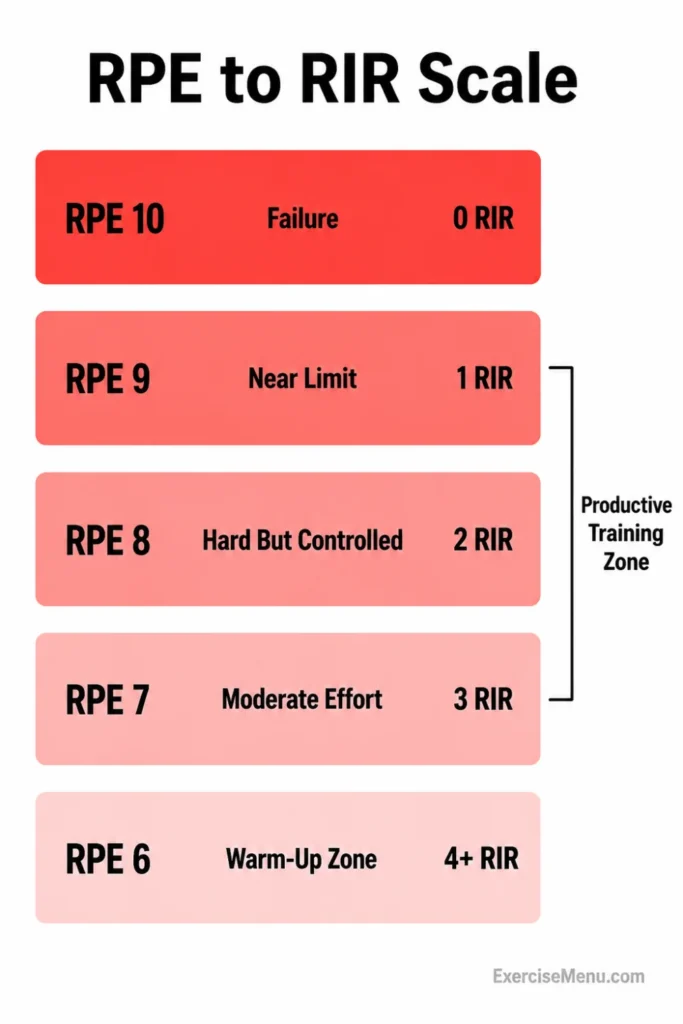
A set logged as RPE 8 and a set logged as 2 RIR describe the same level of effort. The only difference is which side of the scale you are reading. Most coaches use these terms interchangeably for rep-based exercises in the 5–15 rep range.
Below RPE 6, the conversion gets deliberately vague. Distinguishing six reps left from eight is difficult and rarely useful for programming decisions.
Research from Zourdos et al. (2016) in the Journal of Strength and Conditioning Research validated this relationship by testing squatters at various intensities. Experienced lifters showed a strong inverse correlation (r = −0.88) between RPE ratings and bar velocity — as reported RIR decreased, bar speed dropped in a predictable pattern.
What Does RPE 8 Mean? And How Does It Map to Your 1RM?
RPE 8 means you finished the set with roughly 2 clean reps left. It does not identify one fixed percentage of your 1RM because the rep count changes the equation.
A single rep at RPE 8 uses a much heavier percentage of your max than 8 reps at RPE 8. Here is how RPE 8 maps across different rep counts:
| Reps at RPE 8 | Approximate %1RM |
|---|---|
| 1 rep | ~92% |
| 3 reps | ~85% |
| 5 reps | ~80% |
| 8 reps | ~73% |
| 10 reps | ~70% |
These are estimates, not laboratory measurements. Individual variation is large — research has shown that the number of reps people can perform at 70% of 1RM ranges from 6 to 26 across individuals (Zourdos et al., 2019, JSCR). That range is exactly why RPE and RIR exist: they account for individual differences that fixed percentages cannot.
If your program prescribes RPE 8, you do not need to calculate a percentage. Choose a weight that leaves about 2 reps in reserve. If 80% of your calculated max feels like RPE 9 today because you slept poorly, drop to 77%. If it feels like RPE 7, move up to 82%. The RPE target adjusts the load to match your actual capacity on that day.
When Should You Use RPE vs RIR?
Neither scale is universally better. Each fits certain training contexts more naturally.
For Rep-Based Lifting (5–15 Reps): Use RIR
RIR shines on working sets with a defined rep count. “How many more reps could I do?” is a concrete question with a countable answer. On a set of dumbbell rows, cable curls, or leg presses, estimating remaining reps is straightforward because the target muscle is the clear limiting factor.
For beginners especially, RIR is the easier starting point. When a newer lifter finishes a set and rates it “RPE 8,” they are assigning a number to a feeling they have not calibrated yet. They do not know what an 8 feels like versus a 6. “Could you have done 2 more reps with clean form?” is a question anyone can answer, even in their first week.
For Heavy Low-Rep Work (1–5 Reps): Use RPE
Heavy singles and triples are hard to rate by “reps left” because the question does not map cleanly. Saying “that felt like RPE 9” is more informative than “1 RIR” when handling 90%+ of your max, because a near-max single might have had 0.5 of a rep left — the weight could have been slightly heavier, but another full rep was not possible. RPE captures that nuance through the half-point ratings (9.5, 8.5) that RIR cannot express.
For Conditioning, Cardio, and Timed Work: Use RPE
RIR assumes discrete reps, which does not apply to running, rowing, circuits, or interval training. No single muscle is “failing” during a 15-minute conditioning piece — your heart rate is high, breathing is labored, legs are burning, and grip is challenged all at once. RPE captures that holistic experience:
- RPE 5–6: Conversational pace. Sustainable for 30+ minutes. Aerobic base building.
- RPE 6–7: Moderate. Short sentences, not paragraphs. Fastest pace you can hold for a full session without drop-off.
- RPE 7–8: Hard, sustained. Breathing is heavy. Faster than you could hold for a long workout.
- RPE 8–9: High intensity. Speaking is difficult. Used for intervals with planned recovery.
For Intermediate and Advanced Lifters: Use Both
The practical hybrid most experienced lifters settle into: RPE for top sets on heavy compounds, RIR for moderate-rep volume and accessory work. A session might read “work up to a heavy triple at RPE 8, then 3 sets of 10 back-off work at 2–3 RIR.” This approach gives you precision on the heavy work and simplicity on the volume work.
How to Combine RPE/RIR with Percentage-Based Training
Percentages and RPE/RIR are not competing systems — they work best together.
A program might prescribe “squat at 78–82% for sets of 5, targeting 2–3 RIR.” The percentage gives you a starting weight. The RIR target tells you whether that weight is right for today. If 80% of your max feels like 1 RIR because you are fatigued, drop to 77%. If it feels like 4 RIR because you are fresh, move to 83%.
This matters because your true capacity fluctuates daily. Sleep, stress, nutrition, and accumulated training fatigue all affect performance. A fixed percentage hits differently depending on conditions. RIR adjusts the percentage to match reality.
For beginners who have not developed the internal calibration for accurate RIR estimates, starting with percentage-based programs and tracking RIR as a secondary data point builds awareness over time without requiring accuracy from day one.
What RIR Should You Use for Each Training Goal?
The right RIR changes based on what you are training for.
| Training Goal | Recommended RIR | Rep Range | Why This Range |
|---|---|---|---|
| Muscle growth (hypertrophy) | 1–3 RIR | 6–15 reps | Muscle fibers need to be recruited close to failure for a growth stimulus. Sets at 4+ RIR barely register as productive volume for hypertrophy. |
| Strength | 2–3 RIR | 1–6 reps | Heavy loads already recruit high-threshold motor units. Training to failure on heavy compounds creates disproportionate fatigue without additional strength benefit. |
| Muscular endurance | 2–4 RIR | 12–20+ reps | High-rep sets generate metabolic fatigue that feels harder than it is. Stopping short prevents form breakdown where fatigue accumulates quickly. |
| Power and speed | 3–5 RIR | 1–5 reps | Bar speed is the priority. Every rep should be fast and explosive. Proximity to failure slows movement velocity, undermining the training goal. |
A 2024 meta-regression by Robinson et al. in Sports Medicine analyzed the dose-response relationship between proximity to failure and muscle growth. They found that hypertrophy increases as sets get closer to failure, with the strongest effects appearing below 3 RIR. Strength gains showed no meaningful difference across RIR levels — you do not need to grind sets to failure to get stronger.
A follow-up study by Refalo et al. (2024) in the Journal of Sports Sciences tested this directly: training with 1–2 RIR produced similar quadriceps growth to training to failure over eight weeks. The failure group lost more reps and bar speed during workouts with no additional hypertrophy to show for it.
One detail that trips people up: a 2 RIR squat and a 2 RIR lateral raise feel completely different in terms of whole-body effort. The squat at 2 RIR might leave you breathless and shaking. The lateral raise at 2 RIR might feel almost easy from a cardiovascular standpoint. Both sets are equally productive for their target muscles. RIR measures proximity to local muscular failure, not how exhausted you feel overall.
How Accurate Are RPE and RIR Estimates?
Both scales are subjective, and everyone is somewhat inaccurate. The most common pattern is overestimating effort, you call a set “2 RIR” when you had 3 or 4 reps left.
A 2022 meta-analysis by Halperin and colleagues in Sports Medicine, reviewing data from 414 lifters, found that the average person underestimates their remaining reps by about 1 repetition. That error grows on high-rep sets above 12 reps, where metabolic burn clouds judgment. The error shrinks on heavier sets closer to actual failure.
What Affects Accuracy?
Proximity to failure matters most. Estimates made at 1–2 RIR are more accurate than estimates at 4+ RIR, regardless of experience level. The closer you are to your limit, the clearer the signal.
Exercise type matters. Research from Hermann et al. (2025) in Medicine & Science in Sports & Exercise showed that bench press RIR accuracy was better than squat RIR accuracy. Isolation and machine exercises where a single muscle is the limiting factor tend to produce clearer RIR signals than compound movements where bracing, balance, and cardiovascular demand compete for attention.
Sex does not matter. Multiple studies, including Refalo et al. (2024), found no meaningful sex-based differences in RIR accuracy. Men and women estimate remaining reps with similar precision.
Training status has a smaller effect than expected. Beginners and experienced lifters both undershoot by roughly 1 rep on average. The bigger issue for beginners is not worse accuracy — it is that they tend to stop sets further from failure than they realize, keeping training in a zone that does not produce much adaptation.
How to Calibrate Your Estimates?
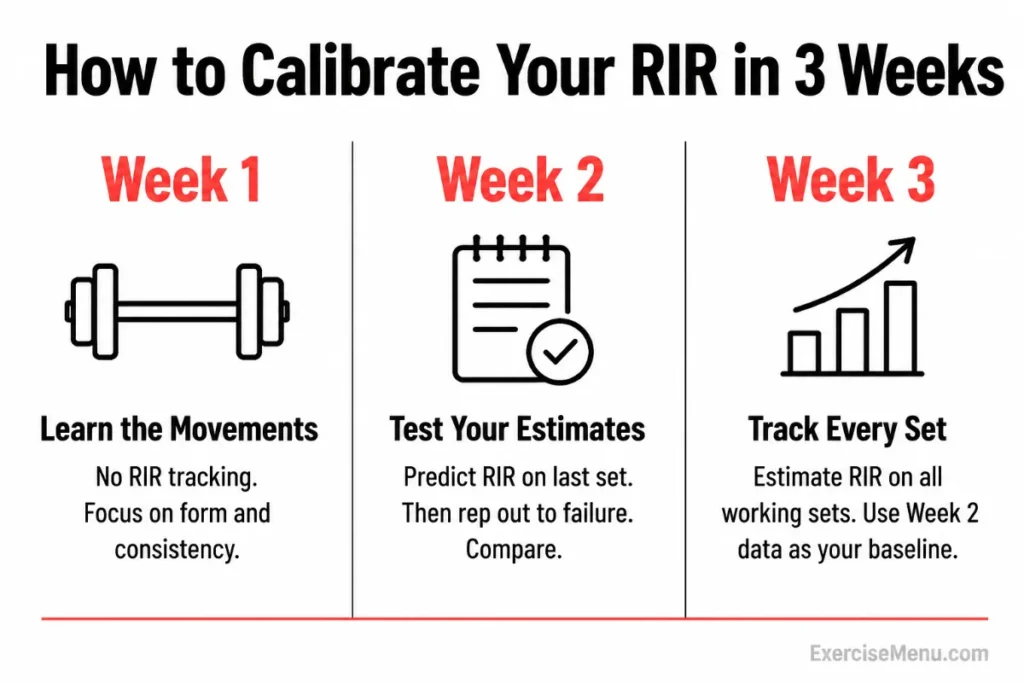
Week 1: Focus on learning movements, hitting prescribed reps, and building consistency. Do not track RIR yet.
Week 2: On your last set of each exercise, estimate your RIR before racking the weight. Then continue until your form breaks down. Compare prediction against reality. If you predicted 2 RIR and completed 5 more reps, your gauge is off, and now you have data to adjust.
Week 3: Estimate RIR on every working set. Use Week 2 data as a reference.
Filming your sets accelerates the process. Bar speed is an objective proxy for proximity to failure — reps at 3 RIR move noticeably faster than reps at 1 RIR. Watching footage back connects what you felt internally with what happened externally.
How to Progress RIR Across a Training Block
RIR is not a static number. A structured approach uses descending RIR targets across a 4–5 week block, pushing closer to failure as your body adapts before pulling back to recover.
| Week | RIR Target | What It Feels Like |
|---|---|---|
| 1 | 3–4 RIR | Comfortable but purposeful. Building momentum. |
| 2 | 3 RIR | Working hard. Last 2–3 reps require real focus. |
| 3 | 2 RIR | Challenging. Every working set demands full concentration. |
| 4 | 1 RIR | Near your limit. Bar speed drops noticeably on the last rep. |
| 5 | Deload | Cut volume and intensity. Let fatigue dissipate before the next block. |
A 2025 study by Martikainen et al. in the Journal of Science in Sport and Exercise tested this directly. They compared a progressive RIR group (4→1 RIR over 10 weeks) against a constant RIR 1 group. Both groups gained similar strength and muscle size — but the progressive group reported lower session fatigue and improved their RIR accuracy more over the training period. Varying proximity to failure lets you accumulate the same stimulus with less perceived cost.
After the deload week, restart at 3–4 RIR but with slightly heavier loads. That combination of RIR-based progression and load increases is how you apply progressive overload without guessing.
RIR also prevents junk volume, sets that look productive on paper but were too far from failure to trigger growth. A set of lateral raises at 5 RIR barely registers as a hypertrophic stimulus. RIR tells you directly whether each set counted toward your goal.
Common Mistakes with RPE and RIR
Calling every moderate set “RPE 8.” If everything is an 8, your scale has no resolution. Use the full range. When uncertain, give a range (7–8) rather than defaulting to 8.
Rating discomfort instead of proximity to failure. A high-rep set can burn intensely while several clean reps remain. Metabolic fatigue — the lactic acid burn, the elevated heart rate — is not the same as muscular failure. Rate how many reps you had left, not how uncomfortable the set felt.
Always training to 0 RIR on compounds. Grinding to failure on every set of squats and deadlifts produces rapid burnout, technique degradation, and injury. Save 0 RIR for isolation and machine work where the risk-to-reward ratio is favorable.
Using 3 RIR as an excuse to underload. “I stopped at 3 RIR” is meaningless if the weight was too light to begin with. If your target is 3 sets of 8 at 2 RIR and you could have done 15 reps, the problem is load selection, not your RIR target.
Ignoring technique in the count. Only count reps you could complete with the intended form. A possible rep with major breakdown is not a clean rep in reserve.
Frequently Asked Questions
Is RPE 8 the same as 2 RIR?
On the RIR-based lifting scale, yes. RPE 10 = 0 RIR, RPE 9 = 1 RIR, RPE 8 = 2 RIR, RPE 7 = 3 RIR. This mapping applies to resistance training only — the Borg aerobic scale uses RPE differently.
What does RIR stand for in the gym?
RIR stands for Reps in Reserve — the estimated number of additional reps you could complete with good form before reaching muscular failure. A set at 2 RIR means you believe two more clean reps were possible.
Can I use percentages of 1RM instead of RPE or RIR?
You can, but percentages do not adjust for daily fluctuations. The number of reps people can perform at 70% of their 1RM ranges from 6 to 26 across individuals. Pairing a percentage starting point with an RIR target — “3 sets of 8 at roughly 70%, aiming for 2–3 RIR” — gives you both structure and flexibility.
Does high-rep training make RIR harder to estimate?
Yes. Halperin’s 2022 meta-analysis confirmed that estimation errors increase on sets above 12 reps. The metabolic burn creates a perception of nearness to failure even when several reps remain. On sets of 15+, treat your RIR estimate as roughly 1 rep optimistic.
Is training to failure necessary for muscle growth?
Not for most of your training. Refalo et al. (2024) found that training with 1–2 RIR produced similar hypertrophy to training to failure over eight weeks. A separate 2025 study found that training to failure also produces consistently higher perceived discomfort that does not decrease with practice, which can reduce long-term training adherence. Reserve failure for the last set of isolation exercises where fatigue cost is low and injury risk is minimal.
Do RPE and RIR work for machine exercises and isolation movements?
Yes, and isolation exercises are where RIR is often easiest to estimate. On a leg extension or cable curl, the target muscle is the only limiting factor, so “how many reps do I have left?” has a clearer answer than on a barbell squat where bracing, balance, and cardiovascular demand all compete.
If you have an existing injury or medical condition, consult your doctor before changing training intensity.

3 Comments
Pingback: Shoulder Pain Bench Press: 4 Form Errors to Fix Now
Pingback: How to Calculate Your 1RM (One Rep Max Calculator + Formula)
Pingback: Progressive Overload: Meaning, 7 Methods & Examples