


- Key takeaways
- What does training to failure mean?
- Should you train to failure?
- Is training to failure necessary for muscle growth?
- Pros and cons of training to failure
- Training to failure vs reps in reserve (RIR)
- Should you train to failure every set?
- Which exercises are safe for training to failure?
- How often should you train to failure?
- A sample week with failure sets (upper/lower, 4 days)
- Who should (and shouldn't) train to failure?
- Past failure: partials, drop sets and rest-pause
- Training to failure FAQs
- The bottom line
Key takeaways
- Proximity to failure is a dose: 2 reps short is close to the same growth stimulus as 0, while 5+ reps short starts costing you muscle.
- Strength responds to load and practice, not grinding — heavy sets with reps left in the tank build strength just as well.
- Failure sets produce more muscle damage, higher creatine kinase at 48 hours, and bigger drops in force than non-failure sets.
- Most lifters misjudge their reps in reserve; testing true failure on a safe machine every few weeks recalibrates you.
- Failure belongs on machines, cables and dumbbell isolation work — not on heavy squats, deadlifts or barbell overhead presses.
Training to failure isn’t good or bad. It’s a high-cost tool. The research is now clear enough to tell you exactly where it pays off (the last set of a curl or leg extension) and where it doesn’t (your first set of heavy squats).
Below you’ll get the verdict by goal, the trade-offs in one table, which exercises are safe, how many failure sets per week fit your split, and a full sample week with RIR targets on every exercise.
What does training to failure mean?
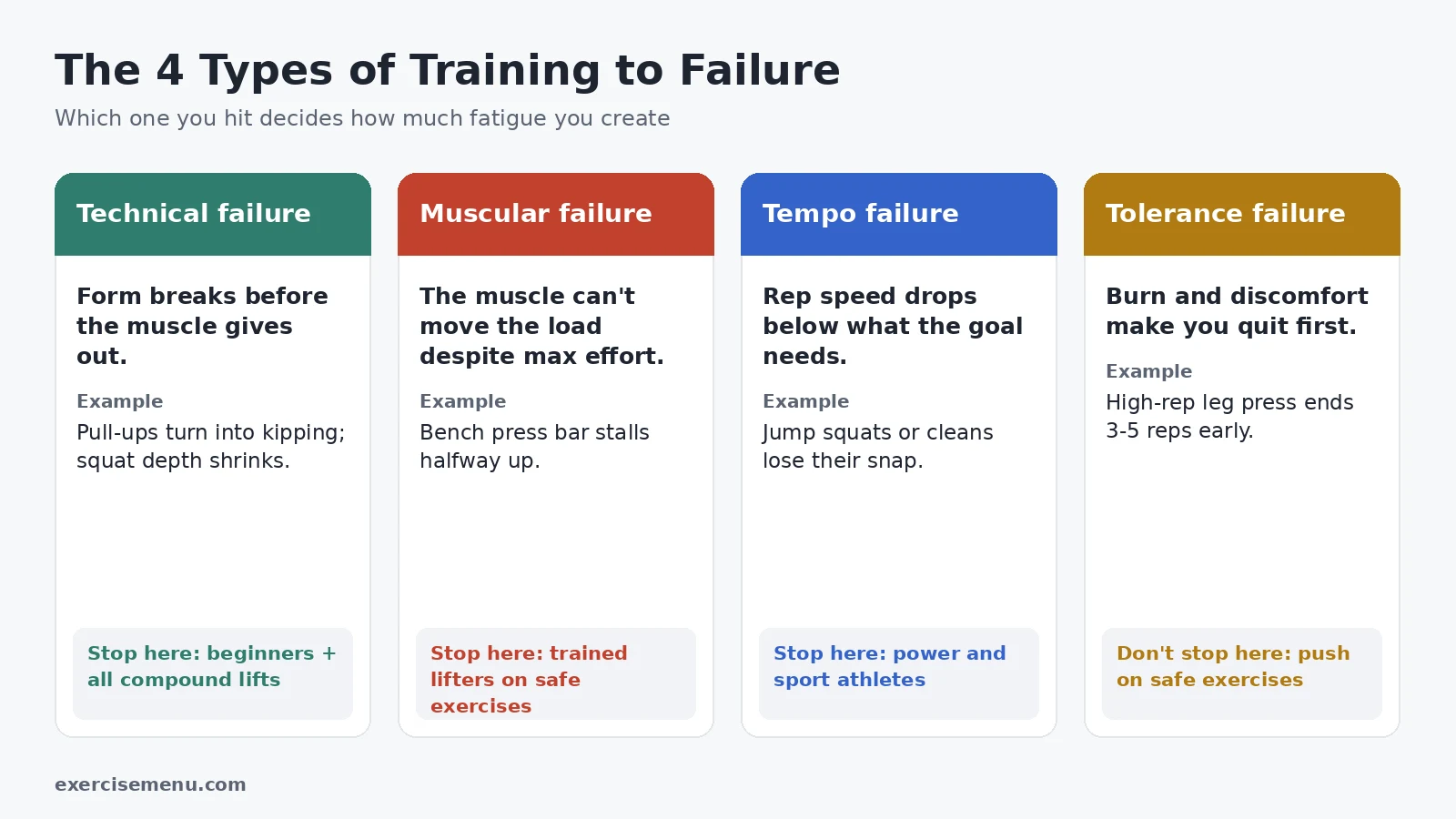
Training to failure means continuing a set until you can’t complete another full rep with good form. Coaches split it into four types, and which one you hit changes how much fatigue you create.
| Type | What happens | Example | Who should stop here |
| Technical failure | Form breaks before the muscle gives out | Pull-ups turn into kipping; squat depth shrinks | Beginners and anyone on compound lifts |
| Muscular (momentary) failure | The muscle can’t move the load despite max effort | Bench bar stalls halfway up | Trained lifters on safe exercises |
| Tempo failure | Rep speed drops below what the goal needs | Jump squats or cleans lose explosiveness | Power and sport athletes |
| Tolerance failure | Burning or discomfort makes you quit first | High-rep leg press where the burn stops you, not your strength | Nobody — push past this on safe exercises |
Tolerance failure is the one most people hit. Burn from metabolite buildup feels like failure, but the muscle can still produce force. That’s why your “failure” set of 20 leg presses often ends 3–5 reps before true muscular failure.
Should you train to failure?
Train to failure only selectively. For muscle growth, sets ending 0–3 reps from failure all work, with a small edge the closer you get. For strength, failure adds nothing. The best default for most lifters is 1–3 reps in reserve, with failure saved for the last set of 1–2 isolation or machine exercises per session.
Your answer depends on your goal:
| Your goal | Recommended proximity | Failure sets? |
| Muscle growth (hypertrophy) | 0–3 RIR | Last set of isolation exercises |
| Maximum strength | 2–4 RIR on heavy lifts | Not needed |
| Power / sport performance | 3–5 RIR, stop when speed drops | Avoid |
| Fat loss / cutting | 2–3 RIR | Rarely — recovery is limited |
| General fitness / beginner | 3–5 RIR first 3 months | Not yet |
For a deeper look at how these two goals are programmed differently, see our guide to hypertrophy vs strength training.
Is training to failure necessary for muscle growth?
No, but getting close to failure is. Three lines of research point the same way.
1. Close beats far. The Robinson et al. (2024) meta-regressions in *Sports Medicine* pooled 55 hypertrophy and 67 strength studies. Muscle growth increased as sets ended closer to failure. Strength gains barely changed across the same range.
2. Close is nearly as good as failure. Refalo et al. (2023) pooled 15 studies and found a small advantage for closer-to-failure training (effect sizes of about 0.15–0.21). That’s real but small — the difference between good and slightly better, not between growing and not growing.
3. Trained lifters grow equally at 1–2 RIR. In Refalo et al. (2024), *Journal of Sports Sciences*, 26 resistance-trained adults trained one leg to failure and the other at 1–2 RIR for 8 weeks. Quadriceps growth was similar.
Earlier, Grgic et al. (2021) found no meaningful difference between failure and non-failure training when volume was equal.
Why the last few reps matter for growth
Your body recruits motor units from small to large (Henneman’s size principle). The large, high-threshold units that control Type II fibers — the fibers with the most growth potential — come online as a set gets hard. Near failure, your rep speed slows involuntarily, and slow, maximally-effortful reps put the most tension on those fibers.
Heavy loads (around 80%+ of your 1RM) recruit most of those units from the first rep. Light loads (30–50% of 1RM) only reach them in the final reps. Practical rule: the lighter the weight, the closer to failure you need to go for the set to count.
Pros and cons of training to failure
| Pros | Cons |
| Slightly more hypertrophy per set (Robinson 2024) | Much more fatigue for that small extra stimulus |
| Removes guesswork — 0 RIR is the only rep count you can’t misjudge | More muscle damage: higher creatine kinase 48 hours later (Vieira et al. 2022) |
| Makes light-load and home training effective | Bigger drop in force and power for the rest of the session |
| Teaches you what true effort feels like | Higher injury risk on multi-joint, spine-loaded lifts |
| Time-efficient: fewer hard sets can do the same job | Higher perceived effort, which hurts adherence for many people |
The trade-off is simple: failure buys a small extra growth signal and pays for it with fatigue that reduces the quality of everything after it.
Training to failure vs reps in reserve (RIR)
Reps in reserve is how many more good reps you could have done when you stopped. RPE (rate of perceived exertion) on a 1–10 scale says the same thing from the other direction.
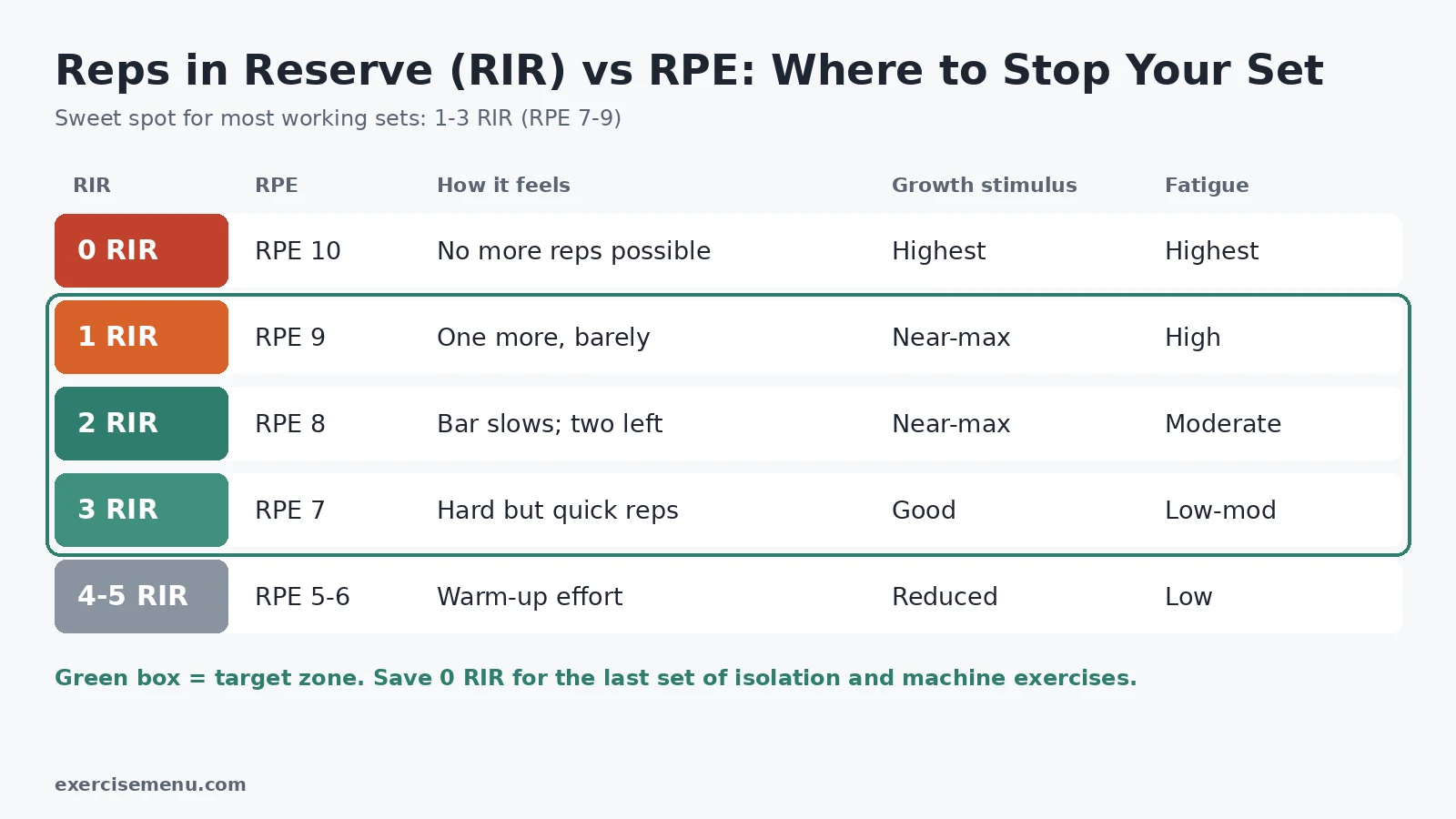
File name: reps-in-reserve-rir-rpe-chart.webp | Alt text: “reps in reserve RIR and RPE chart for training to failure”
The sweet spot for most working sets is 1–3 RIR (RPE 7–9). Our RPE vs RIR guide covers how to use either scale in your log.
Why you misjudge your RIR — and how to fix it
A 2022 meta-analysis in *Sports Medicine* (Halperin et al.) found lifters underpredict their reps to failure by about one rep on average. Accuracy improves near the end of a set, with heavier loads, and in sets of 12 reps or fewer.
Three ways to calibrate:
- Test once every 3–4 weeks. Take one set of a machine exercise to true failure. Count the reps where speed dropped — that’s your personal “2 RIR” signal.
- Make your guess late. Judge RIR on the last 2–3 reps, not at the start of the set.
- Use lower rep ranges for calibration. RIR estimates are more accurate at 5–12 reps than at 15–30.
Should you train to failure every set?
No. Failure on every set lowers the reps you get on later sets, increases recovery needs, and adds little extra growth. If you do 3 sets of curls with 10 reps at failure, you might get 10, 7, 5. Stopping at 2 RIR might give 8, 8, 7 — more total quality reps with less fatigue.
The better pattern:
- Sets 1 to second-last: 1–3 RIR
- Last set of an isolation or machine exercise: 0 RIR (failure)
- Heavy compound sets: 2–3 RIR, always
If you hit failure by accident on a compound lift — say you miss a rep on bench — don’t panic. Drop the next set’s load by 5–10% or reduce the reps by two, and finish the workout as planned.
Which exercises are safe for training to failure?
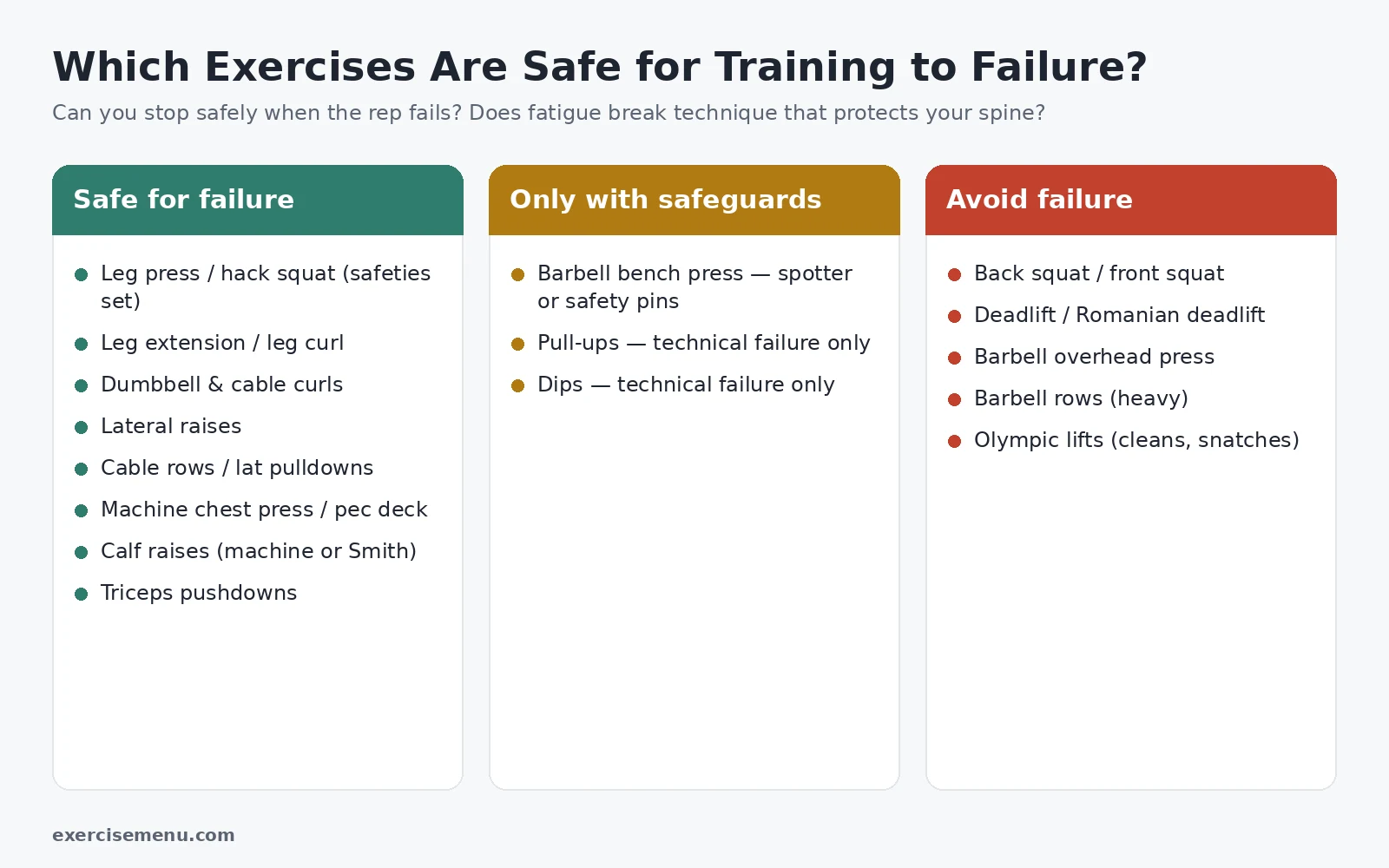
Safety depends on two questions: can you stop safely when the rep fails, and does fatigue break down a technique that protects your spine or joints?
| Exercise | Safe for failure? | Why |
| Back squat / front squat | ❌ No | Spinal loading; depth and bracing break down; risk of getting pinned |
| Deadlift / Romanian deadlift | ❌ No | Lower back rounds under fatigue; high systemic fatigue |
| Barbell overhead press | ❌ No | Lower-back hyperextension as you fatigue; balance demand |
| Barbell bench press | ⚠️ Only with spotter or safety pins | The bar can pin you on your chest |
| Pull-ups / dips | ⚠️ Technical failure only | Form turns into swinging; shoulder strain on dips |
| Leg press / hack squat | ✅ Yes, with safety stops set | Fixed path; easy to rack |
| Leg extension / leg curl | ✅ Yes | Single joint; low risk |
| Dumbbell / cable curls | ✅ Yes | Light load; easy to drop |
| Lateral raises | ✅ Yes | Light load; good for partials |
| Cable rows / lat pulldowns | ✅ Yes | Stack returns safely |
| Machine chest press / pec deck | ✅ Yes | Guided path; no pin risk |
| Calf raises (machine or Smith) | ✅ Yes | Isolation; strongest past-failure research |
The pattern: isolation and machine work is failure-friendly; free-weight compounds aren’t. See compound vs isolation exercises for how to split your workout between them.
How to train to failure safely without a spotter
- Set the safety pins of a squat rack or bench at just below your bottom position.
- Use the Smith machine — rotate the hooks to rack the bar at any point.
- Swap barbell for dumbbells on presses — you can drop them to the side.
- Use machines for the failure set and keep barbells for 2–3 RIR work.
- Never collar a bench bar alone — without collars you can tilt plates off if pinned.
How often should you train to failure?
Most lifters do best with 1–2 failure sets per muscle group per session, on isolation or machine exercises only. Your weekly limit depends on how often you train each muscle: the more frequent your sessions, the fewer failure sets each one can handle.
| Split | Sessions per muscle per week | Failure sets per muscle per session | Notes |
| Full body, 3x/week | 3 | 0–1 | Recovery windows are short |
| Upper/lower, 4x/week | 2 | 1–2 | The best fit for most people |
| Push/pull/legs, 6x/week | 2 | 1 | High weekly volume — keep failure limited |
| Bro split, 5x/week | 1 | 2–3 | A full week to recover |
Failure work raises fatigue markers for at least 48 hours (Vieira et al. 2022). If you train a muscle again sooner, keep that session’s failure sets to zero.
Also cycle intensity over weeks. Run 3–5 weeks pushing RIR down from 3 to 0, then take a deload week at 4–5 RIR with about half the sets. That’s the same logic behind most periodized programs: earn the hardest week, then recover from it.
A sample week with failure sets (upper/lower, 4 days)
Every RIR target below applies to the last set. Earlier sets run 1 RIR higher.
Day 1 — Upper (strength focus)
| Exercise | Sets × reps | Last-set RIR |
| Barbell bench press | 4 × 5–6 | 2 |
| Chest-supported row | 3 × 6–8 | 2 |
| Seated dumbbell shoulder press | 3 × 8 | 2 |
| Lat pulldown | 3 × 10 | 1 |
| Cable curl | 2 × 12 | 0 (failure) |
Day 2 — Lower (strength focus)
| Exercise | Sets × reps | Last-set RIR |
| Back squat | 4 × 5 | 3 |
| Romanian deadlift | 3 × 8 | 3 |
| Leg press | 3 × 10 | 1 |
| Seated calf raise | 3 × 12 | 0 + lengthened partials |
Day 3 — Upper (hypertrophy focus)
| Exercise | Sets × reps | Last-set RIR |
| Incline dumbbell press | 3 × 8–10 | 2 |
| Cable row | 3 × 10–12 | 1 |
| Machine chest press | 2 × 12 | 0 (failure) |
| Lateral raise | 3 × 15 | 0 + partials |
| Triceps pushdown | 2 × 12–15 | 0 (failure) |
Day 4 — Lower (hypertrophy focus)
| Exercise | Sets × reps | Last-set RIR |
| Hack squat or leg press | 3 × 10 | 2 |
| Hip thrust | 3 × 10 | 2 |
| Leg extension | 2 × 12–15 | 0 (failure) |
| Lying leg curl | 2 × 12 | 0 (failure) |
That’s 8–9 failure sets per week, all on safe exercises. The heavy compounds stay at 2–3 RIR so you can keep adding weight. Rest 2–3 minutes after compound sets and 60–90 seconds after isolation sets — our guide on how long to rest between sets explains why.
Who should (and shouldn’t) train to failure?
Beginners (0–6 months): Stay at 3–5 RIR for the first 3 months. You’ll grow well because almost any stimulus is new. From months 4–6, move to 1–3 RIR and try technical failure on the last set of one isolation exercise per workout. Good starters: dumbbell curls, leg extensions, cable pushdowns, machine chest press, machine calf raises.
Intermediate and advanced lifters: Failure on isolation work becomes more useful as gains slow. Use it on the last set and track whether those reps go up week to week.
Returning after a long break: Don’t go to failure in your first 2–3 weeks back. Detrained muscles suffer far more soreness from hard sets, and your strength usually returns faster than your connective tissue adapts.
Adults over 50: Near-failure training still builds muscle, but recovery takes longer. Use 2–3 RIR as the default and limit failure to machines.
During a calorie deficit: Keep 2–3 RIR. Failure adds recovery demand at the point when your body has the fewest resources for repair. Focus on keeping your loads the same.
Home and bodyweight training: Failure is more important here, not less. A push-up is a light load for most people, so sets only build muscle when they end near failure.
Anyone with joint pain or a recent injury: Avoid failure on the affected area until you’re cleared by a clinician.
Past failure: partials, drop sets and rest-pause
Once you hit failure, you can extend the set. These techniques add stimulus cheaply on safe exercises — and the research is more nuanced than most guides suggest.
Lengthened partials after failure
Larsen et al. (2025) in *Frontiers in Psychology* had 23 untrained men do calf raises for 10 weeks. One leg stopped at failure. The other continued with partial reps in the stretched position. The partials leg grew 9.6% versus 6.7% — a 0.62 mm extra gain, with 87% more volume load.
But a follow-up study in trained lifters, Larsen et al. (2025) in the *European Journal of Sport Science*, found that doing only lengthened partials from the start (9.5%) grew calves at least as well as full reps followed by past-failure partials (6.7%).
What this means: the extra growth comes from time in the stretched position, not from going beyond failure itself. Lengthened partials after failure work well on calf raises, lateral raises and leg curls. You don’t need them on every set.
Drop sets
Hit failure, cut the weight by 20–30%, and continue without rest. Drop sets give a similar growth stimulus in less time, which helps when your session is short. Our guide to what a drop set is and how it works covers how much weight to drop.
Rest-pause sets
Hit failure, rest 10–20 seconds, then do 2–4 more reps. Repeat once or twice. It packs more hard reps into one set. See our rest-pause sets guide for full protocols.
| Technique | How it works | Best exercises | Evidence | Spotter needed? |
| Lengthened partials | Partial reps in the stretched range after failure | Calf raises, lateral raises, leg curls | Two 2025 studies | No |
| Drop sets | Lower the weight 20–30% and continue | Machines, cables, dumbbells | Moderate | No |
| Rest-pause | 10–20 s rest, then more reps | Most isolation exercises | Moderate | No |
| Forced reps | Partner helps you through the sticking point | Bench, machine press | Limited | Yes |
Training to failure FAQs
Should you train to failure on the last set?
Yes, if it’s a safe isolation or machine exercise. The last set is where failure costs the least, because no later sets of that exercise suffer from the fatigue.
Does training to failure make you stronger?
Not more than stopping short. Strength depends on lifting heavy loads and practicing the movement; most strength programs keep heavy sets at 2–4 RIR so bar speed and technique stay high.
Is RPE 10 the same as failure?
Yes. RPE 10 means no more reps were possible (0 RIR), while RPE 9.5 means you could have added a little weight but not another rep.
Does training to failure cause more soreness?
Usually, yes. Failure sets produce more muscle damage, so soreness 24–72 hours later tends to be greater — but soreness itself isn’t a sign of better growth.
Is training to failure bad for your joints?
Not on isolation exercises with good form. The risk comes from compound lifts where fatigue changes bar path or spine position, so keep failure off heavy squats, deadlifts and overhead presses.
How do you know you’re overdoing failure training?
Watch for the same weights feeling heavier for two or more weeks, falling rep counts, poor sleep and lingering joint aches. Drop to 3–4 RIR for a week, then add failure back on fewer sets.
The bottom line
Train close to failure, not always to it. Keep compounds at 2–3 RIR and take the last set of your isolation and machine work to failure. Then track your reps: if failure-set reps rise week to week, the approach is working.
If you have an injury, joint pain or a medical condition, check with your doctor or a physiotherapist before training to failure.

2 Comments
Pingback: How to Calculate Your 1RM (One Rep Max Calculator + Formula)
Pingback: Hypertrophy vs Strength: Which to Pick (2026 ACSM Update)