

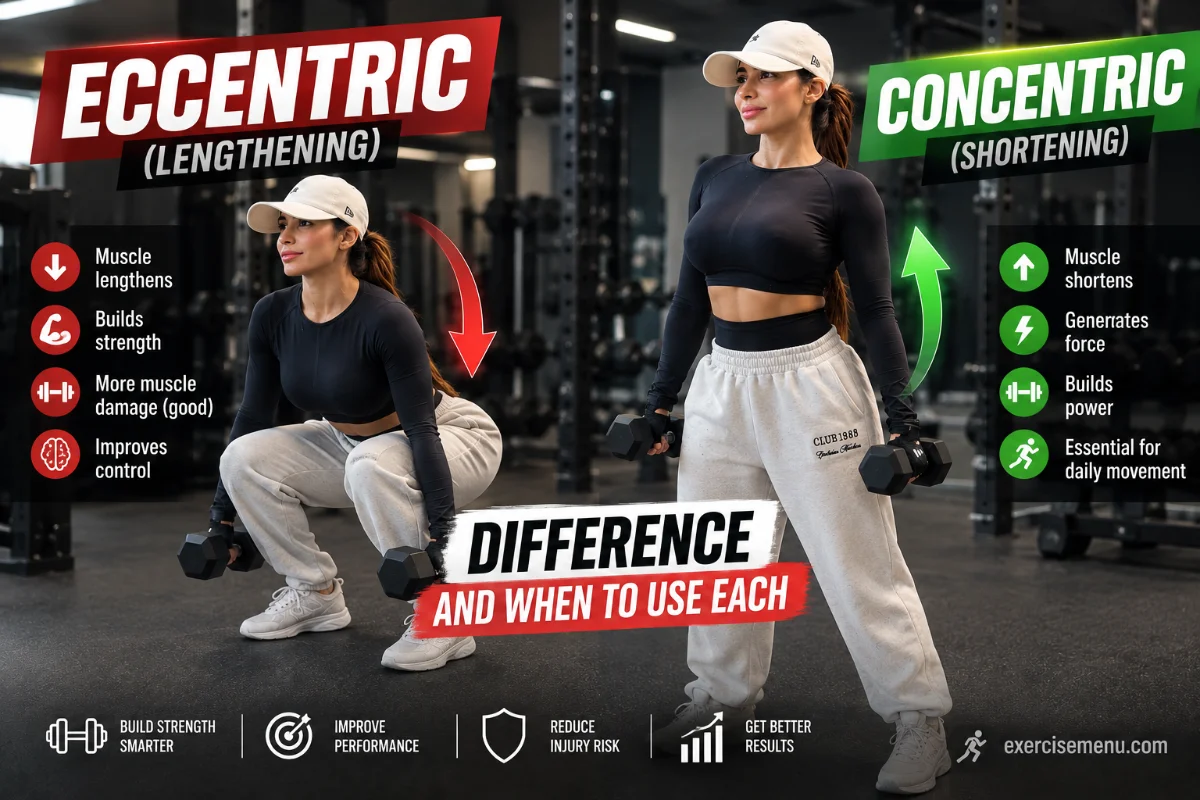
Quick Answer: Eccentric contractions lengthen the muscle under load. Concentric contractions shorten it. Your muscles produce 20 to 40% more force eccentrically. Every rep includes both phases, but emphasizing one over the other changes the stimulus. Eccentrics favor muscle growth and tendon health. Concentrics favor power and faster recovery.
Every time you lower a dumbbell, sit into a squat, or control a pull-up on the way down, your muscles are working while getting longer. Every time you curl the weight up, drive out of the squat, or pull your chin over the bar, those same muscles are working while getting shorter. Same muscles, same exercise, two completely different types of contraction doing two different jobs.
Most people rush through one of these phases (usually the lowering) without realizing it produces a different stimulus than the other. Understanding the difference between eccentric and concentric contractions changes how you approach every set, because it tells you where the muscle-building signal is strongest and where you are leaving results on the table.
- What Are Eccentric and Concentric Contractions?
- Why Can You Lower More Weight Than You Can Lift?
- Does the Eccentric or Concentric Phase Build More Muscle?
- Exercises That Emphasize the Eccentric Phase
- Exercises That Emphasize the Concentric Phase
- When to Emphasize Eccentric Training?
- When to Emphasize Concentric Training?
- Frequently Asked Questions
- Your Next Step
What Are Eccentric and Concentric Contractions?
Three types of muscle contraction exist. Every exercise involves at least two of them.
| Contraction Type | What the Muscle Does | Example (Bicep Curl) |
|---|---|---|
| Eccentric | Lengthens under load | Lowering the dumbbell back down |
| Concentric | Shortens under load | Curling the dumbbell up |
| Isometric | Holds position under load | Pausing mid-curl with the elbow at 90 degrees |
One point most explanations miss: during any exercise, different muscles are in different contraction phases at the same time. When you lower into a squat, your quadriceps are lengthening eccentrically while your hamstrings are shortening concentrically to help control the descent. The same rep involves both contraction types across different muscle groups simultaneously.
This matters because “eccentric training” does not mean only your target muscle is working eccentrically. It means the exercise is structured so the eccentric demand on the target muscle is the primary stimulus.
Why Can You Lower More Weight Than You Can Lift?
Your muscles can produce 20 to 40% more force during an eccentric contraction than a concentric one. Franchi, Reeves, and Narici (2017) confirmed in a comprehensive review published in Frontiers in Physiology that eccentric actions generate greater force than both isometric and concentric contractions, and they do it at a lower metabolic cost.
Two mechanisms explain this. During concentric contractions, force comes entirely from actin-myosin cross-bridges in the muscle fibers, which requires significant energy. During eccentric contractions, structural proteins, particularly titin, contribute passive force on top of the cross-bridge force. You get more total force with less energy expenditure.
This is why you can control a heavy barbell on the way down in a bench press but cannot push it back up. The eccentric capacity exceeds the concentric capacity by a wide margin. That gap is also why eccentric-focused training (using loads closer to your eccentric maximum) creates a unique stimulus your muscles do not experience during standard concentric-focused lifting.
Does the Eccentric or Concentric Phase Build More Muscle?
Both build muscle, but through different pathways.
Eccentric contractions create greater mechanical tension and more microscopic fiber damage per rep. Concentric contractions generate more metabolic stress (the “burn” from lactate and hydrogen ion accumulation). When total training volume and effort are matched, overall muscle size gains are similar between the two.
The structural difference matters more than the size difference. Franchi et al. found that eccentric-dominant training tends to increase fascicle length (longer muscle fibers), while concentric-dominant training tends to increase cross-sectional area (thicker fibers). Both are hypertrophy, but the architecture adapts differently depending on which phase dominates the training.
For most people: control the eccentric, drive the concentric. That combination covers both pathways without overcomplicating your programming. If you want to manipulate the speed of each phase more precisely, the time under tension guide covers tempo programming in detail.
Exercises That Emphasize the Eccentric Phase
These exercises place the primary demand on the muscle while it lengthens.
| Exercise | How It Emphasizes Eccentric | Best For |
|---|---|---|
| Nordic hamstring curl | You resist your bodyweight falling forward using only your hamstrings. The concentric phase is often assisted (push off the floor to return). | Hamstring strength, injury prevention |
| Slow-negative pull-up | Jump or step to the top position, then lower yourself for 3 to 5 seconds. | Building toward a full pull-up, lat development |
| Eccentric Romanian deadlift | Lower the bar for 4 to 5 seconds, then use a normal speed to return. | Hamstring and posterior chain growth |
| Slow-descent goblet squat | 4 to 5 second lowering with controlled depth, normal speed up. | Quad development, depth control |
The Nordic hamstring curl stands out from this list. Research shows that eccentric hamstring training can reduce hamstring injury rates by up to 70% in athletes (Islam et al. 2024, International Journal of Human Movement and Sports Sciences). No other single exercise has that level of injury prevention evidence behind it.
Exercises That Emphasize the Concentric Phase
These exercises produce the majority of their training effect through muscle shortening.
| Exercise | How It Emphasizes Concentric | Best For |
|---|---|---|
| Sled push | Pure concentric, zero eccentric component. The sled stops when you stop pushing. | Conditioning, leg strength without soreness |
| Jump squat | Explosive upward drive is the training stimulus. Landing is brief and reactive. | Lower-body power, fast-twitch fiber recruitment |
| Kettlebell swing | The hip extension that drives the bell is concentric. The backswing involves minimal eccentric demand on the glutes. | Hip power, metabolic conditioning |
| Box jump (step down) | Jump up explosively, step down to eliminate eccentric landing stress. | Explosive power with minimal DOMS |
The sled push is unique because it produces almost no delayed onset muscle soreness. Without an eccentric phase, there is minimal muscle fiber damage, which means faster recovery and the ability to train legs at higher frequency without accumulated soreness.
When to Emphasize Eccentric Training?
Eccentric-focused training is most useful when:
You have plateaued on load progressive overload. Adding a slow eccentric phase increases the stimulus per rep without requiring more weight on the bar. This is a form of progression that works when adding plates is no longer feasible every week.
You want to strengthen tendons, not just muscles. Tendons adapt to eccentric loading more effectively than concentric. Eccentric calf raises for Achilles tendon issues and Nordic curls for hamstring tendons are two of the most research-supported applications.
You are in a rehab setting. When heavy concentric loading is not possible due to injury, eccentric loading at submaximal weights maintains muscle stimulus with lower joint stress.
When NOT to emphasize eccentrics:
If you train the same muscle group three or more times per week, heavy eccentric emphasis will create more DOMS than your recovery window allows. Eccentric training also has a higher recovery cost than concentric, so during a peaking phase before competition or a planned high-frequency training block, reducing eccentric emphasis protects performance.
Beginners who have not yet mastered the basic movement pattern should focus on controlling both phases equally before deliberately slowing one down.
When to Emphasize Concentric Training?
Concentric-focused training fits these situations:
Power and speed development. Explosive sports demand fast muscle shortening. Jump squats, cleans, throws, and sprints are concentric-dominant for a reason: the concentric phase is where athletic output happens.
Strength specificity. If your goal is a heavier squat, bench, or deadlift, the concentric phase is what gets tested. Eccentric training builds capacity, but practicing the concentric portion with heavy loads builds the specific skill of lifting maximal weight. Competitors and strength athletes should keep their primary lifts concentric-focused and use eccentric emphasis only on accessories.
High-frequency training blocks. If you train the same muscle group three to four times per week, reducing eccentric stress (faster lowering, sled work, box jumps with step-downs) lets you maintain high frequency without compounding soreness.
Deload periods. Concentric-focused training during a deload maintains stimulus while reducing the recovery debt that heavy eccentrics accumulate.
Older adults or soreness-sensitive populations. Eccentric DOMS can be severe in people unaccustomed to it. Concentric-dominant exercises allow productive training with less post-session discomfort.
Frequently Asked Questions
Is the eccentric phase the same as “negatives”?
Yes. “Negatives” is the gym term for eccentric-only reps where you lower a weight slowly, usually at a load heavier than you could lift concentrically. A spotter or machine assists the concentric phase so you can focus entirely on resisting the load during the descent.
Should beginners focus on eccentric or concentric training?
Neither in isolation. Beginners should focus on performing both phases with control and consistent form. That means lowering the weight deliberately (not dropping it) and lifting with intention (not using momentum). Deliberate eccentric or concentric emphasis is a tool for intermediate and advanced trainees.
Can eccentric training help with tendinitis?
Eccentric loading is one of the most researched interventions for tendon issues, particularly patellar tendinopathy and Achilles tendinopathy. Slow eccentric calf raises and eccentric single-leg squats are commonly prescribed by physiotherapists. Consult a professional before starting if you have an active tendon condition.
Why do eccentric exercises cause more soreness?
Eccentric contractions produce more microscopic damage to muscle fibers than concentric contractions. That damage triggers the repair-and-rebuild process, but the byproduct is delayed onset muscle soreness (DOMS) that typically peaks 24 to 48 hours after training. Soreness decreases over 2 to 3 weeks as your muscles adapt through the repeated bout effect.
What is eccentric overloading and should I try it?
Eccentric overloading (also called accentuated eccentric loading) uses a heavier load on the lowering phase than you could lift concentrically. A 2018 meta-analysis by Buskard et al. found that supramaximal eccentric training was not more effective than traditional loading for improving 1RM in the lower body. For most lifters, controlling a moderate-to-heavy eccentric at normal training loads is sufficient. Supramaximal eccentrics are an advanced tool with higher injury risk and limited proven advantage over standard training.
Your Next Step
You do not need to choose one phase over the other for most of your training. Control the eccentric, drive the concentric, and you cover both stimuli in every rep. When you have a specific reason to emphasize one, the tables above tell you which exercises to reach for and when that emphasis makes sense. Start with one eccentric-focused exercise and one concentric-focused exercise per week and see what changes.
