Key Takeaways
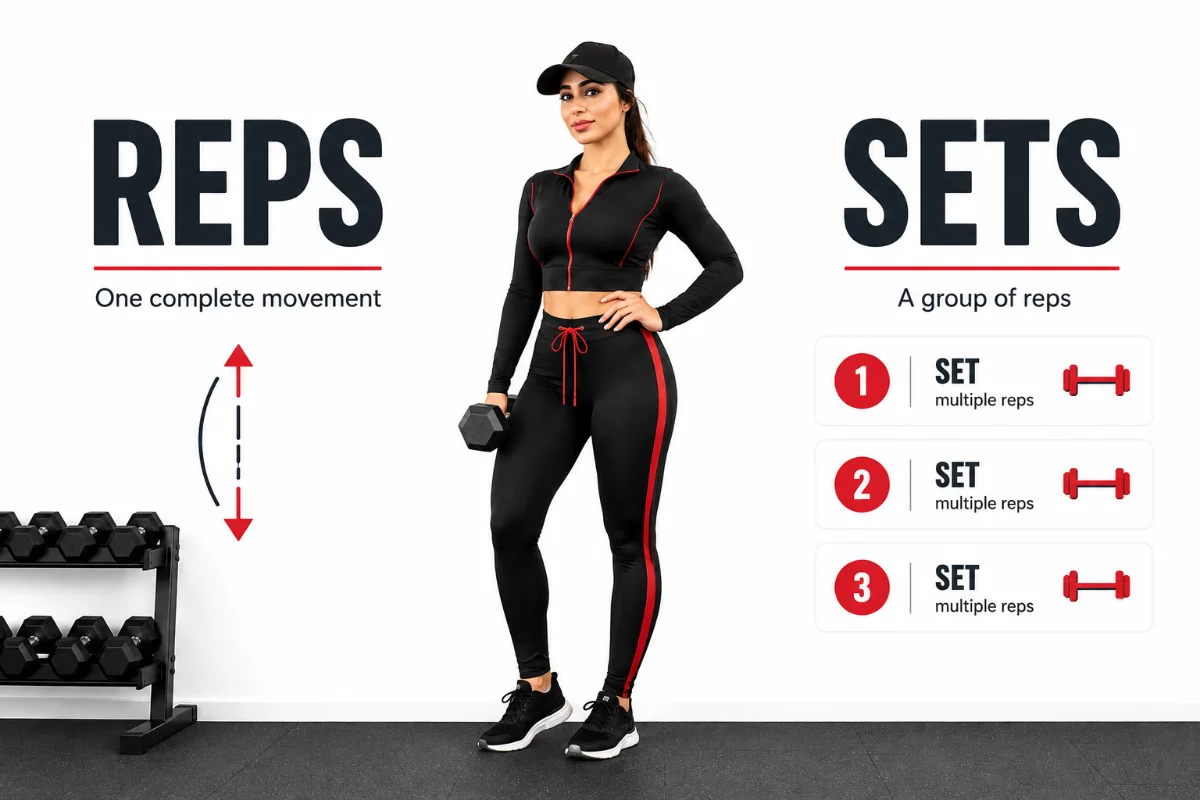
- A rep is one complete movement of an exercise. A set is a group of consecutive reps without rest. Everything in resistance training builds from these two variables.
- Rep ranges directly determine your result: 1–6 reps builds strength, 6–12 builds muscle, 15+ builds endurance — and the science behind each is distinct.
- Rest periods are a training variable, not a break. Cutting them short changes what your body adapts to.
- Progressive overload — not just showing up — is what makes reps and sets actually produce results over time.
- Your final 2–3 reps should require genuine effort. If the last rep feels easy, the weight isn’t doing anything.
If you’ve ever looked at a workout program and seen “4 sets of 10 reps” without knowing what that actually means for your body — you’re in the right place.
I’ve been coaching clients for 7+ years at Exercise Menu, and in that time I’ve worked with over 257 people at every level — complete beginners who’ve never touched a weight, intermediate lifters stuck in a plateau for months, and athletes who needed to restructure their training around a specific goal. Across all of them, the same confusion shows up in the first session: they know the numbers, but they don’t know what those numbers are supposed to do.
That’s what this guide is for. Not just definitions — but why these two variables control everything about how your body responds to training, and how to use them precisely for the result you’re actually after.
What Exactly Are Reps and Sets?
At the most basic level, resistance training comes down to two variables. Get them right and your body changes. Get them wrong and you put in months of effort without meaningful progress.
What Is a Rep?

A rep — short for repetition — is one complete movement of an exercise from start to finish and back again.
- Lower into a squat and stand back up → 1 rep
- Curl a dumbbell up and lower it back down → 1 rep
- Go down in a push-up and press back up → 1 rep
The key word is complete. A half-squat isn’t a rep. A partial push-up isn’t a rep. Each rep must travel through the full range of motion, because cutting it short reduces the muscle activation you’re after. The research on this is clear — studies published in the Journal of Strength and Conditioning Research consistently show that full range-of-motion training produces significantly greater muscle growth than partial-range work.must travel through the full range of motion — because cutting it short reduces muscle activation.
What Is a Set?

A set is a group of consecutive reps performed without resting.
- 10 squats in a row, then you stop → 1 set of 10 reps
- Do it again after rest → your 2nd set
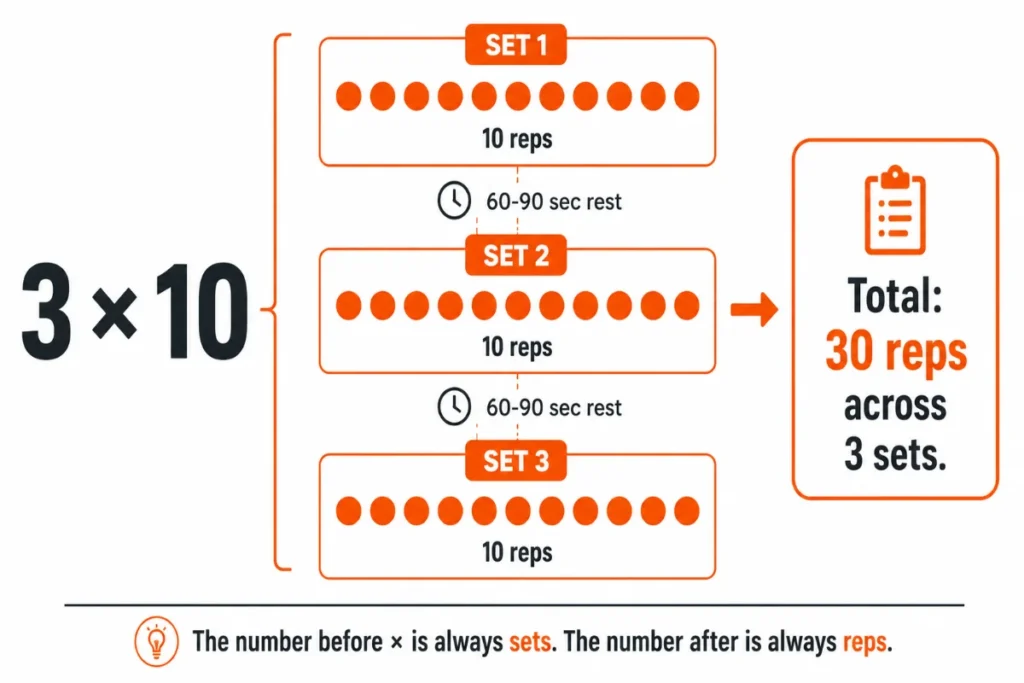
- One more → 3 sets of 10 reps, written as 3×10
That notation — sets × reps — is the universal shorthand used in every gym and every program on earth. Once you know it, every workout you’ll ever read makes immediate sense.
The 3 phases of a rep (why form matters more than weight)
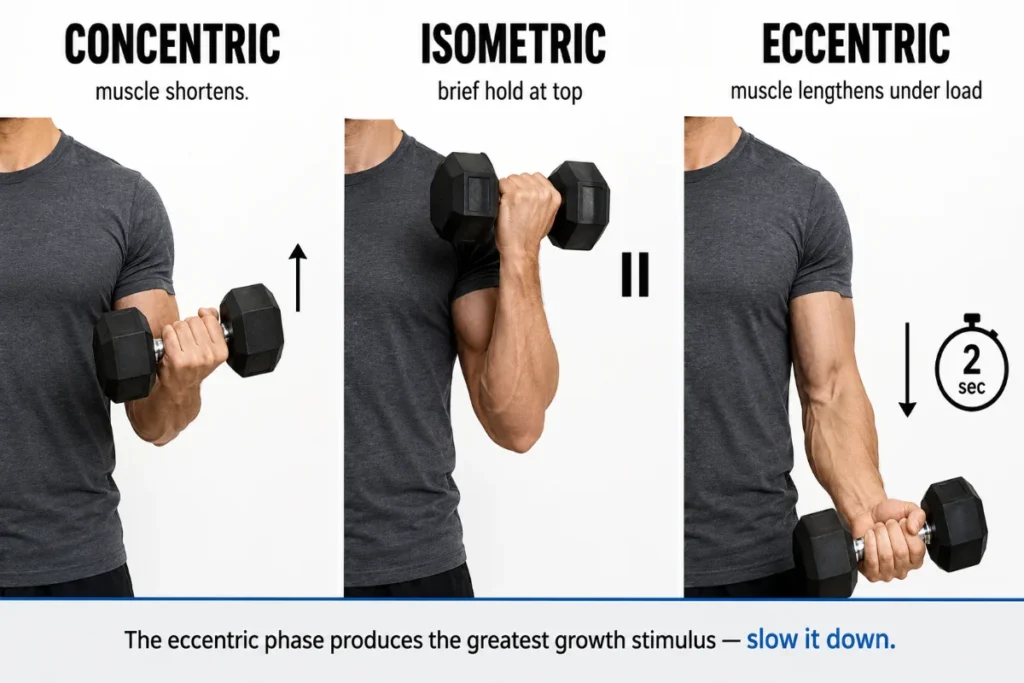
Most beginners focus only on the lifting phase. But a rep has three distinct phases, and understanding all three changes what you get from every set:
- Concentric phase (lifting): The muscle shortens as it produces force — the “up” part of a curl, the “push” of a bench press.
- Isometric phase (pause): A brief hold at the peak contraction. Even a half-second pause here increases muscle activation.
- Eccentric phase (lowering): The muscle lengthens under load — the controlled lowering. This is where significant muscle damage and growth stimulus comes from.
Most lifters rush the lowering phase. That’s a mistake. Research by Dr. Brad Schoenfeld, widely considered the leading authority on hypertrophy, shows that eccentric training produces greater muscle growth per unit of effort than concentric work alone. Slowing your lowering phase by just two seconds per rep changes what that set does to your muscle.
I see this constantly with new clients. They’re focused entirely on getting the weight up, and barely controlling the way down. Once we fix just the eccentric, their muscles respond faster without adding a single extra set.
Are reps or sets more important?
Neither one in isolation. They work together to create your total training stimulus.
Two workouts can have identical total reps but produce completely different results depending on how those reps are structured through sets, load, and rest. The combination is what matters — not either number alone.
How Reps and Sets Affect Your Muscles? The Science Explained

Before you start assigning numbers to your training, it helps to understand why different rep ranges produce different results. This is what separates lifters who make consistent progress from those who do the same workout for years and wonder why nothing changes.
Training volume is the primary driver of muscle growth
Training volume — calculated as sets × reps × weight — is the key variable behind long-term hypertrophy. A 2017 dose-response meta-analysis by Schoenfeld, Ogborn, and Krieger in the Journal of Strength and Conditioning Research found a clear relationship: more weekly volume produces more growth, up to the point where recovery can’t keep up.
That upper limit is where most people who plateau are living — either not doing enough, or doing so much that recovery suffers. Programming reps and sets correctly means finding that productive threshold and staying just above it over time.
Time under tension — why rep speed changes everything
Time under tension (TUT) refers to how long a muscle is under load during a set. A set of 10 reps where you take 2 seconds to lift and 3 seconds to lower creates far more stimulus than 10 rushed reps done in half the time — even with the same weight.
For muscle growth, it’s not just the weight. It’s how long the muscle is working at a high level of tension. Tempo manipulation — specifically controlling the eccentric — is one of the most underused tools in most training programs.
If you want to understand how to apply specific tempo codes and time under tension to your training, we’ve covered that in full detail in our guide on time under tension and rep tempo.
How your CNS responds to different rep ranges
Your central nervous system and your muscles respond to load very differently — and this is one of the more important things to understand if you’ve been training for any length of time.
Heavy, low-rep work in the 1–5 range trains your CNS to fire more motor units simultaneously. That’s why strength athletes get dramatically stronger without always looking bigger — their nervous system has learned to recruit more of what’s already there. This is called neural adaptation, and it’s the primary mechanism behind early strength gains in anyone who starts lifting.
Higher rep ranges — 12 and above — work through a different pathway: metabolic stress, muscle damage, and lactate accumulation. Neither approach is complete on its own.
Understanding exactly how your central nervous system responds to each rep range is worth reading if you’re designing your own program.
What is DOMS, and does it mean you trained well?
DOMS — delayed onset muscle soreness — is the muscle stiffness and soreness that peaks 24–72 hours after a workout. It’s caused by microtrauma to muscle fibers, particularly from eccentric loading.
DOMS is not a reliable indicator of training quality. You can have an excellent session with minimal soreness, particularly once your body adapts to a consistent movement pattern. Chasing soreness is not a training strategy — progressive overload is. I’ve had clients who were never sore and made exceptional progress, and others who were constantly sore and barely moved their lifts.
How many reps and sets for your specific goal
The NSCA and the American College of Sports Medicine define distinct rep and set prescriptions for each training goal. These benchmarks form the foundation of every prescription below.
Most beginners I work with are either doing 3×10 on everything because they read it somewhere, or they’re copying a bodybuilder split from YouTube. Neither is wrong, but neither is matched to a specific goal. The first thing I do with any new client is match their rep range to what they’re actually trying to achieve.
How many reps and sets for muscle growth (hypertrophy)?
6–12 reps, 3–5 sets, 1–3 minutes rest. Use a weight that brings you genuinely close to failure by the last 2 reps.
This range produces the optimal combination of mechanical tension, metabolic stress, and muscle damage — the three primary hypertrophic stimuli identified in Schoenfeld’s mechanistic review. In practice, pick a weight where rep 10 feels genuinely hard. Not impossible, but not comfortable either. That’s the zone where growth happens.
A complete breakdown of why this range works and how to structure it week by week is in our guide on how many reps and sets for muscle growth.
How many reps and sets for strength?
1–6 reps, 3–5 sets, 2–5 minutes rest. Load should be heavy enough that you couldn’t complete more than 1–2 extra reps with good form.
The extended rest isn’t optional. Your muscles rely on creatine phosphate as the primary energy source for heavy lifting, and those stores need 3–5 minutes to replenish to near-full capacity. Cut that short and every set after the first is performed partially fatigued — which means less neural drive, less strength stimulus, and slower progress.
Compound movements — squats, deadlifts, bench press, overhead press — are the foundation here because they allow the heaviest loads across the most total muscle mass.
How many reps and sets for fat loss?
8–12 reps, 3–4 sets, 30 seconds to 2 minutes rest. Combined with a calorie deficit and 2–3 cardio sessions per week.
The most important thing to understand about training during a cut: your primary job in the gym is to preserve muscle, not burn calories. Calories are managed through diet and cardio. Resistance training signals to your body that the muscle is still needed — so it burns fat for fuel instead of breaking down muscle tissue.
I’ve seen this go wrong more times than I can count. Someone cuts calories hard, adds cardio, then halves their training volume thinking they’re being efficient. Three months later they’re lighter but they look worse — because they lost muscle alongside the fat. One client came to me after a failed 12-week cut where she’d done exactly this. We restored her training volume, set her deficit at a conservative 300 calories per day, and added a protein target of 0.8g/lb bodyweight. She lost 11 lbs of fat over 14 weeks while maintaining every major lift. That’s what protecting training volume during a cut actually looks like.
For a complete breakdown of how to structure resistance training specifically for fat loss, read our guide on how many reps and sets for fat loss.
How many reps and sets for muscular endurance?
15+ reps, 2–4 sets, 20–60 seconds rest with loads typically under 67% of your 1RM.
This is relevant for athletes who need muscles to sustain repeated contractions over time — runners, cyclists, swimmers, and team sport athletes. It improves both cardiovascular efficiency and local muscular endurance, but it won’t produce significant strength or size gains when used exclusively.
Full programming details for endurance-focused training are in our guide on how many reps and sets for muscular endurance.
How many reps and sets for maintenance?
8–12 reps, 3–4 sets — same range as hypertrophy, but you don’t need to train as close to failure. You need just enough stimulus to tell your body the muscle is still being used. Useful during busy periods, travel, or extended calorie deficits when full hypertrophy programming isn’t sustainable.
Rep and set ranges at a glance
| Goal | Reps | Sets | Rest |
|---|---|---|---|
| Strength | 1–6 | 3–5 | 2–5 min |
| Hypertrophy (muscle growth) | 6–12 | 3–5 | 1–3 min |
| Fat loss | 8–12 | 3–4 | 30s–2 min |
| Muscular endurance | 15+ | 2–4 | 20–60s |
| Maintenance | 8–12 | 3–4 | 1–2 min |
Not sure what these numbers look like in an actual workout? Our guide on what 3×10, 4×12, and 5×5 mean in a workout walks through exactly which notation suits which goal.
Goal-specific sample workouts
Numbers are only useful when you know what to do with them. Here are three ready-to-use gym workout structures built around the rep and set prescriptions above.
Muscle growth (3 days per week, full body)
| Exercise | Sets | Reps | Rest |
|---|---|---|---|
| Barbell squat | 4 | 8–10 | 90 sec |
| Dumbbell bench press | 4 | 8–10 | 90 sec |
| Barbell row | 3 | 10–12 | 90 sec |
| Romanian deadlift | 3 | 10–12 | 90 sec |
| Overhead press | 3 | 8–10 | 90 sec |
| Cable curl | 3 | 10–12 | 60 sec |
| Tricep pushdown | 3 | 10–12 | 60 sec |
Strength (3–4 days per week, upper/lower)
| Exercise | Sets | Reps | Rest |
|---|---|---|---|
| Barbell squat | 5 | 4–5 | 3–4 min |
| Deadlift | 4 | 3–5 | 4–5 min |
| Bench press | 5 | 4–5 | 3–4 min |
| Bent-over barbell row | 4 | 4–5 | 3–4 min |
| Overhead press | 4 | 4–5 | 3 min |
Fat loss (3 days per week, full body)
| Exercise | Sets | Reps | Rest |
|---|---|---|---|
| Goblet squat | 3 | 10–12 | 60 sec |
| Dumbbell bench press | 3 | 10–12 | 60 sec |
| Seated cable row | 3 | 10–12 | 60 sec |
| Hip thrust | 3 | 12–15 | 60 sec |
| Dumbbell shoulder press | 3 | 10–12 | 60 sec |
| Walking lunges | 3 | 12–15 per leg | 60 sec |
Combine the fat loss workout with 2–3 cardio sessions per week and a moderate calorie deficit. Don’t reduce training volume unless you absolutely have to.
How long should you rest between sets?
Rest periods are a training variable, not downtime. The length of your rest directly determines how much you can lift in your next set and what adaptation your body makes.
Strength training (3–5 minutes): Creatine phosphate stores — the fuel for maximal lifting — replenish to roughly 95% after 3–5 minutes. Rest less than that before a heavy set and your output drops, which means less strength stimulus.
Muscle growth (1–2 minutes): This window keeps metabolic stress elevated while allowing enough recovery to maintain load quality across all sets. Rest longer than 3 minutes for hypertrophy work and you reduce the metabolic stimulus without meaningful benefit.
Fat loss (30–60 seconds): Shorter rest keeps heart rate elevated and increases caloric expenditure during the session. The tradeoff is lighter weights — which is acceptable, because muscle preservation is the goal during a cut.
| Goal | Rest period |
|---|---|
| Strength | 3–5 minutes |
| Muscle growth | 1–2 minutes |
| Fat loss | 30–60 seconds |
| Endurance | 20–60 seconds |
How many reps and sets for beginners?
Start with 3 sets of 8–12 reps per exercise at a moderate weight. Focus entirely on learning movement patterns before you chase heavier loads.
The most common beginner mistake isn’t doing too little — it’s doing too much, too soon. Week-one enthusiasm leads to week-three burnout. I always tell new clients: start at the lower end of every range, build the habit first, then add volume as your body adapts.
One client — a complete beginner with no previous training experience — followed a simple 3-day full body program at 10–12 sets per muscle per week in the 8–12 rep range. She gained 6 lbs of muscle in her first 16 weeks while losing 4 lbs of fat. The program wasn’t complicated. She just trusted the process and stayed consistent.
For a complete beginner program with exact progressions week by week, read how many reps and sets should a beginner do.
Warm-up sets vs working sets — what counts and what doesn’t
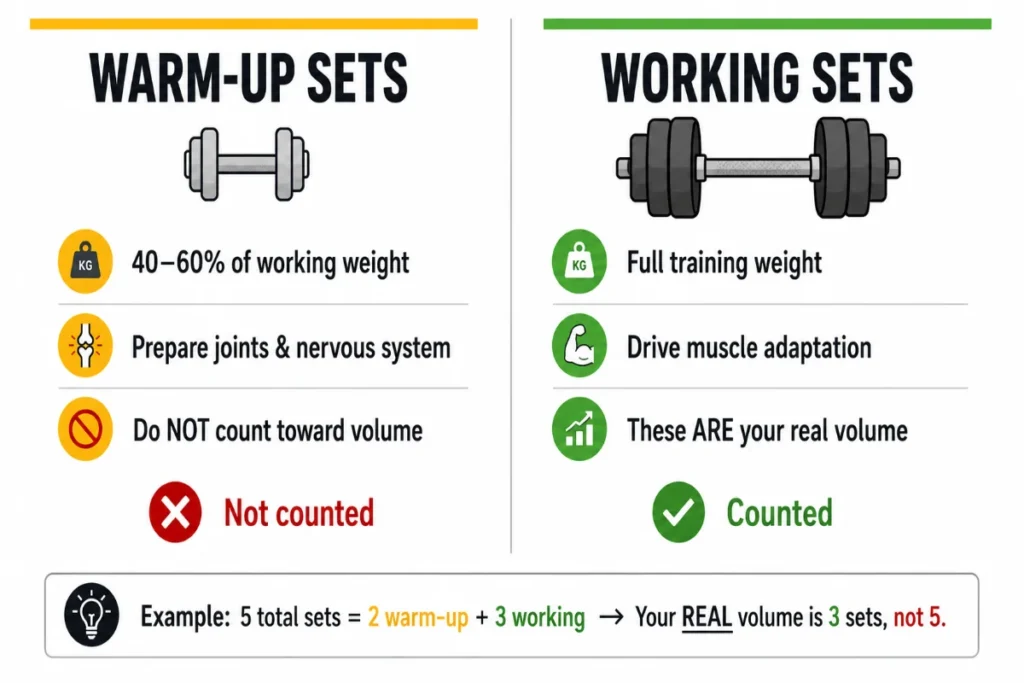
A working set is performed at your target training weight and counts toward your rep and set total. A warm-up set is a lighter set performed beforehand to prepare your joints, muscles, and nervous system for the load ahead.
Warm-up sets don’t count toward your volume. This matters more than most people realize.
One of the first things I check with new clients is how they count their sets. Most are including warm-ups in their total. Once we strip those out and count only working sets, they realize they’re often doing half the effective volume they thought they were — and that explains a lot about why progress has been slow.
A sensible warm-up before squatting 185 lbs: 10 reps with the empty bar, 8 reps at 95 lbs, 5 reps at 135 lbs — then into working sets. Skipping warm-ups entirely is one of the most common reasons beginners underperform their first working set or sustain unnecessary injuries.
For a step-by-step guide on how warm-up and working sets fit together inside a complete session, read our guide on warm-up sets vs working sets.
Reps and sets for women — is it different?
No — the fundamental principles are identical. Muscle adaptation physiology doesn’t differ between sexes in any way that requires different rep ranges.
The concern that heavy lifting causes women to “bulk up” isn’t supported by exercise science. Women have significantly lower testosterone than men, which makes gaining large amounts of muscle mass physiologically difficult regardless of training style. Research from the ACSM consistently shows women respond to resistance training with the same relative strength and hypertrophy gains as men when volume and intensity are matched.
The pattern I notice most with female clients is choosing weights that are too light to create any real adaptation. If you can complete 15 reps easily when your program calls for 10, the weight needs to go up.
| Goal | Reps | Sets | Rest |
|---|---|---|---|
| Muscle tone and definition | 8–12 | 3–4 | 1–2 min |
| Strength | 3–6 | 3–5 | 2–4 min |
| Fat loss | 8–12 | 3–4 | 30–90 sec |
Reps and sets for seniors and older adults
For adults over 50, the principles remain the same but the approach to load progression and recovery requires more care.
Muscle loss with age — sarcopenia — is real and accelerates after 60 if untrained. Resistance training is the most effective tool available to slow it. Older adults benefit from slightly higher rep ranges — 10–15 reps — at moderate loads, which reduces joint stress while still providing enough stimulus for muscle maintenance and growth. Rest periods can be extended to 2–3 minutes even for hypertrophy work.
Weight-bearing resistance exercise in the 8–12 rep range stimulates bone remodeling and helps prevent osteoporosis progression. Compound movements that load the spine and hips — squats, deadlifts, hip thrusts, rows — specifically target the sites most vulnerable to osteoporotic fracture. If you have a diagnosed bone density condition, work with a physical therapist before starting a new program.
Reps and sets without equipment — home workout programming
The same rep and set principles apply to bodyweight training. Challenge comes from exercise selection and rep manipulation rather than external load.
Adjust exercise difficulty to match the rep range for your goal. For strength with bodyweight: choose exercises that limit you to 1–5 reps — archer push-ups, single-leg squats, pike push-ups. For hypertrophy: choose exercises where you reach near-failure at 8–12 reps — standard push-ups, lunges, step-ups, hip thrusts.
Progressive overload still applies. When an exercise becomes too easy, progress to a harder variation or add a weighted backpack.
Sample home workout — muscle growth (3 sets of 10–12 reps, 90 seconds rest):
| Exercise | Sets | Reps |
|---|---|---|
| Push-ups | 3 | 10–12 |
| Bulgarian split squats | 3 | 10–12 |
| Inverted rows (under a table) | 3 | 10–12 |
| Hip thrusts with feet elevated | 3 | 12–15 |
| Pike push-ups | 3 | 8–10 |
Advanced rep and set techniques
Once you have 6–12 months of consistent training, these techniques can break through plateaus and add new stimulus. Use them selectively — not in every session, and not all at once.
Pyramid sets: Change the weight and reps across each set — ascending (heavier weight, fewer reps each set) or descending. An ascending pyramid on bench press: 135 lbs × 12, 155 lbs × 8, 175 lbs × 5. Gradually prepares the nervous system for heavier loads while accumulating volume in earlier sets. We cover exactly how to structure ascending and descending pyramids in our guide on what are pyramid sets.
Supersets: Two exercises back-to-back with no rest between them, followed by rest after both. Most effective when pairing opposing muscle groups — biceps and triceps, chest and back. Supersets cut training time by 30–40% without reducing volume.
Drop sets: Start at your working weight, perform reps to near-failure, then immediately reduce weight by 20–30% and continue to failure again. Most effective on the final set of an isolation exercise. Use once or twice per session — they’re taxing on recovery.
AMRAP sets: AMRAP stands for “as many reps as possible.” On an AMRAP set, you perform reps until failure rather than stopping at a pre-set number. Used strategically on a final set, AMRAP tells you exactly where your strength is relative to a given weight — and creates a natural benchmark for progressive overload the following week.
The 6-12-25 method: A tri-set format where you perform 6 reps of a heavy compound movement, 12 reps of a moderate isolation, and 25 reps of a lighter movement for the same muscle group, all with minimal rest between. Trains multiple rep ranges within one extended set. Effective for experienced lifters who’ve adapted to standard programming.
Progressive overload — the rule that makes reps and sets actually work
Without progressive overload, even a perfectly structured rep and set prescription stops producing results after the initial adaptation period.
Progressive overload means systematically increasing the demand on your muscles over time — through more weight, more reps, more sets, shorter rest, or slower tempo. Your muscles adapt specifically to the stress you give them. Once adapted, the same stress produces no further change.
When a client tells me they’ve been lifting for two years and still look the same, within five minutes of reviewing their training log I almost always find the same thing: their weights haven’t changed in months. They’re comfortable. Comfortable doesn’t build muscle.
The simplest approach: pick a rep range like 8–12. Start at a weight where 8 reps is challenging. Each session, add 1–2 reps until you reach 12 across all sets with clean form. Then increase the weight by 5 lbs and return to 8 reps. This double progression model is consistent enough to produce steady progress for most intermediate lifters and simple enough to track in any logbook.
Should you change your rep and set scheme over time?
Yes — systematically. This is called periodization: the planned variation of training variables over time to prevent adaptation plateaus and reduce injury risk from repetitive stress.
Change your scheme every 4–8 weeks. Changing too frequently prevents the consistent overload needed for adaptation. Staying in one range longer than 12 weeks often leads to a plateau.
A deload week — a planned reduction in training volume and intensity — is recommended once every 4–8 weeks. Reduce sets by 40–50% and drop weight to roughly 60% of your normal load. Signs you need one: persistent joint soreness, strength dropping session to session, or a complete loss of motivation to train.
I had a client training 6 days a week with zero progress. His CNS was fried. We dropped to 4 days, kept the intensity high, and added a mandatory deload every 4th week. He added 25 lbs to his squat and 20 lbs to his bench within 8 weeks. He thought he needed more volume. He needed recovery.
How to calculate your 1RM and use it to set rep ranges?
Your 1RM (one rep max) is the maximum weight you can lift for exactly one rep with good form. Use the Epley Formula to estimate it without attempting a true max:
1RM = Weight × (1 + Reps ÷ 30)
Example: You lift 185 lbs for 8 reps on bench press. 1RM = 185 × (1 + 8 ÷ 30) = approximately 234 lbs.
| Training zone | % of 1RM | Rep range |
|---|---|---|
| Strength | 85–95% | 1–5 reps |
| Hypertrophy | 67–85% | 6–12 reps |
| Endurance | Below 67% | 15+ reps |
A challenging set of 5–10 reps is enough data for the formula — you don’t need to attempt a true 1RM.
The RPE scale (Rate of Perceived Exertion) rates effort from 1–10. RPE 10 means absolute maximum effort. RPE 8 means you had roughly 2 reps left in the tank. RPE-based programming accounts for daily variation — poor sleep, stress, and nutrition all affect performance in ways fixed percentages can’t.
How to calculate weekly volume per muscle group
For muscle growth, research by James Krieger and colleagues supports a range of 10–20 working sets per muscle group per week as the productive volume window for most natural lifters.
- Beginners: 10–12 sets per week per muscle
- Intermediate: 12–18 sets per week per muscle
- Advanced: 16–22 sets per week per muscle
Beyond 20 weekly sets per muscle, most natural lifters see diminishing returns — and often accumulating fatigue that actually suppresses growth. The most common intermediate mistake I see is chasing volume before fixing execution. They’re doing 25 sets per muscle per week but stopping every set 5 reps before failure. When we drop to 12 quality sets and push close to failure, they grow faster than they did at double the volume.
Training splits — how to structure your week
Your weekly training frequency determines how your total volume distributes across sessions. The best split is the one you can recover from and stay consistent with.
Full body (3 days/week): Best for beginners and intermediates. Each session trains all major muscle groups, with 48 hours of recovery between sessions working the same muscles.
Upper/lower (4 days/week): Two upper body sessions, two lower body sessions per week. Allows higher frequency per muscle group while keeping session volume manageable.
Push/pull/legs (5–6 days/week): Each session targets a specific movement pattern or muscle group. Better suited to advanced lifters who can recover from and benefit from that frequency.
Training frequency matters less than most people think, as long as weekly volume is consistent. Research by Schoenfeld and Krieger shows that training a muscle twice per week produces greater hypertrophy than once per week when total volume is equated — but consistency beats optimal frequency every time.
How genetics affect your response to reps and sets
Fast-twitch fibers (Type II) generate high force quickly but fatigue fast — they dominate during heavy, low-rep strength work. Slow-twitch fibers (Type I) generate less force but resist fatigue — they dominate during endurance and higher-rep training.
Your fiber type ratio is largely genetic. To find your personal optimal rep range: run 6 weeks of heavy low-rep training (3–6 reps) on a well-learned exercise and track your progress. Then run 6 weeks of moderate-rep training (8–12 reps) on the same exercise and compare. Most people find one range produces noticeably better results — prioritize that range while keeping some volume in the other for balanced development.
For a deep look at how fiber type affects your training response, we cover the full genetics of fast-twitch vs slow-twitch muscles here.
Reps and sets for specific muscle groups
Legs and glutes: Respond well across a wide range. Heavy compound work — 3–6 reps on squats and deadlifts — combined with higher-rep isolation work — 10–15 reps on leg press, leg curls, and hip thrusts. Glutes in particular respond well to 12–20 reps on hip thrusts with a one-second contraction held at the top.
Back and chest: Both respond well to 6–12 reps on compound movements — bench press, rows, lat pulldowns. For the back, 10–15 reps on isolation movements like face pulls and cable rows develops the smaller stabilizer muscles most lifters underdevelop.
Shoulders and arms: Biceps and triceps respond well to 10–15 reps. The lateral deltoid responds particularly well to high-rep, high-frequency training — 15–20 reps of lateral raises performed 3–4 times per week at moderate weight consistently outperforms heavy, low-rep work on this specific muscle. For a complete breakdown of how to apply these principles to every shoulder and biceps exercise, see our guide on how to train deltoids and biceps with dumbbells.
The mind-muscle connection — why it changes what you get from every rep
The mind-muscle connection refers to your ability to consciously direct attention to the specific muscle you’re training during a rep. A 2018 study in the European Journal of Sport Science found that focusing attention on the target muscle during a set significantly increased muscle activation compared to focusing on the movement itself.
In practical terms: during a bicep curl, if you’re thinking about getting the weight up, you’ll use whatever muscles get it there. If you’re thinking about your bicep contracting through the full range, you activate it more completely. The weight doesn’t need to be heavier — the intent needs to be sharper.
This is why 8 controlled reps with real attention to the target muscle outperforms 20 rushed reps every time. Quality of contraction is a variable most people never consider.
Common mistakes with reps and sets
Weight too light to create adaptation: Your final 2–3 reps should require genuine effort with clean form. If you finish a set of 10 feeling like you had 6 more reps in the tank, the weight isn’t doing anything for you.
Skipping rest periods: Cutting rest short means every set after the first is performed partially fatigued, which reduces the quality of the stimulus. For strength work especially, rushing rest is the fastest way to stall progress.
Never changing rep ranges: Your body adapts specifically to the stress you give it. Same reps, same weight, same workout for months equals no new adaptation after the initial period. Change your scheme every 4–8 weeks.
Volume without intensity: Ten rushed sets stopping far short of failure produce less muscle growth than four deliberate sets taken close to failure. More is not always more — this is the most common intermediate plateau I see.
How to track reps and sets for consistent progress?
Tracking isn’t optional for serious progress. Memory isn’t reliable enough to recall exact weights, reps, and sets across multiple exercises over months of training. If you’re not tracking, you can’t verify that you’re progressively overloading.
A paper logbook is reliable and distraction-free. Write the date, exercise, sets, reps, and weight for every working set. Review the previous session before you start so you know exactly what you’re trying to beat. Also log when form broke down, you felt unusually fatigued, or had to cut a set short — these notes reveal patterns that numbers alone miss.
Best rep and set tracking apps:
| App | Best for |
|---|---|
| Strong | Clean interface, fast mid-workout logging |
| JEFIT | Detailed programming, large exercise library |
| Hevy | Workout sharing, friend accountability |
Frequently Asked Questions
What are reps and sets in simple terms?
A rep is one complete movement of an exercise. A set is a group of consecutive reps without stopping. Ten push-ups, rest, ten more — that’s 2 sets of 10 reps.
What does 3×10, 3×8, or 4×12 mean in a workout?
The number before the × is always sets, the number after is always reps. 3×10 means 3 sets of 10 reps. 4×12 means 4 sets of 12 reps. Both fall in the hypertrophy range and are among the most commonly prescribed combinations for muscle growth.
What Does 5×5 Mean in the Gym?
5 sets of 5 reps using heavy weight with 3–5 minutes rest between sets. It’s a classic strength protocol that trains neural adaptation and has been one of the most proven beginner-to-intermediate strength programs for decades.
What is AMRAP in a workout?
AMRAP stands for “as many reps as possible.” An AMRAP set means you perform reps until you can no longer complete another rep with good form. It’s used on a final working set to push close to failure and creates a natural benchmark for tracking progress week to week.
What is the 3-3-3 rule at the gym?
3 exercises, 3 sets each, done 3 times per week. It gives beginners a simple and sustainable structure without overcomplicating their routine or risking burnout early on.
What is the 6-12-25 method?
A tri-set format where you perform 6 reps of a heavy compound movement, 12 reps of a moderate isolation exercise, and 25 reps of a lighter movement for the same muscle group, all back-to-back with minimal rest. It trains multiple rep ranges and metabolic pathways in a single extended set. Effective for experienced lifters who’ve adapted to standard programming.
Is 2 sets of 10 enough?
For complete beginners or maintenance phases, yes — it provides a baseline stimulus. For meaningful muscle growth or strength gains, NSCA guidelines recommend 3–5 working sets per exercise to generate sufficient volume for adaptation.
How many reps and sets to lose weight?
8–12 reps, 3–4 sets, 30–90 seconds rest. Combine with a calorie deficit and 2–3 cardio sessions per week. Resistance training preserves muscle so the weight you lose comes from fat, not muscle tissue.
Is it better to do more sets or more reps?
It depends on your goal. More sets with lower reps and heavier weight builds strength. More reps with moderate weight builds size and endurance. Total training volume — sets × reps × weight — drives results, not either number in isolation.
What rep range builds the most muscle?
The 6–12 rep range produces the most consistent hypertrophy results because it optimally balances mechanical tension, metabolic stress, and muscle damage. Research also shows muscle can be built anywhere from 5 to 30 reps, provided sets are taken close to failure.
Do high reps burn more fat than low reps?
Not directly. Fat loss is driven by a calorie deficit, not rep range. High reps with short rest do increase caloric expenditure slightly, but the more important role of resistance training in fat loss is preserving muscle mass — which keeps your metabolism elevated during a deficit.
Is 3 sets of 10 reps enough to build muscle?
For beginners and early intermediates, yes — provided the weight is challenging enough that the last 2–3 reps require real effort. As you advance, 4–5 sets per exercise produces greater volume for continued growth.
How do I know if I’m lifting enough weight?
Your final 2–3 reps in a working set should require genuine effort to complete with good form. If you finish feeling like you had 5 or more reps left, the weight is too light to create a meaningful training stimulus.
What happens if you do too many reps?
Excessive volume without adequate recovery leads to accumulated fatigue, declining performance, and potential overuse injury. Past your productive volume threshold, more reps produce diminishing returns rather than additional growth.
Can you build muscle with high reps and light weight?
Yes — a 2016 study from McMaster University found that high-rep, low-load training (20–25 reps) produced similar hypertrophy to low-rep, high-load training when sets were taken to failure. Light weight with reps in reserve does not produce the same result.
How many sets per muscle group per week?
For muscle growth, aim for 10–20 working sets per muscle group per week. Beginners start at 10–12 sets. Intermediates can handle 15–20 sets as recovery capacity improves. Beyond 20 sets, most natural lifters see diminishing returns rather than additional growth.
Should I train to failure every set?
Not every set. Training to failure on every working set is taxing on recovery and increases injury risk when technique breaks down under fatigue. A more effective approach: train to within 1–2 reps of failure on most working sets, and push to true failure only on the final set of an isolation exercise where form doesn’t deteriorate significantly.