


You’re adding reps every session. Three months ago you did 8 reps at 60 kg on bench press. Now you’re doing 14 at the same weight. By every definition of progressive overload, you’re progressing. But your max hasn’t moved. You can’t press 65 kg. You can’t press 70 kg. You can do more reps — but you can’t lift more weight.
This is one of the most common frustrations in strength training, and the answer isn’t what most plateau articles tell you. It’s not that you need more sleep, more protein, or a new program. Those matter — but they’re not the reason this specific problem is happening.
This happens because rep endurance and maximal strength are different adaptations. More reps at the same weight trains your body to sustain effort longer — not to produce more force. You’re applying progressive overload, but in the wrong direction.
Why more reps don’t make you stronger
When you add reps at the same load, your body gets better at sustaining effort — not producing more force. Your muscles resist fatigue longer. Your cardiovascular system supports longer sets. Those are real adaptations, but none of them are strength.
Strength is a neural skill. It depends on your central nervous system recruiting more motor units, firing them faster, and coordinating muscle groups under heavy load. That only develops when you actually train heavy. Going from 3×8 to 3×14 at 60 kg teaches your body to sustain 60 kg longer — not to handle 70 kg.
A 2021 review by Schoenfeld et al. in Sports (MDPI) found a dose-response relationship between load and strength — heavier loads produce greater 1RM improvements. Muscle growth was similar across rep ranges, but strength was not. To get better at lifting heavy, you need to practice lifting heavy.
But your rep work isn’t wasted. Those 14 reps built muscle and work capacity that will support heavier lifting later — once you start training for it.
When more reps actually work against strength
Going from 8 reps to 15+ without adding weight doesn’t just stall strength — it moves your training in the opposite direction.
At 8 reps with a challenging load, fast-twitch muscle fibers do most of the work under high mechanical tension. Those are the two drivers of strength. At 15 reps with that same load, the weight is too light relative to what you can handle. Slow-twitch fibers take over. The burn and the pump feel productive — but the signal your body receives is “sustain this longer,” not “produce more force.”
Stronger by Science confirms this — strength endurance is specific to the rep range you train in. Training at 15 reps makes you better at 15 reps. Your 1RM doesn’t follow.
If your reps have climbed from 8 to 15 at the same weight over several months, you haven’t plateaued on a strength program. You’ve drifted into an endurance program without noticing.
How double progression fixes this
Double progression uses rep progression and load progression together — and it’s the most reliable method for intermediate lifters who can no longer add weight every session.
The Four Steps
Step 1: Set a target rep range — say 3×8 to 3×10.
Step 2: Start at the bottom of the range with a weight that makes 3×8 challenging but doable with clean form.
Step 3: Each session, try to add 1 rep to one or more sets. When you hit 3×10 across all three sets:
Step 4: Add weight (2.5 kg upper body, 5 kg lower body). Drop back to 3×8. Repeat.
Upper body lifts — bench press, overhead press, rows — respond best to 2.5 kg jumps, or 1.25 kg per side. Lower body lifts — squat, deadlift, leg press — can handle 5 kg. A 5 kg jump on bench when your working weight is 60 kg is an 8% increase — too aggressive for most intermediate lifters to handle with clean form. If your gym doesn’t stock 1.25 kg plates, fractional plates are worth buying.
Week-by-Week Example: Bench Press
| Week | Weight | Sets × Reps | Action |
|---|---|---|---|
| 1 | 60 kg | 3×8 | Bottom of range — hold |
| 2 | 60 kg | 8 / 9 / 8 | Added 1 rep to set 2 |
| 3 | 60 kg | 9 / 9 / 9 | Building |
| 4 | 60 kg | 10 / 10 / 10 | Top of range — all sets complete |
| 5 | 62.5 kg | 3×8 | Weight up. Reps reset. |
| 6 | 62.5 kg | 8 / 8 / 9 | Climbing again |
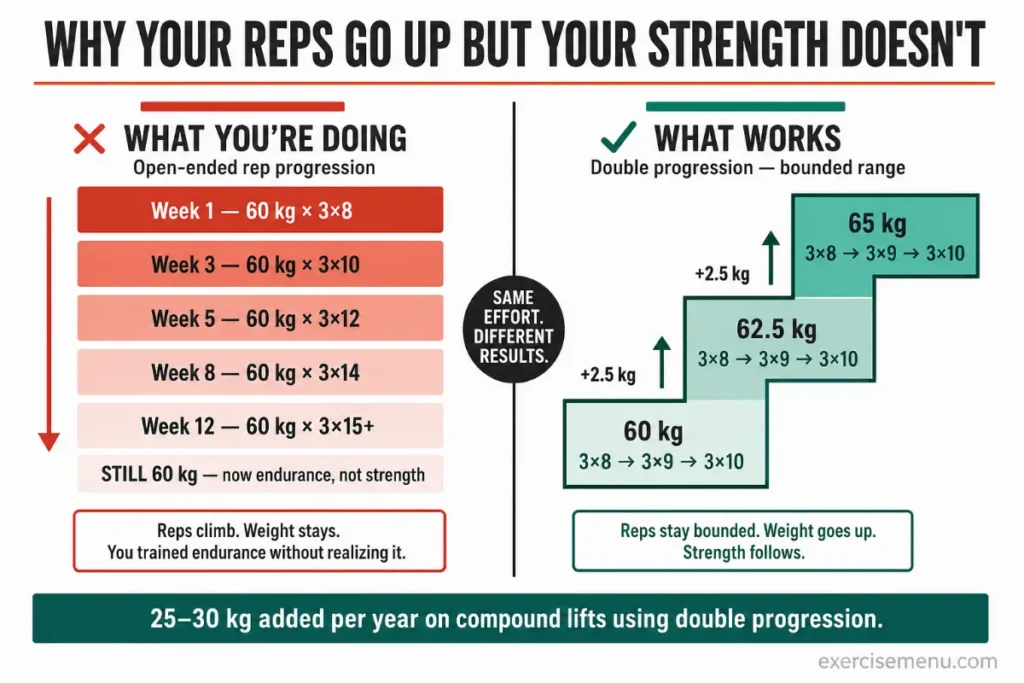
The reps increase within a bounded range. Once you hit the ceiling, the weight goes up and the reps come back down. You never drift into 15+ rep territory because the system forces a load increase before that happens.
That’s the key difference between what you were doing — open-ended rep progression — and what actually drives strength: bounded rep progression with mandatory load increases.
How to tell if you’re actually plateaued
Before restructuring your entire program, make sure you’re genuinely stuck — not just impatient.
A real plateau: Your working weight on a compound lift hasn’t increased in 3+ weeks despite consistent training, adequate nutrition, and proper recovery.
Not a real plateau: You had one bad session. You missed a rep on your final set. You didn’t PR this week. Strength progression for intermediate and advanced lifters is measured in weeks and months, not individual sessions.
Three questions to ask before assuming you’ve plateaued:
- Are you actually tracking your sessions? Without a training log, you’re relying on memory — and memory overestimates past performance. A 2022 study by Plotkin, Schoenfeld et al. showed that both load and rep progression produce comparable hypertrophy, but only when systematically tracked and applied. Guessing is not structured progression.
- Has your bodyweight changed? If you’ve lost 3 kg while trying to get stronger, that’s not a plateau — that’s a calorie deficit limiting your recovery capacity. Strength is energy-expensive. Under-fueling stalls it.
- Are you sleeping consistently? Strength adaptations happen during recovery — particularly during deep sleep when growth hormone release peaks. Chronic sleep debt under 7 hours suppresses testosterone and elevates cortisol — both of which directly impair strength gains.
When Increasing Reps Is the Right Move
Rep progression isn’t wrong — it’s wrong for strength as a primary strategy. But there are specific situations where adding reps before adding weight is the correct approach.
When load jumps are too large. If the smallest available weight increase is 5 kg on an upper body lift, that’s a 5-8% jump for most intermediate lifters — too aggressive. Increasing reps from 8 to 10 first builds the work capacity to handle the jump.
During a calorie deficit. When cutting, recovery is compromised. Expecting load increases is unrealistic. Holding your weight on the bar while maintaining reps is still forward progress relative to what a non-training body would do. Adding 1 rep during a cut is genuine adaptation.
For hypertrophy blocks. If your current training phase is focused on muscle growth, rep progression in the 8-12 range is appropriate. The goal during a hypertrophy block is volume accumulation, not 1RM improvement. Strength blocks follow later.
Common mistakes that keep people stuck in the rep trap
Never testing heavier weight. If you’ve been doing 3×12 at a given weight for two months, you might be able to do 3×6 at 10 kg more — but you’ll never find out unless you try. The fear of failing a heavier set keeps people locked into comfortable rep ranges long past their usefulness.
Confusing muscular fatigue with effective training. A set of 20 at a moderate weight produces deep fatigue, burning, and a massive pump. It feels like it’s working. It is — for endurance and metabolic conditioning. It’s not building the neural drive or mechanical tension that maximal strength requires.
No periodization. Staying in one rep range indefinitely leads to accommodation — your body adapts fully and stops responding. Cycling between strength phases (1-6 reps), hypertrophy phases (6-12 reps), and endurance phases (15+) forces continuous adaptation.
Increasing reps and weight and sets simultaneously. Change one variable at a time. If you jumped from 3×8 to 4×10 at a heavier load, that’s three changes at once — weight, reps, and sets. Your body can’t isolate which signal matters. Progression needs to be trackable and attributable.
Frequently asked questions
Why am I getting stronger at reps but not at heavier weight?
Rep strength and maximal strength are different adaptations. More reps at 60 kg means your body sustains that load longer — not that your nervous system can handle 70 kg. To lift heavier, train heavier.
Is increasing reps considered progressive overload?
Yes — but it drives endurance and hypertrophy, not maximal strength. More weight drives strength. Rep progression alone leaves strength unaddressed.
How many reps is too many for strength?
Above 12-15 reps per set, the load is too light for a meaningful strength stimulus. The ACSM recommends 1-6 reps at 80-90% of 1RM for maximal strength. Past 15, you’re training endurance.
Should I add weight even if I can’t hit my target reps?
No. Only increase weight when all prescribed sets are complete at the top of your rep range with clean form. Adding weight too early breaks form and causes injuries.
How often should I increase weight?
Beginners can add weight every session. Intermediates typically increase every 1-2 weeks using double progression. Advanced lifters may need 4-8 week blocks. If you’re hitting rep targets but weight hasn’t moved in 3+ weeks, nutrition, sleep, or stress is the bottleneck.
If your reps have been climbing but your max hasn’t moved, the fix is straightforward: pick a rep range, cap it, and add weight when you hit the ceiling. Start your next session with that.

1 Comment
Pingback: Hypertrophy vs Strength: Which to Pick (2026 ACSM Update)