

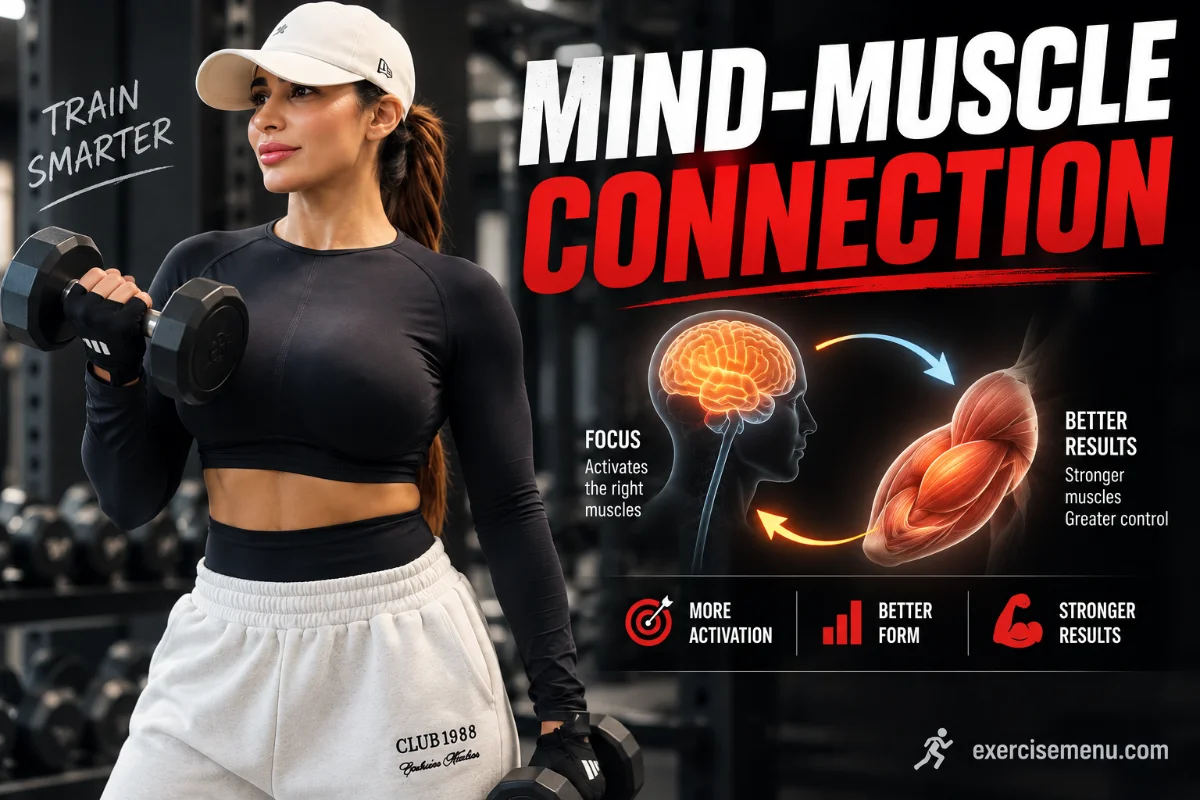
Quick Answer: The mind-muscle connection is real but conditional. Focusing on the target muscle during moderate-load exercises increases muscle activation and can enhance growth over time. The effect disappears above roughly 60% of your max. Use it on isolation exercises and lighter sets. On heavy compound lifts, focus on the movement instead.
“Squeeze the muscle.” “Feel the contraction.” “Think about your lats.” If you’ve spent any time in a gym, you’ve heard some version of this cue. The idea is simple: focusing your attention on a specific muscle while training it makes that muscle work harder and grow faster.
For years, this was treated as bodybuilding folklore. Then the research caught up. The mind-muscle connection is a real, measurable phenomenon, but it has boundaries that most gym advice ignores. It works under specific conditions, on specific muscles, at specific loads. Outside those conditions, it does nothing, or worse, it reduces performance.
- What Is the Mind-Muscle Connection?
- Does It Actually Build More Muscle?
- The Load Threshold Most Advice Ignores
- Five Cues That Help You Feel the Right Muscle Working
- How to Build the Mind-Muscle Connection If You Can't Feel a Muscle?
- When the Mind-Muscle Connection Hurts More Than It Helps?
- Frequently Asked Questions
- Your Next Step
What Is the Mind-Muscle Connection?
The mind-muscle connection is the practice of deliberately focusing your attention on contracting the target muscle during an exercise rather than simply moving the weight from point A to point B.
In research, this is called an “internal focus of attention.” The alternative, an “external focus,” means thinking about the outcome of the movement: push the bar up, drive the floor away, pull the handle to your chest. Both are valid training strategies. They just serve different purposes.
When you focus internally on a specific muscle, your brain increases neural drive to that muscle, recruiting more of its fibers. The target muscle works harder while the surrounding muscles contribute less, producing a stronger contraction per rep at the same weight.
Does It Actually Build More Muscle?
One well-designed study says yes, with a caveat.
Schoenfeld et al. (2018) published an 8-week trial in the European Journal of Sport Science. Thirty untrained men performed the same exercises with the same weight and volume. One group was told to “squeeze the muscle.” The other was told to “get the weight up.” After 8 weeks, the internal focus group saw 12.4% growth in their biceps compared to 6.9% in the external focus group. That’s nearly double the hypertrophy from the exact same training, with only the mental cue changed.
But the same study found no difference in quadriceps growth between the two groups. Both grew their quads at the same rate regardless of focus strategy.
The likely reason: you can consciously contract your biceps while standing in a queue. Try doing that with your vastus lateralis. The muscles you can voluntarily isolate and control (biceps, chest, delts, lats) respond better to internal focus than muscles with coarser voluntary control (quads, hamstrings, glutes during compound movements).
One study on untrained men is promising evidence, not proof for all populations. But combined with EMG data from multiple other studies, the direction is consistent: deliberate focus on the target muscle increases its activation during moderate-load work.
The Load Threshold Most Advice Ignores
Most MMC advice skips the most important finding.
Calatayud et al. (2016) tested internal focus during bench press at loads ranging from 20% to 80% of 1RM. The finding was clear: focusing on the pecs or triceps increased their activation at loads between 20 and 60% of 1RM. At 80%, the effect disappeared completely.
When the weight is heavy enough that completing the rep requires everything your body has, your nervous system recruits every available fiber regardless of where your attention is. There’s no room for selective focus. The bar is either going up or it isn’t.
The practical rule:
Use the mind-muscle connection on:
- Warm-up sets and back-off sets
- Isolation exercises (curls, lateral raises, leg extensions, cable flyes)
- Moderate-weight accessories (60% of your max or below)
Skip it on:
- Heavy working sets of compound lifts (squats, deadlifts, bench at 80%+ 1RM)
- Power and speed movements (cleans, jump squats, throws)
On your heavy sets, switch to external cues. “Push the floor away” during squats. “Drive the bar to the ceiling” on bench. These cues improve force output when the load is high.
Five Cues That Help You Feel the Right Muscle Working
Generic instructions like “feel the muscle” are not useful if you don’t know what to focus on. These cues shift attention to the target muscle in a specific, practical way.
| Exercise | Target Muscle | Cue | Why It Works |
|---|---|---|---|
| Lat pulldown | Lats | “Pull from your elbows, not your hands” | Shifts effort from forearms and biceps to the lats by removing grip-focus |
| Cable fly | Chest | “Hug a wide tree” | Creates an arc motion that maximizes pec stretch at the bottom and contraction at the top |
| Lateral raise | Side delts | “Lead with your elbows, pour water from a jug” | Prevents the traps from taking over by keeping the elbow above the hand |
| Romanian deadlift | Hamstrings | “Push your hips back to close a car door behind you” | Loads the hamstrings through hip hinge rather than lower back bending |
| Glute bridge | Glutes | “Drive through your heels and squeeze at the top like you’re holding something between your cheeks” | Prevents quad dominance and ensures the glutes finish the hip extension |
These cues work best at lighter loads where you have the mental space to apply them. By the time you’re grinding a heavy set, your attention belongs on the lift, not the cue.
How to Build the Mind-Muscle Connection If You Can’t Feel a Muscle?
Not being able to “feel” a muscle working is the most common frustration, especially with the back, glutes, and rear delts. Here’s a systematic approach.
Step 1: Touch the muscle. Place your free hand on the target muscle during warm-up sets. This tactile feedback gives your brain a physical reference point. Touch your lat before a set of rows. Touch your rear delt before reverse flyes. The contact makes the connection tangible rather than abstract.
Step 2: Drop the weight. Use 40 to 50% of your normal working weight. The lighter load removes the struggle of moving the weight and frees up your attention to focus on where you feel tension.
Step 3: Slow the rep down. A 3 to 4 second lowering phase forces control. When you lower slowly, you can feel which muscle is resisting the load. If you rush the lowering, the weight drops and you feel nothing. For more on how manipulating rep speed affects the muscle, the time under tension guide covers tempo programming.
Step 4: Add an isometric hold. Pause for 2 to 3 seconds at the point of peak contraction. During a bicep curl, that’s the top. During a chest fly, that’s when your hands meet. During a row, that’s when your shoulder blades are fully retracted. The hold forces the target muscle to sustain effort without momentum.
Step 5: Remove your hand and repeat. Once you’ve built the sensation with tactile cueing and light weight, carry that focus into your normal working sets. The connection strengthens with practice over sessions, not within a single set.
If a muscle still doesn’t activate after two to three sessions of focused work, the exercise may not match your anatomy for that muscle. A different angle, grip width, or variation often solves this. The compound vs isolation guide can help you pick exercises that target the right muscles more directly.
When the Mind-Muscle Connection Hurts More Than It Helps?
Internal focus is not always the right strategy. Using it at the wrong time reduces performance.
Heavy compound lifts above 80% 1RM. At maximal effort, your job is to complete the lift safely, not to think about one muscle. Cueing “squeeze your quads” during a max squat splits your attention and can reduce total force output. Cue the movement instead: “drive the floor away.”
Speed and power movements. Cleans, snatches, box jumps, and throws require fast, coordinated muscle firing across multiple joints. Internal focus on a single muscle slows output and disrupts timing.
Late sets under fatigue. MMC requires mental effort. By set 4 or 5 of a demanding exercise, your focus degrades naturally. Use internal focus on your first 2 to 3 sets when your attention is sharp. Let the final sets rely on effort and form cues rather than muscle focus.
Beginners learning a new movement. When the movement pattern itself is unfamiliar, attention should go to form and coordination first. Trying to “feel the lats” during your first month of lat pulldowns adds confusion to a motor pattern that hasn’t been established yet. Learn the movement, then layer in the focus.
Frequently Asked Questions
Can you build a mind-muscle connection with any muscle?
Yes, but some muscles take longer. Upper body muscles like biceps, chest, and delts typically respond within a few sessions of focused practice. Lower body muscles, particularly the deep glutes and hamstrings, can take weeks. If a standard compound exercise isn’t producing the sensation, switch to an isolation variation for that muscle: leg extensions for quads, leg curls for hamstrings, hip thrusts for glutes. Isolation removes competing muscles and makes the target easier to feel.
Does visualizing a muscle before a set actually help?
There is limited direct research on pre-set visualization specifically. However, motor imagery research in sports science consistently shows that mentally rehearsing a contraction primes the neural pathways for that movement. Spending 5 to 10 seconds visualizing the target muscle contracting before your set is low-cost and anecdotally supported by experienced coaches.
Why can’t I feel my glutes working during squats?
Because squats are a quad-dominant compound movement where glute activation depends on depth, stance width, and hip angle. Your glutes are most active at the bottom of a deep squat and during the final hip extension at lockout. If you never hit full depth, or if you stop short of full hip extension, the glutes stay underloaded. Hip thrusts and glute bridges are better exercises for building the glute connection because the glutes are the undisputed prime mover throughout the entire range.
Is the mind-muscle connection more important for beginners or advanced lifters?
More important for intermediate and advanced lifters. Beginners grow from almost any stimulus because the adaptation threshold is low. As you advance, the margin for growth narrows and every rep needs to count. That’s when the quality of each contraction matters more than the quantity.
Should I use the mind-muscle connection during cardio or stretching?
During stretching, focusing on the muscle being lengthened helps you relax into the stretch and identify areas of tightness. During cardio, it has minimal application because cardio targets systemic cardiovascular adaptation, not isolated muscle contraction. Running while trying to “feel your hamstrings” is not useful.
Your Next Step
Pick one exercise where you struggle to feel the target muscle. On your next session, drop the weight by 30 to 40%, slow the rep down, and apply the cue from the table above. Give it three sessions before judging. The connection is a skill that improves with repetition, not a switch you flip once.
