

Quick Answer: You can progressive overload without adding weight by increasing reps, slowing tempo, cutting rest periods, increasing range of motion, or switching to harder variations. Research shows rep progression produces comparable muscle growth to load progression.
Key Takeaways
- Non-load methods have a limit — rotating between them buys 8–16 weeks before you need to increase load again.
- Weight is one of at least five variables you can manipulate to keep progressing.
- Once you hit 25–30 reps per set, the stimulus shifts to endurance — time to rotate methods.
- A training log that tracks tempo, rest, and RPE — not just weight — is the only way to confirm non-load progression.
- During a calorie deficit, maintaining your current lifts while losing bodyweight counts as progression.
Adding 5 pounds to the bar every week works — until it doesn’t. Weights stall. Joints push back. And if you train at home with limited dumbbells, jumping from 10 to 15 pounds on lateral raises is a 50% increase in load — far too much for a small muscle group to handle cleanly. Even in a fully equipped gym, isolation exercises hit this wall fast because the available weight jumps don’t match what your shoulders, biceps, or triceps can actually tolerate.
Progressive overload means increasing the demand on your muscles over time, and load is only one variable you control. Your reps and sets, tempo, rest periods, range of motion, and exercise selection all create training stimulus your muscles must adapt to — and every one of them can be tracked and progressed just like weight on the bar.
Quick Reference Table
| Method | What You Change | Practical Range |
|---|---|---|
| Volume (reps/sets) | Total work per session | Add 1–3 reps or 1 set per week |
| Tempo | Time per rep | 3–5 second eccentric, 1–2 second pause |
| Rest periods | Recovery between sets | Cut 10–15 seconds per week, minimum 30–45 seconds |
| Range of motion | Distance per rep | Deficit push-ups, full-depth squats, deeper stretches |
| Exercise variation | Movement difficulty | Wall → knee → full → decline → archer push-ups |
Can You Build Muscle Without Lifting Heavier?
Yes — and the research backs it clearly. A 2022 study by Plotkin et al. published in PeerJ compared two training groups over eight weeks. One group increased load while keeping reps constant. The other kept load fixed and added reps. Both groups saw comparable increases in muscle thickness.
Load progression is still the most direct path to strength gains, and no study has proven that rep-only progression works equally well beyond a few months. But when adding weight isn’t an option — whether you’re stuck at a plateau, training with limited equipment, managing an injury, or eating in a deficit — the methods below keep your muscles responding instead of stalling.
5 Ways to Progressive Overload Without Increasing Weight
1. Add More Reps or Sets
The most accessible form of non-load progression. If you benched 135 pounds for 3 sets of 8 last week, hitting 3 sets of 9 this week increases your total volume from 3,240 to 3,645 pounds of work. Over a month, those single-rep additions compound into a measurable jump in training demand.
Once your reps reach the top of your target range — usually 12–15 for hypertrophy — add a set instead. Going from 3 to 4 sets of 10 at 135 pounds adds over 1,000 pounds of total work to that exercise alone.
Another way to increase volume without touching the weight: train the same muscle more often. If you’re hitting chest once per week with 9 total sets, switching to twice per week with the same 9 sets spreads the work across two sessions — which most people recover from better. Or keep the same frequency and bump total weekly sets from 9 to 12. Either way, your muscles see more work across the week without a single plate being added.
One boundary: once you can hit 25–30 clean reps per set, the stimulus shifts toward endurance rather than muscle growth. At that point, move to one of the methods below — or find a way to increase load.
2. Slow Down Your Tempo
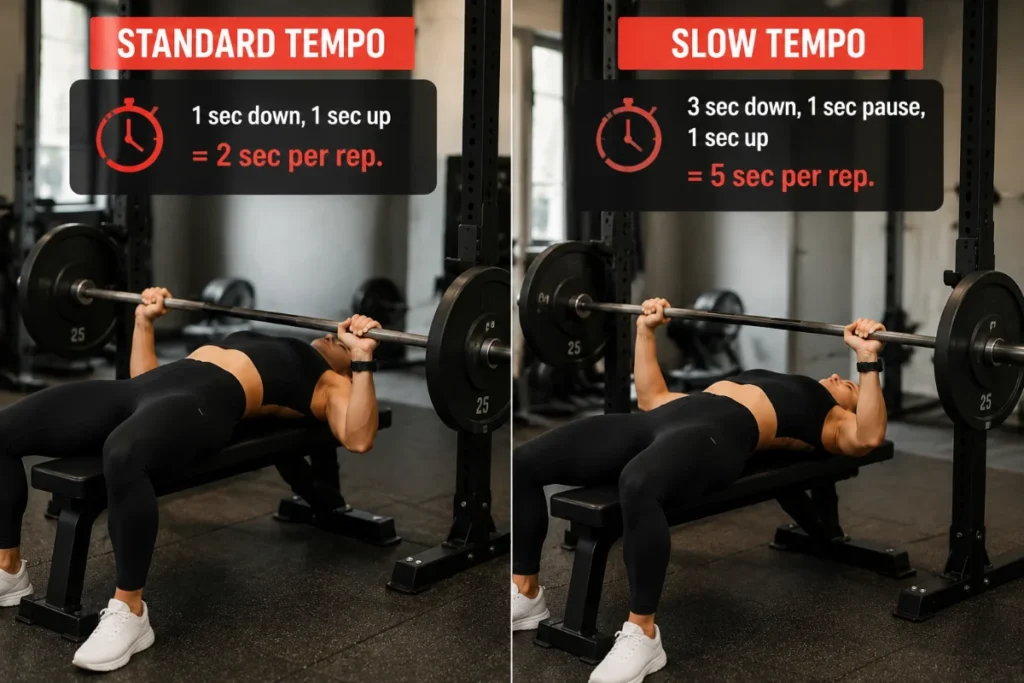
Tempo controls how long each rep takes and how hard your muscles work during it. A bench press with a 1-second lower and 1-second push puts your chest under tension for roughly 2 seconds per rep. Add a 3-second lower with a 1-second pause at the bottom, and that rep now lasts 5 seconds — with the weight never changing.
Here’s what the research actually shows: a 2025 meta-analysis by Enes, Schoenfeld et al. in the Journal of Strength and Conditioning Research analyzed 14 studies and found that tempo has minimal overall effect on hypertrophy — faster and slower reps produced similar muscle growth. So why use slow tempo at all?
Because in the context of overloading without heavier weight, the goal isn’t “slow reps build more muscle.” The goal is making the same load harder to lift. A 5-second rep with 135 pounds demands more muscular control than a 2-second rep with the same 135 pounds. Your muscles have to produce force for longer, and that increased difficulty is the overload stimulus.
Start by adding a 3-second lowering phase to your main lifts. Once that feels manageable after 2–3 weeks, add a 1-second hold at the stretched position. That single change can restart progress on exercises that have been stuck for months.
3. Shorten Your Rest Periods
Performing the same sets, reps, and weight with less recovery between them is objectively harder. Your muscles produce force under greater fatigue, and that increased metabolic stress pushes adaptation.
Cut 10–15 seconds per week. If you currently rest 90 seconds between sets, drop to 75 next week, then 60 the week after. Use a timer — guessing rest periods is one of the most common reasons lifters believe they’re progressing when nothing has actually changed.
One guardrail: rest below 30–45 seconds on compound lifts compromises form and increases injury risk. Short rest works well for hypertrophy and endurance goals. If maximal strength is the priority, keep rest at 2–3 minutes for heavy compounds and apply this method to isolation and accessory work only.
4. Increase Your Range of Motion
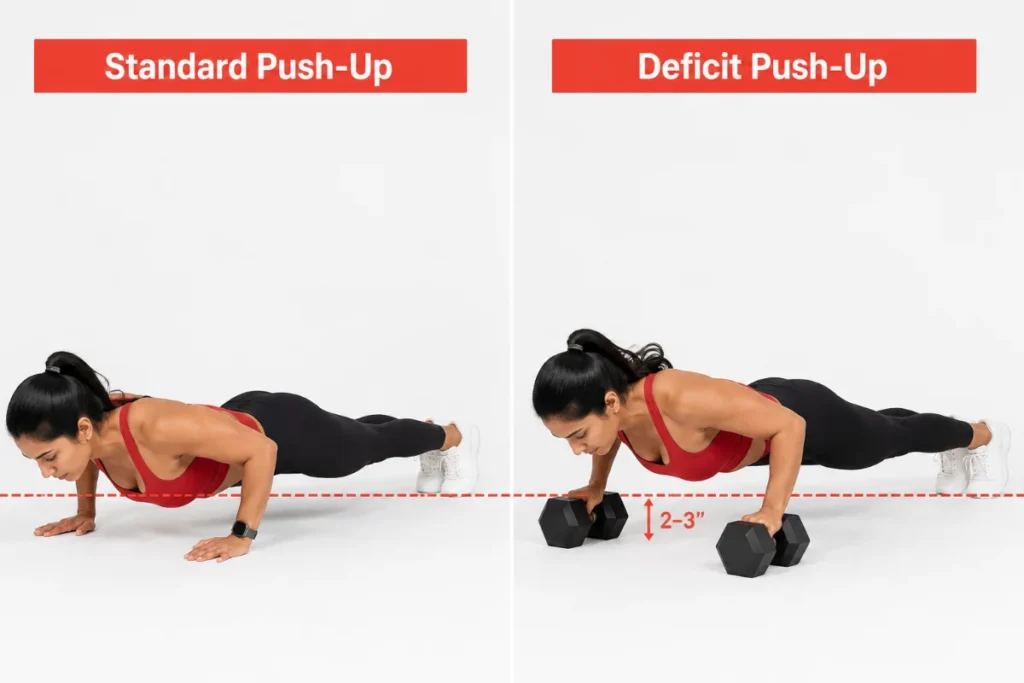
A deeper squat, hands elevated on push-ups to lower your chest past your hands, a full stretch at the bottom of a fly — all increase the distance your muscles travel per rep.
More range means more mechanical work per rep with no plate changes. Your muscles spend longer under load, and you recruit more fibers at lengthened positions — where research shows the growth signal is strongest. Going deeper on the same exercise with the same weight is a direct increase in training demand.
Practical examples:
- Deficit push-ups with hands on blocks or dumbbells for extra depth
- Full-depth squats below parallel instead of stopping at 90 degrees
- A 1–2 second hold at the stretched position of Romanian deadlifts or incline curls
Two extra inches of depth on a squat doesn’t feel dramatic in one session. Tracked across four weeks, the accumulated work is real and visible in your log.
5. Progress to a Harder Variation
When reps, tempo, rest, and ROM are all progressed on an exercise, the movement itself needs to change.
Bodyweight example: wall push-ups → knee push-ups → full push-ups → decline push-ups → diamond push-ups → archer push-ups. Each step increases the demand on your muscles relative to body position, with zero external load added.
Gym example: bilateral dumbbell curls → single-arm curls with the same dumbbell (doubled demand per arm) → incline curls (longer lever arm, harder stretch under load).
At home, exercise progressions are often the only path forward once bodyweight reps become easy. In the gym, switching variations shifts the strength curve, challenges stability, and hits motor units that your current exercise no longer reaches. This is structured variation with a specific goal. Changing exercises randomly every session because you believe muscles need to be ‘surprised’ is a different approach, and research on muscle confusion shows it doesn’t produce better results than staying consistent with purposeful progressions.
One more option worth noting: techniques like drop sets and rest-pause sets also create overload without increasing your starting weight. You finish a set, reduce the load or take a short pause, and continue repping — all within the same working set. The starting weight never goes up, but the total stimulus per set does. These fall under advanced set techniques, which we cover separately.
How Do You Track Progress Without Adding Weight?
A training log that only records weight, sets, and reps misses half the picture when load isn’t the variable you’re progressing.
Add two fields: tempo (written as lowering-pause-lifting, like 3-1-1) and rest period length in seconds. Each session, you should be able to point to at least one number that moved forward from last week. If nothing changed, no progression happened — no matter how hard the session felt.
A simple log entry:
| Exercise | Weight | Sets × Reps | Tempo | Rest | RPE |
|---|---|---|---|---|---|
| Bench Press | 135 lb | 3 × 10 | 3-1-1 | 75 sec | 8 |
If nothing in your log has moved in three consecutive weeks on any variable, rotate to a different method from the five above. Repeating the same method too long is one of the most common reasons non-load progression stalls out.
Does This Work During a Calorie Deficit?
Yes — and during a cut, non-load progression matters more than at any other time.
When you’re in a deficit, putting more weight on the bar becomes nearly impossible. Recovery is slower, energy is lower, and strength gains flatten. But here’s what gets overlooked: the same weight on the bar gets relatively heavier as your bodyweight drops.
If you weigh 180 pounds and squat 225, that’s a 1.25× bodyweight squat. Drop to 170 pounds while maintaining that 225, and your relative intensity has gone up — your muscles are doing more work per pound of lean mass. The plates didn’t change. The demand did.
During a cut, the goal shifts from building to preserving. Maintaining your current weights, reps, and tempo while losing body fat is a real form of progression. Tempo and ROM adjustments help keep training intensity where it needs to be without asking more from a recovery capacity that’s already reduced.
When Do These Methods Stop Working?
Every non-load method runs out eventually, and no competitor article will tell you where.
Reps lose their hypertrophy effect past the 25–30 range. Slower tempo makes the same weight harder, but it doesn’t keep scaling — at some point, reps get so slow that you have to drop weight below what’s useful. Rest periods can only shrink so far before form breaks. ROM has anatomical limits. And once you’ve moved through every variation of a pattern, there’s nowhere left to go.
The Plotkin study backing non-load progression ran for eight weeks. That doesn’t mean the methods collapse at week nine — but no research has shown that rep-only or tempo-only progression matches load progression over six months or a year.
In practice, rotating between all five methods sustains progress for roughly 8–16 weeks before you’ll need to add load again — whether through micro-plates, bands layered onto the bar, or switching to a different exercise where weight progression is still available. Programming a deload week before restarting a new cycle helps clear the fatigue you’ve built up.
These methods keep muscles growing when load stalls. They are not a permanent substitute for getting stronger.
Frequently Asked Questions
Does progressive overload without weight work differently for upper body vs lower body?
Lower body muscles handle higher rep ranges better before endurance takes over, so rep-based progression tends to last longer for legs. Upper body — especially shoulders and arms — responds faster to tempo and ROM changes because those muscles fatigue quicker under sustained tension.
Should you change one variable at a time or stack multiple?
One at a time. Changing reps, tempo, and rest simultaneously makes it impossible to identify what drove progress — or what caused a stall. Isolate one variable per 2–4 week block, then rotate.
Can you use these methods if you have joint pain or an injury?
Tempo and ROM progression are particularly joint-friendly because they increase difficulty without increasing external force on the joint. Shorter rest periods can also work, though they raise systemic fatigue. Avoid variation changes that put the injured joint in vulnerable positions.
How long before you see results from non-load progression?
Most people notice measurable changes within 3–4 weeks if they’re tracking accurately and pushing at least one variable forward each session. The Plotkin study showed muscle thickness increases at the 8-week mark.
Is non-load progression only for beginners, or do advanced lifters use it too?
Advanced lifters rely on it more than beginners. A beginner can add weight to the bar almost every session. An advanced lifter may add 5 pounds to their bench press twice in a year. The rest of their progress comes from volume, tempo, density, and variation manipulation.
Can resistance bands replace heavier weights for progressive overload?
Bands change the strength curve of an exercise — resistance is lightest at the bottom and heaviest at the top. Layering a band onto a dumbbell exercise creates accommodating resistance, which increases overload without adding plate weight.
