

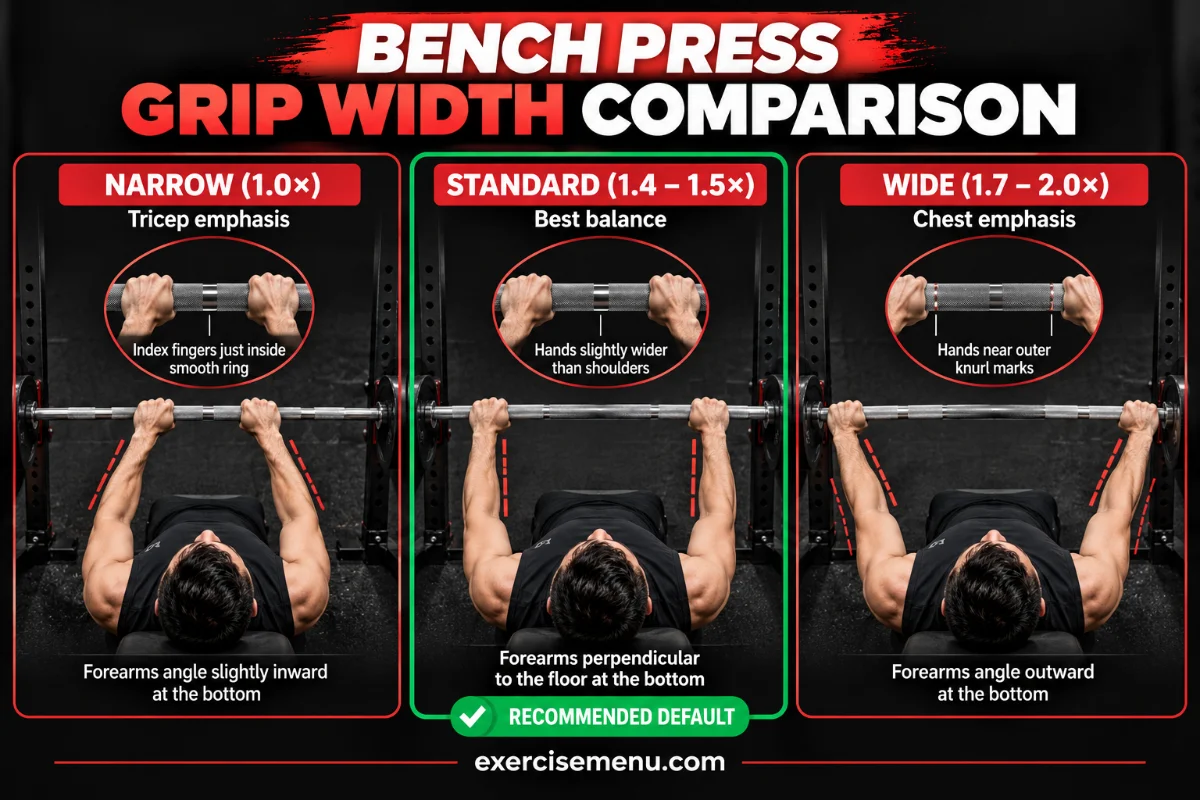
Quick Answer: A standard grip at roughly 1.4 to 1.5 times your shoulder width balances chest, tricep, and shoulder activation while keeping shoulder stress low. Wider grips increase chest emphasis but raise shoulder injury risk. Narrower grips shift demand to the triceps and reduce range of motion stress on the shoulders.
Grip width is the single easiest variable to change on a bench press, and it has a bigger effect on which muscles do the work than most people realize. Moving your hands two inches wider or narrower changes the angle of your elbows, the path the bar travels, and the amount of stress your shoulder joints absorb on every rep.
The question is not which grip is “best.” It’s which grip is best for YOUR goal. Chest development, tricep strength, shoulder safety, and competitive powerlifting each favor a different hand position, and the research behind each one is clear.
How to Measure Your Grip Width?
Grip width in research is measured relative to your biacromial width: the distance from the outside edge of one shoulder to the other. This distance varies by person, which is why “shoulder-width grip” means different things for different builds.
| Grip Name | Width (× Biacromial) | Approximate Guide |
|---|---|---|
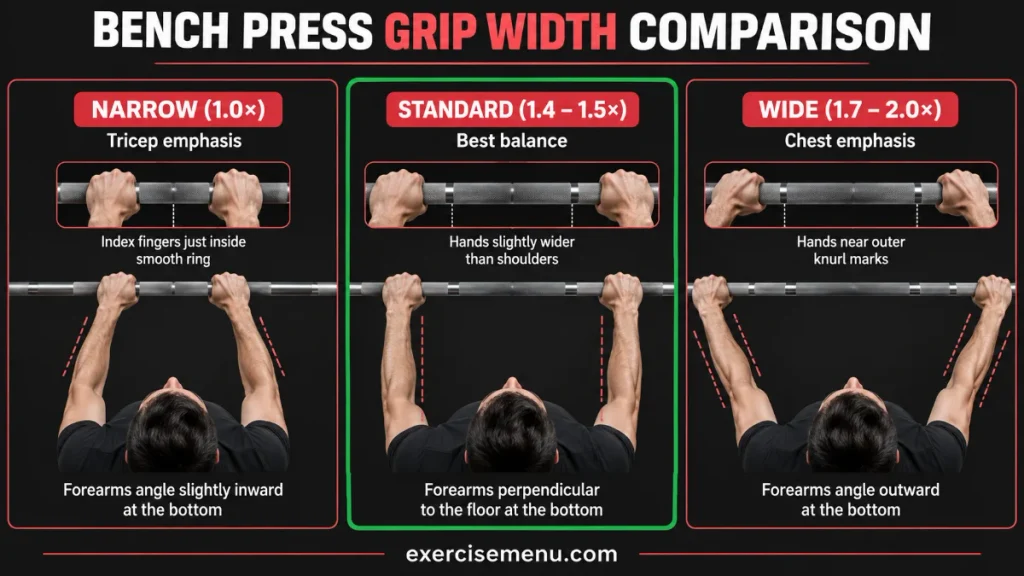
| Narrow | 1.0× | Hands directly above shoulders, index fingers just inside the smooth ring on the bar |
| Standard | 1.4–1.5× | Hands slightly wider than shoulders, forearms roughly perpendicular to the floor at the bottom |
| Wide | 1.7–2.0× | Hands near or on the outer knurl marks (81 cm powerlifting max width) |
The simplest way to find your standard grip without measuring: lie on the bench, lower an empty bar to your chest, and adjust your hands until your forearms point straight up at the bottom position. That’s your starting point.
Which Muscles Each Grip Width Emphasizes?
Lehman (2005) published a study in the Journal of Strength and Conditioning Research measuring EMG activity across three grip widths during the flat bench press. The findings have been replicated consistently across multiple studies since.
| Muscle | Narrow Grip | Standard Grip | Wide Grip |
|---|---|---|---|
| Pectoralis major (sternocostal) | Lower activation | Moderate activation | Highest activation |
| Triceps brachii | Highest activation | Moderate activation | Lower activation |
| Anterior deltoid | Higher activation | Moderate activation | Lower activation |
| Biceps brachii | Lower activation | Moderate activation | Higher activation |
Widening your grip increases the horizontal adduction demand at the shoulder, which is the primary function of the pec muscles. Narrowing your grip increases the elbow extension demand, which is the primary function of the triceps.
Neither width completely isolates one muscle. The bench press is always a compound movement involving chest, triceps, and delts together. Grip width changes the ratio, not the roster.
How Grip Width Affects Range of Motion and Strength?
A wider grip shortens the distance the bar travels. The difference between a narrow and wide grip is roughly 5 to 8 cm, depending on arm length. Less range of motion means less total work per rep but a stronger mechanical position off the chest for most lifters.
Research on bar speed shows that narrow grip bench press produces higher bar velocity, while wide grip produces higher peak force. This tracks with the muscle emphasis data: the triceps (narrow grip) are faster-contracting muscles suited to pushing speed, while the pecs (wide grip) are larger muscles suited to generating force through a shorter range.
In terms of 1RM, Green and Comfort (2007) found that reducing grip width from 2.0× to 1.5× biacromial resulted in only a ±5% difference in one repetition maximum. For most lifters outside competitive powerlifting, that difference is smaller than a bad night’s sleep.
Does Wider Grip Increase Shoulder Injury Risk?
Yes, and the research is consistent on this.
Green and Comfort (2007) reviewed the evidence in the Strength and Conditioning Journal and concluded that grip widths greater than 1.5 times biacromial width place the shoulder in a position associated with higher injury risk, including anterior instability and distal clavicle osteolysis.
A 2024 biomechanical modeling study by Serrancolí et al. in Frontiers in Physiology confirmed this with measured data: wider grips at 2× biacromial width produced higher compression forces at the distal clavicle and higher glenohumeral shear forces compared to narrower grips. The researchers concluded that there is a trade-off between performance and injury risk when choosing grip width.
What this means in practice: going wider than 1.5× your shoulder width gains you a few percent more pec activation and a slightly shorter bar path, but at the cost of progressively more shoulder stress per rep. Over hundreds of reps across weeks and months, that accumulated stress matters.
If you bench two to three times per week with high volume, a standard grip at 1.4 to 1.5× biacromial width gives you strong chest activation with a safer shoulder position. If you’re a competitive powerlifter who needs every mechanical advantage, a wider grip is a calculated trade-off you accept with proper shoulder maintenance work.
Which Grip Width Should You Use?
| Your Goal | Recommended Grip | Why |
|---|---|---|
| Chest development | Standard to slightly wide (1.4–1.7×) | High pec activation with manageable shoulder stress |
| Tricep strength | Narrow (1.0–1.2×) | Maximizes tricep demand; useful as accessory work |
| General strength | Standard (1.4–1.5×) | Best balance of force output, muscle activation, and joint safety |
| Competitive powerlifting | Wide (1.7–2.0×) | Shortest bar path, highest peak force; accept shoulder risk with maintenance |
| Shoulder sensitivity | Standard or narrow (1.0–1.5×) | Minimizes shoulder abduction angle and joint stress |
Most people should start with a standard grip and keep it as their primary position. Narrow grip and wide grip bench can rotate in as accessories for tricep or chest emphasis, not as permanent replacements.
How to Find Your Strongest Grip Width?
You can measure your biacromial width and calculate 1.4× or 1.5×, but the fastest practical method is this:
- Lie on the bench with an empty bar.
- Lower the bar to your mid-chest.
- Look at your forearms from the side or have someone check.
- Adjust your hand position until your forearms are roughly perpendicular to the floor at the bottom.
- Mark the position by noting where your index or ring finger sits relative to the knurling or the smooth ring on the bar.
- Use that position consistently. Consistency matters more than perfection; a half-inch difference either way won’t change your results, but changing grip every session will prevent adaptation.
Arm length matters. Lifters with longer arms relative to their torso naturally need a slightly wider grip to achieve the perpendicular forearm position. Two people with the same shoulder width but different arm lengths will end up with different optimal grip positions. Let the forearm test guide you rather than copying someone else’s hand placement.
Watch your wrists. As grip width increases, the wrist is more likely to bend backward under the bar if you grip with the bar high in your palm. Keep the bar stacked directly over the wrist joint (lower in the palm, closer to the heel of the hand) regardless of grip width. A bent wrist under load leaks force and creates unnecessary wrist strain.
If you want to know your exact 1RM at your chosen grip width before comparing to standards, test it after a few weeks of consistent grip use, not on the first session.
Frequently Asked Questions
Does grip width affect the touch point on the chest?
Yes. A wider grip brings the bar to a higher touch point near the clavicle. A narrower grip brings it lower toward the base of the sternum. Let the touch point shift naturally with the grip rather than forcing the same contact point across different widths.
Is close grip bench press bad for your elbows?
Not with proper form. Elbow stress from narrow grip usually comes from flaring the elbows outward while using a narrow hand position. Keep your elbows tucked at roughly 30 to 45 degrees from your torso and the elbow load stays manageable.
Does grip width change how much you can bench?
By a small amount. Green and Comfort (2007) found only a ±5% difference in 1RM between a 1.5× and 2.0× grip. For most lifters, that’s 2 to 5 kg. Shoulder health over a training career matters more than a marginal weight difference.
Should my grip width change on incline bench press?
Many lifters naturally use a slightly narrower grip on incline because the steeper angle shifts more demand to the upper chest and front delts. Narrowing by 1 to 2 finger widths from your flat bench grip is a reasonable starting point.
Can I use different grip widths in the same workout?
Yes. A standard grip for your main working sets followed by a narrow grip close-grip bench as a tricep accessory is a common and effective approach. Treat the secondary grip as a separate exercise, not a set-to-set change on the same movement.
Your Next Step
Set your grip using the forearm-perpendicular test described above and lock it in for the next 8 weeks. Track your bench press numbers at that consistent width. Once you have a reliable baseline, experiment with narrow or wide grip as an accessory on a separate day and compare how each feels on your shoulders and which muscles fatigue first.

3 Comments
Pingback: How to Bench Press? Setup, Descent, and Press
Pingback: Shoulder Pain Bench Press: 4 Form Errors to Fix Now
Pingback: Progressive Overload: Meaning, 7 Methods & Examples