

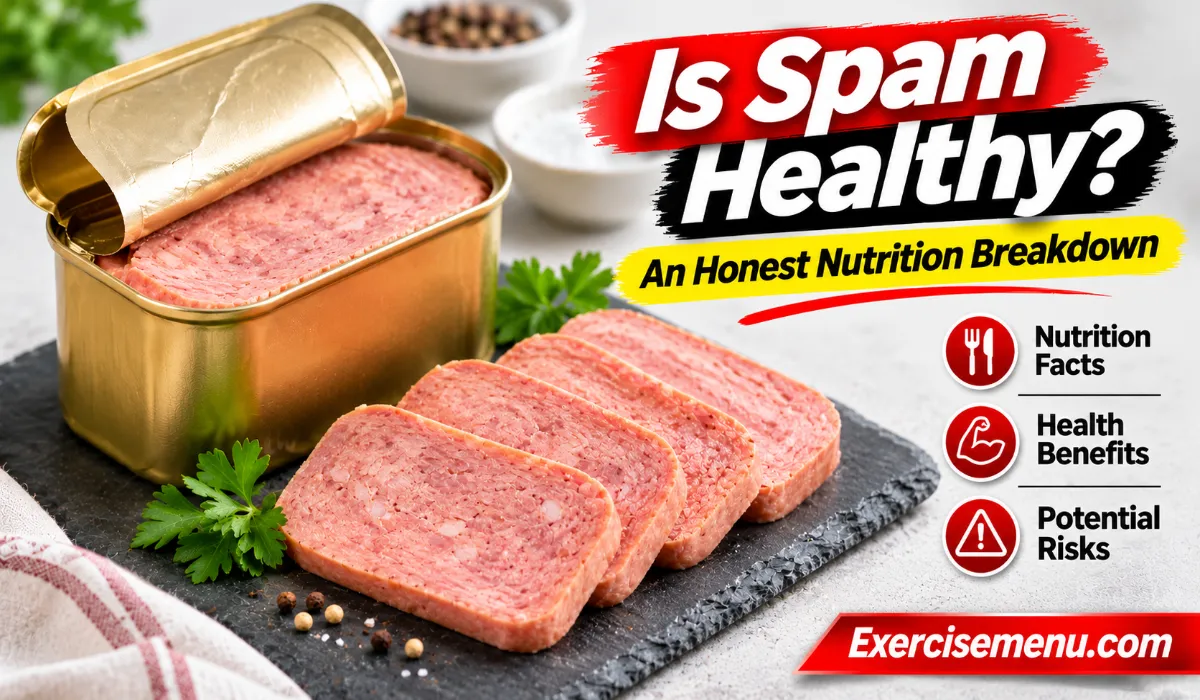
Quick Answer: Spam is safe to eat, but it isn’t a health food. A 2-ounce serving has 180 calories, 16 grams of fat, and about a third of a day’s sodium, with only 7 grams of protein. It works as an occasional convenient meal, not a daily staple, and lighter or lower-sodium versions help.
Spam gets treated as a punchline, but the real question is simpler: where does it fit in a normal diet? The honest answer sits between the two extremes online. It’s not poison, and it’s not a lean protein either.
Below is exactly what’s in it, the numbers that matter, the real concerns worth knowing, and how to eat it without the guilt or the sodium overload.
What is Spam, and what’s in it?
Spam is a canned, fully cooked pork product, not “mystery meat.” Hormel has made it since 1937, and the classic recipe has just six ingredients: pork with ham (about 89% of the can), salt, water, potato starch, sugar, and sodium nitrite.
Each one has a job. The pork and ham supply the protein and fat, potato starch binds it, sugar and salt handle flavor, and sodium nitrite preserves the meat and keeps its pink color. Nothing on that list is exotic. The issue isn’t what Spam is made of; it’s how much sodium and fat come with it.
Spam nutrition facts
Here’s a standard 2-ounce (56 g) serving, which is about one-sixth of a can, with the per-100-gram figures for comparison. Values come from USDA FoodData Central.
| Nutrient | Per 2 oz (56 g) | Per 100 g |
| Calories | 180 | 321 |
| Protein | 7 g | 13 g |
| Total fat | 16 g | 29 g |
| Saturated fat | 6 g | 10 g |
| Cholesterol | 40 mg | 71 mg |
| Sodium | 790 mg | 1,410 mg |
| Carbs | 1 g | 1.8 g |
One number reframes the whole food: Spam gives roughly 4 grams of protein per 100 calories. Lean chicken breast or shrimp deliver four to six times that. By the measure that matters most for building muscle or losing fat, protein per calorie, Spam is an inefficient source. If you’re tracking protein, see how it stacks up against the full list of high-protein foods.
Spam isn’t empty calories, though. The pork gives it real vitamin B12, niacin, zinc, and iron, so it carries some of the nutrition of the cuts it’s made from, just alongside a heavy dose of salt and fat.
Is Spam bad for you? The real concerns
Spam won’t harm you in moderation, but three things make it a food to limit rather than lean on: sodium, fat, and its status as a processed meat.
Sodium
One serving carries 790 mg of sodium, about a third of the 2,300 mg daily limit the Dietary Guidelines for Americans set for adults. Eat half a can and you’re near 1,600 mg from one food. For anyone managing blood pressure, that single number is the biggest reason to keep portions small.
Processed meat and nitrite
Spam is a cured, processed meat, and the Dietary Guidelines advise limiting these alongside saturated fat. The sodium nitrite that preserves it can form compounds called nitrosamines under high-heat cooking. The World Health Organization’s cancer agency classifies processed meat as a Group 1 carcinogen, tied to higher colorectal cancer risk when eaten regularly in large amounts. That finding is about a long-term daily habit, not the occasional slice, so frequency is what counts here.
A few groups have more reason to keep it minimal: people with high blood pressure, kidney disease, or heart disease, and anyone on a low-sodium diet, since Spam’s salt load works against all of them.
Is Spam Lite or low-sodium Spam healthier?
Both are a step down, not a health upgrade. Here’s how the common varieties compare per 2-ounce serving:
| Variety | Calories | Key difference |
| Spam Classic | 180 | baseline |
| Spam Lite | 110 | ~40% fewer calories, about half the fat |
| Spam Less Sodium | 180 | 25% less sodium |
| Spam Turkey | 80 | leanest, lowest fat and calories |
| Spam Tocino | 190 | sweetened, more sugar |
Spam Turkey and Lite are the better picks if you eat it often, and Less Sodium helps if blood pressure is your concern. All of them are still processed and salty, though, and none is high in protein per calorie. Treat them as a smaller dose, not a green light.
How to eat Spam more healthily?
You don’t have to quit Spam to eat it sensibly. A few habits keep it in check:
- Keep the portion to one or two slices. Most of the downside scales with how much you eat, so a thin serving alongside other foods is the simplest fix.
- Pair it with fiber and produce. Build the plate around vegetables, beans, or a whole grain so Spam is the accent, not the main event.
- Choose the lower-sodium or Lite version if it’s a regular part of your week.
- Balance the rest of your day. If Spam is lunch, keep other meals low in salt so the day stays near the sodium limit.
- Make it occasional. Eaten daily, the sodium and saturated fat add up; eaten now and then, Spam fits a normal diet without issue.
Healthier high-protein alternatives
When you want the convenience of canned protein without the sodium load, a few options give far more protein per calorie: canned chicken, canned tuna or salmon, eggs, and fresh chicken breast. For a processed-but-leaner swap, turkey bacon is lighter than classic Spam, though still salty. Any of these slot into the same meals with a better nutrition profile. The full ranked list lives in the high-protein foods guide.
Frequently Asked Questions
Is Spam musubi healthy?
It’s a treat, not an everyday meal. Spam musubi pairs salty Spam with white rice, so one piece can carry heavy sodium and refined carbs. Using lower-sodium Spam, a thinner slice, and brown rice makes it a reasonable occasional option.
Can you eat Spam raw?
Yes. Spam is fully cooked during canning, so it’s safe to eat straight from the can. Pan-frying improves the texture and flavor, but it isn’t required for safety.
Can you eat Spam during pregnancy?
Heat it first. Because Spam is a luncheon meat, foodsafety.gov advises pregnant people to reheat such meats to steaming hot (165°F / 74°C) before eating to kill any Listeria, even though they’re precooked. Its shelf-stable can makes it lower-risk than refrigerated deli-counter meats, but the high sodium still means small portions. Check with your provider.
Is Spam healthier than bacon?
They’re close. Both are cured, processed pork high in sodium and saturated fat. Spam has slightly less fat per serving, but neither is a lean protein, so “healthier” mostly comes down to portion size.
Is Spam real pork?
Yes. Spam is about 89% pork shoulder and ham. The remaining ingredients are salt, water, potato starch, sugar, and sodium nitrite.
How often can you eat Spam?
As an occasional food, once in a while fits fine. Daily Spam pushes sodium and saturated fat high over time, so it’s best kept to the rare meal rather than a routine.
Is Spam keto-friendly?
Yes. With about 1 gram of carbs and 16 grams of fat per serving, Spam fits keto macros, and it’s technically Whole30-compliant on ingredients too. The catch is sodium, which can upset electrolyte balance on keto, so hydrate and keep portions in check.
Is Spam good for weight loss?
It can fit a calorie deficit with tight portion control, but it isn’t a weight-loss food. The protein helps with fullness, while the high sodium can cause short-term water retention. Leaner proteins give far more protein for the same calories.
Can people with diabetes eat Spam?
In small portions, occasionally. Spam is low in carbs, but its sodium and saturated fat matter for the heart risk that often accompanies diabetes. Pair a thin slice with vegetables and a whole grain, and follow your provider’s advice.
How much cholesterol is in Spam?
One serving has about 40 mg, roughly 13% of the old daily value. For most healthy people the saturated fat is the bigger thing to watch, which is another reason to keep Spam occasional.
Disclaimer: Spam is high in sodium. If you have high blood pressure, heart, or kidney concerns, factor its salt into your day or choose a lower-sodium option.
