
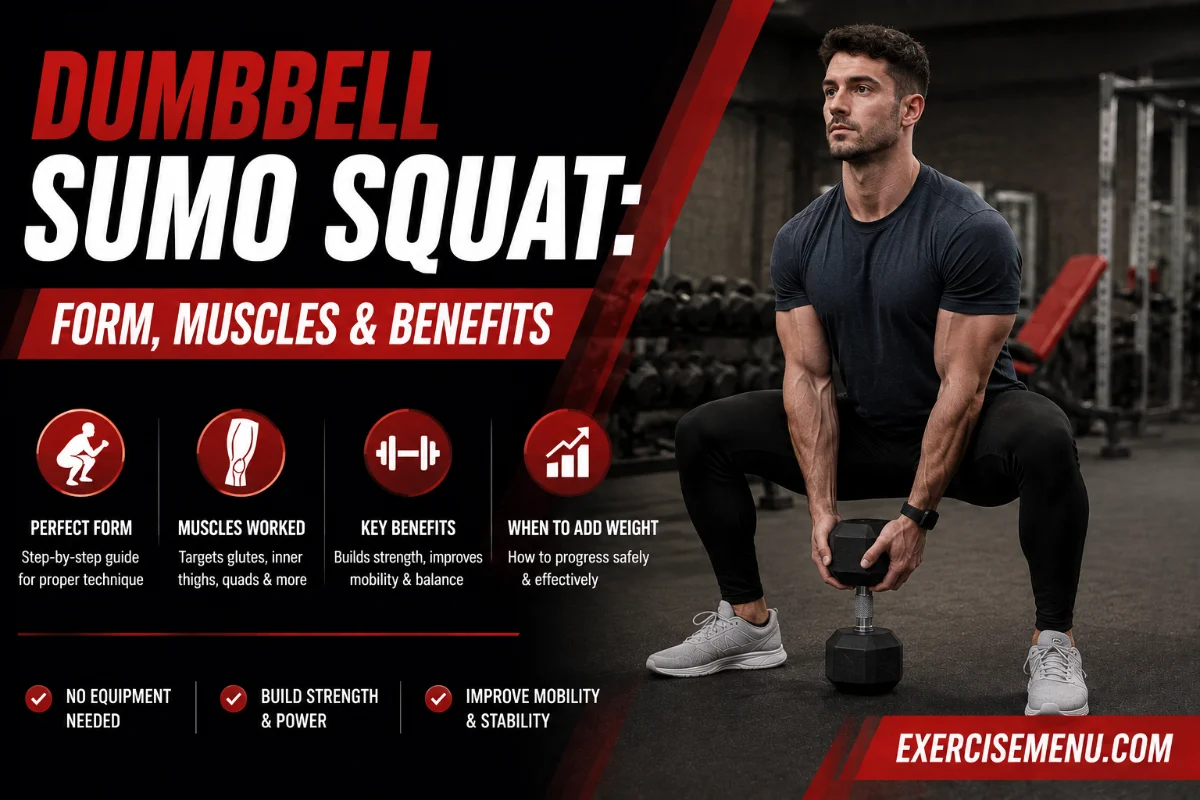
Quick Answer: The dumbbell sumo squat is a wide-stance squat that shifts more demand to the inner thighs (adductors) and glutes compared to a regular squat. Hold one dumbbell hanging between your legs, set your feet 1.5–2x shoulder-width apart with toes turned out 30–45 degrees, and squat until your thighs are at or below parallel.
The dumbbell sumo squat needs a single dumbbell, no rack and no spotter, which makes it practical for home training, hotel rooms and busy gyms. If you haven’t squatted with any load before, the air squat guide covers the bodyweight version to build the pattern first.
- How to Do a Dumbbell Sumo Squat?
- How to Hold the Dumbbell ?
- Muscles Worked by the Dumbbell Sumo Squat
- Benefits of Dumbbell Sumo Squats
- Dumbbell Sumo Squat vs Regular Dumbbell Squat
- Common Mistakes and How to Fix Them
- Why Don’t I Feel It in My Inner Thighs?
- How Many Sets and Reps Should You Do?
- Dumbbell Sumo Squat Variations
- Is a Sumo Squat the Same as a Plie Squat?
- Frequently Asked Questions
- The Practical Takeaway
How to Do a Dumbbell Sumo Squat?
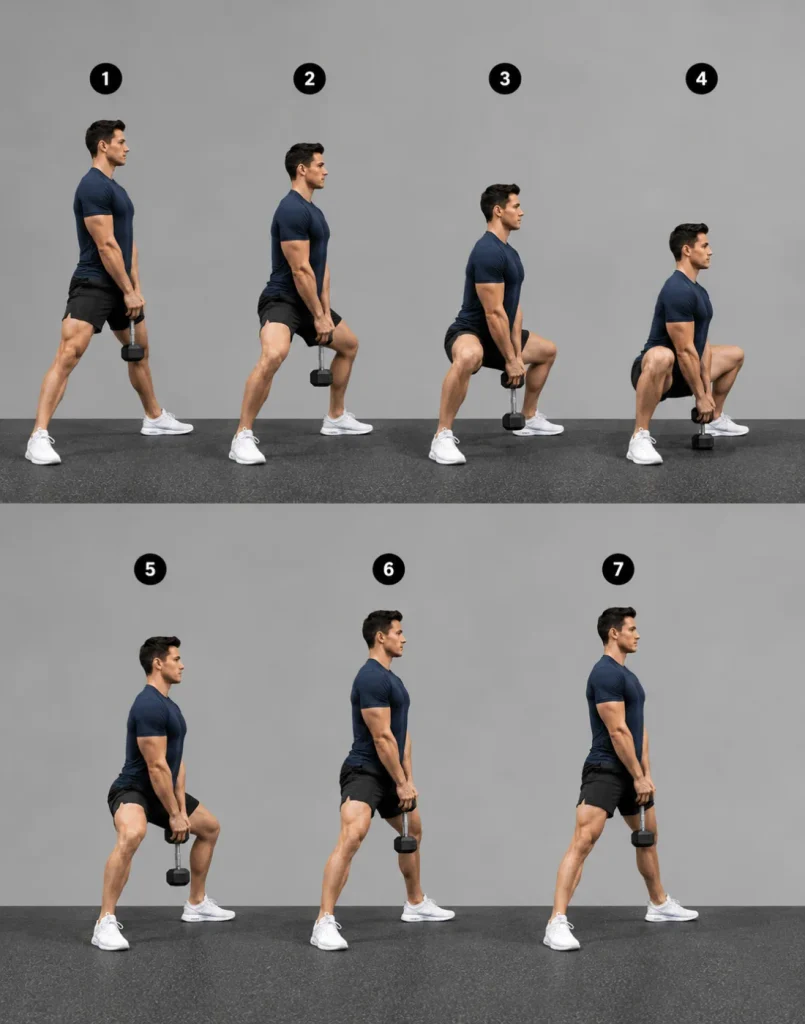
Stance: Set your feet 1.5–2 times shoulder-width apart. Turn your toes out 30–45 degrees. The exact width depends on your hip anatomy; start at 1.5x and widen gradually until you feel a controlled stretch in the inner thighs at the bottom.
Grip: Hold one end of a dumbbell with both hands, arms straight, letting it hang between your legs. Keep a firm grip but relaxed shoulders.
Descent: Push your hips back slightly and bend your knees outward, tracking them over your toes. Keep your chest up and your torso as upright as possible. The low centre of gravity makes this easier than a barbell squat.
Depth: Lower until your thighs reach parallel or just below. Your hip crease should be at or below the top of your knees. If the dumbbell touches the floor before you reach depth, stand on two weight plates or low steps to increase your range of motion.
Ascent: Drive through the whole foot, squeeze your glutes at the top and fully extend your hips. Don’t let your knees collapse inward on the way up.
Breathing: Inhale and brace your core as you descend. Exhale as you drive up.
How to Hold the Dumbbell ?
There are three common ways to hold the dumbbell. Each one changes the difficulty and muscle emphasis slightly.
Single dumbbell hanging between legs (most common): Hold one end of a dumbbell with both hands, letting it hang vertically below your hips. This is the easiest position to learn and keeps the centre of gravity low, which makes balance straightforward. Best for beginners and the widest stance widths.
Goblet position (dumbbell at chest): Cup one end of the dumbbell with both hands and hold it against your upper chest. This raises the centre of gravity, increases core demand and forces a more upright torso. It’s slightly harder than the hanging position and works well for lifters who struggle to keep their chest up.
Two dumbbells at sides: Hold one dumbbell in each hand, arms hanging straight down beside your thighs. This allows heavier total loading since grip isn’t the limiter. The dumbbells can hit the legs if the stance is very wide, so this works best with a slightly narrower sumo stance.
Muscles Worked by the Dumbbell Sumo Squat
The dumbbell sumo squat trains the same muscles as a regular squat but shifts emphasis toward the adductors and glutes because of the wide stance and hip external rotation.
Adductors (inner thighs): The adductor magnus, longus, brevis, gracilis and pectineus are the primary differentiator between sumo and regular squats. The wide stance stretches and loads the adductors through a larger range than any other compound squat variation.
Glutes: The gluteus maximus works hard to extend the hip from the bottom position. The wide stance and external hip rotation increase glute recruitment compared to a narrow-stance squat. The gluteus medius and minimus stabilise the pelvis and control knee tracking throughout the movement.
Quadriceps: The rectus femoris, vastus lateralis, vastus medialis and vastus intermedius extend the knee during the ascent. Quad involvement is slightly lower than in a narrow squat because the knees travel forward less, but the quads are still a primary mover.
Hamstrings, core and calves: The hamstrings (biceps femoris, semitendinosus, semimembranosus) assist hip extension. The abdominals and spinal erectors brace the trunk to keep it upright. The calves (gastrocnemius and soleus) help maintain balance, particularly when pressing through the whole foot.
Benefits of Dumbbell Sumo Squats
Targets the inner thighs more than regular squats. The wide stance places the adductors under a meaningful stretch and load that narrow-stance squats do not replicate. If inner-thigh development is a goal, the sumo squat is one of the most direct compound options.
Easier on the lower back. Because the dumbbell hangs between the legs and the torso stays upright, spinal loading is lower than in a barbell back squat. This makes it a practical option for lifters who want to train their legs hard without compressing the spine.
Accessible with minimal equipment. One dumbbell and enough floor space is all you need. No rack, no barbell, no spotter.
Improves hip mobility and external rotation. The wide, externally rotated stance trains ankle dorsiflexion and hip mobility through a loaded range. Over time, this carries over to improved barbell squat depth and comfort.
Builds foundation for barbell sumo squats and sumo deadlifts. The stance pattern is the same. Practising it with a dumbbell first builds the motor pattern, strength and mobility before adding a barbell.
Dumbbell Sumo Squat vs Regular Dumbbell Squat
The movement pattern is similar but the stance changes which muscles do the most work.
| Feature | Dumbbell sumo squat | Regular dumbbell squat |
| Stance width | 1.5–2x shoulder width, toes out 30–45° | Shoulder width, toes out 15–20° |
| Primary muscle emphasis | Adductors, glutes, quads | Quads, glutes |
| Torso angle | More upright | Slightly more forward lean |
| Knee travel | Less forward, more outward | More forward |
| Depth limiter | Hip mobility and dumbbell hitting floor | Ankle mobility |
| Lower-back demand | Lower (upright torso, low load position) | Moderate |
| Best for | Inner thigh and glute emphasis, home training | Quad emphasis, general leg strength |
Neither variation is better in absolute terms. Use sumo when you want more adductor and glute emphasis. Use regular stance when quad development is the priority. Both can be part of the same programme on different days.
Common Mistakes and How to Fix Them
| Mistake | Why it matters | Fix |
| Knees caving inward | Reduces adductor activation; stresses the knee joint | Push knees out toward pinky toes; reduce weight if needed |
| Stance too wide | Limits depth and puts strain on the hips or groin | Start at 1.5x shoulder width and widen gradually |
| Not deep enough | Limits glute and adductor contribution | Aim for thighs at or below parallel; use plates to elevate feet if dumbbell hits floor |
| Dumbbell hits floor early | Cuts range of motion short | Stand on two weight plates or low steps to add space |
| Torso collapsing forward | Shifts load to lower back instead of legs | Try the goblet hold position to force a more upright torso |
| Rushing reps | Reduces time under tension and control | Use a 2-second descent; pause at the bottom for 1 second |
Why Don’t I Feel It in My Inner Thighs?
If the sumo squat feels like a regular squat and you do not feel any work in the adductors, three things usually explain it.
Stance is too narrow. If your feet are only slightly wider than shoulder width, the adductors aren’t stretched enough to contribute meaningfully. Widen your stance until you feel a gentle stretch in the inner thighs at the bottom of the squat.
Toes are not turned out enough. Toes pointing forward or only slightly outward keeps the squat quad-dominant. Turn your toes out 30–45 degrees and make sure your knees track in the same direction.
Not going deep enough. The adductors are most active in the bottom half of the squat. If you’re stopping well above parallel, the inner thighs barely work. Use the elevated-platform technique to get deeper if the dumbbell limits your range.
How Many Sets and Reps Should You Do?
| Goal | Sets × Reps | Dumbbell Weight | Rest |
| Strength | 3–4 × 6–8 | Heaviest you can control with good form | 90–120 sec |
| Hypertrophy (muscle growth) | 3–4 × 10–15 | Moderate; last 2–3 reps should feel hard | 60–90 sec |
| Endurance / conditioning | 2–3 × 15–20 | Light to moderate | 45–60 sec |
Starting weight: If you’ve never done a loaded sumo squat, begin with 10–15 lb (5–7 kg) for women and 20–30 lb (10–15 kg) for men. Focus on depth and control for the first two weeks before adding weight.
Progress by adding 5 lb (2.5 kg) when you can complete your target reps with 2–3 reps in reserve. This is basic progressive overload applied to a single exercise. Matching rep ranges to your training goal will keep your programming structured as you get stronger.
Dumbbell Sumo Squat Variations
Pulse sumo squat: At the bottom of each rep, pulse up 3–4 inches and back down 2–3 times before standing fully. Keeps the adductors and glutes under constant tension. Brutal with light weight.
Tempo sumo squat: Use a 3-second descent, 1-second pause at the bottom, then stand at normal speed. Increases time under tension and forces control through the weakest part of the range.
Elevated sumo squat: Stand on two weight plates, low steps or sturdy blocks. This creates space below the dumbbell so you can squat deeper without the weight hitting the floor. The added depth increases adductor and glute stretch significantly.
Sumo squat to calf raise: Stand from the bottom of the squat, then immediately rise onto your toes for a calf raise before descending again. Adds a calf component without needing a separate exercise.
Kettlebell sumo squat: Swap the dumbbell for a kettlebell held by the horns (goblet) or hanging from the handle. The kettlebell shape can feel more natural in the hanging position because the load sits more compactly between the legs.
All five variations above keep the wide stance and adductor emphasis. To see how the sumo squat compares to narrow-stance, barbell, and machine squat variations, the full comparison breaks down 17 options by muscles, equipment, and difficulty
Is a Sumo Squat the Same as a Plie Squat?
Functionally, yes. Both use a wide stance with externally rotated hips. The term “plie” comes from ballet; “sumo” comes from the wrestling stance. Some coaches use “plie” for a more upright, toe-heavy version and “sumo” for a heel-driven, hip-dominant version, but in practice the overlap is so large that treating them as the same movement is reasonable. Perform the movement with heels flat and knees tracking over toes regardless of which name you use.
Frequently Asked Questions
How Wide Should My Sumo Squat Stance Be?
Wide enough that you feel a stretch in the inner thighs at the bottom, narrow enough that your knees can still track over your toes without hip pinching. Most people land between 1.5 and 2 times shoulder width, but hip anatomy varies. If you’re unsure, start narrower and add a few inches each session until the adductors engage without the hips feeling jammed.
Is the Sumo Squat Better Than Regular Squats for Glutes?
The sumo squat tends to recruit more glute and adductor due to the wide stance and hip external rotation. Regular squats recruit more quad. For maximal glute development, use both: sumo squats for width and adductor contribution, regular squats for overall quad and glute loading.
Can I Do Sumo Squats Every Day?
Bodyweight sumo squats can be done daily. Loaded dumbbell sumo squats are better limited to 2–3 sessions per week with at least one rest day between sessions. The adductors recover more slowly than you might expect from a squat variation.
What If the Dumbbell Hits the Floor Before I’m Deep Enough?
Stand on two weight plates, low aerobic steps or sturdy blocks. This raises your feet 2–4 inches above the floor and gives the dumbbell room to travel deeper. Make sure the surface is stable and flat before loading.
Can I Use Two Dumbbells Instead of One?
Yes. Hold one dumbbell in each hand with arms hanging at your sides. This allows heavier total loading since grip is less of a limiter. Use a slightly narrower sumo stance to avoid the dumbbells hitting your legs.
When Should I Switch From Dumbbell to Barbell Sumo Squats?
When the heaviest dumbbell available no longer challenges you for your target rep range, a barbell is the next logical step. The front squat vs back squat comparison and average squat weight standards can help you navigate the transition and see where your strength stands.
The Practical Takeaway
The dumbbell sumo squat gives you loaded adductor and glute work with nothing more than a single dumbbell and floor space. Set the stance wide enough to feel the inner thighs stretch at the bottom, hold the dumbbell in whichever position keeps your torso upright, and squat to at least parallel. Add weight when the current dumbbell stops challenging you. When dumbbells run out, the barbell is waiting.
Fitness Disclaimer: If you have an existing injury or medical condition, check with your doctor before starting a new programme or changing your training. The information in this article is for educational purposes and does not replace individual assessment by a qualified health or fitness professional.

1 Comment
Pingback: 17 Types of Squats: Muscles, Difficulty and How to Choose