

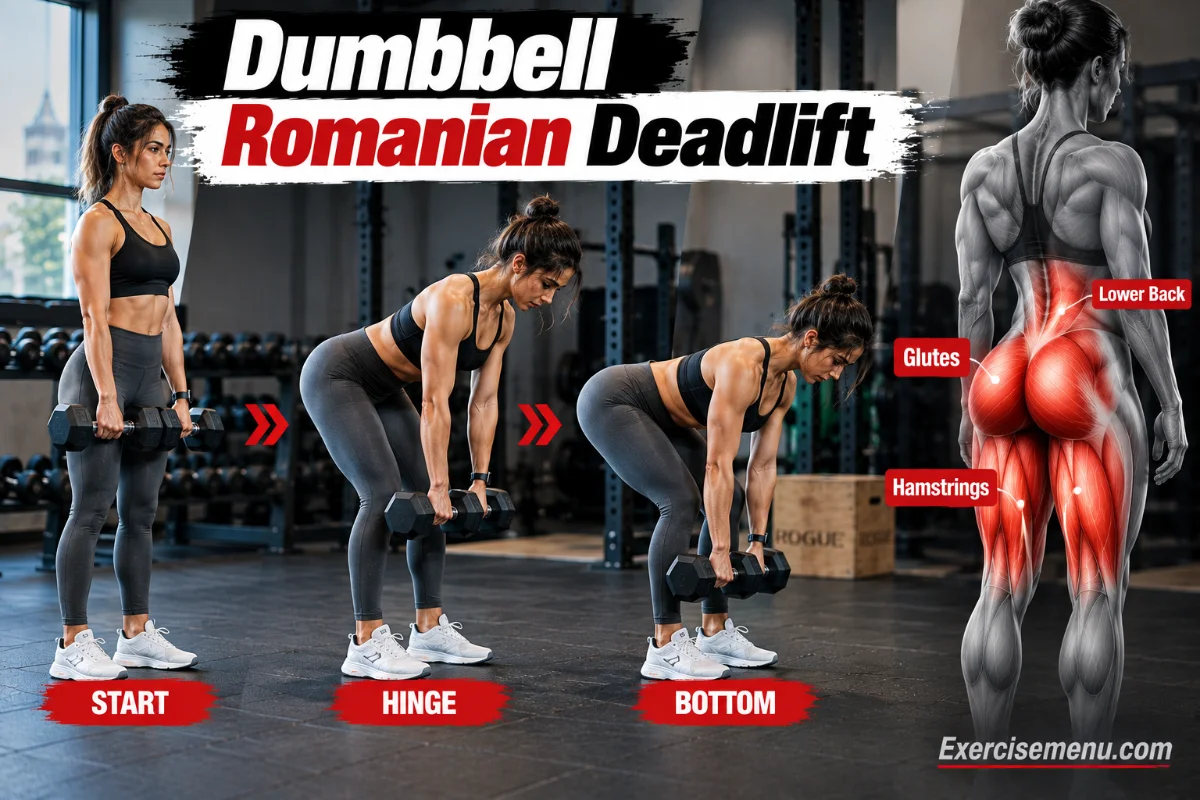
Quick Answer: The dumbbell RDL is a hip hinge exercise where you push your hips back and lower two dumbbells down your legs with a soft knee bend, then drive your hips forward to stand. It primarily trains your hamstrings and glutes through a deep stretch. Most people should lower until the dumbbells reach mid-shin.
The dumbbell Romanian deadlift looks simple — pick up two dumbbells, hinge forward, come back up. But most people who try it make the same small errors: bending the knees too much, letting the dumbbells drift away from the legs, or cutting the descent short and wondering why their hamstrings never grow.
This guide covers the exact form, how deep to go, what to check if you feel it in the wrong place, and what the research actually shows about why depth matters.
- What Is the Dumbbell Romanian Deadlift?
- How to Do the Dumbbell Romanian Deadlift?
- How Deep Should You Go on a Dumbbell RDL?
- What Mistakes Should You Avoid?
- What Muscles Does the Dumbbell RDL Work?
- What Are the Benefits of the Dumbbell RDL?
- Dumbbell RDL vs Barbell RDL: Which Should You Use?
- How Can You Progress the Dumbbell RDL?
- How to Program the Dumbbell RDL?
- Frequently Asked Questions
What Is the Dumbbell Romanian Deadlift?
The dumbbell RDL is a hip hinge movement that starts and finishes standing. You lower the dumbbells by pushing your hips back with a fixed, soft knee bend — not by bending your knees into a squat — then drive your hips forward to return upright. The weights do not touch the floor between reps, which keeps the hamstrings under continuous tension throughout every set.
Unlike a conventional deadlift, the RDL does not train leg drive off the floor. The focus is entirely on the hip hinge: loading the posterior chain through a long range of motion, then extending the hips to stand.
How to Do the Dumbbell Romanian Deadlift?
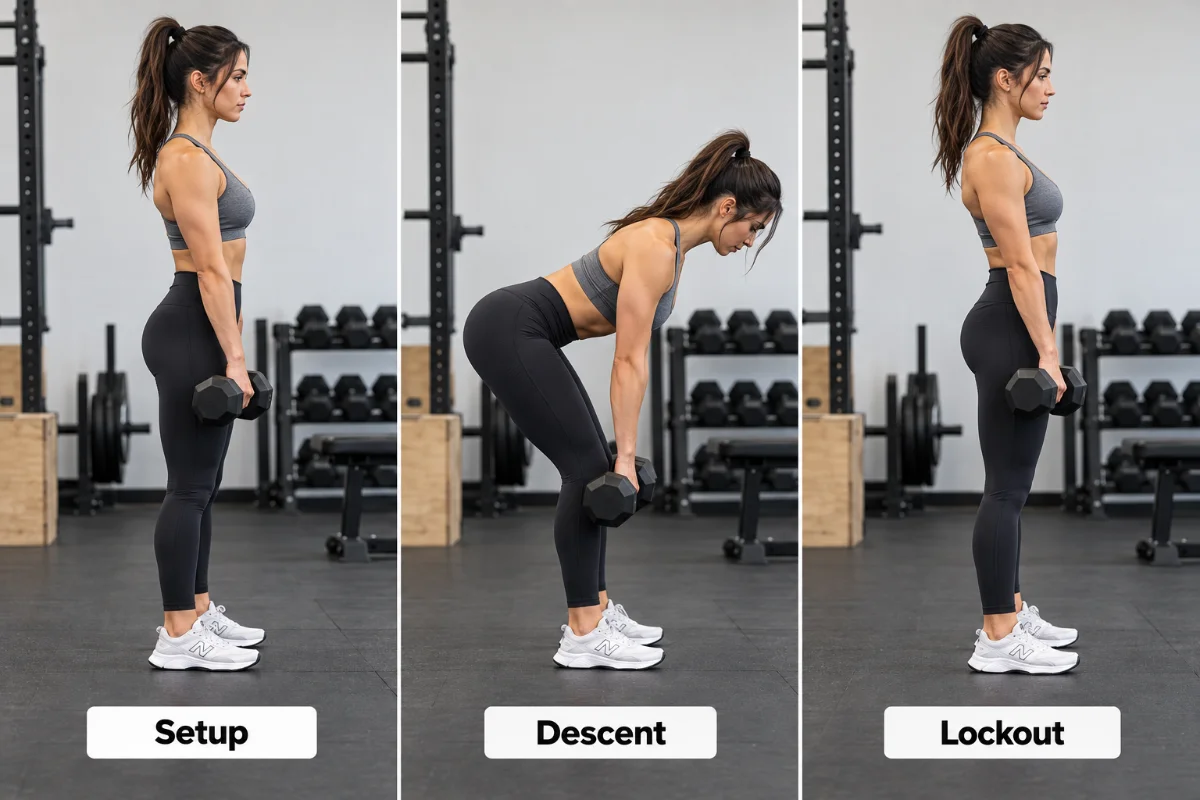
Setup
- Stand with feet hip-width apart, a dumbbell in each hand in front of your thighs, palms facing your legs.
- Set a soft knee bend — approximately 30 degrees. Your knees are unlocked but not deeply bent. This angle is fixed for the entire rep — it does not change during the descent or ascent.
- Engage your lats. Think “squeeze oranges in your armpits.” Shoulder blades down and back. This keeps the dumbbells tracking close to your legs and prevents them from floating forward under load.
- Brace your core. Breathe into your belly and create pressure through your trunk before you move.
The Descent
- Push your hips straight back — not down. Think “hips to the wall behind you.” Your torso leans forward as your hips move back. Your shins stay nearly vertical throughout.
- Keep the dumbbells within 1–2 inches of your thighs and shins. The further they drift forward, the more your lower back carries the load.
- Maintain a flat spine. No rounding at the lower or upper back. Look at a spot on the floor 4–5 feet ahead — your head moves with your torso, not independently.
- Stop when your hips stop moving back. For most people that puts the dumbbells between the knee and mid-shin. More on this in the depth section below.
The Ascent
- Drive your hips forward to return upright. The arms stay straight — hip extension does the work, not a pull with the arms.
- Squeeze your glutes as you approach the top. This finishes hip extension and reinforces glute activation at the end range.
- Stand tall. Hips locked out, ribs stacked over hips. Do not lean back past vertical.
- Breathe out on the way up, reset your brace, and begin the next rep.
Adjusting for Glutes vs Hamstrings
Small adjustments shift the emphasis. Less knee bend and a more forward torso lean increases hamstring stretch and loading. A slightly greater knee bend and more upright torso shifts emphasis toward the glutes. Both are valid — just stay consistent within a set.
How Deep Should You Go on a Dumbbell RDL?
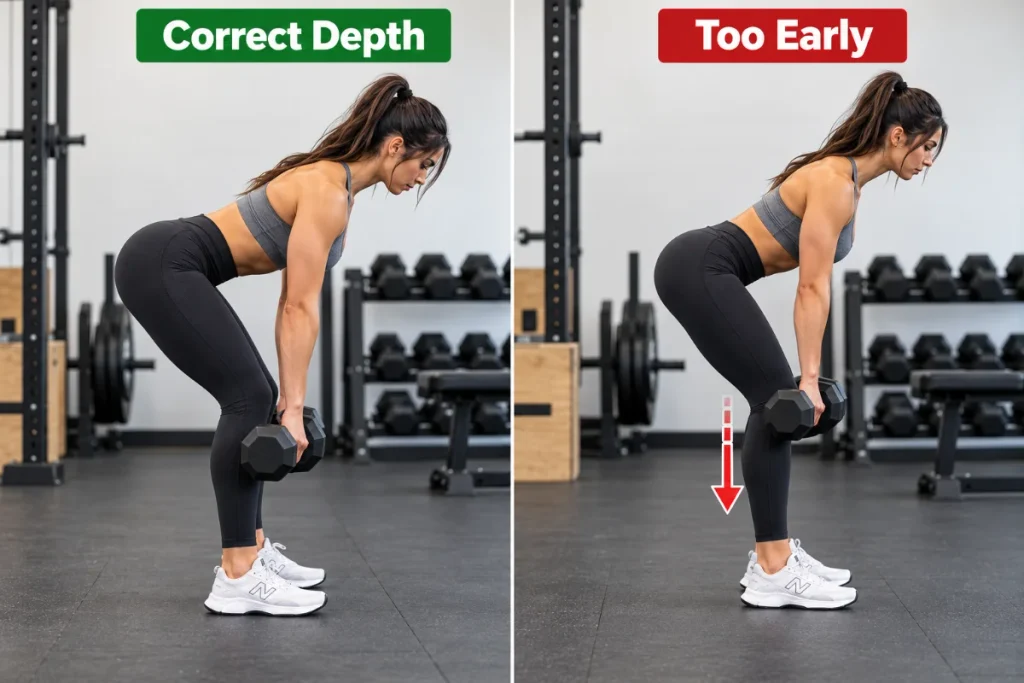
Go down until your hips stop moving back, with your back still flat. For most people, that puts the dumbbells between the knee and mid-shin. Do not try to go further by bending your knees more or rounding your lower back — both reduce hamstring stretch rather than increase it.
Depth matters because the bottom of the rep is where the hamstrings are longest and under the most load — the range where growth stimulus is highest. Research by Maeo et al. (2021) found that training the hamstrings at longer muscle lengths produced 14% growth over 12 weeks, compared to 9% at shorter lengths. A 2025 systematic review by Wolf et al. across multiple studies further supported that longer-muscle-length training produces greater hypertrophy. Cutting the descent short means you are spending most of each rep in the least productive range.
Two things that reduce depth incorrectly:
- Bending the knees more to reach lower — this shortens the hamstrings. The knee angle in the RDL sits between 30–35 degrees based on biomechanical analysis; increasing it shifts the movement toward a squat and reduces the hamstring stimulus.
- Rounding the lower back to reach the floor — depth comes from hip movement, not spinal flexion. Once your hips stop moving back, the rep is done.
What Mistakes Should You Avoid?
Rounding the Lower Back
The most common reason people feel the RDL in the lower back instead of the hamstrings. When the lumbar spine flexes under load, the erectors absorb stress that the hamstrings and glutes were supposed to handle. If you cannot maintain a neutral spine at a given depth, stop higher — more range is only useful with a flat back.
Bending the Knees Too Much
Once the knee bend increases past the starting position, the movement becomes a squat. The hamstrings shorten as the knee flexes further, removing the stretch that makes the RDL effective. Set the soft bend at the top and treat it as locked for the duration of the rep.
Dumbbells Drifting Forward
The further the dumbbells drift from your legs, the longer the moment arm on your lower back. Keep them tracking close to your thighs and shins. If they float forward consistently, re-engage your lats harder at the start of the next rep before descending.
Cutting the Descent Short
Stopping at knee height instead of mid-shin means you are training only in the shortened range. The peak loading of the RDL is at the bottom. Going to where your hips stop — not to where it starts to feel like a stretch — is where the exercise actually works.
Leaning Back at Lockout
Passing vertical and leaning backward at the top hyperextends the lumbar spine under load. Standing tall with hips extended is lockout — nothing further is needed.
Head Extending Upward
Looking up toward the ceiling extends the cervical spine throughout the set. Keep your gaze on the floor 4–5 feet ahead. Your head moves as one unit with your torso.
What Muscles Does the Dumbbell RDL Work?
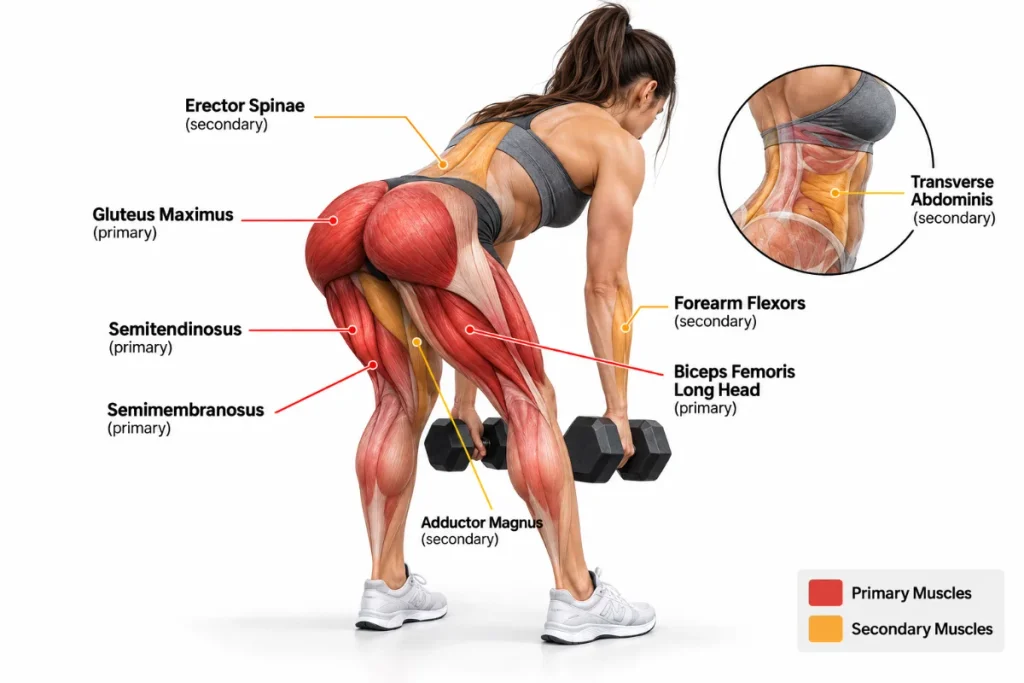
Primary Muscles
Hamstrings
The main target. As the hips push back, the hamstrings lengthen under load — the eccentric loading that drives both strength and hypertrophy. A 2025 randomised controlled trial by Crawford et al. found that 6 weeks of twice-weekly RDL training produced a 10% increase in hamstring cross-sectional area, comparable to Nordic curls for muscle architectural development.
One practical limit: only three of your four hamstring muscles cross both the hip and the knee. The biceps femoris short head crosses only the knee joint, so it barely contributes to hip hinge exercises. To develop all parts of the hamstrings fully, pairing RDLs with a knee-flexion exercise — leg curl or Nordic curl — is more effective than RDLs alone.
Glutes (Gluteus Maximus)
Drive hip extension on the ascent and stabilise the hip throughout. The glutes fire hardest as you drive from the bottom position back to standing. Squeezing the glutes deliberately at the top reinforces full hip extension and maximises their activation at the end range.
Secondary Muscles
Adductor Magnus
Works as a hip extensor throughout — not just an inner thigh stabiliser. Research by Takahashi et al. (2025) in the Journal of Applied Physiology found the adductor magnus generates over twice as much hip extension torque as adduction torque. This is why the inner thighs can become sore after heavy RDL sessions — they are contributing meaningfully to hip extension.
Erector Spinae
Work isometrically to hold the spine in neutral. They stabilise, they do not move the load — and they do not get stronger from RDL training alone. Fisher et al. (2013) found that 10 weeks of RDL training improved RDL 1RM significantly but produced no increase in isolated lumbar extension torque. If lower back strength is a specific training goal, add dedicated back extensions — the RDL will not deliver it.
Core and Grip
The core braces isometrically against spinal flexion throughout every rep. The forearms and grip hold the load — and typically become the limiting factor before the hamstrings do on heavier or longer sets.
Muscle Summary
| Muscle | Role | Activation Level |
|---|---|---|
| Hamstrings | Primary mover — hip extension and eccentric stretch | High |
| Glutes | Hip extension — peaks at ascent from bottom | High |
| Adductor magnus | Hip extension synergist | Moderate–High |
| Erector spinae | Spinal stabilisation only (isometric) | Moderate |
| Core | Trunk bracing | Moderate |
| Forearms / grip | Hold the load | Moderate |
What Are the Benefits of the Dumbbell RDL?
Hamstring Development Through Long-Range Loading
The RDL trains the hamstrings at their longest — hips flexed, weights near the bottom of the range — which current evidence identifies as the most effective position for hypertrophy. Maeo et al. (2021) found 14% hamstring growth at long muscle lengths versus 9% at short lengths over 12 weeks. The Wolf et al. (2025) systematic review further supports this principle. To convert this per-session stimulus into long-term development, applying progressive overload — adding load or reps consistently — is what drives ongoing adaptation.
Continuous Hamstring Tension
Because the weights do not reach the floor between reps, the hamstrings stay loaded throughout every rep of every set. No brief offloading at the bottom, no opportunity to reset tension. This continuous demand is part of why the RDL is more challenging than it looks at moderate weights.
Hip Mobility Improvement Over Time
Regularly hinging through a full range of motion under load gradually improves hip flexion range and hamstring flexibility. Most people find that after 4–6 weeks of consistent RDL training, the bottom position that felt restricted at the start becomes accessible without forcing it.
Athletic Carryover
The hip hinge pattern built by the RDL transfers directly into the deadlift, trap bar deadlift, and any athletic movement requiring hip extension — sprinting, jumping, and change-of-direction mechanics. Programming it as an accessory to heavier pulling work reinforces the mechanics that make those movements stronger.
Dumbbell RDL vs Barbell RDL: Which Should You Use?
| Factor | Dumbbell RDL | Barbell RDL |
|---|---|---|
| Maximum load | Limited by dumbbell availability | Higher — small plate increments possible |
| Setup | Pick up and go | Requires loading a barbell |
| Learning curve | Lower — natural arm path | Higher — bar path around the knees |
| Hamstring stimulus | Comparable to barbell | Comparable to dumbbell |
| Best for | Beginners, home training, accessory work | Advanced loading, primary strength work |
For beginners, dumbbells are the better starting point. Once the heaviest dumbbells at your gym are no longer challenging, a barbell RDL [bold placeholder — not yet live] is the natural next step.
How Can You Progress the Dumbbell RDL?
Single-Leg Dumbbell RDL
Perform the movement on one leg while the other extends behind you for counterbalance. Each side works independently, which exposes strength imbalances and adds hip stability demand the bilateral version does not create. Start lighter than your standard working weight.
B-Stance (Kickstand) RDL
One foot slightly behind the other with just the toe touching — roughly 85–90% of the load on the front leg. A bridge between bilateral and single-leg work for lifters who find the single-leg version too unstable to load usefully.
Deficit Dumbbell RDL
Stand on a weight plate to increase range of motion below standard floor height. Research by Coratella et al. (2022) found that performing an RDL from a step produced significantly greater gluteus maximus and semitendinosus activation compared to the standard floor version. Use this only once your standard form is solid.
Tempo Dumbbell RDL
Slow the descent to 3–4 seconds per rep. More time under tension, more positional demand, without adding load. Useful when load progression has plateaued or when technique breaks under fatigue before it breaks under weight.
How to Program the Dumbbell RDL?
Warm Up First
Hip circles, leg swings, and 2–3 sets of bodyweight hinges before your working sets prepare the posterior chain and help establish the movement pattern before adding load.
How Much Weight to Use
Start light enough to maintain a flat spine and full depth for every rep. If you could do 2 more reps with perfect form at the end of a set, increase weight next session. If your last rep showed form breakdown, hold the weight.
| Level | Starting Weight (per dumbbell) |
|---|---|
| Beginner | 10–20 lbs / 5–10 kg |
| Intermediate | 30–50 lbs / 15–22.5 kg |
| Advanced | 55 lbs+ / 25 kg+ |
Sets, Reps, and Goals
| Goal | Sets × Reps | Load | Rest |
|---|---|---|---|
| Muscle growth | 3–4 × 8–12 | Moderate — 2–3 reps from failure | 90 sec–2 min |
| Strength | 4 × 5–8 | Heavy — controlled form throughout | 2–3 min |
| Beginner / learning | 3 × 10–12 | Light — form focus | 90 sec |
Train the dumbbell RDL 1–2 times per week with at least 48 hours between sessions. The posterior chain needs adequate recovery from heavy eccentric loading. For guidance on volume and rep ranges by goal, see how many sets and reps you need depends on what you are training for.
Frequently Asked Questions
Can I Do Dumbbell RDLs Every Day?
No. The eccentric loading of the RDL causes meaningful muscle damage that requires recovery time. Training it daily does not allow this and will stall progress. Once or twice per week with at least 48 hours between sessions is appropriate for most people.
Should I Use Straps for Dumbbell RDLs?
Only when grip is genuinely the limiting factor before the hamstrings are. For most working sets, grip should develop alongside the lift. If your hands consistently give out well before your legs, straps are appropriate — but not as a default from the first working set.
Should I Use a Neutral Grip or Overhand Grip for Dumbbell RDLs?
Neutral grip — palms facing your legs — is standard and suits most people. It positions the wrists and elbows comfortably through the full range of motion and reduces forearm strain on longer sets. An overhand grip (palms facing backward) is sometimes used but places more rotational stress on the wrists and has no advantage for hamstring or glute loading.
How Do I Know if My Hip Hinge Is Correct Without a Mirror?
Two reliable self-checks: (1) Press one hand against your lower back during a practice rep — if your spine rounds, you will feel the gap close. (2) Perform a bodyweight hinge with your back against a wall, one arm-length away. Push your hips back to touch the wall while keeping your shins vertical and back flat. If you can do this cleanly, your hinge mechanics are solid. Film yourself from the side when possible — it is the fastest way to confirm the shins are staying vertical and the back is staying flat.
Can I Superset Dumbbell RDLs With Another Exercise?
Yes, with the right pairing. The RDL heavily loads the posterior chain and lower back, so the best superset partner is an exercise that uses completely different muscle groups — upper body pushing or pulling works well (dumbbell press, cable row, lat pulldown). Avoid pairing RDLs with other hip-dominant or lower back-intensive movements like good mornings, back extensions, or hip thrusts in the same superset — those muscles need recovery between sets to maintain form and stimulus quality.
If you have an existing hamstring injury, lower back condition, or are returning from injury, get clearance from a physiotherapist before loading this movement.
