

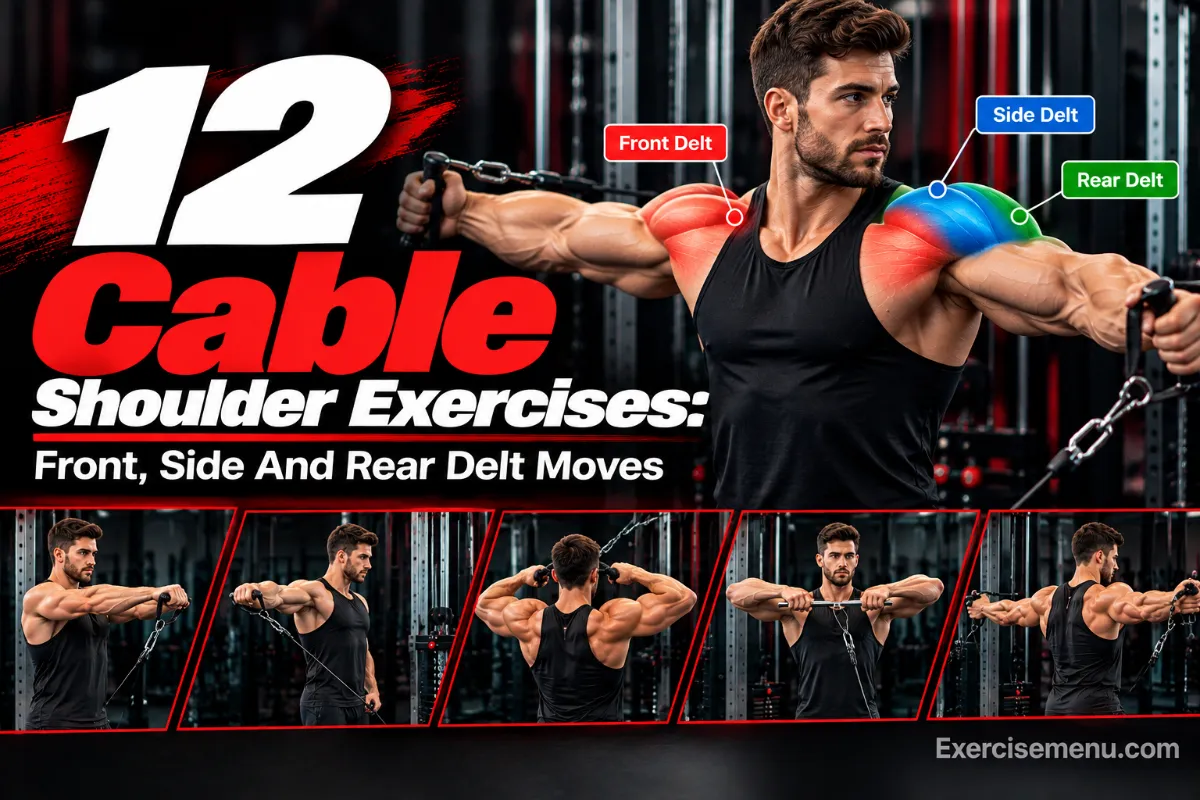
Quick Answer: The best cable shoulder exercises target all three deltoid heads using different pulley heights. Cable lateral raises build side delts, front raises hit front delts, and face pulls develop rear delts. Cables keep tension on the muscle through the full range, unlike dumbbells, which lose load at the bottom.
Cables let you train shoulders from angles dumbbells can’t match. You can set the pulley low for raises, at chest height for crossovers, or high for face pulls, and the weight stack loads the deltoid through positions where a dumbbell would go slack. Any cable station works: a single-pulley machine, a functional trainer, or a dual cable crossover.
This guide covers 12 cable shoulder exercises grouped by the part of the shoulder they target: side delts, front delts, rear delts, and rotator cuff. Each exercise includes the pulley height, attachment, and form cues you need to do it right. At the end, there’s a ready-to-use cable shoulder workout you can take to the gym.
- Cable Shoulder Exercise Quick Reference
- Why Use Cables for Shoulder Exercises?
- Where Should You Set the Pulley for Each Shoulder Exercise?
- Cable Exercises for Side Delts (Lateral Deltoid)
- Cable Exercises for Front Delts (Anterior Deltoid)
- Cable Exercises for Rear Delts (Posterior Deltoid)
- Cable Exercises for Shoulder Health (Rotator Cuff)
- Cable Shoulder Workout: Complete Routine
- What Are the Most Common Cable Shoulder Mistakes?
- Frequently Asked Questions
Cable Shoulder Exercise Quick Reference
| Exercise | Delt Head | Pulley Height | Attachment |
|---|---|---|---|
| Cable Lateral Raise | Side | Low | D-handle |
| Leaning Cable Lateral Raise | Side | Low | D-handle |
| Cable Upright Row | Side + Traps | Low | Straight bar or rope |
| Cable Front Raise | Front | Low | D-handle or straight bar |
| Cable Overhead Press | Front + Side | Low | D-handles (dual) |
| Cable Arnold Press | All three heads | Low | D-handles (dual) |
| Cable Face Pull | Rear | High (face height) | Rope |
| Cable Reverse Fly | Rear | High (shoulder height) | D-handles or no attachment |
| Cable Rear Delt Row | Rear | Mid (chest height) | Rope |
| Cable Y Raise | Rear + Side | Low | D-handles or rope |
| Cable External Rotation | Rotator Cuff | Mid (elbow height) | D-handle |
| Cable Internal Rotation | Rotator Cuff | Mid (elbow height) | D-handle |
Why Use Cables for Shoulder Exercises?
Cables maintain resistance throughout the entire range of motion. With a dumbbell lateral raise, there’s almost no tension on the side delt at the bottom of the movement — gravity pulls straight down, and the lever arm is minimal. A cable pulling from the side keeps the muscle loaded from the first inch to the last.
A 2017 study in the Journal of Strength and Conditioning Research compared cable-based exercises to selectorized machines for pressing and curling movements. The cable versions produced different muscle activation patterns and greater range of motion at multiple joints — suggesting cables demand more stabilization work from surrounding muscles (Signorile et al., 2017).
That said, cables don’t automatically produce more muscle growth than dumbbells. A 2025 study in Frontiers in Physiology compared cable and dumbbell lateral raises over eight weeks in trained lifters and found no measurable difference in lateral deltoid hypertrophy between the two (Larsen et al., 2025). Both tools work. Cables give you more angles and a different resistance curve — the load stays on the muscle through positions where a dumbbell would go slack. That matters most when you’re isolating a specific head of the deltoid.
If you’re new to cable machines, the cable machine guide covers setup, attachments, and basic movement patterns.
Where Should You Set the Pulley for Each Shoulder Exercise?
The pulley position determines the direction of resistance, which changes which part of the shoulder works hardest. Getting this wrong doesn’t just reduce effectiveness — it can shift the load onto the traps or chest instead of the delts.
| Pulley Height | Best For | Exercises |
|---|---|---|
| Low (ankle–knee) | Raises, presses, upright rows, Y raises | Lateral raise, front raise, overhead press, Arnold press, upright row, Y raise |
| Mid (chest–elbow) | Horizontal pulls, rotator cuff work | Rear delt row, external rotation, internal rotation |
| High (face–overhead) | Face pulls, reverse flys | Face pull, reverse fly |
A common mistake: setting the pulley at mid-height for lateral raises. This shortens the range of motion and reduces the stretch at the bottom. For raises, always start with the pulley at the lowest setting.
Cable Exercises for Side Delts (Lateral Deltoid)
The side delt is responsible for shoulder abduction — raising your arm out to the side. It’s the muscle that gives shoulders their width, and cables are one of the best ways to isolate it because the resistance stays perpendicular to the arm through the full range.
1. Cable Lateral Raise
Pulley: Low (bottom setting)
Attachment: D-handle
Target: Lateral deltoid
How to do it:
- Stand sideways to the cable machine with the D-handle in your outside hand.
- Start with your arm at your side, elbow slightly bent (around 10–15 degrees). Keep that bend locked throughout.
- Raise your arm out to the side until your hand reaches shoulder height. Lead with your elbow, not your wrist.
- Pause briefly at the top, then lower under control over 2–3 seconds.
- Complete all reps on one side before switching.
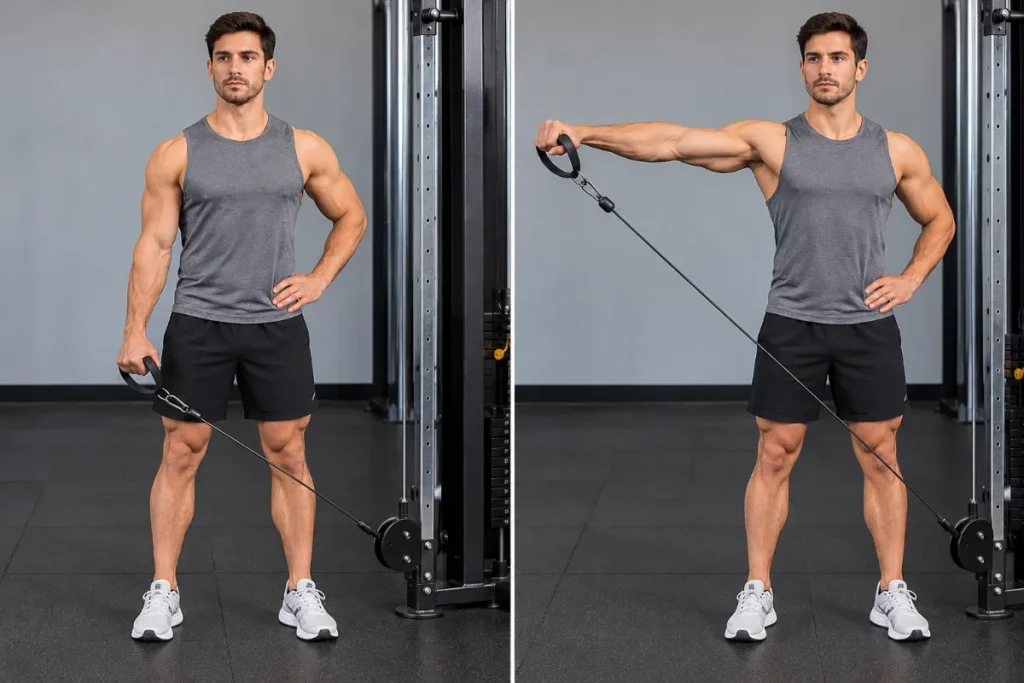
Why it works: Unlike a dumbbell lateral raise, the cable version keeps tension on the lateral deltoid at the bottom of the movement. There’s no dead zone where the weight just hangs.
Common mistake: Shrugging the shoulder up as you raise the arm. This shifts the load to the upper traps. Keep your shoulder blade pulled down and focus on moving only at the shoulder joint.
2. Leaning Cable Lateral Raise
Pulley: Low (bottom setting)
Attachment: D-handle
Target: Lateral deltoid (greater stretch at bottom)
How to do it:
- Stand sideways to the machine and grab the frame with your inside hand at about shoulder height.
- Hold the D-handle in your outside hand and lean your body away from the machine — your feet stay close to the base.
- Raise your arm out to the side until it’s roughly parallel to the floor.
- Lower under control. The lean increases the range of motion at the bottom, so you’ll feel a deeper stretch in the side delt.
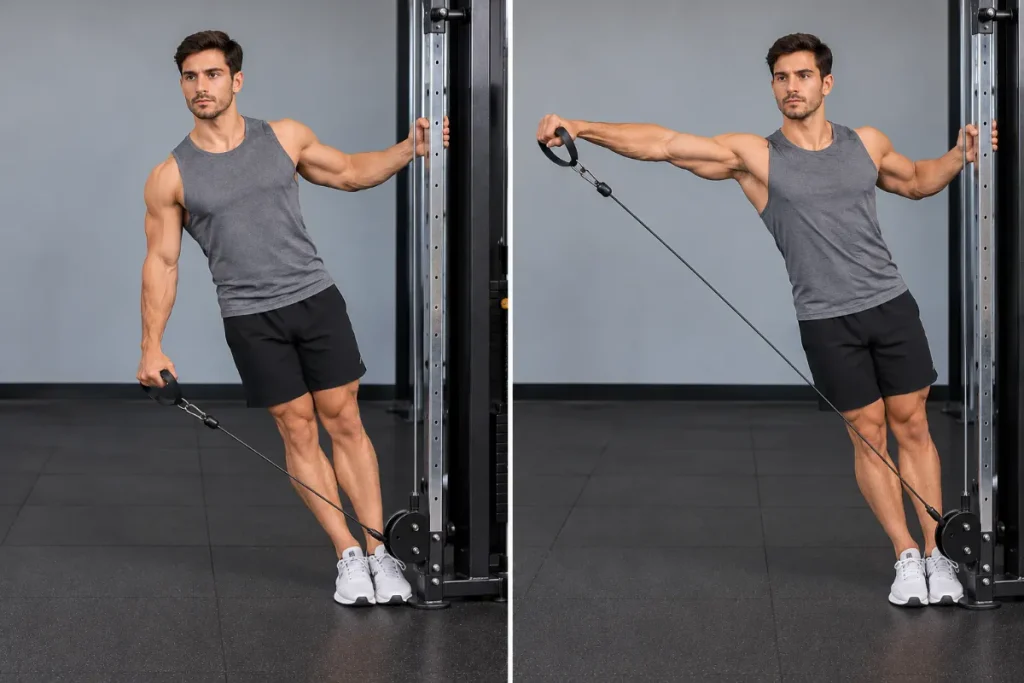
Why it works: Leaning shifts the resistance curve so the side delt stays loaded even at the bottom of the rep — the position where a standard lateral raise has the least tension. The extra stretch under load may contribute to greater stimulus, though this hasn’t been tested in isolation for this specific variation.
3. Cable Upright Row
Pulley: Low (bottom setting)
Attachment: Straight bar or rope
Target: Lateral deltoid, upper trapezius
How to do it:
- Face the cable machine and grip the bar or rope with both hands, palms facing your body, hands roughly shoulder-width apart.
- Pull the attachment upward along your torso, leading with your elbows. Stop when your elbows reach shoulder height.
- Keep the bar close to your body throughout.
- Lower under control.
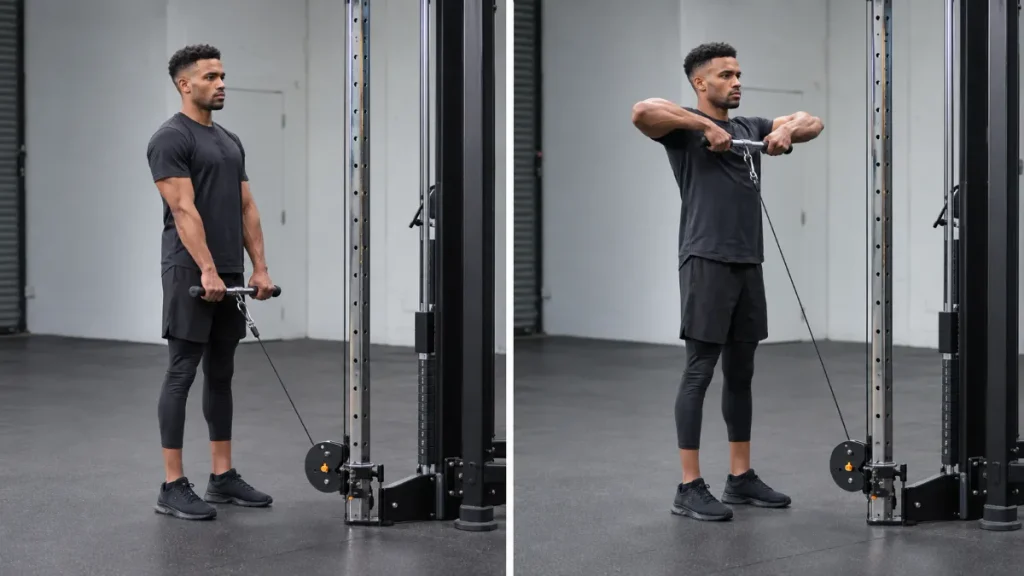
Form note: Upright rows sometimes get blamed for shoulder impingement. The risk comes from pulling too high — bringing elbows well above the shoulders — with a narrow grip. A shoulder-width or slightly wider grip with elbows stopping at shoulder height keeps the subacromial space open. If you feel pinching at the top, widen your grip or switch to a rope attachment, which allows a more natural wrist angle.
Cable Exercises for Front Delts (Anterior Deltoid)
The front delt drives shoulder flexion, raising your arm forward. It also assists in pressing movements. Most lifters already get plenty of front delt work from bench presses and overhead presses with free weights, so cable front delt exercises work best as targeted additions rather than the foundation of a shoulder session.
4. Cable Front Raise
Pulley: Low (bottom setting)
Attachment: D-handle (single arm) or straight bar (both arms)
Target: Anterior deltoid
How to do it:
- Face away from the machine. Hold the D-handle at your side with your palm facing behind you.
- With a slight bend in your elbow, raise your arm forward until your hand reaches shoulder height.
- Hold for a count at the top.
- Lower slowly. The cable will try to pull your arm back — resist it on the way down.
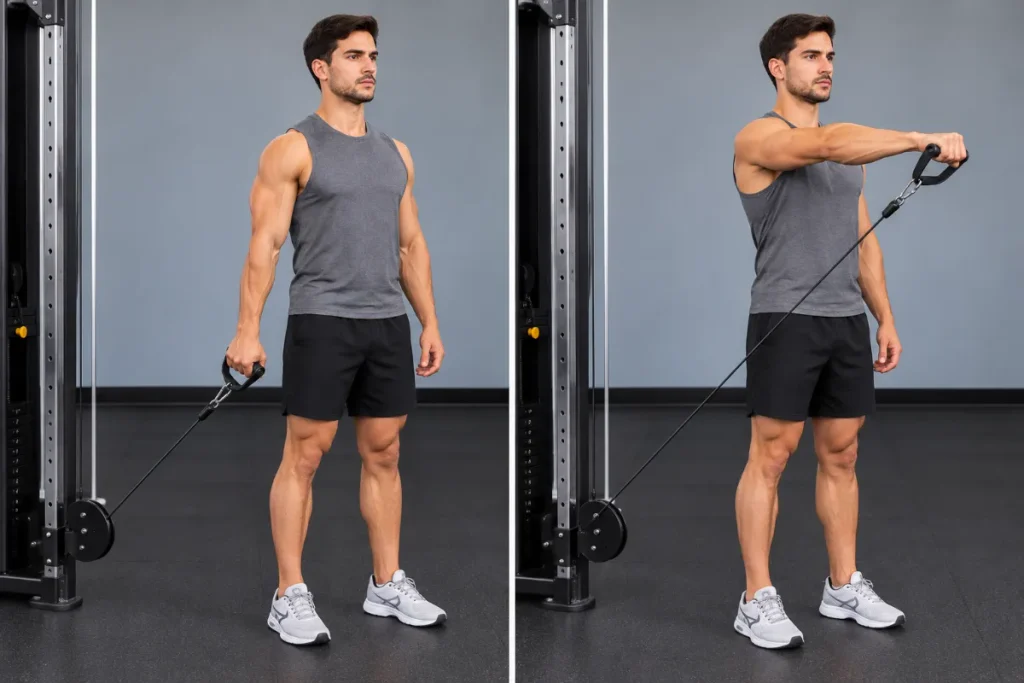
Common mistake: Arching the lower back as the arm comes up, especially with heavier weight. Brace your core and stop the rep at shoulder height. Going higher shifts work to the upper traps.
5. Cable Overhead Press
Pulley: Low (bottom setting)
Attachment: D-handles (one in each hand)
Target: Anterior and lateral deltoid, triceps
How to do it:
- Set both pulleys to the lowest position on a dual cable machine. Stand between them facing away, one handle in each hand.
- Bring the handles to shoulder height, palms facing forward, this is your start position.
- Press both handles overhead until your arms are fully extended. Don’t let the cables pull your arms backward — stay in a slight forward lean if needed.
- Lower the handles back to shoulder height under control.
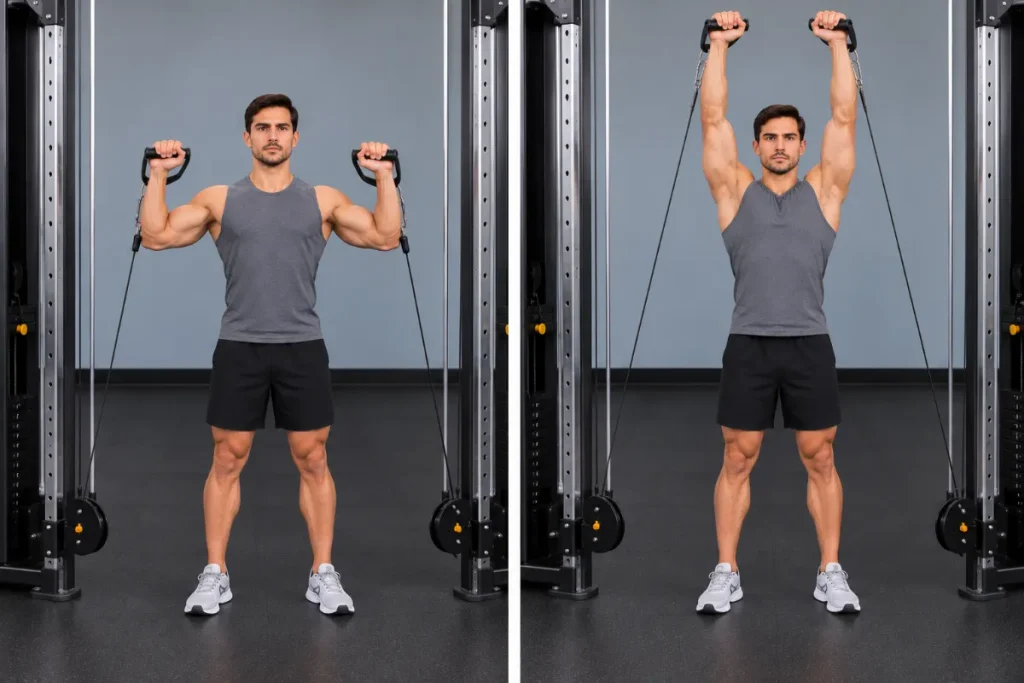
Why cables for pressing: The cable pulls at an angle, which forces the deltoids to stabilize horizontally as well as press vertically. You’ll use less weight than a barbell press, but the stabilization demand is higher.
6. Cable Arnold Press
Pulley: Low (bottom setting)
Attachment: D-handles (one in each hand)
Target: All three deltoid heads (emphasis shifts through the rotation)
How to do it:
- Set up the same way as the cable overhead press — pulleys low, one handle in each hand, standing between the cables.
- Start with the handles at shoulder height, palms facing you (like the top of a bicep curl).
- Press upward while rotating your palms outward. By the top of the press, your palms face forward.
- Reverse the rotation as you lower back to the starting position.
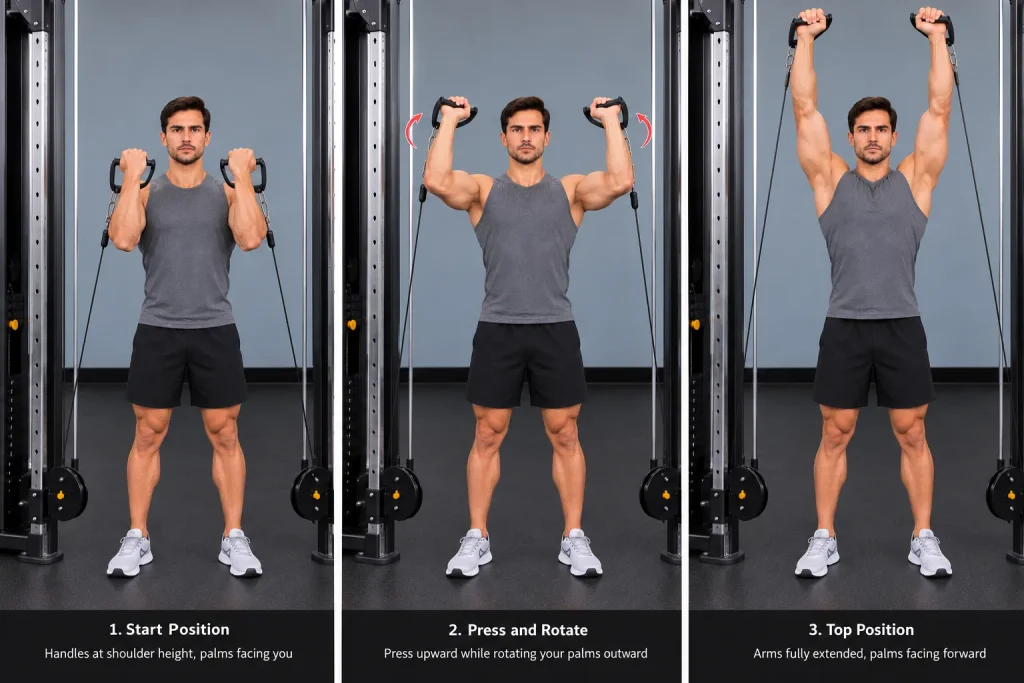
Why it’s useful: The rotation means the front delt does more work at the bottom, the side delt kicks in through the middle range, and all three heads contribute at the top. It’s the most well-rounded single cable pressing movement for shoulders.
Cable Exercises for Rear Delts (Posterior Deltoid)
The rear delt is the most neglected part of the shoulder for most gym-goers. It handles shoulder extension and external rotation, pulling your arm back and rotating it outward. Weak rear delts contribute to rounded shoulders and increase the risk of shoulder injuries during pressing movements.
7. Cable Face Pull
Pulley: High (set at face height or slightly above)
Attachment: Rope
Target: Posterior deltoid, rhomboids, external rotators
Face pulls are one of the best rear delt exercises you can do with cables. The high pulley angle targets the posterior deltoid more directly than a row, and the external rotation at the top also hits the infraspinatus and teres minor.
How to do it:
- Set the pulley to face height or slightly above. Attach a rope handle.
- Take an end of the rope in each hand with your thumbs pointing back.
- Step back until the cable is taut with your arms straight ahead.
- Pull toward your forehead, separating your hands as they arrive and keeping your elbows level with your shoulders.
- Squeeze your shoulder blades together at the end position, then return forward under control.
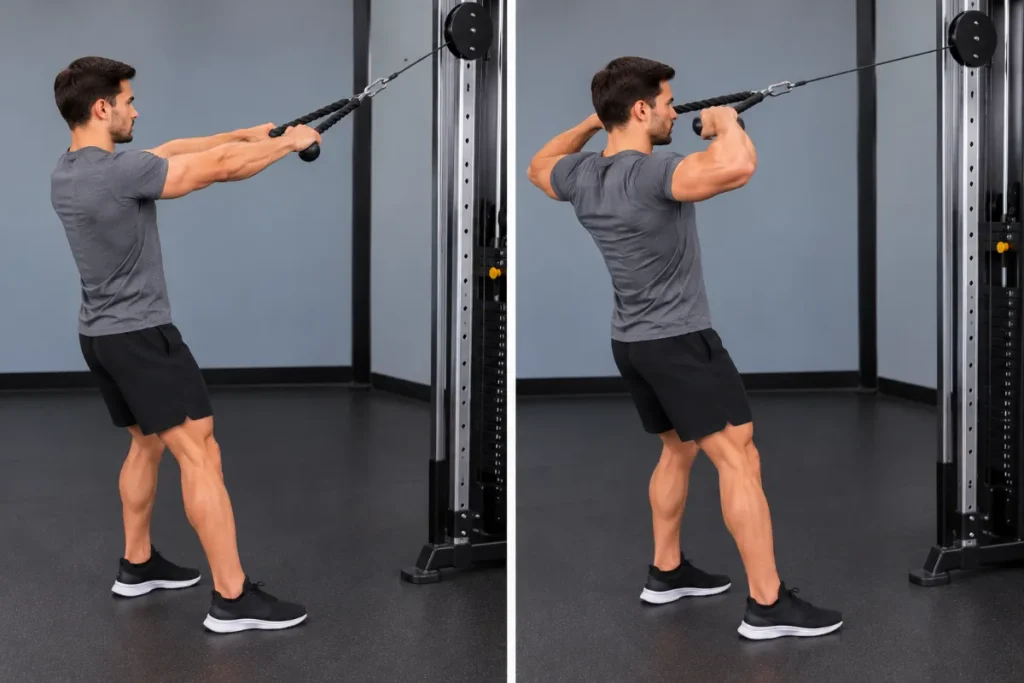
Common mistake: Pulling the rope to your chest instead of your face. This turns the movement into a high row and shifts the load to the lats and mid-traps. Aim for your forehead — elbows high, hands finishing beside your ears.
The cable back exercises guide also covers face pull execution, since the movement trains both rear delts and upper back. For a shoulder session, 3 sets of 12–15 reps works well.
8. Cable Reverse Fly
Pulley: High (shoulder height or slightly above)
Attachment: D-handles or no attachment (grip the cable ball stops)
Target: Posterior deltoid
How to do it:
- Set both pulleys to shoulder height on a dual cable machine. Stand between them.
- Cross the cables, grab the left cable with your right hand and the right cable with your left hand.
- Step back slightly so there’s tension in the starting position. Arms are extended in front of you, elbows slightly bent.
- Pull your arms apart and back in a wide arc, squeezing your shoulder blades together at the end.
- Return slowly to the starting position.
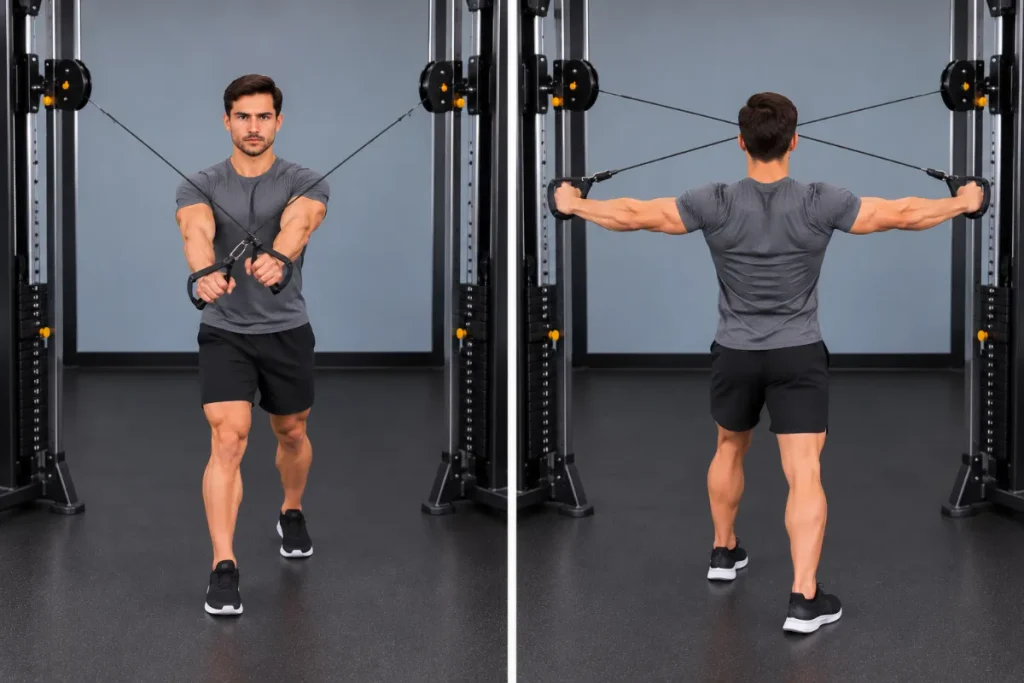
Common mistake: Bending the elbows too much through the movement. This turns the exercise into a row and shifts emphasis from the rear delt to the lats and rhomboids. Keep the same slight elbow bend from start to finish.
9. Cable Rear Delt Row
Pulley: Mid (chest height)
Attachment: Rope
Target: Posterior deltoid, rhomboids
How to do it:
- Face the cable machine with the pulley set at chest height. Grip both ends of the rope.
- Step back until your arms are extended with tension on the cable.
- Pull the rope toward your face, flaring your elbows out to the sides at shoulder height — not down toward your ribs.
- Squeeze at the top, then extend your arms back to the start under control.
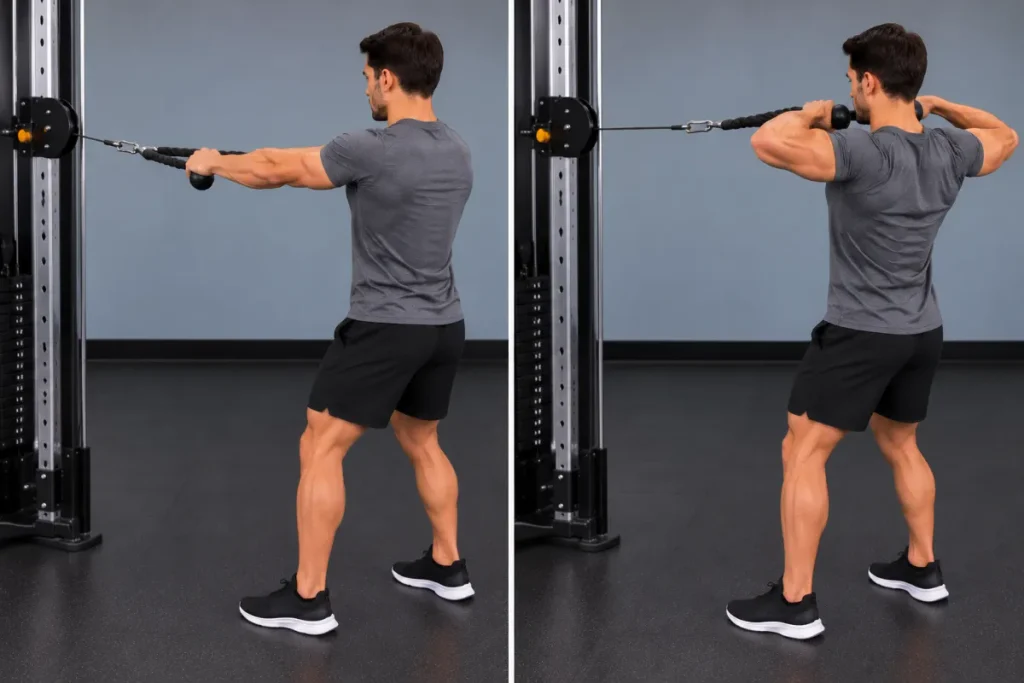
Key difference from face pulls: The mid-height pulley creates a more horizontal pull compared to the downward angle of a face pull. This shifts a bit more emphasis to the mid-traps and rhomboids while still hitting the rear delt. Think of this as a rear delt row, not a high pull.
10. Cable Y Raise
Pulley: Low (bottom setting)
Attachment: D-handles (dual) or rope
Target: Posterior deltoid, lower trapezius, scapular stabilizers
How to do it:
- Face the dual cable machine. Grab the left handle with your right hand and the right handle with your left, cables crossed.
- Step back until there’s light tension. Start with your arms down in front of your hips.
- Raise both arms forward and slightly outward, forming a Y shape overhead. Thumbs point toward the ceiling.
- Lower under control.
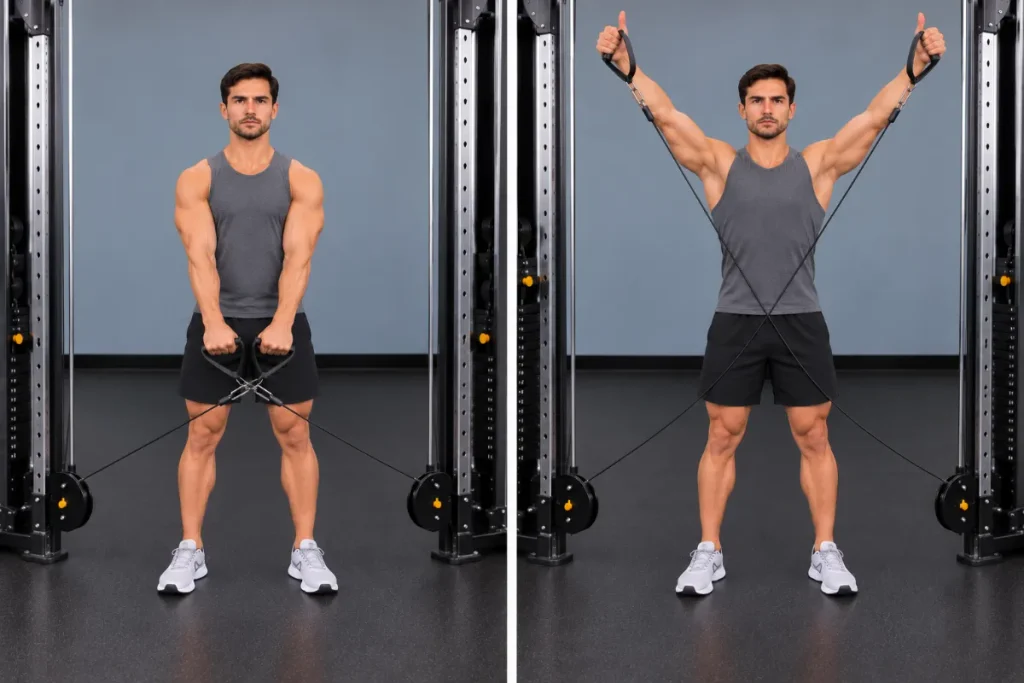
Why include it: Y raises train scapular upward rotation and lower trap activation — functions most shoulder exercises miss. They’re a solid finisher and a good option for lifters working on overhead mobility or shoulder stability.
Cable Exercises for Shoulder Health (Rotator Cuff)
The rotator cuff is a group of four muscles — supraspinatus, infraspinatus, teres minor, and subscapularis, that stabilize the shoulder joint during every pressing, pulling, and raising movement. Training them directly reduces injury risk and supports heavier loads on compound lifts. Cables are well-suited for this because the resistance stays constant and the pulley angle matches the rotation pattern.
11. Cable External Rotation
Pulley: Mid (elbow height)
Attachment: D-handle
Target: Infraspinatus, teres minor (external rotators)
How to do it:
- Stand sideways to the machine. Hold the D-handle in your outside hand.
- Pin your elbow to your side with a 90-degree bend — keep it there through the whole movement.
- Rotate your forearm outward, away from your body. Your elbow stays fixed; only the forearm moves.
- Return slowly to the starting position.
Practical note: Use light weight — 5 to 15 pounds for most people. The rotator cuff muscles are small and fatigue quickly. High reps (15–20) with controlled tempo work better here than heavy sets.
12. Cable Internal Rotation
Pulley: Mid (elbow height)
Attachment: D-handle
Target: Subscapularis (internal rotator)
How to do it:
- Stand sideways to the machine. Hold the D-handle in your inside hand (the hand closest to the machine).
- Pin your elbow to your side with a 90-degree bend.
- Rotate your forearm inward, across your body. Your elbow stays fixed.
- Return slowly to the starting position.
Why pair both rotations: Most lifters overtrain internal rotation through pressing and underwork external rotation. Pairing both in a shoulder session keeps the rotator cuff balanced. If you’re short on time, prioritize external rotation — it’s the side that’s almost always weaker.
Cable Shoulder Workout: Complete Routine
You can build a full shoulder workout using only a cable machine. Pick one compound movement and 3–4 isolation exercises that cover all three deltoid heads. Here’s a template for two levels.
Beginner Cable Shoulder Workout (25 Minutes)
| Exercise | Sets | Reps | Rest |
|---|---|---|---|
| Cable Overhead Press | 3 | 10–12 | 90 sec |
| Cable Lateral Raise | 3 | 12–15 | 60 sec |
| Cable Face Pull | 3 | 12–15 | 60 sec |
| Cable External Rotation | 2 | 15–20 | 45 sec |
Intermediate Cable Shoulder Workout (35 Minutes)
| Exercise | Sets | Reps | Rest |
|---|---|---|---|
| Cable Arnold Press | 3 | 8–10 | 90 sec |
| Leaning Cable Lateral Raise | 3 | 10–12 | 60 sec |
| Cable Face Pull | 3 | 12–15 | 60 sec |
| Cable Reverse Fly | 3 | 12–15 | 60 sec |
| Cable External Rotation | 2 | 15–20 | 45 sec |
Compound movements come first while the muscle is fresh. Isolation work follows, ordered from the weakest area to the strongest. For most people, that means rear delts before side delts, and side delts before front delts — since front delts already get heavy work from bench presses and overhead presses throughout the week.
Programming tip: Aim for roughly a 2:1 ratio of rear delt to front delt volume. Most lifters already get enough anterior work from pressing movements, so doubling up on rear delt sets corrects the imbalance rather than adding to it. If you’re looking for guidance on how many reps and sets to use for muscle growth, the general principles apply here: 3–4 sets per exercise in the 8–15 rep range covers both strength and hypertrophy.
What Are the Most Common Cable Shoulder Mistakes?
Form cues for individual exercises are covered above. These two mistakes are programming-level errors that affect your entire cable shoulder session.
Skipping rear delts. Most cable shoulder routines lean heavily toward side and front delt exercises. Over time, this creates a strength imbalance that increases shoulder injury risk. Include at least one rear delt exercise per shoulder session — face pulls or reverse flys take under five minutes.
Going too heavy on rotator cuff work. External and internal rotations train small stabilizer muscles. Loading them like a compound lift leads to compensation from larger muscles — which defeats the purpose. Stay light, stay controlled, and treat these as injury prevention, not strength work.
Frequently Asked Questions
Can you build broad shoulders with only cables?
Cables can cover every function of the deltoid — abduction, flexion, extension, and rotation. A well-structured cable-only routine provides enough exercise variety and resistance to build shoulder size, especially for beginners and intermediates. Advanced lifters may benefit from adding heavy barbell or dumbbell presses for raw strength, but cables alone can handle hypertrophy.
Why do cable lateral raises hurt my shoulder?
The most common cause is internal rotation of the shoulder during the raise — turning the wrist so the pinky leads upward. This narrows the subacromial space, which can pinch the supraspinatus tendon. Keep your thumb slightly higher than your pinky throughout the movement, and don’t raise your arm above shoulder height.
Does cable crossover work shoulders?
A standard cable crossover primarily targets the chest. However, the anterior deltoid assists during the pressing motion, and a high-to-low crossover variation loads the front delt more directly. If your goal is shoulder development, dedicated shoulder exercises are more efficient than relying on crossover spillover.
Why are cable shoulder exercises harder than dumbbell shoulder exercises?
Cables pull at a fixed angle from the pulley, so your deltoid has to stabilize against that sideways or diagonal force through the entire rep. With dumbbells, gravity only pulls straight down — and at the bottom of a lateral raise, the lever arm is almost zero. Cables eliminate that rest point, which means more time under load per rep even at lighter weight.
Can cable shoulder exercises help with shoulder impingement?
Cable external and internal rotations are commonly used in shoulder rehabilitation to strengthen the rotator cuff without heavy loading. The adjustable pulley lets you match the resistance angle to a pain-free range of motion. That said, if you have diagnosed impingement, work with a physiotherapist to choose exercises and load — cables are a tool, not a treatment plan.
Should you train shoulders on the same day as chest?
You can, but place chest pressing first — it’s the heavier movement. The front delts assist during bench and incline presses, so they’ll be partially fatigued by the time you move to dedicated cable shoulder work. Prioritize side and rear delt cable exercises on a chest-and-shoulders day, since those heads won’t be pre-exhausted from pressing.
Disclaimer: If you have a shoulder injury, impingement, or any pain during these exercises, stop and consult a healthcare provider before continuing. These exercises are not a substitute for professional medical advice or physical therapy.
