

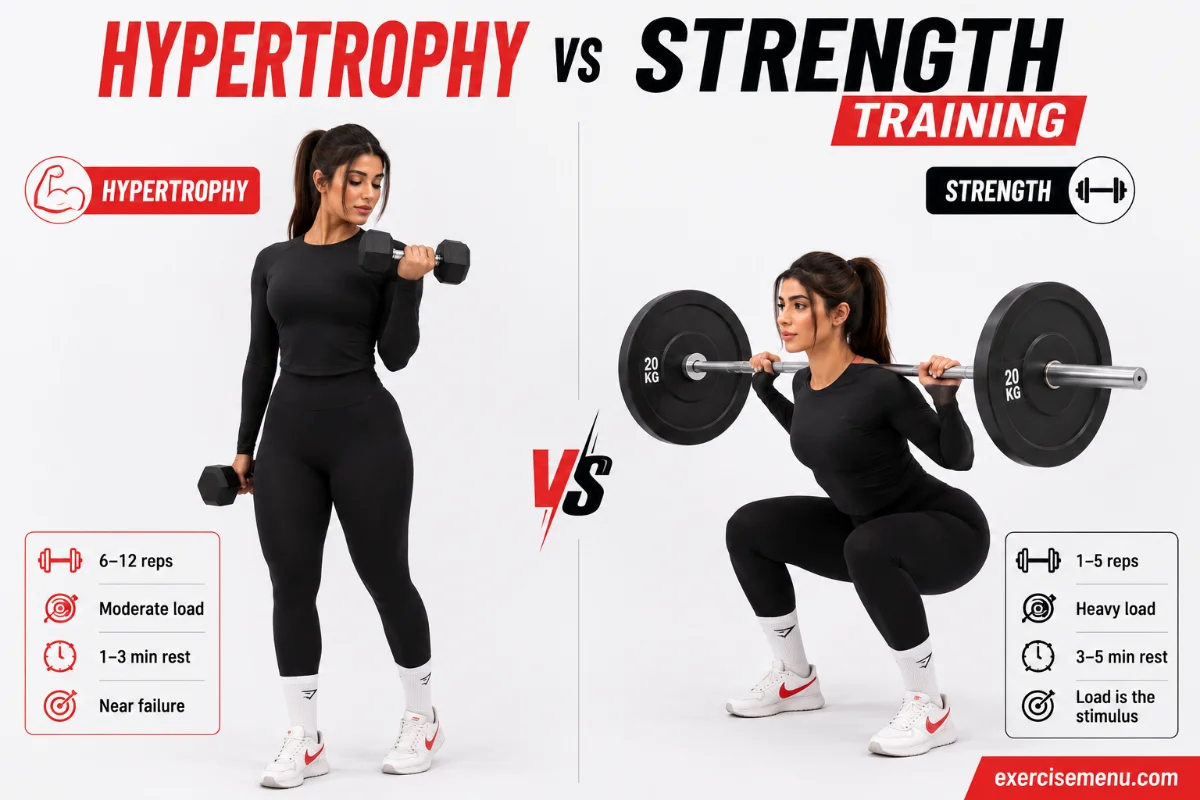
Quick Answer: Hypertrophy training builds muscle size with moderate loads, 6–12+ reps and higher weekly volume. Strength training builds maximal force with loads of 80%+ of your 1RM and 1–5 reps. The 2026 ACSM guidelines show both grow muscle, but only heavy, specific practice maximizes strength.
You train consistently, but the scale on your goal isn’t moving. Your lifts climb while your arms look the same — or your arms grow while your bench stalls. That mismatch almost always comes from training variables that don’t match the result you want.
Below you’ll see exactly how the two goals differ on reps, load, rest, volume and exercise choice, what the 2026 American College of Sports Medicine (ACSM) position stand changed, and a decision table plus a 4-day plan to apply it this week.
- What's the difference between hypertrophy and strength?
- What did the 2026 ACSM guidelines change?
- Hypertrophy vs strength training at a glance
- What do hypertrophy and strength training have in common?
- Benefits and drawbacks of each
- Why most people accidentally train for neither
- Why you're getting stronger but not bigger (and vice versa)
- How do reps, load, rest and effort change the result?
- Does exercise selection matter differently for each goal?
- How does progressive overload differ between the two?
- How much weekly volume does each goal need?
- Can you train for both at the same time?
- Which should you pick? A decision table
- When should you switch between hypertrophy and strength phases?
- How do you track progress for each goal?
- Hypertrophy vs strength FAQs
- The bottom line
What’s the difference between hypertrophy and strength?
Hypertrophy is an increase in muscle size. Strength is the maximum force you can produce in a specific movement. One is a structural change; the other is a performance result built from muscle size, nervous-system efficiency and lifting skill.
Hypertrophy: a bigger muscle
Muscle grows mainly by adding contractile proteins (myofibrils) inside each fiber, which thickens the fiber and the whole muscle. The main trigger is mechanical tension from hard sets, accumulated over enough weekly volume.
You’ll also see the term sarcoplasmic hypertrophy — growth of the fluid and energy stores around the myofibrils. It happens, but there’s little evidence that any rep range builds it “instead of” myofibrillar growth. For practical training, treat hypertrophy as one process.
Strength: a stronger movement
Strength depends on three things: how much muscle you have, how many motor units your nervous system can recruit and how fast it fires them, and how well you’ve practiced the exact lift. That third factor is why strength is specific.
A 2023 meta-analysis by Haugen et al. found free weights and machines produce similar overall gains — but each improved most on its own test. Train on the leg press and your leg-press max climbs faster than your squat.
The one-line rule: hypertrophy cares which muscle you fatigue; strength cares which movement you practice.
What did the 2026 ACSM guidelines change?
The ACSM’s April 2026 position stand, built on 137 reviews, recommends loads of at least 80% of 1RM for strength, with 2–3 sets per exercise at least twice a week and key lifts early in the session. For hypertrophy, it recommends about 10 sets per muscle group weekly and found load range matters little when effort is high.
| Goal | ACSM 2026 recommendation |
| Strength | ≥80% of 1RM · ≥2 sessions/week · 2–3 sets per exercise · full range of motion · key lifts first |
| Hypertrophy | ~10 sets per muscle group per week · light-to-heavy loads all work when sets are hard |
| Power | 30–70% of 1RM · move the weight as fast as possible on the way up |
The same report found that training to failure, machines vs free weights, and complex periodization didn’t consistently change results for the average healthy adult (ACSM, 2026). In other words: consistency and the basics beat fine-tuning.
Hypertrophy vs strength training at a glance
| Variable | Hypertrophy | Strength |
| Main goal | Muscle size | Maximal force on specific lifts |
| Reps per set | 6–12 (5–30 works near failure) | 1–5 |
| Load | ~60–85% of 1RM | ≥80% of 1RM |
| Rest between sets | 1–3 min | 3–5 min |
| Weekly sets per muscle | ~10 to start, up to ~20 when advanced | Lower; 2–3 sets per lift per session |
| Frequency | Each muscle 2x/week | Each main lift 2–3x/week |
| Effort | 0–2 reps in reserve | 2–3 reps in reserve on heavy sets |
| Exercise choice | Compounds + isolation; any equipment | A few main lifts + close variations |
| Progression | More reps, sets or load | More load |
| How you measure progress | Tape, photos, reps at a fixed weight | 1RM, top-set weight |
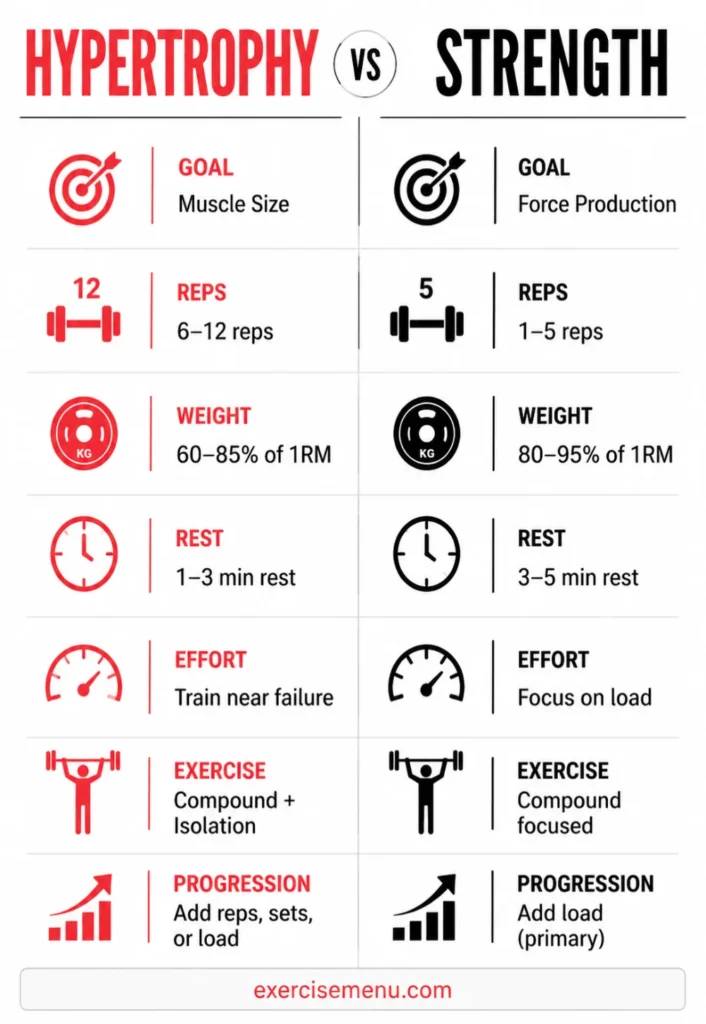
If you need the percentages, our guide on how to calculate your 1RM gives you an estimate from a 3–5 rep set.
What do hypertrophy and strength training have in common?
Both are resistance training, so they share more than the debate suggests:
- Both build both. A 2023 Bayesian network meta-analysis by Currier et al. in the *British Journal of Sports Medicine* (178 strength and 119 hypertrophy studies) found every resistance-training prescription increased strength and size compared with not training.
- Both run on progressive overload. Only the preferred lever differs.
- Both favor heavier, multi-set work. In Currier’s analysis, higher-load, multi-set training ranked first for strength (3x/week) and for hypertrophy (2x/week).
- Both protect long-term health: stronger bones and tendons, better insulin sensitivity, and more muscle to carry into older age.
Benefits and drawbacks of each
| Hypertrophy training | Strength training | |
| Benefits | Visible muscle gain · lighter loads are easier on joints · flexible exercise choice (great for home gyms and machines) · builds the muscle that later supports strength | Fastest route to bigger lifts · fewer, shorter sessions per muscle · heavy loading supports bone density · progress is objective and easy to track |
| Drawbacks | Longer sessions to fit the volume · more muscle soreness · hard sets to near-failure are uncomfortable | Long rest periods · technique demands are high · heavy loads stress joints if you rush progression · less visible size change on its own |
Neither column wins outright. The better choice is whichever drawback you can live with for the result you want.
Why most people accidentally train for neither
The most common stall pattern: loading a bar so 8–10 reps feel hard, resting 2–3 minutes, stopping 3–4 reps short of failure, and repeating the same 3 sets every week.
- For hypertrophy, those sets end too far from failure and total weekly volume stays low.
- For strength, the load never gets near the 80%+ range where your nervous system practices maximal force.
[Existing image — keep: training spectrum showing hypertrophy zone, strength zone and the middle zone. Alt: “hypertrophy zone vs strength zone training spectrum”]
Self-check: if your last two reps aren’t a grind, the set isn’t hard enough for growth. If you can do more than 6 reps, it isn’t heavy enough for maximal strength. Sets that are neither add fatigue without much stimulus, what coaches call junk volume.
Fix it by labeling each exercise before you start: this one is for size or this one is for strength. Then set reps, load and rest to match.
Why you’re getting stronger but not bigger (and vice versa)
You get stronger without growing when most of your progress comes from your nervous system and lifting skill rather than new muscle. It’s common in the first months of training and in low-rep programs with few weekly sets. Add hard sets in the 6–15 rep range and stop them within 0–2 reps of failure.
Stronger, not bigger — common causes:
- Low weekly volume. Three heavy sets of 3 twice a week trains the lift, not the muscle. Count your hard sets per muscle; fewer than ~10 is a likely cause.
- Sets end too far from failure. The Robinson et al. 2024 meta-regressions found growth improves as sets end closer to failure, while strength barely changes.
- Eating at a deficit. Strength can rise in a deficit; meaningful size gain rarely does once you’re past the beginner stage.
Bigger, not stronger — common causes:
- No heavy practice. Growth from cables and machines doesn’t fully transfer to a barbell max.
- Constant fatigue. High-volume sessions leave no fresh, heavy top sets.
- Not testing. If you never lift above 80% of your 1RM, your max won’t show what your muscle can do.
If your issue is that reps go up but load doesn’t, see why you’re not getting stronger even though you increase reps.
How do reps, load, rest and effort change the result?
Each variable shifts the main adaptation. Here’s the short version, with a link to the full guide for each.
Reps and load. Strength gains are greatest with heavy loads in the 1–5 rep range. Muscle growth happens across 5–30 reps if sets are hard (Schoenfeld et al., 2021). Heavy loads beat light ones for strength, while hypertrophy is similar across load ranges (Schoenfeld et al., 2017). The 6–12 range stays popular because it builds volume without beating up joints. Our high reps vs low reps guide compares every range.
Rest. Strength needs 3–5 minutes so each heavy set stays heavy. For size, a 2024 Bayesian meta-analysis (Singer et al.) found a small advantage for resting longer than 60 seconds, likely because you keep more reps in later sets.
Effort. Hypertrophy rewards sets that end 0–2 reps from failure. Strength doesn’t: load is the stimulus, and grinding heavy compounds to failure adds fatigue and injury risk without extra strength. Full detail is in our guide to training to failure.
Does exercise selection matter differently for each goal?
Yes. Strength programs center on 3–5 main lifts trained often — a powerlifter’s squat, bench press and deadlift plus close variations. Adding exercises only helps if it builds one of those lifts.
Hypertrophy programs use 2–4 exercises per muscle to load it through different angles and ranges. Chest might get a barbell press, an incline dumbbell press and a cable fly. Because growth depends on the muscle, not the movement, machines and cables work as well as barbells for size (Haugen et al., 2023).
| Discipline | Main goal | Typical training |
| Powerlifting | Max squat, bench, deadlift | 1–5 reps on the three lifts + accessories |
| Olympic weightlifting | Max snatch, clean & jerk | 1–3 fast reps; technique-heavy |
| Strongman | Strength on varied implements | Heavy carries, loads, presses |
| Bodybuilding | Size and symmetry | 6–20 reps, high volume, many exercises |
See compound vs isolation exercises for how to balance the two.
How does progressive overload differ between the two?
For strength, the main lever is load. Reps and sets stay fairly fixed while the weight climbs — commonly by 2.5–5 kg on lower-body lifts and 1–2.5 kg on upper-body lifts when you hit your target reps.
For hypertrophy, you can add reps, add sets or add load. A 2022 *PeerJ* study by Plotkin et al. put 43 trained adults on either load progression or rep progression for 8 weeks. Both groups grew similarly (muscle thickness up about 7–13%). The method matters less than progressing at all.
A simple hypertrophy rule: add 1–2 reps per set each week until you reach the top of your range, then add weight and drop back to the bottom. More options are in our progressive overload guide.
How much weekly volume does each goal need?
| Level | Hypertrophy (hard sets per muscle per week) | Strength (per main lift) |
| Beginner | 6–10 | 2–3 sets × 2 sessions |
| Intermediate | 10–15 | 3–5 sets × 2–3 sessions |
| Advanced | 12–20 for priority muscles | 3–6 sets × 2–3 sessions, varied intensity |
The ACSM’s 10-set figure is a starting point, not a ceiling. Pelland et al. (2025) in *Sports Medicine* pooled 67 studies and found more weekly volume keeps adding size and strength, but with diminishing returns — and the returns flatten much faster for strength. That’s why strength programs stay lean on volume while hypertrophy programs push it higher. Our guide on how many sets per muscle group per week breaks this down by muscle.
Can you train for both at the same time?
Yes, and most people should. The limit isn’t physiology — it’s recovery and session length. Heavy strength work needs long rests and fresh nerves; hypertrophy work needs many hard sets.
The hybrid approach: heavy first, volume second
Open with 1–2 heavy compound lifts for strength, then switch to moderate-load accessories for size. Heavy work goes first so your nervous system is fresh — the same order the ACSM recommends.
Sample 4-day hybrid week (upper/lower)
| Day | Strength block | Hypertrophy block |
| 1 — Upper heavy | Bench press 4×3–5 @ 82–87%, 3–4 min rest · Weighted pull-up or row 4×4–6 | Incline DB press 3×8–12 · Cable row 3×10–12 · Lateral raise 3×12–15 (90 s rest) |
| 2 — Lower heavy | Back squat 4×3–5 @ 82–87% · Romanian deadlift 3×5–6 | Leg press 3×10–12 · Leg curl 3×10–15 · Calf raise 3×12–15 |
| 3 — Upper volume | Overhead press 3×5 @ ~80% | DB bench 3×8–12 · Lat pulldown 3×10–12 · Cable fly 3×12–15 · Curls + pushdowns 3×10–15 each |
| 4 — Lower volume | Deadlift 3×3–5 @ 80–85% | Hack squat or split squat 3×8–12 · Hip thrust 3×8–12 · Leg extension 3×12–15 |
This gives each muscle roughly 10–14 hard sets per week and each main lift two exposures. If you prefer other layouts, compare upper/lower vs full body splits.
When combining both stops working
As you get more advanced, one program can’t push both to the max. Signs it’s time to run separate blocks:
- Main lifts flat for 4+ weeks despite good sleep and food
- Joint aches that don’t clear after a deload week
- Poor sleep, low motivation and general fatigue — not just sore muscles
- Strength and measurements both stalled
Which should you pick? A decision table
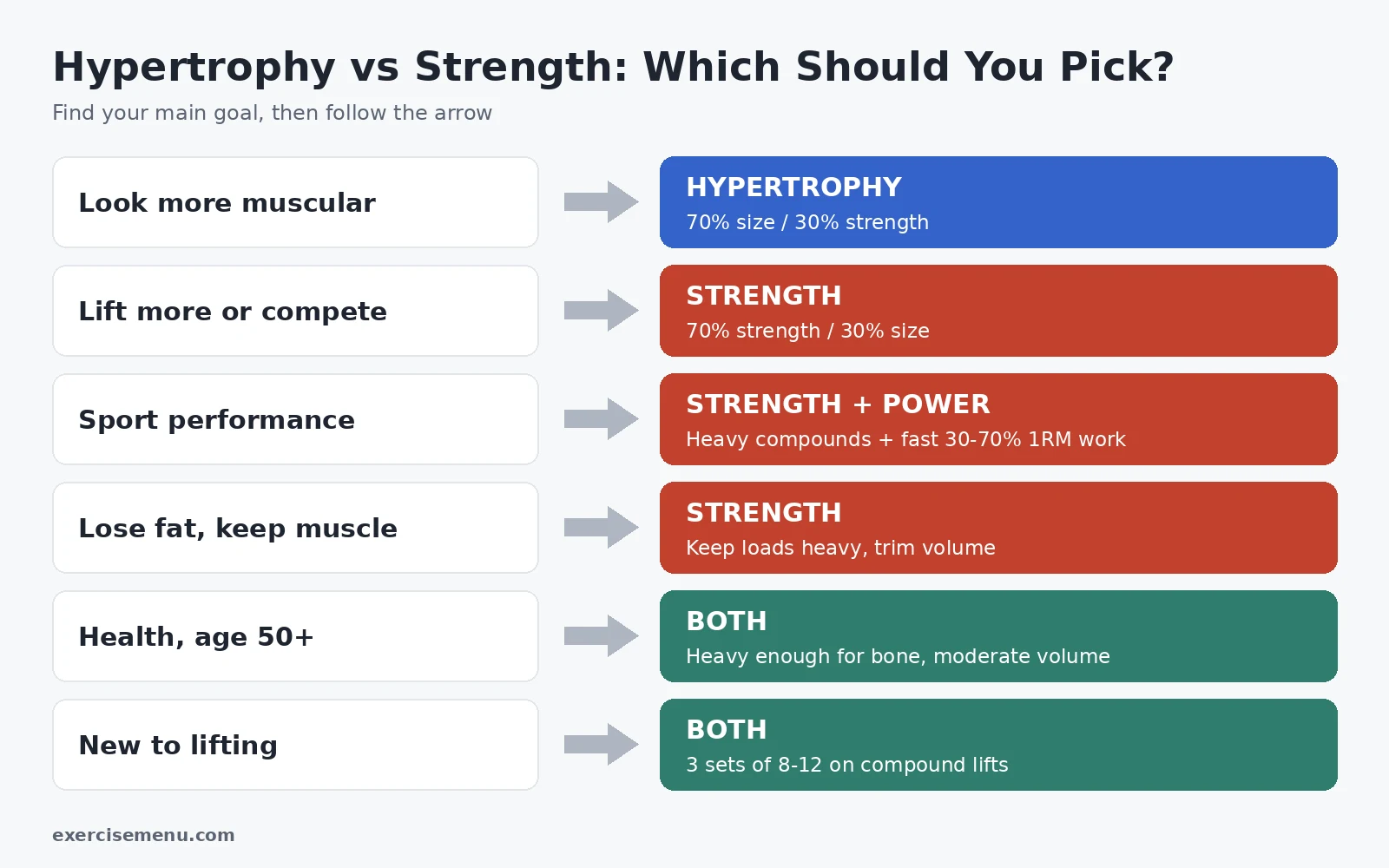
| If your main goal is… | Prioritize | Split of your training |
| Looking more muscular | Hypertrophy | ~70% hypertrophy / 30% strength |
| Lifting more weight or competing | Strength | ~70% strength / 30% hypertrophy |
| Sport performance | Strength (+ power work) | Heavy compounds + 30–70% 1RM speed work |
| Fat loss while keeping muscle | Strength | Keep heavy loads; trim volume during the deficit |
| General health, over 50 | Both | Heavy enough to stress bone; moderate volume |
| New to lifting | Both (it doesn’t matter yet) | 3 sets of 8–12 on compound lifts |
Beginners: in your first 6–12 months almost any structured program builds both. Hypertrophy-style sets (8–12 reps) are the easier start: lighter loads, more practice reps, lower injury risk. Our guide on how many reps and sets a beginner should do gives a starting template.
Women: the programming is the same. Women gain muscle more slowly in absolute terms because of lower testosterone, so “bulky” takes years of deliberate surplus eating — hypertrophy training mostly adds shape. See reps and sets for women.
Adults over 50: heavier loading supports bone and strength, which matter most for daily function. Build up gradually — see reps and sets for adults over 50.
When should you switch between hypertrophy and strength phases?
Once you’re past the beginner stage, alternating 4–8 week blocks keeps both moving.
Switch to a strength block when:
- You’ve added size but your main lifts have stopped climbing
- You have a test, meet or PR target
- You want to “cash in” new muscle by teaching your nervous system to use it
Switch to a hypertrophy block when:
- Your joints need a break after 6–8+ weeks of heavy loading
- You want more muscle before pushing heavier loads
- Your strength has stalled on low volume
Two common models:
- Linear (block) periodization: one focus per 4–8 weeks.
- Daily undulating periodization (DUP): heavy, moderate and light days in the same week, like the sample plan above.
The ACSM’s 2026 review found neither model beats consistent training for most adults, so choose the one you’ll stick to.
How do you track progress for each goal?
| Goal | Track this | How often |
| Hypertrophy | Reps at a fixed weight, arm/thigh/waist measurements, photos in the same lighting | Reps every session; tape and photos every 4 weeks |
| Strength | Top-set weight, estimated 1RM, reps at a given % of 1RM | Every session; test or estimate 1RM every 6–12 weeks |
Body weight alone tells you little about either. A logbook or app that records sets, reps, load and RPE shows whether the program is working before the mirror or the barbell does.
Hypertrophy vs strength FAQs
Does hypertrophy increase strength?
Yes. A bigger muscle can produce more force, so hypertrophy raises your strength ceiling. You still need heavy practice on a lift to express that strength fully.
Can you get stronger without getting bigger?
Yes, especially early on. Better motor-unit recruitment, coordination and technique can add a lot of strength before any visible size change.
Is 5×5 for strength or hypertrophy?
A 5×5 at 80–85% of 1RM is mainly a strength scheme that also builds some muscle. Our guide to 3×10, 4×12 and 5×5 compares common set schemes.
How much protein do you need for either goal?
About 1.6 g per kg of body weight per day covers most people; a 2018 meta-analysis by Morton et al. found gains plateaued around that intake. Going higher won’t hurt, but adds little.
Do bodybuilders train for strength?
Most do in phases. Heavier blocks let them use bigger loads in their hypertrophy sets later, which adds more tension per rep.
Is strength or hypertrophy training better for fat loss?
Neither burns enough extra calories to matter — fat loss comes from your diet. During a cut, keep loads heavy to hold onto muscle and reduce volume if recovery suffers.
The bottom line
Choose hypertrophy if you want to look bigger, strength if you want to lift more, and a hybrid if you want both. Pick one decision-table row today, set every exercise’s reps, load and rest to match it, and log your progress for the next 8 weeks.
If you have an injury, joint pain or a medical condition, check with your doctor or a physiotherapist before starting heavy or high-volume training.

2 Comments
Pingback: How to Calculate Your 1RM (One Rep Max Calculator + Formula)
Pingback: Should You Train to Failure? What 55 Studies Say (2026)