


Quick Answer: The first number is sets, the second is reps. 3×10 means 3 sets of 10 reps (muscle growth). 5×5 means 5 sets of 5 reps (strength). 4×12 means 4 sets of 12 reps (high-volume hypertrophy). Pick the scheme that matches your goal, then choose a weight where the last 2 to 3 reps of each set are genuinely hard.
You are staring at your programme. It says “Back Squat 5×5” or “Bicep Curls 3×12.” The first number is sets, the second is reps. Pick the wrong combination for your goal and you will spend months working hard with nothing to show for it.
- What Do Sets and Reps Actually Mean?
- What Does 3×10 Mean in a Workout?
- What Does 4×12 Mean?
- What Does 5×5 Mean?
- Warm-Up Sets vs Working Sets
- Other Notation You Will See in Workout Programmes
- How Each Scheme Compares
- Which Scheme Matches Your Goal?
- How to Choose the Right Weight for Any Rep Scheme?
- When to Switch Schemes
- Frequently Asked Questions
What Do Sets and Reps Actually Mean?
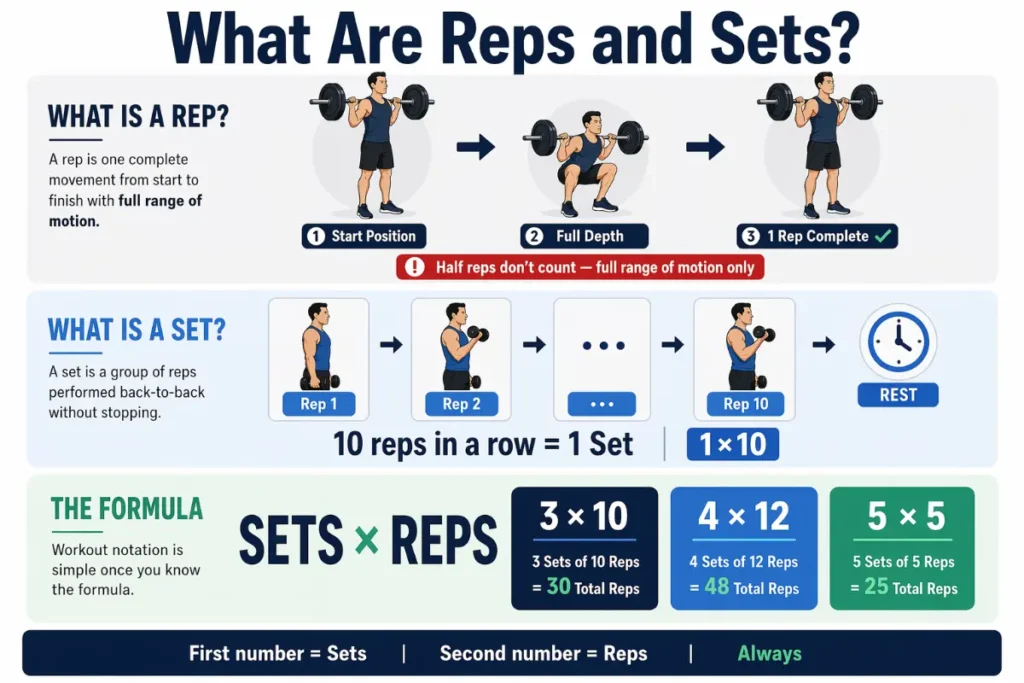
A rep is one complete movement. Squat down and stand back up, that is one rep. A set is a group of reps done back-to-back before you rest. Ten squats, then rest, that is 1×10.
What Does 3×10 Mean in a Workout?
Three sets of ten reps at 65 to 75% of your one-rep max. Heavy enough to create mechanical tension in the muscle, light enough to hold form across all three sets.
A 2017 meta-analysis by Schoenfeld et al. confirmed meaningful muscle growth occurs across a rep range of 5 to 30, provided sets are taken close to failure. Strength gains were greater with heavier loading. 3×10 sits in the hypertrophy range: it builds some strength, but muscle growth is the primary driver.
It works well on isolation exercises like bicep curls and tricep pushdowns, accessory compound movements like Romanian deadlifts and dumbbell rows, and for beginners still learning movement patterns before chasing heavier loads.
When to Add Weight
Finish the final set with 3 or more reps still in the tank? The weight is too light. Finish with 1 to 2 reps left across all sets? Add weight next session. The two-for-two rule is the simplest trigger: if you exceed your target reps by two or more for two consecutive sessions, increase the load.
What Does 4×12 Mean?
Four sets of twelve reps at 60 to 70% of your max. One more set than 3×10, two more reps, slightly lighter load.
That extra volume is what separates it from 3×10. More total reps means more metabolic stress per session. The muscle stays under load longer, which is why 4×12 produces a harder pump than 3×10 at the same weight. It is not a scheme to open a session with on a heavy compound lift.
It works as a finishing scheme: after the heavier work is done, when the goal is driving accumulated fatigue into a specific muscle. For full volume and frequency guidance, how many reps and sets for muscle growth covers this in detail.
What Does 5×5 Mean?
Five sets of five reps at 80 to 85% of your 1RM. The protocol Bill Starr popularised in the 1970s, and the foundation StrongLifts, Starting Strength, and the Texas Method are all built around.
At 5×5 you are not just adding muscle. You are training your central nervous system to recruit more motor units under maximal load. That neurological adaptation is why experienced lifters get dramatically stronger without always getting visibly bigger. The muscle was already there. The nervous system learned to use more of it. How the central nervous system responds to different rep ranges explains this directly.
Rest periods are not optional here. Give yourself 3 to 5 minutes between sets. Cut that short and every subsequent set runs on partial recovery: less neural drive, less strength stimulus, less adaptation.
5×5 is built for compound barbell lifts: squat, deadlift, bench press, overhead press, barbell row. These are the movements that allow the heaviest loads across the most total muscle mass. Running 5×5 on a bicep curl is the wrong tool for the wrong job.
Warm-Up Sets vs Working Sets
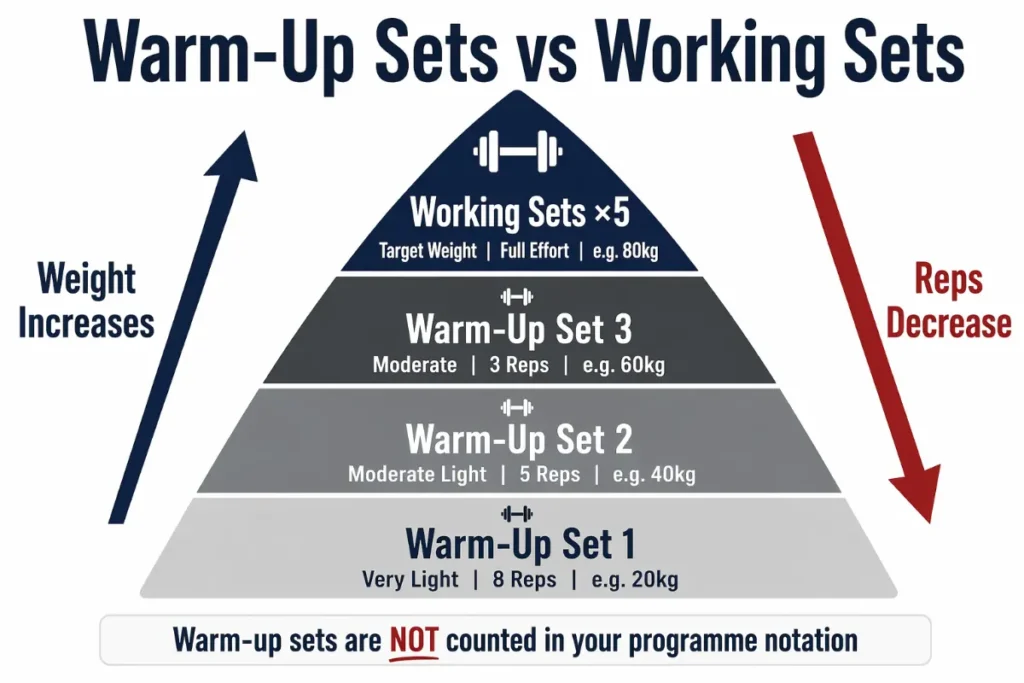
When your programme says 5×5, it does not mean five all-out sets from your first rep. Working sets are performed at your target weight. These are the sets that drive adaptation. Warm-up sets are lighter and do not count toward your notation.
Practical example for Back Squat 5×5 at 80 kg:
| Set | Weight | Reps | Type |
|---|---|---|---|
| 1 | 20 kg | 8 | Warm-up |
| 2 | 40 kg | 5 | Warm-up |
| 3 | 60 kg | 3 | Warm-up |
| 4–8 | 80 kg | 5 | Working |
Two to three progressively heavier warm-up sets is enough. Skipping them on heavy compound lifts is how most avoidable injuries happen. The full breakdown is at warm-up sets vs working sets.
Other Notation You Will See in Workout Programmes
4×8-10: Hit at least 8 reps per set. When you reach 10 on all sets with clean form, add weight next session.
1×5+: One set of at least 5 reps, push as many as possible with good form. Used to measure readiness to increase weight.
3×12, 10, 8: Three sets with descending reps. First set is 12, second is 10, third is 8. Weight increases as reps drop. A pyramid structure that works through multiple rep ranges on one exercise.
A1/A2 (Supersets): Perform both exercises back-to-back before resting. Usually opposing muscle groups, like bench press paired with rows. Same total work, less time.
DS (Drop Set): After completing your working set, immediately reduce weight by 20 to 30% and continue to near failure. Applied to the last set only.
AMRAP: As Many Reps As Possible. Push to near failure with clean form. Used on the final set to gauge whether you are ready to add weight next session.
Tempo (3-0-1-0): Four numbers describing each phase of a rep: eccentric, pause at bottom, concentric, pause at top. A squat at 3-0-1-0 means 3 seconds down, no pause, 1 second up, straight into the next rep. Slowing the eccentric by 2 seconds changes what every set does to muscle tissue without adding a single extra rep. Time under tension covers how to apply this.
How Each Scheme Compares
| Scheme | Goal | Load (% 1RM) | Rest |
|---|---|---|---|
| 5×5 | Strength | 80–85% | 3–5 min |
| 3×10 | Muscle growth | 65–75% | 60–90 sec |
| 4×12 | Volume / hypertrophy | 60–70% | 60–90 sec |
| 3×20+ | Muscular endurance | 50–60% | 30–60 sec |
5×5 builds some muscle. 3×10 builds some strength. The difference is what each scheme prioritises, not what it excludes.
Which Scheme Matches Your Goal?
Strength: 5×5 on compound lifts. Add weight once all five sets are completed cleanly: 2.5 kg upper body, 5 kg lower body.
Muscle size: 3×10 or 4×12. The last 2 to 3 reps of every working set should be genuinely hard. Comfortable reps do not produce a growth stimulus.
Fat loss: 3×10 or 4×12 with shorter rest periods. The job in the gym during a cut is to preserve muscle. The diet handles fat loss. The reps and sets for fat loss guide covers this specifically.
Endurance: 15 to 20+ reps with lighter loads, short rest periods. Builds the capacity to sustain repeated muscular effort rather than produce peak force.
How to Choose the Right Weight for Any Rep Scheme?
This is where most beginners get stuck. The rep scheme tells you how many reps to do, but it does not tell you how much weight to use. The answer depends on your experience level and the specific exercise.
If You Have Never Done the Exercise Before
Start lighter than you think you need to. Pick a weight you are 90% sure you can lift for 8 to 10 slow, controlled reps. Complete your first session with 2 to 3 reps left in the tank on every set. Your goal in week one is learning the movement pattern, not testing your limits.
From there, add weight in small increments each session:
- Compound lifts (squat, bench, deadlift, row): increase by 2.5 to 5 kg per session
- Isolation exercises (curls, lateral raises, pushdowns): increase by 1 to 2.5 kg per session
A practical 4-week ramp for a beginner doing bench press at 3×10:
| Week | Weight | Reps Achieved | Notes |
|---|---|---|---|
| 1 | 30 kg | 10, 10, 10 | Felt controlled. 3 reps in reserve. |
| 2 | 32.5 kg | 10, 10, 9 | Last set slightly harder. Good form. |
| 3 | 35 kg | 10, 9, 8 | Last 2 reps of set 3 were a grind. |
| 4 | 35 kg | 10, 10, 10 | Consolidated. Ready to move to 37.5 kg. |
Notice week 3 to 4: the weight stayed the same because reps dropped. That is not failure. That is the body catching up to the load. Once all sets hit the target, increase again.
How to Know the Weight Is Wrong
Too heavy: Form breaks down before you reach the target reps. You are using momentum, swinging, or shortening range of motion to complete reps. Joints ache during or after the set (not muscle burn, actual joint discomfort). Lower the weight by 10% and rebuild.
Too light: You finish every set without effort. The last rep feels the same as the first. You could add 5 or more reps to every set without form changing. You are doing cardio with weights, not strength training.
Right weight: The first 5 to 6 reps of a 10-rep set feel manageable. Reps 8 and 9 require real concentration. Rep 10 is hard but your form holds.
Using RPE and RIR to Dial In Weight
RPE (Rate of Perceived Exertion) rates how hard a set felt on a scale of 1 to 10. RIR (Reps in Reserve) counts how many clean reps you had left when you stopped.
| Scheme | Target RPE | Target RIR | What It Feels Like |
|---|---|---|---|
| 5×5 | 8–9 | 1–2 | Final rep of last set is a genuine fight. Form holds, but barely. |
| 3×10 | 7–8 | 2–3 | Last 2 to 3 reps require real effort. Not a struggle, not comfortable. |
| 4×12 | 7–8 | 2–3 | Burn is high. Reps slow down noticeably by set 3 and 4. |
Beginners should start at RPE 6 to 7 (3 to 4 RIR) for the first 4 to 6 weeks while learning movements. Pushing to RPE 8 or 9 before your technique is automatic is how injuries happen. The RPE vs RIR comparison covers which system works better for different experience levels.
To calculate percentage-based loads, calculate your 1RM before setting your working weights. The ACSM’s Position Stand on Resistance Training recommends 8 to 12RM for hypertrophy and 1 to 6RM at 80 to 85% 1RM for strength.
When Reps Drop on Later Sets
If your first set hits all target reps but sets 2 and 3 fall short by 1 to 2 reps, keep the weight. That is normal fatigue accumulation. As long as rep 1 of set 1 was not a grind, you are in the right range. Over 2 to 3 sessions, the later sets will catch up.
If reps drop by 3 or more across all sets, the weight is too heavy. Drop by 5 to 10% and rebuild.
When to Switch Schemes
If your working weight on a compound lift has not moved in three consecutive sessions despite consistent training and nutrition, the stimulus needs to change, not the exercise.
Stuck on 3×10? Drop to 5×5 for 3 to 4 weeks. The heavier loading builds new strength. When you return to 3×10, the weight that felt like a ceiling will feel manageable.
Stuck on 5×5? Move to 3×10 or 4×12 for a hypertrophy block. More muscle means more to work with when you return to heavy strength training.
A practical cycle:
- Weeks 1–4: 5×5 on compound lifts
- Weeks 5–8: 3×10 or 4×12
- Week 9: Deload week, reduce volume by 40 to 50%, keep movement quality sharp
- Repeat at slightly heavier loads than the previous cycle
Frequently Asked Questions
Is 3 sets of 10 enough to build muscle?
Yes, if you are training close to failure and progressing the load consistently over time. Schoenfeld et al. 2017 confirmed hypertrophy across rep ranges of 5 to 30 when effort is high. Three sets of 10 falls squarely in that window.
Which is better for building muscle: 5×5 or 3×10?
Both build muscle when sets are taken close to failure. 5×5 prioritises strength and neural adaptation. 3×10 prioritises volume and hypertrophy. Cycling both across training blocks produces better long-term results than staying in either permanently.
How long should I rest between sets?
5×5: 3 to 5 minutes. 3×10 and 4×12: 60 to 90 seconds. Rest periods determine the quality of your next set. Cutting 5×5 rest short undermines the neural adaptation the protocol is built around.
Can I do 5×5 every day?
No. 5×5 on heavy compound lifts is neurologically and physically demanding. Most effective 5×5 programmes run three days per week with rest days between sessions. Daily heavy training without adequate recovery leads to stalled progress and increased injury risk.
What should I do if I cannot finish all my reps?
If you are consistently 2 to 3 reps short across most sets, reduce the load by 5 to 10% and rebuild. If it is only the final set by one or two reps, rest slightly longer and keep the weight. Occasional short sets on the final set are completely normal.
What does AMRAP mean in a workout?
As Many Reps As Possible. Push to near failure with clean form. Used on the final set to measure whether you are ready to add weight next session.
Pick the scheme that matches your current goal, choose a weight using the methods above, and track what you lift. That is the entire system.

2 Comments
Really useful guide for beginners. I finally understand how to read workout programs correctly. Looking forward to applying this in the gym.
Pingback: How to Calculate Your 1RM (One Rep Max Calculator + Formula)