

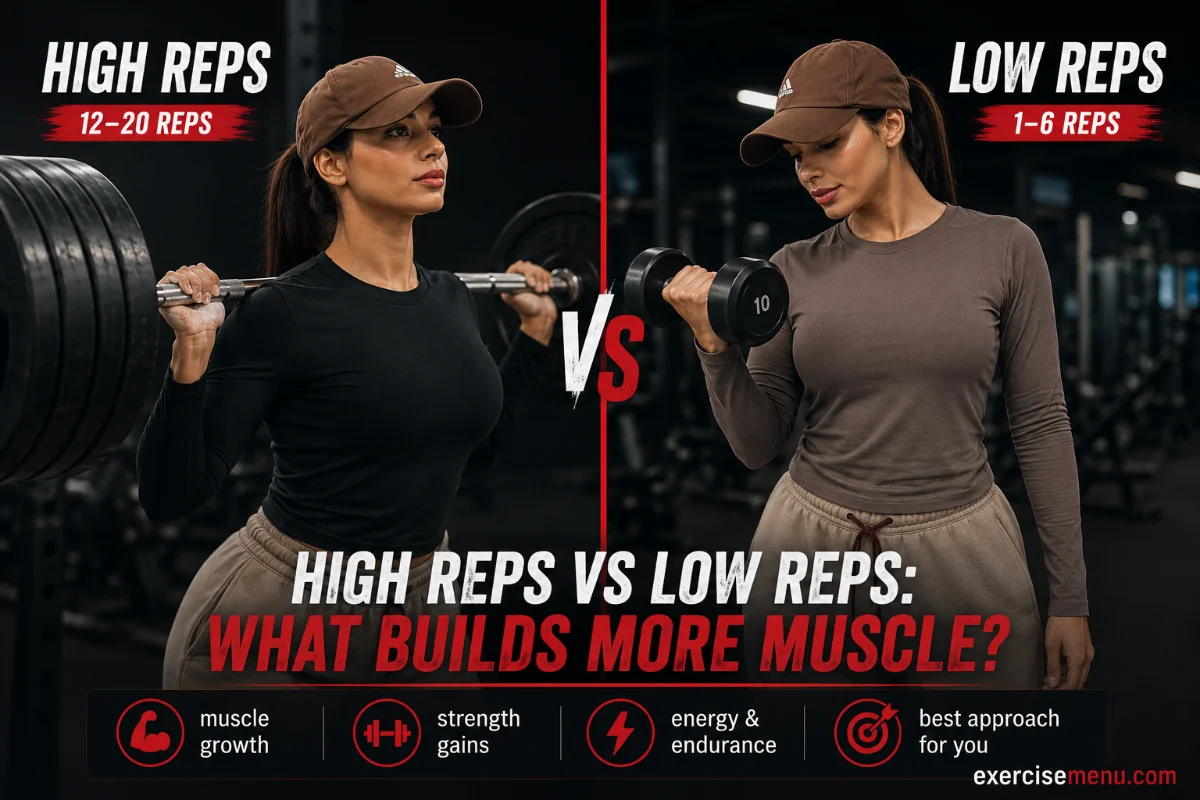
Quick Answer: Most gym advice says heavy weight builds muscle and light weight “tones.” Research says otherwise. Both rep ranges produce similar muscle growth when effort and volume are matched. The real question is not which range is better, but which range fits which exercise and which goal. That is what this guide covers.
The gym version of this debate usually sounds like “heavy weight builds muscle, light weight tones.” The research version is more interesting and less clean-cut. Multiple meta-analyses now show that muscles grow at roughly the same rate across a wide rep range, as long as two conditions are met: total training volume is comparable, and every set is pushed close to failure. Those conditions are easy to control in a study. In a real gym, they rarely play out the same way.
This article breaks down what the evidence says, why both rep ranges drive growth through different pathways, and how to pick the right range based on the exercise you’re doing — not a one-size-fits-all number. If you need a primer on what reps and sets are and how they work, start there first.
Do High Reps and Low Reps Build the Same Amount of Muscle?
When training volume and effort are equated, muscle growth is statistically similar across rep ranges from roughly 5 to 30. Three independent analyses confirm this. A 2017 meta-analysis by Schoenfeld et al. (21 studies), a 2021 network meta-analysis by Lopez et al., and a 2025 study by Lees et al. in The Journal of Physiology all found similar muscle growth between high-load and low-load training when sets were taken close to failure. Strength gains, however, were significantly greater with heavier loads across all three.
The Lees study is notable because 20 men trained one arm and one leg with heavy loads (8-12 reps at 70-80% 1RM) and the opposite limbs with light loads (20-25 reps at 30-40% 1RM) for 10 weeks. Muscle growth was not significantly different between conditions for either upper or lower body.
People who responded well to heavy loads also responded well to light loads, suggesting individual biology drives hypertrophy more than load selection. One caveat: participants were untrained, and untrained lifters tend to grow from almost any stimulus. The finding likely holds for intermediates based on the broader meta-analytic data, but the magnitude of the effect may narrow as training experience increases.
There is one critical detail buried in all of these studies: every set was taken to volitional failure. Participants kept lifting until they physically could not complete another rep. That condition is easy to enforce in a lab. In your gym, at 6 AM, on set four of Romanian deadlifts, it is not. That gap between lab failure and gym failure is where the practical answer diverges from the scientific one.
Why Both Rep Ranges Build Muscle Through Different Pathways?
The research says the destination is the same. The route is not. Here is how each rep range gets there and where each one falls short.
| Low Reps (1–5) | Moderate Reps (6–12) | High Reps (15–30) | |
|---|---|---|---|
| How it grows muscle | Heavy load forces the biggest, most growth-responsive fibers to activate from rep 1 | Balances load and volume — enough weight to recruit growth fibers, enough reps to accumulate work | Lighter load creates a slow fatigue buildup — growth fibers only activate in the final reps, once smaller ones give out |
| Joint stress | Higher — heavy weights accumulate wear over time | Moderate — manageable for most joints long-term | Lower — lighter loads are easier on joints and tendons |
| How it feels | Hard fast, done quick — each rep demands maximum effort | Challenging but sustainable — a controlled grind | Burns slow, gets painful toward the end — the last 5 reps are where the stimulus lives |
| Biggest risk | Injury from heavy loads, especially with fatigue or poor form | Minimal — fewest trade-offs of any range | Stopping too early because the burn feels like failure when it is not |
| Recovery demand | High — nervous system needs longer to recover | Moderate — fits most training frequencies | Lower — muscles recover faster, less central fatigue |
| Works best on | Squats, bench press, deadlifts, barbell rows | Dumbbell press, lunges, pull-ups, cable rows | Curls, lateral raises, flyes, tricep pushdowns, leg extensions |
With heavy loads, a principle called size-ordered recruitment means your largest muscle fibers — the ones with the most growth potential engage from the first rep. You do not need to fatigue your way into recruiting them. That is why even a set of 3 heavy reps produces a growth signal.
With lighter loads, those same fibers sit idle until the smaller fibers tire out. Growth only happens if you push deep enough into the set to force those bigger fibers to take over. A set of 20 that ends at rep 14 because the burn was uncomfortable missed the window entirely.
This is where the two approaches differ most in practice. Low reps make effort obvious the bar either goes up or it does not. High reps hide the line between discomfort and actual failure. And that difference is not theoretical. It changes real results.
How to Choose the Right Rep Range by Exercise?
Instead of picking a single rep range for your entire workout, match the range to the exercise. Use 5–8 reps on heavy compound barbell lifts like squats and bench press, 8–12 reps on accessory compounds like lunges and pull-ups, and 12–20 reps on isolation movements like curls and lateral raises. Each exercise type has a sweet spot where the growth stimulus is high and the injury risk stays low.
Understanding the difference between compound and isolation exercises can help you choose the right movements for each rep range and training goal.
Compound barbell lifts — squat, bench press, deadlift, barbell row: Use 5–8 reps. These movements are built for heavy loading. The multiple joints and large muscle groups involved handle high force well, and the nervous system gets the most training effect from heavier loads on these lifts. Most lifters find that pushing a heavy squat past 12 reps turns the set into a breathing challenge before the legs reach muscular failure the cardiovascular demand overtakes the muscular one, and the growth signal gets diluted.
Accessory compound movements — dumbbell press, lunges, pull-ups, cable rows: Use 8–12 reps. These exercises still involve multiple joints, but the loading ceiling is lower than barbell work. The moderate range lets you accumulate volume without the joint strain that heavy single-joint loading can cause.
Isolation exercises — curls, lateral raises, flyes, tricep pushdowns, leg curls: Use 12–20 reps. Isolation movements target a single muscle through a single joint. Heavy loading here puts disproportionate stress on that joint (elbows on curls, shoulders on lateral raises) with minimal extra growth stimulus. Higher reps let you create a strong muscle contraction with better control and far less injury risk.
This is also where strength enters the picture. If your primary goal includes improving your one-rep max, keep compound lifts in the 3–5 rep range. A 2016 study by Schoenfeld et al. compared 2–4 reps versus 8–12 reps over 8 weeks and found significantly greater squat 1RM gains with heavy loads even though muscle thickness gains were similar or favored the moderate group.
You practice what you want to get better at. Heavy singles and triples train the nervous system to produce maximum force, and that adaptation does not transfer from sets of 20.
For a detailed guide on fitting these into a weekly plan, see how to create a weekly workout schedule.
Putting It Together: A Practical Split
A typical upper/lower or push/pull session might look like this:
First exercise (compound barbell): 4 sets of 5-8 reps, 2-3 min rest
Second exercise (accessory compound): 3 sets of 8-12 reps, 90 sec rest
Third exercise (isolation): 3 sets of 12-20 reps, 60 sec rest
This progression from heavy to light within a single session covers all three growth pathways, manages fatigue, and keeps joints safe. You do not need separate “strength days” and “hypertrophy days” unless you are training for a specific sport or competition.
Rep Range Mistakes That Kill Your Progress
1. Stopping high-rep sets at the burn instead of at failure. A review published by Stronger by Science found that lifters are significantly more accurate at judging proximity to failure when training below 12 reps per set. Above that, most people overestimate how close they are stopping 5–8 reps short of true failure while believing they gave maximum effort.
Those missed reps are the ones that would have recruited the growth-driving muscle fibers. If you train in higher rep ranges, you need to get comfortable with sustained discomfort well past the initial burn. The set starts producing growth around the point where you want to stop.
2. Defaulting to 3×10 on everything. It is the most common rep scheme in any gym, and for most people, it was never chosen it was inherited. The problem is not that 3×10 is bad. The problem is applying it to exercises where it wastes effort. Ten reps on a squat at moderate weight creates so much cardiovascular fatigue that your legs give up for the wrong reason.
Ten reps on lateral raises with heavy dumbbells forces your shoulder joint to absorb load it was not built to handle. The rep range should follow the exercise, not the other way around.
3. Ignoring rest periods when switching rep ranges. A set of 5 heavy squats with 60 seconds rest is a completely different stimulus than the same set with 3 minutes rest. Heavy, low-rep work needs full recovery between sets, typically 2-4 minutes, to maintain force output.
High-rep isolation work benefits from shorter rest (60-90 seconds) because the incomplete recovery adds to the metabolic stimulus. Applying the same rest period across all rep ranges either undertaxes your heavy work or over-rests your light work. The how long to rest between sets guide covers specific rest recommendations for strength, hypertrophy, and endurance goals.
4. Chasing progressive overload only through weight. Adding 2.5 kg to the bar is one way to progress, but it is not the only way. Adding 2 reps to a high-rep set, slowing your tempo by 1 second on the eccentric, or cutting 15 seconds from your rest period these are all forms of overload. Lifters who only chase weight tend to avoid higher rep ranges entirely, which limits their total training volume and their growth ceiling over time.
FAQ
Can you build muscle with just bodyweight high reps?
Yes. High reps can build muscle when sets are taken close to failure and weekly training volume is sufficient. However, adding heavier work can improve strength and make progressive overload easier over time.
Should you change rep ranges every workout?
No. You do not need to change rep ranges every session. A better approach is using different ranges for different exercises — heavier reps for compound lifts and higher reps for isolation movements.
How many sets of low reps equal one set of high reps for growth?
There is no direct conversion. Muscle growth depends on total training volume, effort, and load. Different rep ranges can work when sets are performed with enough intensity and proper progression.
Can I build strength and muscle size at the same time?
Yes. You can train for both by combining heavier compound lifts with moderate and higher rep work. Heavy loads improve strength, while additional volume supports muscle growth.
What if my joints hurt with heavy low-rep training?
Reduce the load and use a higher rep range if it feels more comfortable. Lowering weight while maintaining effort can preserve the muscle-building stimulus while reducing joint stress.
Conclusion
The rep range you choose matters less than how hard you push each set and whether you match the range to the exercise. Use heavier loads on compound lifts where your body handles force well. Use lighter loads on isolation exercises where joint health and muscle control matter more. Push every working set to within 1–3 reps of failure. Progress over time in whatever range you are using. That covers more ground than any single “best” number.
Disclaimer: If you have an existing injury or joint condition, consult your doctor or physiotherapist before applying heavy loading to compound exercises.

4 Comments
Pingback: Air Squats: Form, Benefits & When to Add Weight
Pingback: Dumbbell Sumo Squat: Form, Muscles & Benefits
Pingback: High Bar vs Low Bar Squat: What's the Differences?
Pingback: Hypertrophy vs Strength: Which to Pick (2026 ACSM Update)