


Quick Answer: Start with 2–3 sets of 8–12 reps per exercise, 2–3 times per week. This range builds strength and muscle simultaneously while keeping recovery manageable. The last 2–3 reps of each set should feel genuinely hard if they don’t, the weight is too light.
Most beginners get the numbers wrong not because the information is complicated, but because every programme they find online was written for someone who has already been training for a year or more. The sets, reps, and frequency that work for an intermediate lifter are not what a beginner needs.
The numbers below are built for someone in their first 6–12 months of training simple, research-backed, and consistent with what actually works.
How Many Reps Should a Beginner Do?
8 to 12 reps per set is where most beginners should start.
This range sits at the intersection of two things a muscle needs to grow: mechanical tension the weight challenging the muscle and metabolic stress the effort required to complete the set. The load is manageable enough to focus on movement quality while still being hard enough to drive real adaptation.
Here is how the full rep range breaks down by goal:
| Goal | Reps per Set | Why It Works |
|---|---|---|
| Build muscle | 8–12 | Balances mechanical tension and metabolic stress |
| Build strength | 4–6 | Heavy loads drive neural adaptation |
| Lose fat / tone | 12–15 | Higher reps keep heart rate elevated |
| General fitness | 8–12 | Covers both strength and endurance bases |
| Muscular endurance | 15–20 | Trains muscles to resist fatigue over time |
Both the American College of Sports Medicine and the National Strength and Conditioning Association recommend the 8–12 rep range for untrained individuals beginning resistance training.
The practical test: Pick a weight and do 10 reps. If you finish and feel like you could easily do 6 more, go heavier. If form breaks before rep 8, go lighter. The final 2–3 reps should demand real effort — controlled, not sloppy.
How Many Sets Should a Beginner Do?
2 to 3 sets per exercise — not 5, not 6.
The NSCA confirms that beginners make significant strength gains from just 1–3 sets per exercise, particularly in the first several months. The nervous system is adapting to entirely new movement patterns motor unit recruitment, coordination, and joint stability all improve before meaningful muscle growth begins.
That neurological adaptation does not require high volume to occur. More sets at this stage add recovery demand without proportional return. For weekly volume, aim for 6–12 total sets per muscle group per week, spread across 2–3 sessions.
If you train chest twice a week and do 3 sets per session, that is 6 total sets well within the productive range for a beginner.
Why 2–3 sets beats 5 sets for beginners:
A 5-set programme sounds serious. In practice, most beginners finish session one severely sore, underperform in sessions two and three, and quit by week two. Starting with 2–3 sets builds work capacity without outpacing recovery.
How Long Should a Beginner Rest Between Sets?
60 to 90 seconds for most exercises. Up to 2 minutes for heavy compound lifts.
Rest is not downtime it is when your muscles restore enough phosphocreatine to perform the next set at the same quality. Cut rest short and every subsequent set is performed in a state of partial fatigue, which reduces both the stimulus and the safety of the movement.
| Exercise Type | Rest Period | Why |
|---|---|---|
| Heavy compound lifts (squat, deadlift, row) | 90 sec – 2 min | High neural and muscular demand |
| Moderate compound work | 60–90 sec | Standard hypertrophy range |
| Isolation and accessory movements | 45–60 sec | Lower recovery requirement |
| Core and stability work | 30–45 sec | Minimal systemic fatigue |
Keeping rest short to elevate heart rate is a common instinct but resistance training and cardiovascular training are different stimuli. Cutting rest produces fatigue, not a cardio effect.
What Does a Full Beginner Workout Look Like?
Run this 2–3 times per week with at least 48 hours between sessions.
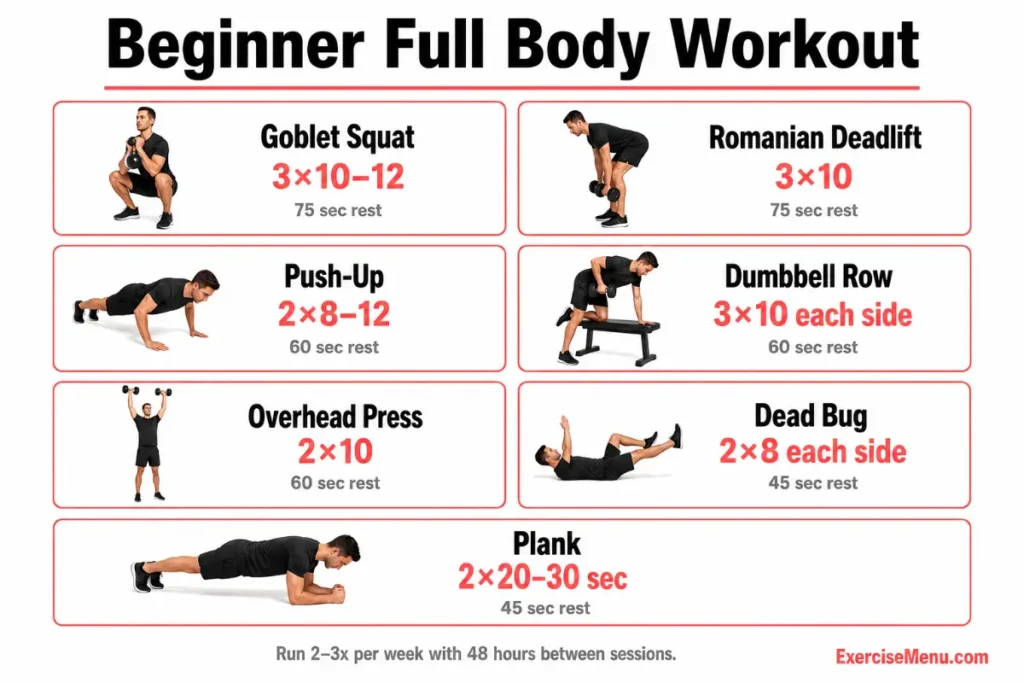
That is 17 working sets enough volume for consistent adaptation without excessive recovery demand.
How hard should each set feel? Finish feeling like you could do 2 more reps cleanly — but chose not to. Stopping short of failure at this stage protects movement quality and speeds recovery without sacrificing the training stimulus.
How Should a Beginner Progress Over Time?
Add weight when you consistently hit the top of your rep range across all sets with 2 reps still left in the tank.
The mechanism is progressive overload systematically increasing the demand on the muscle over time. Without it, the body adapts to the current workload and stops changing.
Step-by-step progression:
- Pick a rep range — 8 to 12
- When you can complete all sets at 12 reps with clean form and energy to spare, increase the load — 1–2 kg for dumbbells, 2.5–5 kg for barbells
- Drop back to the bottom of the range — 8 reps — and build again
Do not increase weight and reps at the same time. Change one variable per session. Give each new load at least one week before deciding if it is right.
Time-based guidance: Upper body lifts tend to progress faster than lower body — many beginners add weight every 1–2 weeks on pressing and pulling movements, and less frequently on squats and deadlifts where recovery takes longer. If three consecutive sessions pass without any improvement in reps or load, look at sleep and nutrition before adding more volume.
What Are the Most Common Beginner Mistakes With Sets and Reps?
Copying intermediate or advanced programmes. A 5-day push/pull/legs split with 5 sets per exercise is built for someone 12–18 months into consistent training. Starting there means high soreness, poor recovery, and likely quitting before adaptation has time to occur. Two to three full-body sessions per week is the right foundation.
Never increasing the load. If the same weight has been used for three months, adaptation stopped. Track every session — weight, reps, sets. Without a record, progressive overload becomes guesswork.
Skipping the warm-up. One light set at 50–60% of working weight before each exercise significantly reduces injury risk. Cold muscles under load fail faster and strain more easily — warm-up sets exist for exactly this reason.
Switching programmes too often. Real adaptation takes 6–8 weeks of consistent stimulus. Changing programmes after two weeks means neither gets a fair test. Pick one, track the numbers, and commit for at least 6 weeks before evaluating.
Frequently Asked Questions
How many reps and sets should an absolute beginner do in week one?
In week one, do 2 sets per exercise at the lower end of the rep range — 8 reps. The focus in week one is learning movement patterns, not volume. Poor form reinforced under fatigue creates lasting problems.
Is 3 sets of 10 enough for a beginner?
Yes, for the first 8–12 weeks. Three sets of 10 at a challenging weight, applied consistently 2–3 times per week, drives meaningful strength and muscle gains.
Should beginners train to failure?
No. Stopping 2–3 reps short is sufficient for adaptation and avoids the form breakdown that raises injury risk. Training to failure belongs to intermediate and advanced lifters with an established technical base.
How many days a week should a beginner lift weights?
Two to three full-body sessions per week. Three sessions — Monday, Wednesday, Friday — is the most common structure and gives each muscle group 48 hours to recover between sessions.
How do I know if the weight is right?
The final 2–3 reps of each working set should feel genuinely hard with clean form. If 12 reps feel like you had 10 left, go heavier. If form breaks before rep 8, go lighter.
How many reps should a beginner do for fat loss?
12–15 reps per set with 30–60 seconds rest. This range keeps heart rate elevated and increases calorie burn per session compared to lower-rep strength work. Pair it with a calorie deficit — training alone does not drive fat loss without the nutrition component.
What happens if a beginner does too many sets?
Recovery suffers first — soreness increases, performance drops between sessions, and rep quality declines. Progress stalls before it ever builds.
