


Quick Answer: Junk volume is training that adds fatigue without adding a meaningful muscle or strength stimulus. It happens when sets are too easy, when per-session volume exceeds what muscles can productively use, or when rep ranges fall too far from failure to trigger adaptation.
More sets, more reps, more time in the gym the assumption is that more effort produces more results. Up to a point, it does. Past that point, you are not building muscle faster. You are just digging a deeper recovery hole.
That threshold where training stops producing results and starts compounding fatigue is what junk volume describes. Knowing where it starts is the difference between a programme that keeps working and one that stalls without an obvious reason.
- What Is Junk Volume in Weight Training?
- What Are the Three Types of Junk Volume?
- How Many Sets Per Session Before It Becomes Junk Volume?
- How Do You Know If You're Doing Junk Volume?
- Is Junk Volume a Myth?
- What Is the Difference Between Junk Volume and Overtraining?
- How to Avoid Junk Volume
- Frequently Asked Questions
What Is Junk Volume in Weight Training?
Junk volume is any training that consumes time and energy without stimulating meaningful muscle growth or strength gains.
For a set to count as productive volume, it needs to create enough mechanical tension and metabolic stress to trigger adaptation. That requires the working muscles to be pushed close to their limit — somewhere between 0 and 4 reps from failure on most exercises. Sets completed well short of that threshold generate fatigue without the stimulus. Those are junk sets.
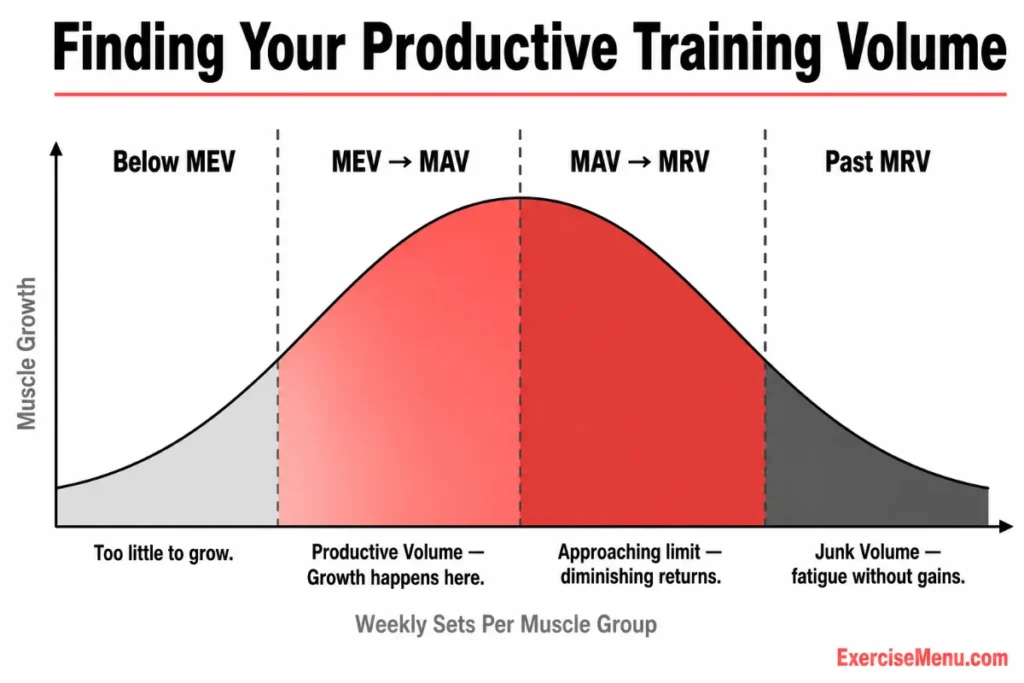
Three volume thresholds help define where junk volume begins:
Minimum Effective Volume (MEV): The lowest number of sets per muscle per week that still produces growth. Below this, you maintain at best.
Maximum Adaptive Volume (MAV): The range where training produces its best results challenging enough to stimulate growth, manageable enough to recover from. Most working sets should land here.
Maximum Recoverable Volume (MRV): The upper limit before additional sets become counterproductive. Past this point, recovery demand exceeds what the training produces. That excess is junk volume.
What Are the Three Types of Junk Volume?
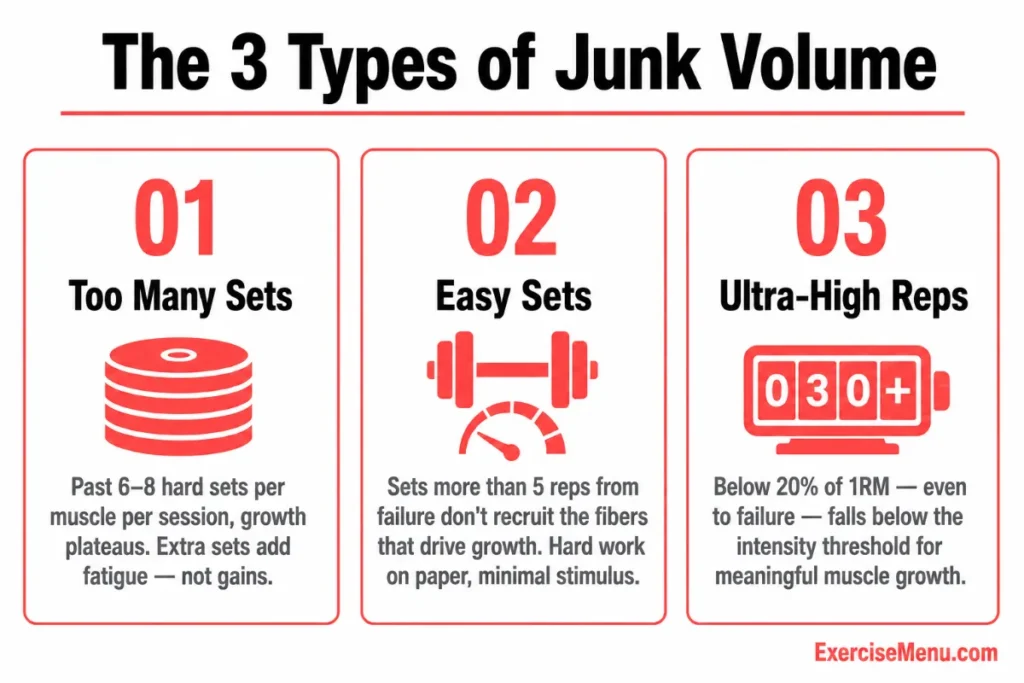
1. Too many sets per session
After a certain number of hard sets on a muscle group in one session, the stimulus plateaus. The muscle has already received the growth signal it needs. Every set past that point generates more fatigue without producing proportional hypertrophy — a ceiling effect confirmed by Baz-Valle et al.
2. Sets with insufficient effort
A set performed well short of failure 6, 7, or 8 reps in reserve is junk regardless of how many sets you complete. Muscle fibers that drive growth are only recruited under sufficient load. If the final reps of a set are not genuinely challenging, the high-threshold motor units responsible for hypertrophy are not being reached. The set looks productive on paper. Physiologically, it is not.
3. Ultra-high rep sets
Sets performed above 30 reps with very light weight below 20% of 1RM fall below the intensity threshold required for meaningful muscle growth, even when taken to failure. The load must exceed this threshold to activate the fiber recruitment patterns that drive hypertrophy. At 40 or 50 reps per set, the recovery cost is high while the growth stimulus is minimal.
Compound vs isolation distinction:
The line between productive and junk volume shifts depending on the exercise. Compound movements squats, deadlifts, rows carry higher injury risk under heavy fatigue, so leaving 2–3 reps in reserve on these is appropriate. Isolation exercises bicep curls, leg extensions, cable flyes can be pushed closer to or to failure more safely, and junk volume tends to start later in a set for these movements.
How Many Sets Per Session Before It Becomes Junk Volume?
6 to 8 hard sets per muscle group per session is where productive volume ends for most people.
A 2019 meta-analysis by Schoenfeld et al established a clear dose-response relationship between training volume and hypertrophy — more sets produce more growth, but only up to a threshold. Beyond approximately 6–8 challenging sets per muscle per session, growth plateaus and recovery demand continues to climb.
For weekly volume, research published in the Journal of Strength and Conditioning Research suggests 10–20 total sets per muscle per week covers the productive range for most intermediate lifters. Going beyond 20 sets per muscle per week without exceptional recovery capacity produces diminishing returns.
These thresholds are not universal:
Larger muscle groups back, quads, glutes tolerate and respond to higher volumes than smaller ones. Biceps and triceps fatigue more quickly because they are already heavily recruited during compound pulling and pressing. Training experience also shifts the threshold: beginners see meaningful gains from as few as 3–5 sets per muscle group per week and reach their productive ceiling earlier in a session than intermediate or advanced lifters.
How Do You Know If You’re Doing Junk Volume?
The clearest signal is that weights feel heavier than they should at familiar loads with no change in sleep, nutrition, or stress.
Five specific signs to watch for:
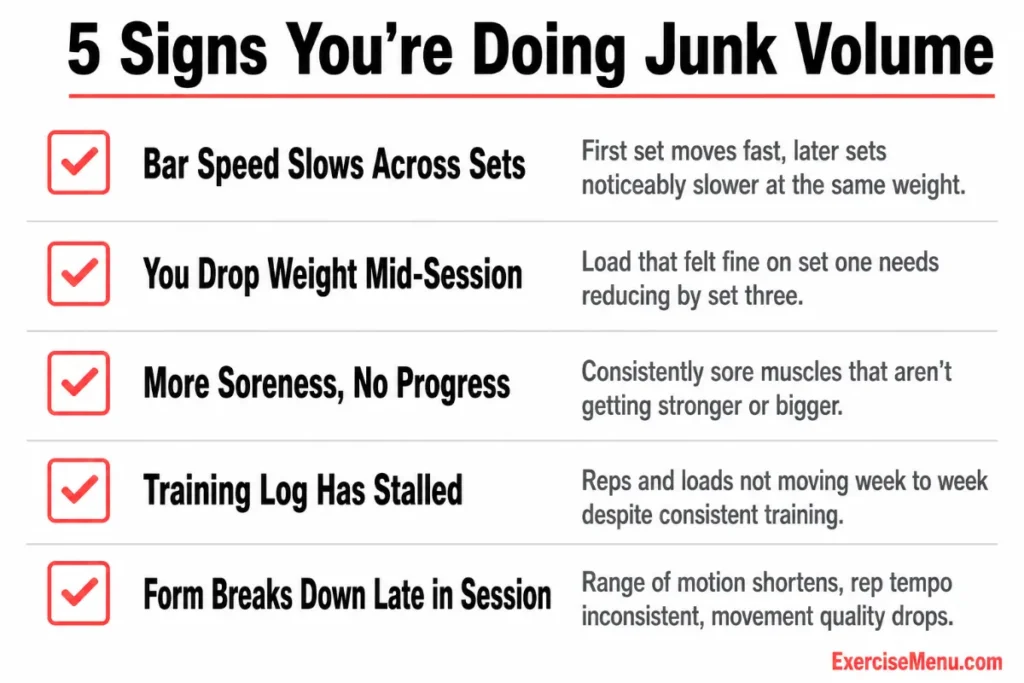
Bar speed slows across sets. The first set moves fast, the third or fourth noticeably slower at the same weight. This is CNS and muscular fatigue compounding not a sign to push through, but a sign the productive threshold has been crossed.
You drop weight mid-session without intending to. If the load that felt manageable on set one requires reduction by set three, earlier sets were pushing into or past MRV.
Soreness increases without progress. Soreness reflects muscle damage, not growth. Consistently sore muscles that are not getting stronger or larger is a reliable indicator that volume is exceeding recovery capacity without producing an adaptive response.
Sessions feel productive but the training log stalls. If reps and loads are not progressing week to week despite consistent attendance, the volume is not producing a stimulus it is producing fatigue that depresses performance.
Form degrades by the final sets. Range of motion shortens, rep tempo becomes inconsistent, and movement quality declines. Any set completed with compromised form is, at best, reduced stimulus and, at worst, a junk set with added injury risk.
Is Junk Volume a Myth?
No the dose-response relationship between training volume and muscle growth is confirmed by multiple studies across the last decade.
The term “junk volume” does not appear in peer-reviewed papers, but the concept does. Scientists call it the ceiling effect, diminishing returns, or excessive volume relative to recovery capacity. Coaches call it junk volume. Same thing, different language.
Pelland et al quantified this directly as weekly set volume increases, the rate of muscle growth slows dramatically before eventually plateauing. Baz-Valle et al found no meaningful difference in muscle development between moderate and high weekly volumes for certain muscle groups, confirming that additional sets above a threshold do not produce proportional results.
Elite athletes do train at very high volumes but under conditions most people do not replicate: exceptional recovery capacity, structured periodisation, adequate nutrition, and often genetic advantages. At standard training frequencies and recovery conditions, excessive volume reliably produces fatigue without equivalent adaptation.
What Is the Difference Between Junk Volume and Overtraining?
Junk volume is a session-level problem. Overtraining is a weeks-to-months accumulation problem.
Junk volume happens within a single workout the sets completed after the muscles have already received the full growth stimulus for that session. Ending the session earlier or improving the quality of earlier sets removes it.
Overtraining syndrome is the result of sustained imbalance between training load and recovery across weeks or months. It produces persistent fatigue, declining performance, disrupted sleep, reduced motivation, and suppressed immune function. Overtraining cannot be fixed by shortening one session.
The connection between them: consistent junk volume session after session, week after week is one pathway into overtraining. If each session accumulates more fatigue than the body can clear before the next training day, that deficit compounds until performance drops across every session, not just the heavy ones.
How to Avoid Junk Volume
Cap per-session volume. For most muscle groups, 6–8 hard sets per session is the productive range. Resistance to ending a session early is common the instinct to “do more” is difficult to override. But completing 10 sets where only 6 were productive does not produce 67% more growth; it produces the same growth with 67% more fatigue.
Train with sufficient intensity. Most working sets should leave 1–3 reps in reserve close enough to failure that the high-threshold fibers required for growth are being recruited, not so close that technique degrades. Keeping most sets at RPE 8–9 on most sets, with the final set of each exercise taken closer to failure.
Apply progressive overload consistently. The same weight, same reps, same sets week after week eventually becomes junk volume not because the sets were always unproductive, but because the muscles have adapted to that exact demand and no longer need to change. Adding weight, reps, or sets over time keeps productive volume productive.
Increase volume gradually. When adding sets to a programme, a 20% increase in weekly sets per muscle group is typically enough to stimulate further adaptation. Doubling volume in one training block exceeds recovery capacity and produces the opposite of the intended effect.
Manage hydration. Dehydration accelerates the onset of junk volume by reducing force output, impairing nerve-muscle signaling, and reducing coordination all of which cause productive sets to tip into unproductive ones earlier in a session. Adequate fluid and electrolyte intake before and during training extends the productive window of a session.
Plan deload weeks. When accumulated fatigue from weeks of productive training begins suppressing performance weights feel heavier, motivation drops, sleep quality declines — a deload week clears that fatigue and allows the body to express the adaptations built during the training block. Continuing to train through accumulated fatigue produces junk volume across the board.
Use volume cycling. Rather than training at the same volume indefinitely, cycling through phases of gradually increasing volume, peak volume, and reduced volume prevents both stagnation and chronic overreaching. Ramp up sets progressively over 4–6 weeks, reach the top of your productive range, then reduce volume for a week or two before building again.
Frequently Asked Questions
What is considered junk volume in the gym?
Any set that does not produce a meaningful muscle or strength stimulus — typically sets more than 5 reps from failure, sets beyond the productive per-session threshold for a muscle group, or ultra-high rep sets below 20% of 1RM.
Is junk volume real or just bro science?
It is real. Research consistently shows a ceiling effect in the dose-response relationship between training volume and muscle growth — additional sets past a threshold produce no further adaptation. The term is informal, but the concept is supported by peer-reviewed data.
How many sets per muscle group before it becomes junk volume?
For most people, productive volume ends at 6–8 hard sets per muscle per session. Weekly productive volume sits between 10–20 sets per muscle depending on training experience and the muscle group being trained.
What is the difference between junk volume and overtraining?
Junk volume is excess, unproductive sets within a single session. Overtraining is a systemic condition caused by sustained training load exceeding recovery capacity over weeks or months. Junk volume can contribute to overtraining if it is repeated consistently.
Does junk volume apply to beginners the same way?
Beginners reach their productive volume ceiling earlier — both within a session and across the week. Fewer sets produce greater relative adaptation at the beginner stage because the neuromuscular system is adapting to the movements themselves.
Can cardio be junk volume?
Yes. Low-intensity cardio at volumes that do not elevate heart rate sufficiently to produce cardiovascular adaptation adds training stress without the compensatory fitness improvement — more sessions, no additional aerobic gains.
How do I fix my training if I’ve been doing junk volume?
Reduce per-session sets to 6–8 per muscle group and increase working intensity — most sets should sit at RPE 8–9. Take one week at reduced volume to clear accumulated fatigue, then rebuild progressively from the lower base.
