


- Key takeaways
- Introduction
- What happens to muscle after 50 — and why reps and sets for adults over 50 matter more than ever
- The right reps and sets for adults over 50
- How to measure intensity without a 1RM test
- How many days a week should adults over 50 lift?
- Warm-up and cool-down: the step most older adults skip
- Breathing during lifts: what actually changes after 50
- Nutrition and supplementation: what actually supports muscle after 50
- Common programming mistakes adults over 50 make
- How long before you see results from strength training after 50?
- Strength training with pre-existing conditions
- Grip strength: the longevity biomarker your program is probably ignoring
- FAQs
- The bottom line
Key takeaways
- The rep range most trainers prescribe for adults over 50 is too conservative — here’s what the research actually recommends.
- Sarcopenia accelerates after age 60 at roughly 3.6% per year — and the only variable that changes that trajectory is how you train.
- RPE is how you measure intensity without a 1RM test — and most older adults are training at the wrong end of the scale.
- Progressive overload still applies after 50 — and RPE is how you know exactly when to add weight.
- 2–3 training days per week at proper intensity consistently outperforms training daily at low effort — recovery is part of the program.
Introduction
Most strength training advice for adults over 50 lands in one of two extremes. Either it’s so cautious it barely challenges you — three sets of ten with a resistance band, rest, repeat — or it copies a program designed for a 28-year-old and expects the same results.
The first approach produces almost nothing. The second produces injuries. After 7+ years coaching clients across all fitness levels at Exercise Menu, I’ve seen both play out — and the programming fix is the same either way.
Adults over 50 can and do build real muscle, improve bone density, protect their joints, and significantly reduce fall risk — but the programming has to match the biology of an aging body, not fight against it.
What happens to muscle after 50 — and why reps and sets for adults over 50 matter more than ever
Before the numbers, you need to understand what you’re working with.
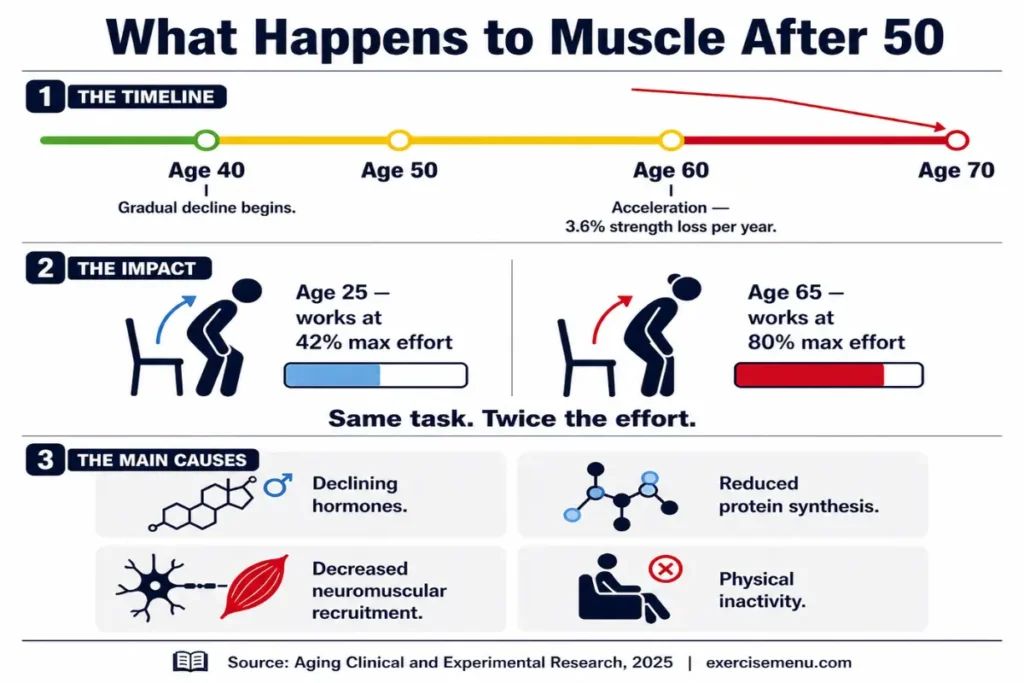
Sarcopenia — the age-related loss of muscle mass and strength — begins gradually around age 40 and accelerates significantly after 60. A 2025 systematic review in Aging Clinical and Experimental Research confirms that resistance training is one of the only interventions with strong evidence for improving strength, gait speed, and functional performance in older adults diagnosed with sarcopenia.
Here’s what that looks like practically: a young adult performing a sit-to-stand works at roughly 42% of their relative maximum effort. An older adult doing the exact same movement works at approximately 80%. The same daily task — twice the effort. That gap widens every year without structured training.
Why muscle loss accelerates — and what’s actually driving it
Four compounding factors are responsible: declining hormone levels, reduced protein synthesis efficiency, decreased neuromuscular recruitment, and physical inactivity. Any one of these slows you down. All four together — which is exactly what happens without structured training — accelerate the decline significantly.
The good news: it’s not irreversible. A 2025 study published in the Journal of Cachexia, Sarcopenia and Muscle found that resistance training significantly improved functional capacity and reduced frailty markers in centenarians — adults aged 100 and above — after just 12 weeks of structured training.
If it works at 100, the case for starting at 50, 60, or 70 makes itself.
That’s not an edge case. That’s what happens when training is dosed correctly — and it’s exactly why getting your 1RM baseline right matters from day one.
Hypertrophy vs. functional strength — which one do you actually need after 50?
Here’s the honest difference: hypertrophy is about making muscles bigger. Functional strength is about making daily life easier — getting off the floor without wincing, carrying shopping without your grip giving out, climbing stairs without bracing for it.
For most adults over 50, the second goal matters more. The good news is the programming overlaps significantly in the 8–12 rep range, so you don’t have to choose. A well-designed program does both — but functional movements come first.
For a full breakdown of exercise selection built around this distinction, see our guide to functional strength training for beginners.
The right reps and sets for adults over 50
Here’s what the research actually recommends — not what feels safe to prescribe.
The evidence-based rep range for strength after 50
The 6–15 rep range is the sweet spot for strength and muscle development in older adults. The American Physical Therapy Association’s “Choosing Wisely” campaign explicitly states: don’t prescribe under-dosed strength training programs for older adults.
Within that range:
- 6 reps approximates 85% of your 1RM — higher intensity, lower volume per set
- 15 reps approximates 60% of your 1RM — the minimum effective threshold for adaptation
- 70–85% of 1RM is the optimal training zone for meaningful strength gains
If you’re new to lifting, start at the higher end of the rep range (12–15 reps) at a manageable load. Over several weeks, work toward lower rep ranges (8–10, then 6–8) as your form and confidence develop. For a full breakdown of how rep ranges map to different training goals, see our complete rep range guide.
How many sets per session and per week?
For most adults over 50 training for functional strength and muscle preservation:
- 2–4 working sets per exercise per session
- 10–16 sets per muscle group per week is a productive volume range
- Beginners should start at the lower end — 10–12 sets per muscle group per week — and build from there
One thing I always check with new clients: whether they’re counting warm-up sets as working sets. Most are. Once we strip those out and count only the sets where they’re hitting RPE 6 or above, they realize they’ve been under-training for months. The number on paper looked fine. The actual training stimulus wasn’t there.
Quick reference: reps, sets, and intensity for adults over 50
| Goal | Rep Range | Sets Per Exercise | Intensity (% 1RM) | RPE Target |
|---|---|---|---|---|
| Strength | 4–8 | 3–5 | 80–85% | 7–8 |
| Muscle (hypertrophy) | 8–12 | 3–4 | 70–80% | 6–8 |
| Beginner / muscle endurance | 12–15 | 2–3 | 60–70% | 6–7 |
| Functional strength | 6–12 | 3–4 | 70–80% | 6–8 |
Start at the beginner row if you’re new to resistance training. Moving to the strength or hypertrophy rows is a realistic 8–12 week progression for most adults.
For more on how these categories compare, our guide on reps and sets for muscle growth and reps and sets for muscular endurance covers each goal in detail.
How to measure intensity without a 1RM test
You don’t need to test your one-rep maximum to train at the right intensity. For most older adults, comprehensive 1RM testing across multiple exercises is time-consuming, unnecessary, and — if form breaks down — a potential injury risk.
Instead, use RPE (Rating of Perceived Exertion).
What is RPE and how do you use it?
RPE is how hard a set feels on a scale of 0–10. For adults over 50, target RPE 6–8 — meaning at the end of a set, you could grind out 2–3 more reps, but you wouldn’t want to. If you’re finishing sets feeling fresh, the weight is too light.
A set that sits at RPE 4 isn’t producing a meaningful training stimulus. This is the under-dosing problem — and it’s exactly why many older adults train consistently for months and see minimal results.
How do you know when it’s time to increase weight?
When the same rep and load combination that used to feel like RPE 7 starts feeling like RPE 5 — that’s your signal. Increase the load by 2.5–10% and target your original RPE again.
Track your sessions. That’s the whole system.
How many days a week should adults over 50 lift?
2–3 days per week is the evidence-based starting point. Three days is optimal for most beginners and intermediates — enough frequency to stimulate adaptation while giving the body adequate recovery between sessions.
Recovery matters more after 50 than it does at 30. Connective tissue repair takes longer, hormone-driven recovery is slower, and cortisol stays elevated longer after hard sessions.
In my coaching practice, the pattern I notice most is this: older adults who train 5–6 days a week at low intensity consistently underperform compared to clients who train 3 days a week at proper intensity with full recovery days in between. More sessions at RPE 4 does not equal fewer sessions at RPE 7. The biology doesn’t work that way.
A practical 3-day weekly structure for adults over 50
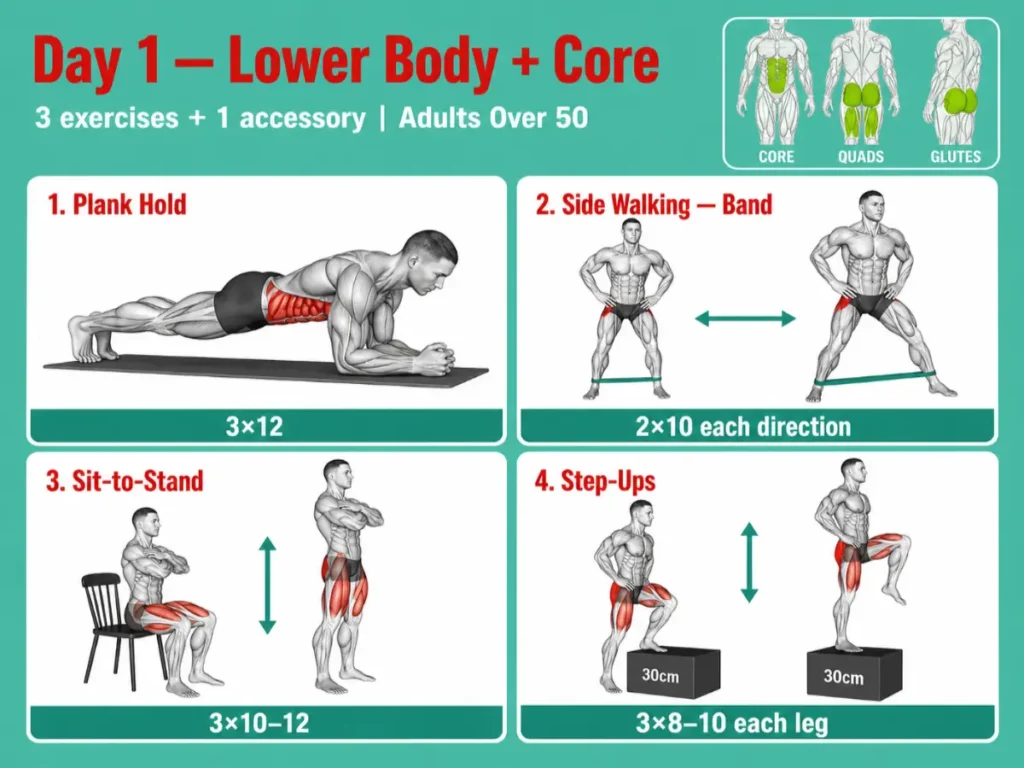
Day 1 — Lower body + core
- Sit-to-stand or leg press: 3 × 10–12
- Single leg lifts or step-ups: 3 × 8–10 per leg
- Abdomen pulses or plank hold: 3 × 12
- Side walking with resistance band: 2 × 10 steps each direction
Day 2 — Rest or light walking
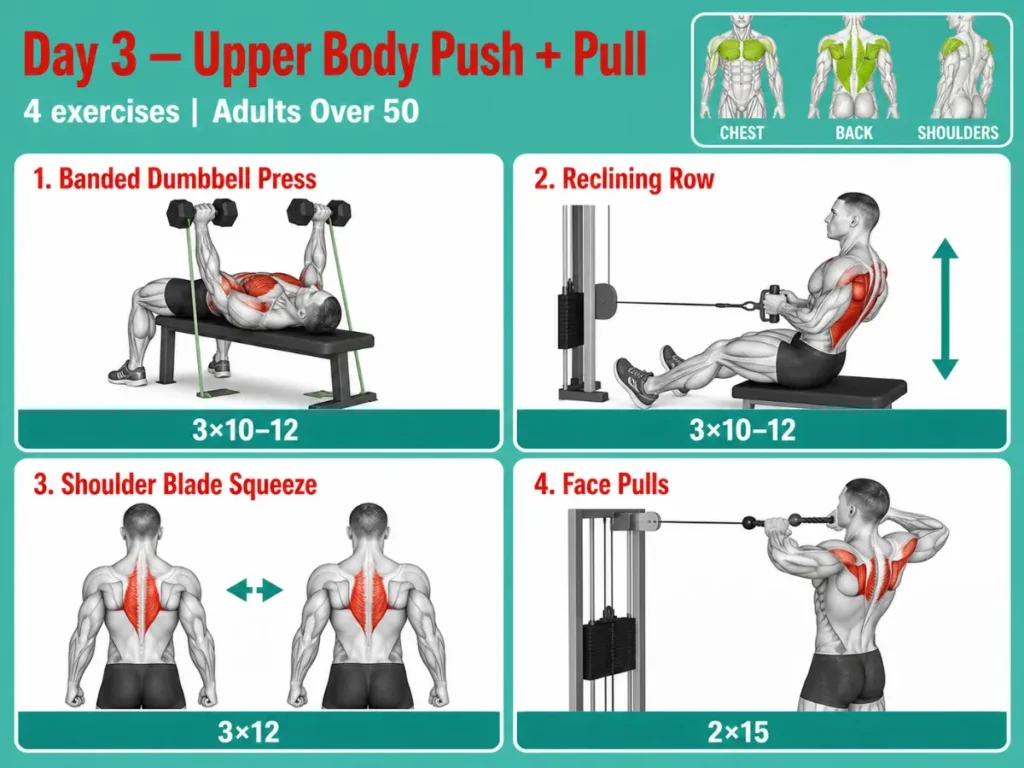
Day 3 — Upper body push + pull
- Banded dumbbell bench press or chest press machine: 3 × 10–12
- Reclining row or lat pulldown: 3 × 10–12
- Shoulder blade squeeze: 3 × 12
- Face pulls: 2 × 15
Day 4 — Rest or light activity
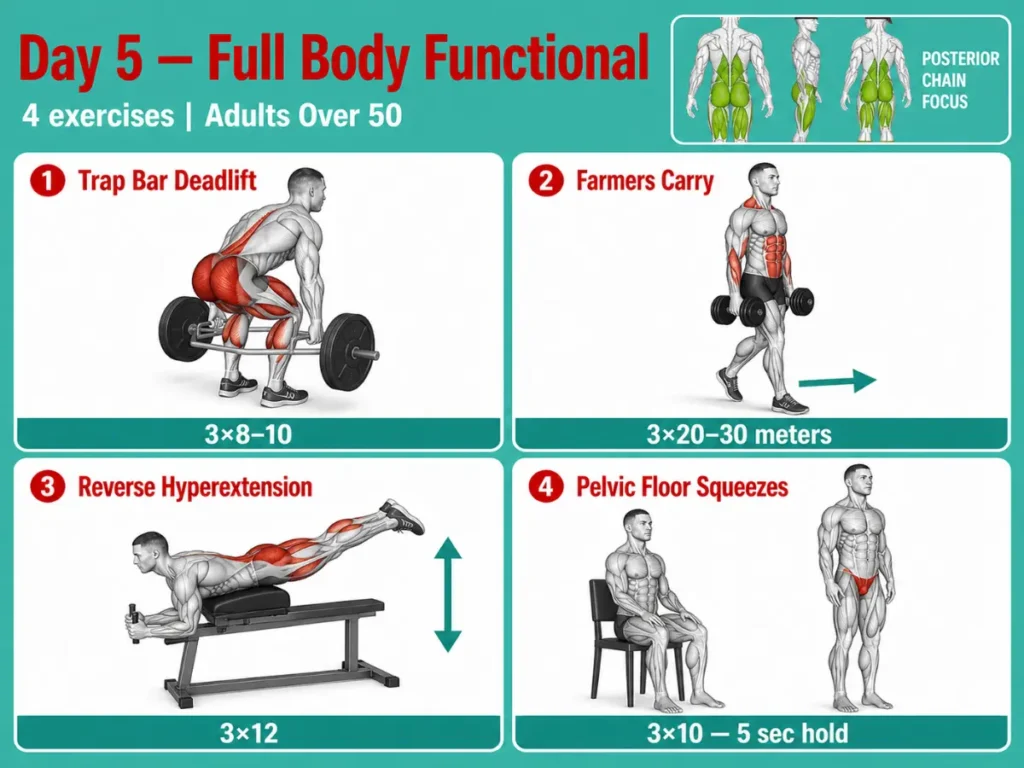
Day 5 — Full body functional + accessory
- Trap bar deadlift or dumbbell RDL: 3 × 8–10
- Farmers carry: 3 × 20–30 meters
- Reverse hyperextension or banded good mornings: 3 × 12
- Pelvic floor squeezes: 3 × 10 (5-second hold)
Days 6–7 — Full rest or restorative activity
Warm-up and cool-down: the step most older adults skip
Skipping the warm-up after 50 is how injuries happen. That’s not an exaggeration — it’s the most consistent pattern I see across new clients who come to me with nagging pain they can’t explain.
Older adults need a longer warm-up than younger trainees. Connective tissue is less elastic, joints require more time to lubricate properly, and neuromuscular activation is slower to engage after inactivity.
A solid 10-minute warm-up before strength training should include:
- Joint circles: ankles, knees, hips, shoulders — 60 seconds each
- Bodyweight activation: glute bridges, shoulder blade squeezes, dead bugs — 10 reps each
- Ramp-up sets: 2 sets of your first exercise at 40–50% of your working weight before your first real set
After your session, spend 5–10 minutes in static stretching. Hip flexors, hamstrings, thoracic spine, and shoulders are priority areas.
Breathing during lifts: what actually changes after 50
The Valsalva maneuver — holding your breath and bracing hard through a lift — creates a significant spike in blood pressure. For younger athletes on heavy compound lifts, it’s a performance tool. For older adults managing hypertension, it’s a variable worth controlling.
The safer default for most adults over 50:
- Exhale on the effort phase — the push, pull, or stand
- Inhale on the return phase — lowering the weight back to start
- Never hold your breath through an entire set
If you have a diagnosed cardiac condition or uncontrolled hypertension, discuss exercise intensity and breathing protocol with your physician before starting a resistance training program.
Nutrition and supplementation: what actually supports muscle after 50
Training stimulus and recovery are only two sides of the equation. Without adequate nutrition, the adaptation signal from your sessions has no raw material to work with.
How much protein do adults over 50 need?
The evidence-based target is 0.8–1 gram of protein per pound of bodyweight per day (approximately 1.8–2.2 grams per kilogram). Most adults over 50 are significantly below this without realizing it. Protein can come from both animal and plant-based sources — the priority is hitting the daily total consistently, spread across meals rather than concentrated in one sitting.
Use our protein calculator to find your exact daily target.
Should adults over 50 take creatine?
Yes — and this is the most under-discussed muscle retention tool in the over-50 population. A 2025 systematic review and meta-analysis published in the European Review of Aging and Physical Activity confirmed that creatine combined with resistance training produces meaningful gains in muscle strength and lean tissue mass in older adults — with the evidence particularly strong for longer intervention periods.
A second 2025 meta-analysis published in the same journal found that creatine plus exercise training significantly improved 1RM strength in older adults compared to training alone.
The standard dose is 3–5 grams per day, taken consistently. No loading phase is necessary. It’s inexpensive, safe, and produces measurable results in the population that arguably needs it most.
Common programming mistakes adults over 50 make
After working with 257 clients across all ages, the mistakes I see in older adults’ programs are remarkably consistent.
Mistake 1 — Training at the same load for months without progressing. Comfortable doesn’t build muscle. If your weights haven’t changed in eight weeks, you’re maintaining at best.
Mistake 2 — Counting warm-up sets as working sets. Strip those out and count only sets where you’re hitting RPE 6 or above. Most people discover they’re doing half the effective volume they thought.
Mistake 3 — Skipping the warm-up to save time. Your joints and connective tissue need preparation that daily activity doesn’t provide. Ten minutes is not optional at this stage.
Mistake 4 — Training through joint pain. Muscle soreness and joint pain are different. Soreness fades in 24–48 hours. Pain during a movement is a signal to modify or stop — not push through.
Mistake 5 — Under-eating protein. You can’t build or preserve muscle in a protein deficit. Most adults over 50 are significantly below the 0.8–1g/lb daily target without realizing it.
Mistake 6 — Doing too much too soon. Week one enthusiasm leads to week three burnout. Start conservative, build the habit first, and add volume in week five when your body — and your schedule — have proven they can handle it.
How long before you see results from strength training after 50?
The first month is mostly invisible. Your nervous system is rewiring itself to recruit muscle fibers more efficiently — you’ll feel stronger before you look it. Lifts that felt clumsy in week one start feeling controlled by week three.
Between weeks four and eight, the physical changes begin. Muscle tone improves. Daily activities feel less demanding. Posture shifts in ways other people notice before you do.
By week 12, if protein and consistency are in place, most clients I’ve worked with have a clear before-and-after moment — not dramatic, but undeniable. Consistency is the only variable that determines where on that timeline you land.
Strength training with pre-existing conditions
Osteoporosis: Resistance training is not just safe for adults with osteoporosis — it’s one of the primary interventions recommended for it. Weight-bearing compound movements like squats, deadlifts, and standing press stimulate bone remodeling directly. Avoid high-impact spinal flexion under load, get medical clearance first, and work with a coach who has specific experience in this area.
Arthritis: The goal is to find a pain-free range of motion and train within it — not to push through joint signals. Machines generally work better than free weights for arthritic joints because they provide a guided movement path. Reduce load before reducing range.
Hypertension and type 2 diabetes: Both conditions respond positively to consistent resistance training — blood pressure and blood glucose both improve with regular strength work. Keep RPE under 8 initially and build from there. Train under medical supervision if these conditions are active.
Should you speak to a doctor before starting? Yes — particularly if you have a cardiovascular condition, osteoporosis, or active diabetes. One conversation can identify contraindications that change your entire program.
Grip strength: the longevity biomarker your program is probably ignoring
Grip strength predicts how long you live — and almost no one is training it deliberately.
The landmark PURE study published in The Lancet — spanning over 140,000 adults across 17 countries — found that grip strength was a stronger predictor of cardiovascular mortality than systolic blood pressure. A 2025 BMC Geriatrics analysis further confirmed handgrip strength as a reliable indicator of aging-related physiological decline.
Grip strength responds well to direct training. The best exercises to build and maintain it after 50:
- Farmers carries: Walk 20–30 meters holding heavy dumbbells or kettlebells — one of the best total-body functional exercises that exists
- Trap bar deadlifts: The load demands grip engagement throughout the entire movement
- Dead hangs: 20–30 seconds hanging from a pull-up bar builds grip and shoulder health simultaneously
Add at least one of these to every session.
FAQs
How many reps should adults over 50 do to build muscle?
The optimal rep range for building muscle after 50 is 8–12 reps per set at 70–80% of your 1RM (RPE 6–8). This range produces sufficient mechanical tension to stimulate muscle protein synthesis without excessive joint stress. Beginners should start at 12–15 reps with a lighter load and build intensity over 4–6 weeks before moving into the 8–12 rep zone.
Is it safe to lift heavy weights after 50?
Yes — when heavy is defined correctly. Training at 70–85% of 1RM is both safe and necessary for meaningful strength gains. Research has demonstrated that adults averaging 90 years old can train at 80% 1RM safely, with no injuries and strength gains of up to 174%. The risk isn’t the weight — it’s poor warm-up, too-fast progression, or compromised technique.
How often should adults over 50 do strength training?
2–3 sessions per week is the evidence-based recommendation. Three sessions provides enough training stimulus for adaptation while allowing 48+ hours of recovery between sessions. Daily training at low intensity is consistently less effective than three well-programmed sessions at proper intensity.
What is the best rep range for strength vs. endurance after 50?
For strength: 4–8 reps at high intensity (RPE 7–8). For muscular endurance and functional fitness: 12–15 reps at moderate intensity (RPE 6–7). Most adults over 50 benefit from programming that cycles between both — building a strength base with heavier sets and maintaining muscular endurance with higher-rep accessory work. See our dedicated guide on reps and sets for fat loss if your goal also includes body composition.
Do you need weights to start strength training over 50?
No. Bodyweight exercises — sit-to-stands, single leg lifts, abdomen pulses, shoulder blade squeezes, side walking — are a legitimate and effective starting point. Progressive overload still applies: as bodyweight exercises become easy, add a resistance band, then light dumbbells. Most beginners over 50 should spend 4–6 weeks building movement patterns and consistency before adding significant external load.
How long does it take to see results from strength training after 50?
Performance improvements typically appear within 2–4 weeks (neural adaptations). Visible body composition changes appear between weeks 6–12, assuming protein intake is adequate and training is consistent. Measurable strength gains by week four to six, clear physical changes by month three.
The bottom line
The research is clear: 6–15 reps at 70–85% of 1RM, for 2–4 working sets per exercise, 2–3 times per week. That’s the framework that builds muscle, improves bone density, reduces fall risk, and preserves functional independence into the decades ahead.
Use RPE to measure intensity. Track your sessions. Progress your loads when the same work gets easier. Eat enough protein. Support that with creatine if you haven’t already. Let the recovery days do their job.
Not sure where your rep ranges should start for your specific goal? The Exercise Menu Rep Range Recommender gives you a personalized starting point based on your current level and goal.
Age changes the variables. The principles don’t.

1 Comment
Pingback: Hypertrophy vs Strength: Which to Pick (2026 ACSM Update)