

- Key Takeaways
- 1RM Calculator
- What is a 1RM?
- Should beginners test their 1RM directly?
- How to calculate your 1RM without maxing out?
- What is my one rep max if I can lift a weight for 3, 5 or 10 reps?
- Which formula should you use?
- Formula accuracy by rep range
- Why does adding RPE make the estimate more accurate?
- How to use your 1RM to set training weights?
- 1RM percentage chart (reps 1-15)
- Which exercises should you track your 1RM for?
- Is your 1RM good for your bodyweight?
- How to tell if your 1RM has changed without retesting?
- Direct 1RM testing protocol (for experienced lifters)
- When to retest?
- Frequently asked questions
- Sources
Key Takeaways
- Your 1RM is the heaviest weight you can lift for one clean rep with correct form.
- You don’t need to max out: the Brzycki formula estimates it safely from a set of 3-8 reps.
- Beginners should estimate, never test directly. Technique comes first.
- Once you have it, every training load has a target based on a real number, not a guess.
- Retest every 4-8 weeks. Track rep performance between tests to spot strength gains early.
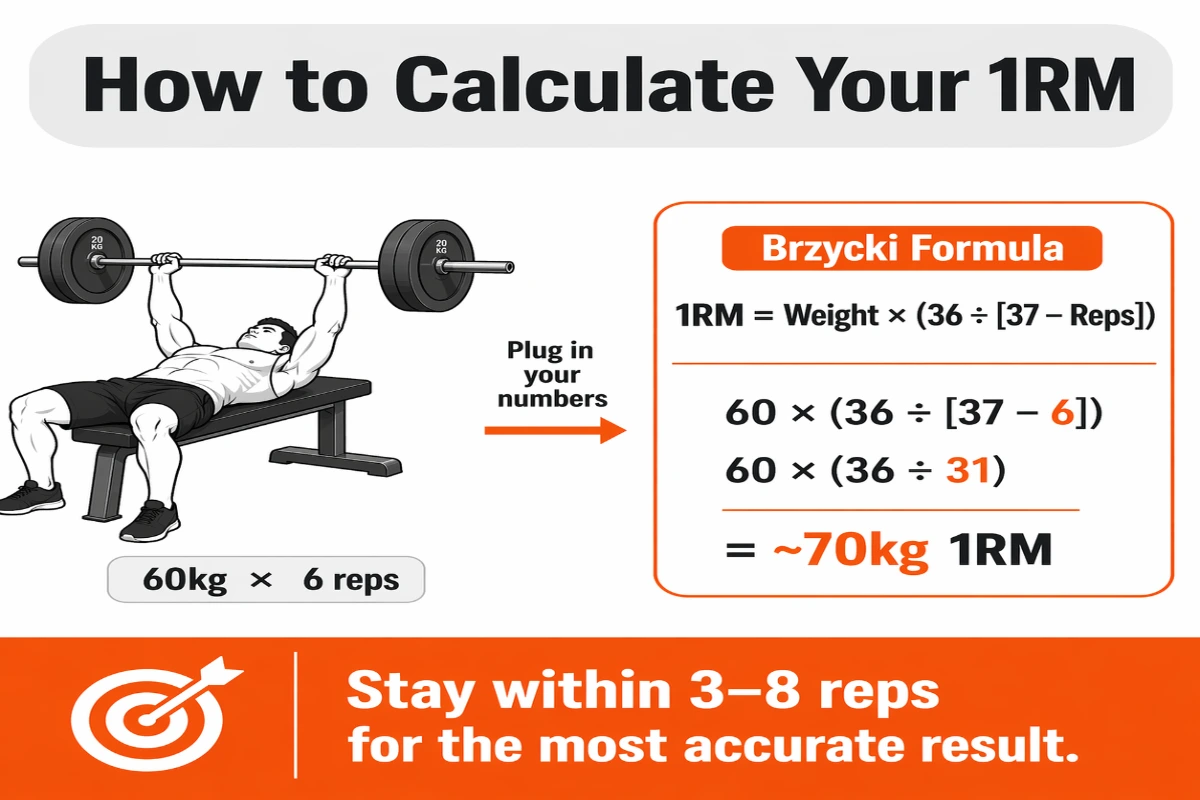
Quick answer: To calculate your 1RM, lift a weight for 3-8 clean reps and apply the Brzycki formula: 1RM = Weight ÷ (1.0278 – 0.0278 × Reps). Example: bench press 60 kg for 6 reps = estimated 1RM of ~70 kg. Or enter your set in the 1RM calculator below. No maxing out required.
That number turns every percentage in your program into an actual weight on the bar. “Work at 80%” stops being a guess and becomes 56 kg: calculated, not felt.
1RM Calculator
Enter the weight, your reps and how hard the set felt. The calculator uses the Brzycki formula by default, shows all seven formulas side by side and turns your result into training weights, rep maxes and a warm-up.
What is a 1RM?
A one rep max is the single heaviest repetition you can complete on a given exercise: full range of motion, no assistance, clean form. It’s the universal strength benchmark in resistance training and the number that makes percentage-based programming possible.
Each lift has its own 1RM. A squat max tells you nothing about your bench press or deadlift. If you’re still building a foundation around how reps and sets work together, that’s worth understanding first. 1RM builds on top of it.
Should beginners test their 1RM directly?
No. Direct 1RM testing, grinding up to the heaviest single rep possible, requires movement pattern mastery that takes months to develop. Loading a barbell near your limit before technique is solid increases injury risk without giving anything useful in return.
Anyone training consistently for less than 3-6 months should use the formula method below. For sets of 3-8 reps it usually lands within a few percent of a tested max, requires no spotter, and doesn’t disrupt the training session.
The most common mistake with newer trainees is wanting to test a max too early. Technique isn’t ready, form breaks under heavy load, and the chance of a strain goes up. The formula delivers the same usable data: no spotter, no drama.
How to calculate your 1RM without maxing out?
Pick a weight that allows 3-8 clean reps: challenging enough that the last rep requires real effort, but not a grind where form is breaking down. Perform the set, count the reps, then apply one of the formulas below.
The Brzycki formula (recommended)
1RM = Weight ÷ (1.0278 – 0.0278 × Reps)
Example: Bench press 60 kg for 6 reps. 1RM = 60 ÷ (1.0278 – 0.0278 × 6) = 60 ÷ 0.8610 = ~70 kg
Developed by Matt Brzycki in 1993, published in the Journal of Physical Education, Recreation & Dance. It’s one of the most widely used formulas for the 3-8 rep range and a standard choice for programming. It is slightly conservative, which makes it safer for setting training loads.
The Epley formula (alternative)
1RM = Weight × (1 + 0.0333 × Reps)
Example: 60 kg × 6 reps → 60 × 1.2 = ~72 kg
Developed by Boyd Epley in 1985. It returns a slightly higher estimate than Brzycki for the same input. For sets of 3-5 reps the difference is small. For 6-8 reps, Brzycki is more conservative and more commonly recommended.
Five more formulas (for reference)
| Formula | Equation | How it behaves |
| Lombardi | Weight × Reps^0.1 | Simplest. Reads high at 2-5 reps and low above 8 reps |
| Lander | (100 × Weight) ÷ (101.3 – 2.67123 × Reps) | Tracks Brzycki closely at every rep count |
| Mayhew | (100 × Weight) ÷ (52.2 + 41.9 × e^(-0.055 × Reps)) | Exponential. Highest estimates at low reps, flattens above 10 |
| Wathan | (100 × Weight) ÷ (48.8 + 53.8 × e^(-0.075 × Reps)) | Exponential. Lands close to Epley from 3 to 10 reps |
| O’Conner | Weight × (1 + 0.025 × Reps) | Matches Brzycki at 5 reps; the lowest estimate above 5 reps |
These are the seven most common formulas. For sets of 3-8 reps they land within about 5% of each other. The differences widen above 10 reps, which is why estimating from high-rep sets isn’t recommended regardless of formula. Individual factors like muscle fiber composition and training history can shift results slightly, but within the 3-8 rep range the variance stays small.
What is my one rep max if I can lift a weight for 3, 5 or 10 reps?
Apply the Brzycki formula to your set, or read your answer from the table below. These are the combinations lifters search for most, each assuming the set was taken to failure.
| Set you completed | Brzycki (recommended) | Epley | Average of both |
| 135 lb × 10 reps | 180 lb | 180 lb | 180 lb |
| 135 lb × 12 reps | 194 lb | 189 lb | 192 lb (low accuracy) |
| 155 lb × 5 reps | 174 lb | 181 lb | 178 lb |
| 185 lb × 3 reps | 196 lb | 204 lb | 200 lb |
| 225 lb × 3 reps | 238 lb | 248 lb | 243 lb |
| 225 lb × 5 reps | 253 lb | 263 lb | 258 lb |
| 315 lb × 5 reps | 354 lb | 368 lb | 361 lb |
| 60 kg × 10 reps | 80 kg | 80 kg | 80 kg |
| 80 kg × 8 reps | 99 kg | 101 kg | 100 kg |
| 100 kg × 5 reps | 112.5 kg | 117 kg | 115 kg |
| 140 kg × 3 reps | 148 kg | 154 kg | 151 kg |
The two formulas meet at 10 reps and drift apart on either side: Epley reads higher below 10 reps and Brzycki reads higher above it. Use the Brzycki number for setting loads, or the average when you want a middle estimate.
Which formula should you use?
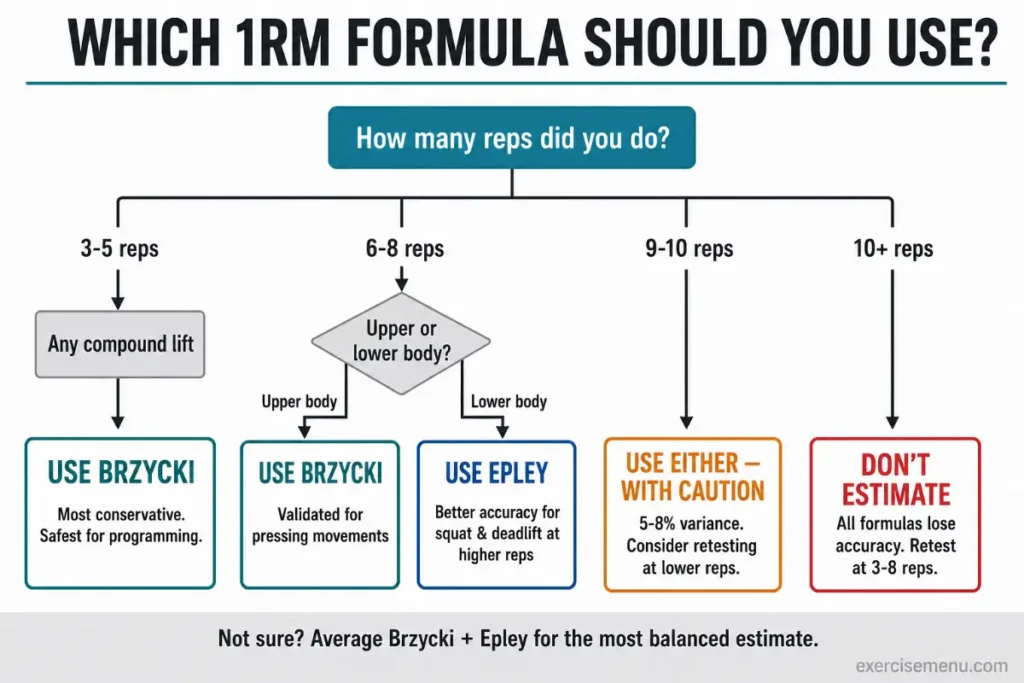
Most guides list the formulas and stop there. This decision framework tells you which one to pick for your set.
| Your situation | Use this | Why |
| 3-5 reps, any compound lift | Brzycki | Most conservative, safest for programming |
| 6-8 reps, upper body (bench, OHP) | Brzycki | Conservative estimate keeps pressing loads manageable |
| 6-10 reps, lower body (squat, deadlift) | Epley | Reads a little higher, which helps because rep-based formulas tend to underestimate the deadlift |
| 10+ reps | Neither: retest at lower reps | All formulas lose accuracy above 10 |
| Not sure which to trust | Average Brzycki + Epley | Most balanced estimate |
Same weight, all formulas: how much do they differ?
Example: 80 kg bench press × 5 reps
| Formula | Estimated 1RM |
| Brzycki | 90.0 kg |
| Epley | 93.3 kg |
| Lander | 91.0 kg |
| Lombardi | 94.0 kg |
| Mayhew | 95.2 kg |
| O’Conner | 90.0 kg |
| Wathan | 93.3 kg |
| Average of all seven | 92.4 kg |
The estimates cluster between 90 and 95 kg, a spread of about 5 kg. For programming at 80% of 1RM, that’s the difference between 72 kg and 76 kg on the bar. Meaningful, but not dramatic. Averaging Brzycki and Epley lands at ~91.7 kg, a reliable working number.
Formula accuracy by rep range
| Rep range | Typical accuracy | Best formula |
| 1-2 reps | Excellent (within 1-2%) | Any |
| 3-5 reps | High (within 2-3%) | Brzycki or Epley |
| 6-8 reps | Good (within 4-5%) | Brzycki |
| 9-10 reps | Moderate (5-8% variance) | Either, with caution |
| 10+ reps | Low (10%+ possible variance) | Neither: retest at lower reps |
Research backs the pattern. In 70 men and women aged 18 to 69, a 5-rep max predicted 1RM better than 10- or 20-rep maxes, and the authors advised using no more than 10 reps (Reynolds et al., 2006). When seven equations were tested on the bench press, squat and deadlift, predictions correlated above 0.95 with tested maxes, yet most still missed on average, and all of them underestimated the deadlift (LeSuer et al., 1997). Even a real max test moves from day to day: across 32 studies, the median variation was 4.2% (Grgic et al., 2020).
Never calculate 1RM from a fatigued set. By the third or fourth set of an exercise, accumulated fatigue underestimates true capacity. Always run the calculation from a fresh, standalone effort, ideally the first working set of the session.
Why does adding RPE make the estimate more accurate?
Every formula assumes your set ended at failure, and most people stop a rep or two short. RPE records how many reps you had left, so the estimate can use your true reps to failure. On the scale built for lifting, RPE 10 means no reps left, RPE 9 means one and RPE 8 means two (Zourdos et al., 2016).
Example: 100 kg for 5 reps to failure gives a Brzycki estimate of 112.5 kg. The same set at RPE 8 equals 7 reps to failure, which gives 120 kg. Skip the RPE and your estimate, and every load built from it, sits about 7.5 kg low. In the same study, novice lifters gave their true max a lower RPE than experienced lifters did, so if you’re new and unsure, pick the higher RPE. The difference between the two scales is explained in RPE vs RIR, and training to failure helps you judge where a set truly ended.
How to use your 1RM to set training weights?
Different goals need different intensities. Your 1RM gives the reference point to hit each one precisely.
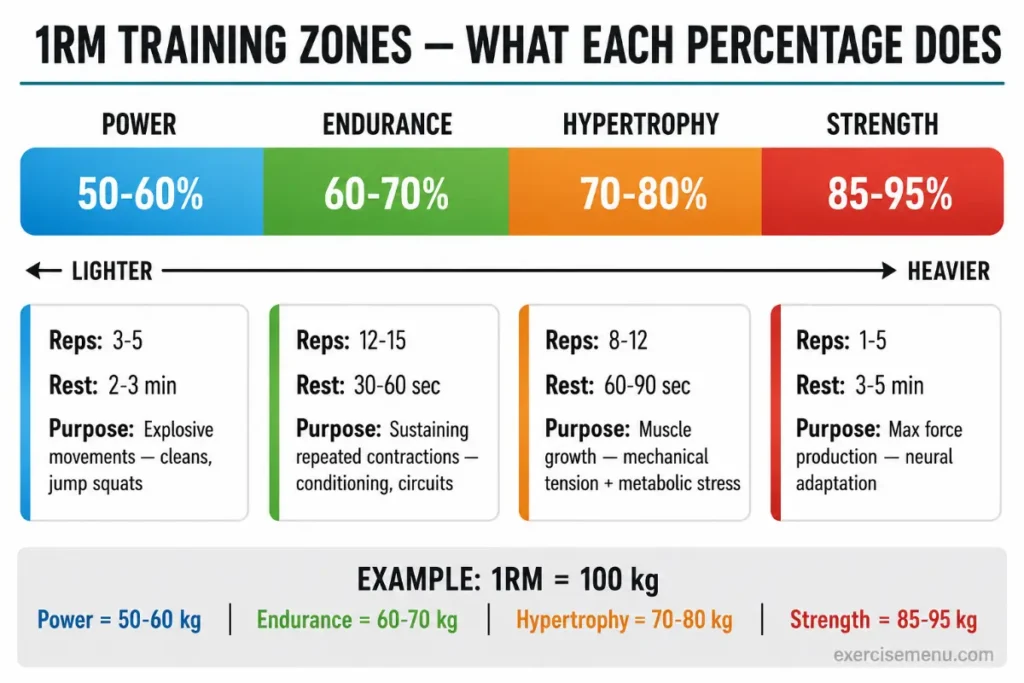
| Training goal | % of 1RM | Reps per set | Rest period |
| Maximum strength | 85-95% | 1-5 | 3-5 min |
| Muscle growth (hypertrophy) | 65-80% | 6-12 | 1-3 min |
| Muscular endurance | 60-70% | 12-15 | 30-60 sec |
| Explosive power | 50-60% | 3-5 | 2-3 min |
With a 70 kg bench 1RM and a muscle growth goal, the working weight is 45-56 kg for 6-12 reps. That’s a calculated training stimulus, not a weight chosen because it felt right. Common set schemes map onto these zones too: see what 3×10, 4×12 and 5×5 mean for the load each one uses.
What each intensity zone does
85-95% (strength): Trains the nervous system as much as the muscles. High load, low reps builds the ability to express the strength you already have. Programs like 5/3/1 and Starting Strength are built around this zone.
65-80% (hypertrophy): The main range for muscle growth. Sets of 6-12 reps create the mechanical tension that drives hypertrophy. Lighter loads can build muscle too when sets end close to failure (Schoenfeld et al., 2021), which is why the hypertrophy vs strength training choice is about load and effort together.
60-70% (endurance): Lighter loads, higher reps, shorter rest. Builds the muscle’s ability to sustain repeated contractions, relevant for sport, circuit training, and conditioning.
50-60% (power): Used for explosive movements like power cleans, jump squats, or medicine ball work. The load is light enough to move fast, which is the entire point. Never use this percentage for slow, controlled lifts.
1RM percentage chart (reps 1-15)
Use this to reverse-engineer working weight for any rep target without recalculating each time.
| Reps | % of 1RM | Reps | % of 1RM |
| 1 | 100% | 8 | 81% |
| 2 | 97% | 9 | 78% |
| 3 | 94% | 10 | 75% |
| 4 | 92% | 12 | 71% |
| 5 | 89% | 15 | 67% |
| 6 | 86% | ||
| 7 | 83% |
If 8 reps are now possible at a weight that previously maxed out at 6, the 1RM has already moved. Adjust percentages now; there’s no need to wait for a formal retest.
Why your reps may not match the chart
The chart shows averages, and real lifters spread widely around them. A 2024 meta-regression of 7,289 people across 269 studies found that at 70% of 1RM the average lifter completed about 15 reps, while older textbook tables list 11 (Nuzzo et al., 2024). The exercise mattered more than sex, age or training status: at 80% of 1RM, lifters averaged about 9 reps on the bench press but about 13 on the leg press. Treat the chart as a starting point and let your own rep counts correct it.
Which exercises should you track your 1RM for?
Compound movements that load multiple joints and represent real patterns of strength. Isolation exercises (curls, lateral raises, leg extensions) don’t need a 1RM because the numbers won’t translate meaningfully into programming.
| Movement pattern | Primary choice | Alternative |
| Lower body push | Back squat | Front squat |
| Upper body push | Bench press | Overhead press |
| Hip hinge | Deadlift | Romanian deadlift |
| Upper body pull | Barbell row | Weighted pull-up |
Pick one movement per pattern and commit to it. Swapping from back squat to front squat mid-cycle doesn’t mean strength decreased; it means the test changed. Stay consistent with the movement before drawing conclusions.
Dumbbells and weighted pull-ups
For dumbbell lifts, enter the weight of one dumbbell; the result is your max per hand, and it won’t convert to a barbell max. For weighted pull-ups and dips, you lift your bodyweight plus the added load, so add them together before using a formula, then subtract your bodyweight from the result. At 80 kg bodyweight, 20 kg added for 5 reps is 100 kg total, a Brzycki 1RM of 112.5 kg, or about +32.5 kg added.
Is your 1RM good for your bodyweight?
Divide your 1RM by your bodyweight and compare the ratio with standards for your sex, age and experience. Full tables are in average bench press by age, weight and sex and average squat by bodyweight and experience. Strength matters beyond the gym too: in 8,762 men followed for 18.9 years on average, those in the middle and top thirds of combined bench and leg press 1RM had a lower risk of death from all causes than the weakest third (Ruiz et al., 2008).
How to tell if your 1RM has changed without retesting?
Formal retesting on a monthly cycle keeps prescribed percentages in sync with actual strength. But between tests, rep performance at fixed weights reveals changes the moment they happen, as long as you track your workouts:
Previously maxed at 6 reps → now hitting 8 clean reps at the same weight: 1RM has increased. Plug the new rep count into Brzycki’s equation and update training loads.
Previously hitting 5 reps → now struggling at 3 with the same load: Not a strength loss; likely a recovery issue. Check sleep, nutrition, and accumulated fatigue, and consider a deload week before adjusting the program.
This approach catches strength changes in real time, not weeks later when a formal test finally confirms what rep performance already showed.
Direct 1RM testing protocol (for experienced lifters)
Lifters with 2+ years of consistent training and solid technique on compound lifts can test directly. The protocol below follows NSCA testing standards and aligns with validated methodology from Science for Sport. The 1RM attempt mode in our [LINK AFTER PUBLISHING: warm-up set calculator → /warm-up-set-calculator/] builds this ramp with the plates for each step.
Step 1: Warm up with 5-10 reps at 40-50% of estimated 1RM. Rest 1 minute.
Step 2: 3-5 reps at 60-70%. Rest 2 minutes.
Step 3: 2-3 reps at 75-85%. Rest 2-3 minutes.
Step 4: 1 rep at 90-95%. Rest 3-5 minutes.
Step 5: Attempt 1RM. If successful, rest 5-7 minutes and attempt 2-3% heavier. Maximum 3-5 total attempts.
Requirements: Power rack with safety bars. Experienced spotter. Closed pronated grip (no false/open grip). Five-point body contact on bench (head, upper back, glutes, both feet). No testing if sore, under-slept, sick, or recently injured.
For anyone who doesn’t meet those criteria, the formula method delivers the same usable number safely.
When to retest?
Every 4-8 weeks. Test more frequently and recovery resources go toward assessment instead of training. Leave it longer and prescribed percentages drift out of sync with actual capacity.
For percentage-based programs (5/3/1, GZCLP, and most structured strength programs) staying current with 1RM is what keeps every session calibrated correctly. When progressive overload drives consistent strength gains, the 1RM that was accurate 8 weeks ago may already be 5-10% below reality.
Frequently asked questions
Can a 1RM be calculated on a machine?
Yes, but a machine 1RM cannot be compared to a free-weight 1RM. A leg press max will be much higher than a squat max: different mechanics, different stabilizer demands. Track both separately.
How accurate is the Brzycki formula?
For sets of 3-5 reps, estimates usually land within about 5% of a tested 1RM. Accuracy drops above 8 reps and becomes unreliable above 10. Regular retesting keeps percentages current.
Does the Brzycki formula work for women?
Yes. A 2024 meta-analysis of 7,289 people found that sex did not clearly change how many reps lifters complete at a given percentage of 1RM, so the same formulas apply (Nuzzo et al., 2024).
What if form breaks during the estimation set?
Stop immediately. An estimate from compromised reps is useless, and percentages derived from bad data will prescribe weights that don’t match reality. Rest, reduce load by 10%, repeat with clean form.
What is the difference between 1RM and e1RM?
1RM is a true tested maximum. e1RM (estimated 1RM) is what a formula predicts from a submaximal set. For programming purposes both serve the same function. Most lifters work from e1RM because it’s safer, repeatable, and doesn’t disrupt training.
What does ORM mean?
ORM stands for one rep max, the same thing as 1RM. An ORM calculator, a 1RM calculator and a max calculator all estimate the heaviest weight you can lift for one repetition.
Should I train from my full 1RM or a training max?
Many programs, including Wendler’s 5/3/1, calculate every set from a training max of 90% of your 1RM. It leaves a margin for bad days and keeps progress steady.
Why do different 1RM calculators give different results?
They use different formulas, and some apply the Epley equation even to a single rep, which adds about 3% to a lift you already completed. A true single should return your exact weight.
How long does it take to improve a 1RM?
Expect meaningful gains after 8-12 weeks of structured training. Beginners see faster early progress because initial adaptations are neurological: the nervous system gets better at recruiting existing muscle before the muscle itself grows.
This article is for general education, not medical advice. If you have an injury or a medical condition, check with your doctor or a qualified coach before lifting near your maximum, and always use a spotter or safety bars for heavy sets.
Sources
- Brzycki M. Strength testing: predicting a one-rep max from reps-to-fatigue. Journal of Physical Education, Recreation & Dance. 1993;64(1):88-90. doi:10.1080/07303084.1993.10606684
- LeSuer DA, McCormick JH, Mayhew JL, Wasserstein RL, Arnold MD. The accuracy of prediction equations for estimating 1-RM performance in the bench press, squat, and deadlift. Journal of Strength and Conditioning Research. 1997;11(4):211-213. doi:10.1519/00124278-199711000-00001
- Reynolds JM, Gordon TJ, Robergs RA. Prediction of one repetition maximum strength from multiple repetition maximum testing and anthropometry. Journal of Strength and Conditioning Research. 2006;20(3):584-592. PubMed 16937972
- Zourdos MC, Klemp A, Dolan C, et al. Novel resistance training-specific rating of perceived exertion scale measuring repetitions in reserve. Journal of Strength and Conditioning Research. 2016;30(1):267-275. PubMed 26049792
- Grgic J, Lazinica B, Schoenfeld BJ, Pedisic Z. Test-retest reliability of the one-repetition maximum (1RM) strength assessment: a systematic review. Sports Medicine – Open. 2020;6(1):31. PubMed 32681399
- Nuzzo JL, Pinto MD, Nosaka K, Steele J. Maximal number of repetitions at percentages of the one repetition maximum. Sports Medicine. 2024;54(2):303-321. PubMed 37792272
- Schoenfeld BJ, Grgic J, Van Every DW, Plotkin DL. Loading recommendations for muscle strength, hypertrophy, and local endurance: a re-examination of the repetition continuum. Sports. 2021;9(2):32. PubMed 33671664
- Ruiz JR, Sui X, Lobelo F, et al. Association between muscular strength and mortality in men: prospective cohort study. BMJ. 2008;337:a439. PubMed 18595904

8 Comments
Pingback: Knees Hurt When Squatting? 5 Form Errors and How to Fix Each
Pingback: High Bar vs Low Bar Squat: What's the Differences?
Pingback: Average Bench Press by Age, Weight and Sex (2026)
Pingback: Smith Machine Bar Weight: Every Brand and Gym (2026)
Pingback: How to Bench Press? Setup, Descent, and Press
Pingback: Should You Train to Failure? What 55 Studies Say (2026)
Pingback: Is Your Deadlift Good? Average Weights by Level & Age
Pingback: How to Deadlift for Beginners Without Hurting Your Back