

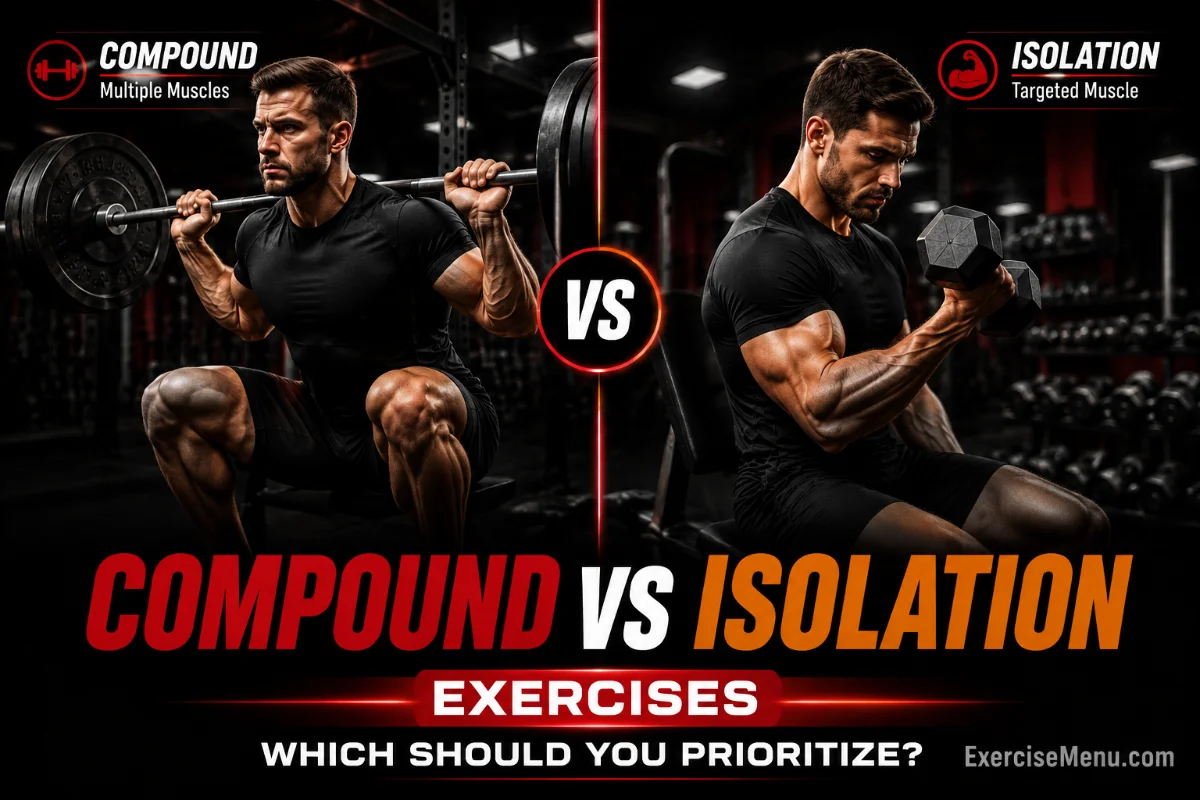
QUICK ANSWER: Compound exercises use multiple joints and train several muscles per movement — squats, deadlifts, bench press. Isolation exercises use one joint and target a single muscle — bicep curls, leg extensions, lateral raises. Start workouts with 3–4 compound lifts, finish with 2–3 isolation exercises. Both build comparable muscle when training volume is matched.
Compound and isolation exercises train your muscles in different ways. One loads multiple joints and forces several muscle groups to work together. The other focuses on a single muscle through a single joint. The difference between them shapes how much weight you can lift, how fast you build strength, which muscles grow, and how your body recovers between sessions.
The real question is not which type is “better” it is when each one earns its place in your training. This guide covers the differences, what research shows about muscle growth, and how to build a program that uses both based on your training level and goals.
- What Are Compound and Isolation Exercises?
- Which Builds More Muscle Compound or Isolation?
- Where Compound Exercises Win?
- Where Isolation Exercises Win?
- The Downsides of Each
- Should You Do Compound or Isolation First?
- How Many Compound and Isolation Exercises Per Workout?
- Best Compound and Isolation Exercises by Muscle Group
- How to Pick the Right Isolation Exercises for Your Weak Points?
- Is This Exercise Compound or Isolation?
- How to Fit Both Into Your Training Split
- FAQ's
What Are Compound and Isolation Exercises?
Compound exercises move two or more joints and train multiple muscle groups in a single movement. Isolation exercises move one joint and direct all the work to a single muscle. This distinction determines how you load the exercise, how many muscles benefit, and where each type fits in your workout.
Count the joints. A squat moves the ankles, knees, and hips three joints, multiple muscles working together. Compound. A leg extension moves only the knee one joint, one target muscle. Isolation.
Every compound exercise has a primary mover the muscle doing the most work and secondary movers that assist. In a bench press, the chest is the primary mover while the triceps and front delts are secondary. The core and upper back stabilize. This shared workload lets you lift heavier, but it also means no single muscle gets the full stimulus.
Isolation exercises work the opposite way. A bicep curl forces the biceps to handle the entire load with no assistance. The weight is lighter, but the target muscle receives maximum tension per set.
Compound vs Isolation: Side-by-Side
| Feature | Compound | Isolation |
| Joints involved | Two or more | One |
| Muscles trained | Multiple groups | One specific muscle |
| Weight potential | Higher — more muscles share the load | Lower — one muscle handles everything |
| Calorie burn per set | Higher | Lower |
| Learning curve | Steeper — more technique points | Simpler — fewer things to coordinate |
| Fatigue level | High — taxes the whole body | Low to moderate — localized fatigue |
| Functional carryover | Strong — mimics real-life movements | Minimal — isolated motion patterns |
| Best for | Strength, power, time efficiency | Targeting weak points, rehab, muscle detail |
Which Builds More Muscle Compound or Isolation?
When training volume is matched, both compound and isolation exercises produce similar whole-muscle growth. A 2023 systematic review by Rosa et al. in the Strength and Conditioning Journal confirmed no significant difference in overall hypertrophy between single-joint and multi-joint movements across seven randomized trials. Where isolation pulls ahead is regional growth it develops specific parts of a muscle more effectively than compounds alone.
For years, the assumption was that compound lifts were superior for building size because they recruit more muscle and allow heavier loads. The research tells a more nuanced story.
Squats grow the outer portion of the quadriceps (vastus lateralis) more than leg extensions do. But leg extensions grow the middle portion of the quad (rectus femoris) more than squats. Neither exercise alone produces complete quad development.
A study by Mannarino et al. (2021) in the Journal of Strength and Conditioning Research found that dumbbell curls increased elbow flexor thickness by approximately 11%, compared to just 5% from dumbbell rows — even though rows train the biceps as a secondary mover. The biceps simply did not receive enough direct stimulus from the compound lift to match a targeted isolation exercise.
A separate study by Costa et al. (2021) in the International Journal of Sports Medicine showed that performing three different exercises for the same muscle group produced greater regional hypertrophy in the proximal and middle biceps compared to a single exercise. Varying exercise selection not just exercise type drove more complete development across muscle regions.
The practical takeaway: compound exercises build the foundation. Isolation exercises fill the gaps compounds miss. Neither alone covers everything.
Where Compound Exercises Win?
Compound movements dominate in six areas, each of which shapes how you should build your program.
Overall strength. Moving weight across multiple joints with several muscle groups trains your body to produce force the way it works outside the gym pushing, pulling, lifting, squatting. A stronger squat makes you better at standing from a chair, climbing stairs, and carrying heavy loads. No isolation exercise replicates these movement patterns.
Heavier loading. When multiple muscles share the workload, you can handle more weight safely. A bench press at 185 lbs trains the chest, triceps, and shoulders simultaneously. A dumbbell fly a chest isolation exercise caps out at much lighter loads because the chest works alone. Heavier loading creates a stronger progressive overload signal, the gradual increase of training stress that drives strength and muscle growth over time.
Time efficiency. Four compound exercises can train your entire body in 30 minutes. Covering those same muscles with isolation movements would take double the time and double the exercise count. For anyone with limited training time, compounds deliver the highest return per minute.
Calorie burn. More working muscle mass per set means higher energy expenditure. Compound-heavy sessions create a larger metabolic demand than isolation-focused workouts relevant for anyone training in a calorie deficit or working to improve body composition.
Coordination and stability. Compound lifts force multiple muscles to fire in sequence, building intermuscular coordination. Better coordination improves athletic performance, movement quality, and reduces injury risk during daily activities.
Measurable progress. Because compound lifts allow heavier loads, small improvements show up faster. Adding 5 lbs to a squat is straightforward to track. Adding 2.5 lbs to a lateral raise is harder to measure and happens less often. Visible progress keeps training motivation high.
Where Isolation Exercises Win?
Isolation exercises solve five problems that compound movements cannot:
Targeting underdeveloped muscles. Lateral delts, biceps, hamstrings, and calves get secondary work during compound lifts but rarely enough direct volume to grow optimally. Lateral raises, curls, leg curls, and calf raises give these muscles the focused stimulus they need.
Regional muscle growth. The Rosa et al. systematic review showed that isolation exercises develop specific regions of a muscle more effectively than compounds. Leg extensions grow the mid-quad better than squats. Incline curls stretch the long head of the biceps more than any rowing movement. For complete muscle development across all regions, compounds alone fall short.
Fixing imbalances. Unilateral isolation exercises single-arm curls, single-leg extensions force each side to work independently. During compound lifts, the stronger side often compensates for the weaker one. Isolation removes that compensation and exposes the deficit so you can correct it.
Rehab and injury recovery. Simpler movement patterns mean less joint stress and lower coordination demands. A physical therapist prescribing leg extensions after knee surgery chooses isolation for a reason it loads the quad without requiring the hip, ankle, and core stability a squat demands.
Mind-muscle connection. Focusing on a single muscle through a controlled movement builds your awareness of how it contracts and lengthens. Once you develop that awareness during a cable pulldown, you can engage your lats more effectively during rows and pull-ups.
The Downsides of Each
Compound Exercise Drawbacks
Technique complexity. A squat requires correct bar position, bracing, stance width, depth, and knee tracking all at once. Mistakes carry higher injury risk because multiple joints are loaded simultaneously.
Mental and systemic fatigue. Heavy compound sets drain your nervous system and your motivation. A set of heavy deadlifts generates fatigue that a set of bicep curls never will. Programs built entirely around compound lifts increase the risk of burnout and overtraining.
Weaker muscles hide. During a compound lift, the muscle closest to failure determines when the set ends — which may not be the muscle you are trying to grow. Your triceps might fail before your chest during bench press. Your grip might give out before your back during deadlifts. The target muscle never reaches full capacity because a weaker link stops the set early.
Isolation Exercise Drawbacks
Lower loading potential. Single-muscle work means lighter weights and slower strength progression. You cannot overload a lateral raise the way you can overload an overhead press.
Limited functional transfer. Real-life movements picking up a child, carrying groceries, pushing a heavy door — involve multiple muscle groups coordinating together. Isolation exercises do not train that coordination.
Junk volume risk. Adding too many isolation exercises piles up sets that fatigue you without driving additional growth. If your pressing volume already gives your triceps enough weekly stimulus, stacking more tricep extensions on top can cross from productive training into junk volume excess work that delays recovery without improving results.
Should You Do Compound or Isolation First?
Compound exercises go first. They require more energy, more coordination, and heavier loads all of which perform best when you are fresh. Doing isolation exercises beforehand fatigues individual muscles and reduces the total volume you can handle on compound lifts.
A bench press after three sets of tricep extensions will be weaker than a bench press done fresh. Your triceps are already fatigued, so they fail before your chest reaches a meaningful stimulus. The compound lift suffers, and total training output drops.
The one exception: pre-exhaustion. This is an advanced technique where you deliberately fatigue a target muscle with isolation before a compound lift for example, leg extensions before squats to force the quads to work harder during the squat. Pre-exhaustion works for intermediate and advanced lifters chasing hypertrophy in a specific muscle, but it reduces the total weight you can handle on the compound lift. Beginners should skip it.
A well-structured session follows this order: warm-up (5–10 minutes of light movement and mobility) → compound lifts (3–4 exercises) → isolation accessories (2–3 exercises) → optional core work or finisher → cool-down stretch.
How Many Compound and Isolation Exercises Per Workout?
Most sessions work best with 3–4 compound exercises followed by 2–3 isolation exercises, totaling 5–7 movements per workout. The exact split depends on your training experience and goals.
| Training Level | Compound | Isolation | Why |
| Beginner (0–12 months) | 3–4 | 1–2 | Compounds alone drive growth at this stage. Isolation adds volume without adding complexity. |
| Intermediate (1–3 years) | 3 | 2–3 | Weak points start appearing. Isolation fixes them while compounds maintain the strength base. |
| Advanced (3+ years) | 2–3 | 3–4 | Growth slows. More targeted isolation work is needed to push lagging muscles past plateaus. |
The volume ratio across a full training week sits around 60–70% compound sets and 30–40% isolation sets for most people. Your reps and sets should serve a purpose every set you add needs to drive adaptation, not just accumulate fatigue.
Best Compound and Isolation Exercises by Muscle Group
This reference table covers the most effective exercises per body part the movements with the strongest research support and the widest practical application.
Compound Exercises
| Muscle Group | Exercise | Joints Involved |
| Chest | Barbell/dumbbell bench press, incline press, push-up, dips | Shoulder + elbow |
| Back | Barbell row, pull-up/chin-up, lat pulldown, cable row, deadlift | Shoulder + elbow (+ hip for deadlift) |
| Shoulders | Overhead press (barbell/dumbbell), push press | Shoulder + elbow |
| Quads / Glutes | Squat, front squat, leg press, lunge, Bulgarian split squat | Hip + knee + ankle |
| Hamstrings / Glutes | Romanian deadlift, conventional deadlift, hip thrust | Hip + knee |
Isolation Exercises
| Muscle Group | Exercise | Joint Involved |
| Biceps | Dumbbell/barbell curl, hammer curl, incline curl, cable curl | Elbow |
| Triceps | Tricep pushdown, overhead extension, skullcrusher, kickback | Elbow |
| Lateral delts | Lateral raise (dumbbell/cable), machine lateral raise | Shoulder (abduction) |
| Rear delts | Reverse fly, face pull, cable rear delt fly | Shoulder (horizontal abduction) |
| Quads | Leg extension | Knee |
| Hamstrings | Leg curl (seated/lying/standing) | Knee |
| Calves | Standing/seated calf raise | Ankle |
| Chest (isolation) | Dumbbell fly, cable fly, pec deck | Shoulder (horizontal adduction) |
How to Pick the Right Isolation Exercises for Your Weak Points?
Most programs fail at isolation exercise selection. People pick exercises randomly or copy what someone else does. A better approach: identify which muscle is limiting your compound lifts, then isolate it.
| If This Stalls… | The Likely Weak Link | Add This Isolation |
| Bench press | Triceps (lockout weakness) or chest (off the chest) | Tricep pushdowns / cable flys |
| Squat | Quads (can’t drive out of the bottom) | Leg extensions |
| Deadlift (off the floor) | Quads | Leg extensions |
| Deadlift (at lockout) | Glutes / hamstrings | Hip thrusts / leg curls |
| Overhead press | Lateral delts / triceps | Lateral raises / tricep extensions |
| Pull-ups / rows | Biceps fatiguing early | Bicep curls |
| Shoulders look narrow | Lateral delts (pressing alone does not grow them enough) | Lateral raises — 3–4 sets, 2x per week |
| Arms not growing | Biceps/triceps only get secondary work from compounds | Direct arm work — curls + extensions |
The pattern: find the muscle that fails first during your compound lift, isolate it to build its individual strength, then return to the compound movement. The compound lift gets stronger because its weakest link is no longer holding it back.
Is This Exercise Compound or Isolation?
Some exercises cause confusion because they feel like one type but technically classify as the other. This reference clears up the most common questions.
| Exercise | Type | Joints Involved | Why It Confuses People |
| Push-up | Compound | Shoulder + elbow | Bodyweight feels simple, but it trains chest, shoulders, triceps, and core |
| Lat pulldown | Compound | Shoulder + elbow | Machine-based, but two joints move — shoulder extension and elbow flexion |
| Hip thrust | Compound | Hip + knee | Feels like glute isolation, but the knee extends and hamstrings assist |
| Leg press | Compound | Hip + knee | Machine-guided path, but hip and knee joints both move under load |
| Lunges | Compound | Hip + knee + ankle | Quad burn feels targeted, but three joints work through full range |
| Hip abductor machine | Isolation | Hip only | Machine setup suggests compound, but only the hip joint moves |
| Shrugs | Isolation | Shoulder elevation only | Heavy weight feels compound, but only the scapula elevates |
| Face pulls | Isolation | Shoulder (external rotation) | Cable movement, but primary motion is rotation at one joint |
| Calf raises | Isolation | Ankle only | Standing version feels like it involves the knee, but the knee stays locked |
The test: count the joints that move under load. One joint = isolation. Two or more = compound. The weight, equipment, and difficulty level do not change the classification.
How to Fit Both Into Your Training Split
The ratio of compound to isolation shifts depending on your training split and how many days per week you train.
Full body (3 days per week): 3 compound exercises + 2 isolation exercises per session. Every session covers a squat or hinge, a push, and a pull with isolation addressing whatever needs extra attention. This structure suits beginners who need to build a strength foundation with high frequency across all movement patterns.
Upper/lower (4 days per week): Upper days use 2 compound pushes, 1 compound pull, and 2–3 isolation accessories for arms and shoulders. Lower days use 2 compound movements (squat + hinge) and 2 isolation exercises (leg extensions, leg curls, or calf raises). The upper lower split vs full body comparison covers the programming details of each format.
Push/pull/legs (6 days per week): Push day bench press + overhead press + tricep isolation + lateral raises. Pull day rows + pulldowns + bicep curls + face pulls. Leg day squat + Romanian deadlift + leg extensions + leg curls + calf raises. This split gives each muscle group the highest training frequency and the most room for targeted isolation work. The push pull legs split guide covers exercise selection, weekly volume, and scheduling in full.
FAQ’s
What is a compound set?
A compound set pairs two exercises for the same muscle group with little or no rest between them. It is different from a compound exercise, which uses multiple joints, and different from a superset, which combines two exercises that may target different muscles.
Do compound exercises release more testosterone than isolation?
Compound exercises create a larger short-term hormonal response because they involve more muscle mass. However, these temporary hormone changes do not determine long-term muscle growth. Hypertrophy depends mainly on progressive overload, training volume, and consistent effort.
Should I use machines or free weights for isolation exercises?
Both can build muscle effectively. Machines provide stability and make it easier to focus on the target muscle, while free weights require more control and stabilization. Choose the option that allows you to train the muscle effectively with good form and without joint discomfort.
Can I do compound and isolation for the same muscle in one session?
Yes. Most effective programs combine both. Compound exercises provide heavy loading and overall strength stimulus, while isolation exercises add targeted volume for specific muscles. For example, bench press followed by cable flys trains the chest through both approaches.
How do I know when to add more isolation to my program?
Add more isolation work when a muscle becomes a limiting factor or appears underdeveloped compared with other areas. If a compound lift stalls because a specific muscle is weak, targeted isolation exercises can strengthen that weak point and improve overall performance.
Are bodyweight exercises compound or isolation?
Most bodyweight exercises are compound because they involve multiple joints and muscles. Push-ups, pull-ups, squats, and lunges all train several muscle groups together. True bodyweight isolation exercises are less common because isolating one muscle usually requires more controlled resistance.
FITNESS DISCLAIMER
If you have an existing injury or medical condition, check with your doctor before starting a new training program.

2 Comments
Pingback: Mind-Muscle Connection: Does It Work? Science + Cues
Pingback: Cable Chest Exercises: 10 Best Moves and a Full Workout