


Quick Answer: 10–20 hard sets per muscle group per week builds muscle for most people. Beginners: 6–10 sets. Intermediates: 10–16. Advanced: 16–20. Count only sets taken within 1–3 reps of failure. Spread volume across 2–3 sessions per muscle per week. Larger muscles like quads and back tolerate more volume than biceps and triceps.
Most people plateau not because their programme is wrong, but because their weekly volume is either too low to force adaptation or too high to recover from. Three sets of bench press once a week and wondering why your chest isn’t growing, that’s under-stimulation. Twenty-five sets of chest with declining quality by the final few, that’s exceeding your recovery capacity. Both stall progress for different reasons.
This guide gives exact set ranges by training level, body part, and goal, plus a framework to tell whether your current volume is working. If you’re still learning the fundamentals, start with what reps and sets are.
- What Counts as a "Set" When You Track Volume?
- How Many Sets Per Muscle Group Per Week by Training Level?
- How Many Sets Does Each Muscle Group Need Per Week?
- How Many Sets Should You Do Per Session?
- How Do You Count Direct vs Indirect Volume?
- Does Training to Failure Change How Many Sets You Need?
- Does a Caloric Deficit Change How Many Sets You Need?
- How Do You Know If Your Volume Is Too High or Too Low?
- How Should You Add Sets Over Time?
- Common Volume Mistakes
- Faq's
What Counts as a “Set” When You Track Volume?
A set only counts toward your weekly volume when it meets two conditions: it uses a working weight (not a warm-up load) and you take it within 1–3 reps of failure.
Warm-up sets at 50–60% of your working weight prepare joints and the nervous system. They do not contribute to muscle growth and should not appear in your weekly count.
This distinction matters because every volume study defines a “set” as one taken close to or at failure. If your sets stop well short of that, leaving 5, 6, or 7 reps in the tank, each set produces far less stimulus than the research numbers assume. Those are not junk volume in the traditional sense, but they are doing less per set than you think.
How compound sets count across muscles:
A set of bench press counts as one set for chest, one for front delts, and one for triceps. It is still one set of one exercise, but it applies to three muscles. A set of barbell rows counts as one direct back set plus significant indirect bicep work. A set of curls counts as one direct bicep set with no contribution elsewhere.
This is how people accidentally over-train smaller muscles. If you do 12 sets of pulling work, your biceps already receive 12 indirect sets. Four to six direct bicep sets on top of that is usually enough, not another 12.
How Many Sets Per Muscle Group Per Week by Training Level?
| Training Level | Weekly Sets Per Major Muscle | Why This Range |
|---|---|---|
| Beginner (0–1 year) | 6–10 | Neural adaptation drives early gains. Every stimulus is new, so less volume is needed to grow. |
| Intermediate (1–3 years) | 10–16 | The beginner adaptation response fades. More volume is required to keep progressing. |
| Advanced (3+ years) | 16–20 | Closer to the upper limit of recoverable volume. Diminishing returns above 20 for most muscles. |
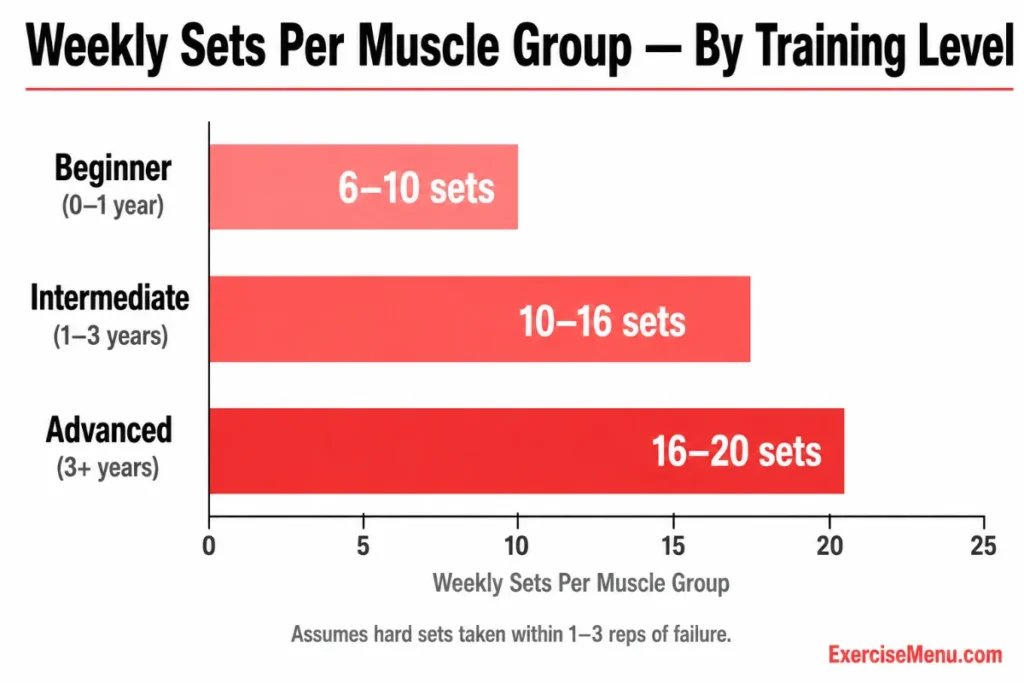
A 2017 meta-analysis by Brad Schoenfeld, Ogborn, and Krieger (Journal of Sports Science and Medicine) confirmed a dose-response relationship between weekly sets and hypertrophy. Ten or more sets per muscle per week produced more growth than fewer than five. A follow-up review by Baz-Valle et al. (2022) (Sports Medicine) found no hypertrophy advantage past 12–20 weekly sets for most muscles, that is where diminishing returns reliably set in.
On minimum effective volume:
As few as 1–4 sets per muscle per week still produces roughly 64% of the gains that higher volumes produce. This is a useful reference point if you are training with limited time or managing an injury. Not ideal for growth, but far from useless.
On maintenance volume:
4–8 sets per muscle per week is generally enough to maintain muscle that has already been built. You can drop to this range during high-stress periods, travel weeks, or planned deload phases without meaningful muscle loss.
How Many Sets Per Muscle Group Per Week for Strength?
Strength and hypertrophy require different volume prescriptions. Most lifters apply the same set ranges to both goals, that is a mistake.
For strength — improving your 1RM on squat, bench press, and deadlift, the minimum effective dose is lower than for building muscle. A systematic review by Androulakis-Korakakis et al. (2020) (Sports Medicine) found that 1 set per exercise, performed 2–3 times per week, is enough to produce significant strength gains in resistance-trained men. Strength is partly a motor skill: consistent exposure to the movement pattern at heavy loads drives adaptation more than volume alone.
That said, Ralston et al. (2017) found that medium and high weekly set volumes outperform low volumes for strength development. The key difference: strength sets are typically stopped 3–5 reps short of failure, which reduces recovery demand and allows higher weekly totals without overreaching.
Practical strength volume targets:
- 3–5 sets per exercise per session
- 4–10 total sets per muscle per week
- Sets stopped 3–5 reps short of failure on most compound lifts
- Heavier loads (80–90% of 1RM) with lower reps (1–5)
How Many Sets Does Each Muscle Group Need Per Week?
Not every muscle requires the same weekly volume. Larger muscles tolerate more direct work. Smaller muscles receive significant indirect stimulation from compound lifts, and that indirect volume counts toward their weekly total.
| Muscle Group | Beginner | Intermediate | Advanced | Primary Indirect Sources |
|---|---|---|---|---|
| Quads | 6–8 | 10–16 | 16–20 | Squats, leg press, lunges |
| Back (lats + upper back) | 6–10 | 12–16 | 16–20 | Rows, pull-ups, deadlifts |
| Chest | 6–8 | 10–14 | 14–18 | Bench press, dips, push-ups |
| Shoulders (side + rear delts) | 4–6 | 8–12 | 12–16 | Front delts get indirect work from all pressing |
| Hamstrings | 4–6 | 8–12 | 12–14 | RDLs, squats (minor), hip hinges |
| Glutes | 4–6 | 8–12 | 12–16 | Squats, deadlifts, lunges, hip thrusts |
| Triceps | 4–6 | 6–10 | 10–14 | Every pressing movement (bench, OHP, dips) |
| Biceps | 4–6 | 6–10 | 10–14 | Every pulling movement (rows, pull-ups, chin-ups) |
| Calves | 6–8 | 8–12 | 12–16 | Minimal indirect work — need direct training |
[IMAGE: Grid showing weekly set recommendations for each muscle group at beginner intermediate and advanced levels]
Back, shoulders, glutes, and quads respond well to the higher end of these ranges. Chest, biceps, and triceps typically do not, primarily because they already receive substantial indirect volume from compound pressing and pulling. Tracking indirect sets is what prevents the common mistake of unintentionally over-training the arms while thinking the volume is appropriate.
How Many Sets Should You Do Per Session?
Weekly volume matters, but how you distribute it across sessions determines set quality.
Research by Krieger (2010) indicates that roughly 6–10 hard sets per muscle group per session is the productive range. Beyond 10–12 sets for the same muscle in a single session, set quality drops, fatigue accumulates faster than stimulus.
A practical example: 16 weekly chest sets is not best achieved by doing all 16 on Monday. Eight sets on Monday and eight on Thursday keeps every set within the productive range. Training each muscle twice per week produces greater hypertrophy than once per week, even when total weekly volume is identical. This finding is consistent across multiple meta-analyses, including Schoenfeld, Ogborn, and Krieger (2016) in Sports Medicine.
Distribution by split:
| Split | Days | Sets Per Muscle Per Session | Sessions Per Muscle Per Week |
|---|---|---|---|
| Full body | 3 | 3–5 | 3 |
| Upper/lower | 4 | 5–8 | 2 |
| Push/pull/legs | 6 | 6–10 | 2 |
How Do You Count Direct vs Indirect Volume?
Compound exercises train multiple muscles simultaneously. Each muscle receiving meaningful tension should appear in your weekly tally.
| Exercise | Direct Volume For | Indirect Volume For |
|---|---|---|
| Bench press | Chest | Front delts, triceps |
| Close-grip bench press | Triceps, chest | Front delts |
| Barbell row | Back (lats, upper back) | Biceps, rear delts |
| Chin-up | Back | Biceps (significant) |
| Lat pulldown (overhand) | Back | Biceps (moderate) |
| Squat | Quads | Glutes, hamstrings (minor) |
| Romanian deadlift | Hamstrings | Glutes, lower back |
| Hip thrust | Glutes | Hamstrings (minor) |
| Dumbbell flye | Chest | None — pure isolation |
| Lateral raise | Side delts | None — pure isolation |
| Bicep curl | Biceps | None — pure isolation |
The indirect contribution shifts by exercise variation. A close-grip bench press loads triceps harder than a wide-grip bench. The grip width you choose changes how volume distributes across chest, triceps, and shoulders, which matters when you’re tracking weekly sets per muscle group. A chin-up hits biceps harder than an overhand lat pulldown. This is why blindly counting “3 sets” without noting which muscles each exercise loads leads to lopsided programming.
Does Training to Failure Change How Many Sets You Need?
Yes. The answer changes meaningfully based on how close to failure your sets actually get.
Sets taken to absolute failure demand more recovery time than sets stopped 1–3 reps short. Research consistently shows that stopping just before failure produces similar hypertrophy with faster recovery — which means you can train more frequently, accumulate more weekly volume, and keep set quality higher across each session.
The practical implication: if you train mostly to failure, your weekly set ceiling drops below the ranges above. Recovery becomes the limiting factor. If you stop 2–3 reps short on most sets, you can push toward the upper end of your training level’s range without recovery breaking down.
| Training Style | Recommended Weekly Set Adjustment |
|---|---|
| Most sets to failure (RPE 10) | Use the lower end of your range (e.g., 10–12 for intermediates instead of 10–16) |
| Most sets at RPE 8–9 (1–2 RIR) | Use the mid-to-upper end of your range |
| Most sets at RPE 7 (3 RIR) | Can push toward the upper end; recovery is fastest |
Does a Caloric Deficit Change How Many Sets You Need?
Yes. Recovery capacity drops during a caloric deficit, which directly affects how much training volume your body can handle and benefit from.
When you eat below maintenance, muscle protein synthesis runs at a reduced rate. A moderate deficit (roughly 500 calories below maintenance) does not eliminate the growth signal from resistance training, but it does shrink the window your body has to repair and build. The practical result: the same weekly volume that drives growth in a surplus may exceed your recovery capacity in a deficit.
Volume adjustments during a cut:
| Situation | Volume Recommendation |
|---|---|
| Mild deficit (300–500 cal) | Reduce volume by 15–20% from your growth phase. If you trained at 16 sets per muscle, drop to 12–14. |
| Aggressive deficit (500–750+ cal) | Reduce volume by 25–30%. Prioritize maintaining loads over maintaining volume. |
| Maintenance / body recomposition | Keep volume at normal growth-phase levels. Recovery capacity is not compromised. |
The priority during a cut is maintaining the weight on the bar — not maintaining every set. Cutting sets while keeping loads and intensity high preserves more muscle than keeping all your sets but lifting lighter because you’re fatigued. If strength starts declining, the first fix is reducing volume, not reducing weight.
How Do You Know If Your Volume Is Too High or Too Low?
The right volume is individual. Research has shown that responses to the same weekly set count vary between people — roughly a third respond better to lower volumes, a third to higher, and a third show no meaningful difference. Genetics, sleep quality, nutrition, stress, and training history all shift where the productive range sits.
Three signals tell you where you are:
Volume is productive: Lifts trend upward across 3–4 week blocks. Soreness resolves within 48 hours. Energy stays consistent session to session. Do not change anything. Add sets only when progress genuinely stalls — not when you feel like “more” should help.
Volume exceeds recovery: Persistent soreness lasting 3+ days. Declining sleep quality. Dropping motivation. Lifts moving backwards despite consistent effort. Cut total weekly sets by 20–30% and monitor for 2–3 weeks. This is where junk volume starts replacing productive volume — the sets are happening, but adaptation is not.
Volume is too low: Sessions feel easy. Recovery is fast. But lifts have not moved in 3+ weeks despite good technique and nutrition. Add 2 sets per muscle per week and reassess after 3–4 weeks.
[IMAGE: Three column comparison showing signs of too low productive and too high training volume]
On injury risk when increasing volume:
Muscles adapt to increased load faster than joints and connective tissue. Over-aggressive volume increases — doubling sets in a single training block — overload tendons and ligaments before they have adapted. A 20% increase in weekly sets per muscle is the safe ceiling for any single training block. Beyond that, overuse injury risk climbs faster than the adaptation benefit.
How Should You Add Sets Over Time?
Starting at the upper end of your volume range and staying there indefinitely is one of the more reliable ways to stall progress. The smarter approach: start at the lower end, apply progressive overload within those sets (more reps, more weight), and add volume only when load and rep progression has genuinely plateaued.
Volume mesocycle framework:
| Phase | Weeks | What to Do |
|---|---|---|
| Baseline | 1–4 | Start at the bottom of your level’s range. Beginner: 6 sets. Intermediate: 10. Advanced: 14–16. |
| Build | 5–8 | Add 1–2 sets per muscle per week. Monitor recovery signals. |
| Peak | 9–12 | If lifts are still climbing, hold current volume. If progress stalls, add 1–2 more sets. |
| Deload | 13 | Drop volume by 40–50% for one week. Maintain exercises and frequency. Then restart the cycle at a slightly higher baseline. |
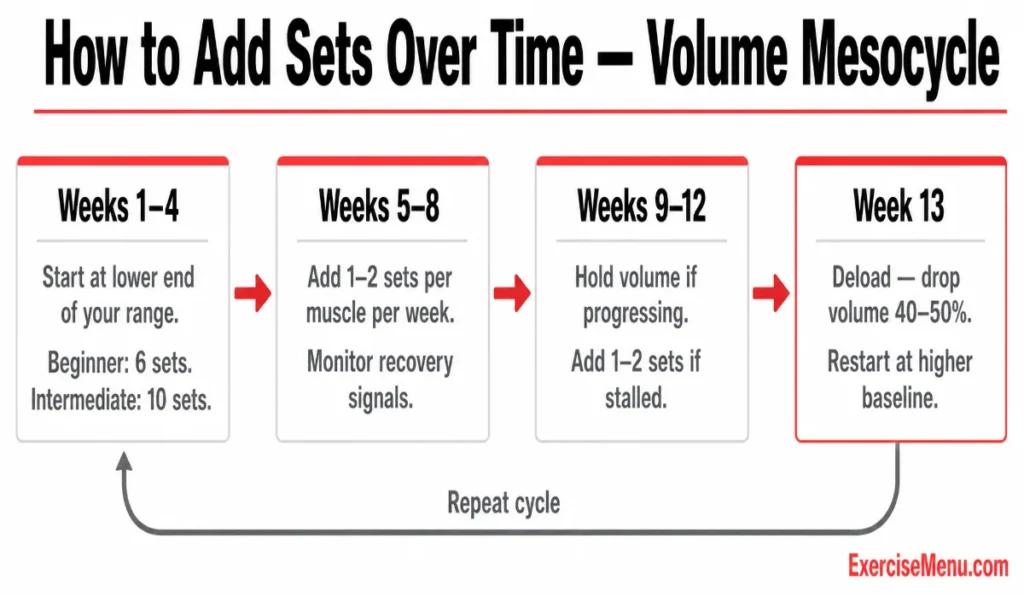
This approach prevents the trap of starting at 20 sets with nowhere to go when adaptation slows. Volume is a tool for overcoming plateaus — not a default setting to maximise from week one.
As you repeat the same movements week after week, muscles adapt to that specific pattern through the repeated bout effect. Each session with the same exercise and load produces less disruption to muscle tissue. Training variety, exercise rotation, and gradual volume increases help maintain the muscle’s sensitivity to the stimulus over time.
Common Volume Mistakes
Counting warm-up sets as working sets. Three sets at 40–60% of your working weight do not produce the same stimulus as three hard working sets. Count only sets that genuinely challenge you close to failure.
Using the same volume for every muscle group. Your back can handle 16–20 sets per week. Your biceps probably cannot — especially when they already receive 10+ indirect sets from all pulling work. Volume should match the muscle, not be applied uniformly.
Chasing volume instead of intensity. Twenty easy sets produce less growth than twelve hard ones. Fewer sets closer to failure consistently beat more sets further from failure.
Adding volume too fast. Jumping from 10 to 18 sets per muscle in a single block overloads connective tissue before it adapts. Add no more than 2 sets per muscle per week. Cap increases at 20% per training block.
Never deloading. Volume accumulates fatigue across weeks. Without a planned reduction every 4–8 weeks, performance gradually declines — not because the programme is wrong, but because accumulated fatigue is masking your actual fitness level.
Faq’s
Does rest time between sets affect how many sets you need?
Indirectly. Shorter rest periods (under 60 seconds) reduce the quality of subsequent sets — each set produces less mechanical tension because you’re starting it in a more fatigued state. This means you may need more total sets to accumulate the same effective stimulus. Resting 2–3 minutes on compounds keeps each set productive and allows you to get more done with fewer total sets.
Do supersets count as one set or two?
Two. Each exercise in a superset counts as one set for its target muscle. A superset of bench press and barbell rows adds one chest set and one back set to your weekly tally — not one combined set. The only thing that changes is rest structure, not volume credit.
Should you do more sets for a lagging muscle group?
Yes — but add volume gradually. Increase the lagging muscle’s weekly sets by 2–4 while slightly reducing volume on a strong muscle group to keep total session workload manageable. Prioritisation works best across a full training block (4–8 weeks), not as a permanent setup where one muscle always gets double the attention.
Does age affect how many sets you need per week?
Not the minimum — but it changes the ceiling. Lifters over 40 still need 10+ weekly sets per muscle to grow, but recovery between sessions slows. The practical adjustment is more sessions at lower per-session volume (3–4 sets per muscle across 3–4 days rather than 8–10 sets across 2 days) and longer deload frequency (every 3–4 weeks instead of every 6–8).
Do machine sets and free weight sets count equally toward volume?
Yes for volume tracking — one set is one set regardless of equipment. But they are not equal in stimulus per set. A free weight set (barbell squat, dumbbell press) demands more stabilisation and recruits more total muscle. A machine set isolates the target more precisely. Neither is better — they serve different roles. Count both equally, but don’t replace all free weight work with machines and expect identical results.
Can you split your weekly sets across every day instead of 2–3 sessions?
You can, but it’s impractical for most people and not superior. Training a muscle 5–6 times per week means only 2–3 sets per session — barely enough to warm up and reach working intensity. Two to three sessions per muscle per week is the sweet spot: enough frequency to keep muscle protein synthesis elevated, enough volume per session to make each workout productive.
Sources
- Schoenfeld BJ, Ogborn D, Krieger JW. Dose-response relationship between weekly resistance training volume and increases in muscle mass. J Sports Sci Med. 2017. PubMed 27433992
- Baz-Valle E, Balsalobre-Fernández C, Alix-Fages C, Santos-Concejero J. A systematic review of the effects of different resistance training volumes on muscle hypertrophy. Sports Med. 2022. PubMed 35291645
- Androulakis-Korakakis P, Fisher JP, Steele J. The minimum effective training dose required to increase 1RM strength in resistance-trained men. Sports Med. 2020. PubMed 31797219
- Ralston GW, Kilgore L, Wyatt FB, Baker JS. The effect of weekly set volume on strength gain. Sports Med. 2017. PMC 5684266
- Krieger JW. Single vs. multiple sets of resistance exercise for muscle hypertrophy: a meta-analysis. J Strength Cond Res. 2010. PubMed 20300012
- Schoenfeld BJ, Ogborn D, Krieger JW. Effects of resistance training frequency on measures of muscle hypertrophy. Sports Med. 2016. PubMed 27102172
