


Quick Answer: When weekly volume is equal, neither split produces better results. The difference is distribution: upper lower concentrates more sets per muscle per session, better for intermediates focused on muscle growth. Full body spreads volume across more sessions, better for beginners, fat loss, and anyone with three or fewer training days.
The full body vs split debate comes up at every level of the gym. Beginners ask it before they have even started. Intermediates ask it after stalling on whatever they have been doing. The answer most people get is some version of “it depends on your goals,” which is technically true and practically useless.
What actually separates the two splits is how weekly training volume is structured, and that determines which one fits your training age, your schedule, and your goal. Here’s the specific breakdown.
- What's the real difference between upper lower and full body training?
- Is upper lower or full body better for building muscle?
- Is full body or upper lower better for fat loss?
- Is full body or upper lower better for beginners?
- Is upper lower better for bodybuilding than full body?
- Is full body or upper lower better for athletes?
- What people get wrong about upper lower vs full body
- When Should You Switch from Full Body to Upper Lower?
- Which split should you choose?
- What does a week of upper lower vs full body training actually look like?
What’s the real difference between upper lower and full body training?
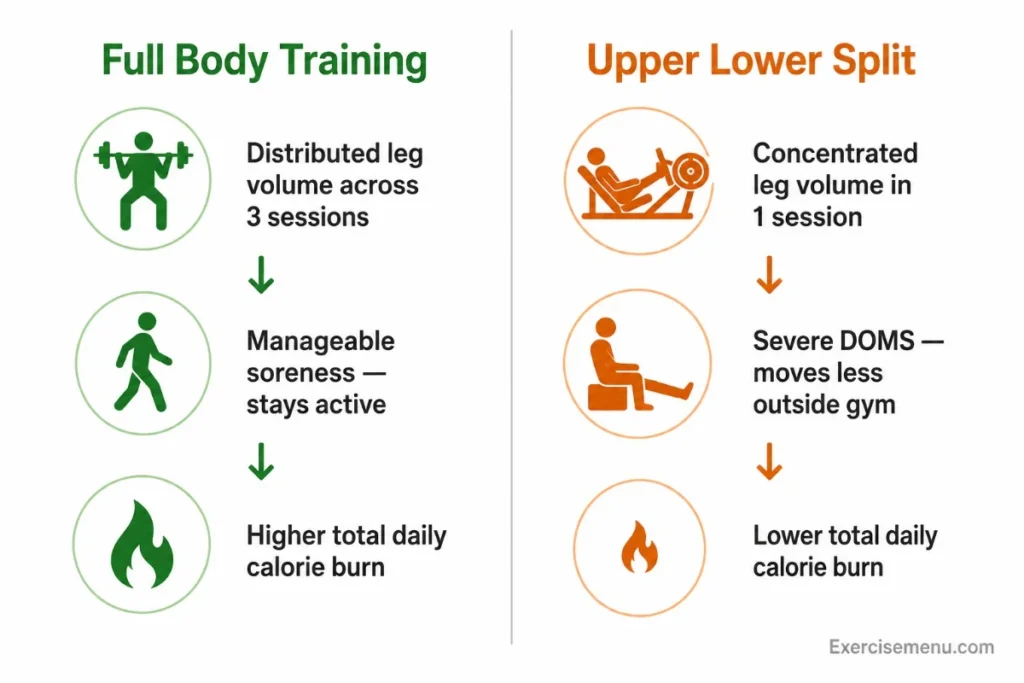
The difference comes down to two variables: training frequency per muscle group and training volume per session.
Full body training hits every major muscle group each session. Volume per muscle is lower — typically 3–4 sets — but each muscle trains 2–3 times per week. Muscle protein synthesis stays elevated more consistently because the muscle gets a fresh stimulus every 48–72 hours.
Upper lower splits concentrate volume into fewer, longer sessions targeting half the body at a time. Each muscle group gets 8–12 sets per session but trains twice per week. Weekly volume runs higher — 16–24 sets per muscle for intermediates — which is why the split favors hypertrophy goals in trained lifters.
The table below compares the two most common versions. For a quick reference, upper lower concentrates more volume per session while full body spreads stimulus more evenly across the week — and that single difference drives every goal-specific recommendation that follows.
| Factor | 4-day upper lower | 3-day full body |
|---|---|---|
| Sessions per week | 4 | 3 |
| Muscle frequency | 2× per week | 2–3× per week |
| Sets per muscle per session | 8–12 | 3–5 |
| Estimated weekly sets per muscle | 16–24 | 9–15 |
| Missed session impact | One muscle group undertrained | All muscles still hit |
| Recovery window | 48–72 hrs per body half | 48 hrs whole body |
| Best fit | Intermediate, hypertrophy | Beginner, fat loss, variable schedule |
Is upper lower or full body better for building muscle?
For intermediates, upper lower produces more muscle growth over time. For beginners, full body works better, and the reason is neural, not muscular.
In the first 6–12 months of training, most strength gains come from neural adaptations. The nervous system gets better at recruiting muscle fibers before the fibers themselves grow significantly. Practicing a squat or bench press three times per week accelerates that adaptation faster than twice. Technique improves, coordination builds, and the beginner develops the foundation needed to eventually train with real intensity.
Once that foundation exists — typically after 12–18 months, muscles need more stimulus to keep growing. The 9–12 weekly sets per muscle typical of a 3-day full body program stops being enough. Switching to upper lower and hitting 16–20 weekly sets per muscle is usually where stalled intermediates start progressing again.
A 2017 meta-analysis by Dr. Brad Schoenfeld found that training a muscle group twice per week produced significantly greater hypertrophy than once per week when total volume was matched — precisely the frequency both splits deliver, which is why volume per session, not frequency alone, becomes the deciding factor for intermediates.
The most common mistake I see with intermediate lifters who’ve switched to full body to “keep things simple” is that their weekly volume per muscle quietly drops below what their training age requires. Three sets of bench press three times a week is 9 working sets. That was enough at month three. At month 18, it’s not.
The frequency question — three days versus four days — matters less than most people assume. Johnsen and van den Tillaar (2021) found no significant difference in strength gains between groups training two versus four sessions per muscle group per week when total volume was equal.
Three days works when intensity is high and sets are taken close to failure. Four days works for the same reason. A 2024 meta-analysis by Ramos-Campo et al. in the Journal of Strength and Conditioning Research confirmed this directly: across 14 studies and 392 subjects, split and full body routines produced identical results in both strength and muscle growth when training volume was matched. Volume is the driver, not how you distribute it across the week.
Is full body or upper lower better for fat loss?

For fat loss, full body vs upper lower isn’t a close comparison, full body wins for two concrete reasons.
First, compound movements recruiting multiple muscle groups in one session — squats, deadlifts, rows, presses, burn significantly more calories per workout than split sessions targeting half the body.
Second, and more practically: concentrated lower body sessions in an upper lower split generate severe DOMS in the legs and lower back. That soreness suppresses NEAT (non-exercise activity thermogenesis), the calories burned through normal daily movement outside the gym. When legs are too sore to move comfortably for two days after a lower session, total daily energy expenditure drops without the training log reflecting it.
Full body training spreads lower body work across three sessions instead of two. Per-session leg volume is lower, soreness stays manageable, and daily movement stays consistent. During a deficit where every 200-calorie walk matters, that difference compounds across weeks.
I’ve seen this pattern consistently: someone is in a calorie deficit, training their upper lower split four days a week, and fat loss stalls after six weeks. Their nutrition hasn’t changed. What’s happened is their NEAT has collapsed, their legs are constantly sore, they’re moving less between sessions, and the effective deficit has shrunk without them noticing. Shifting to 3-day full body during a cut fixes it without touching the calorie target.
For how to structure sets and reps specifically during a fat loss phase, the how many reps and sets for fat loss guide covers the evidence-based approach.
Is full body or upper lower better for beginners?
Full body training is better for beginners. Not because upper lower doesn’t work at this stage, but because higher frequency on each movement pattern matters more than higher per-session volume when you’re still learning.
The beginner’s real job in the first six months is to practice the movements. A squat performed three times per week gets corrected and reinforced three times per week. The same squat performed twice a week on lower day gets half the repetitions and half the feedback loops in the same timeframe.
One of my clients, a complete beginner, no previous training experience, gained 6 lbs of muscle and lost 4 lbs of fat in 16 weeks on a 3-day full body program. Her squat went from bodyweight to 85 lbs. That outcome came from three consistent sessions per week, not the five-day program she’d convinced herself she needed. When the frequency matches the training age, the results follow.
If you’re building your first program, understanding what reps and sets actually mean will help you structure these sessions correctly from the start.
Is upper lower better for bodybuilding than full body?
For bodybuilding-specific goals, maximizing muscle size, upper lower splits are more effective than full body once a lifter has a year or more of consistent training.
The volume difference is the main reason. A dedicated upper day can include a flat press, an incline variation, a horizontal pull, a vertical pull, and direct arm work. That level of targeted stimulus across multiple angles isn’t achievable in a full body session without the session running 90+ minutes and performance on later exercises degrading.
Upper lower also manages joint stress better than the classic bro split. Training each muscle group once per week at 20+ sets per session generates high local fatigue with a full week’s gap before training that muscle again. Spreading that volume across two sessions per week — what upper lower does, keeps total stimulus high without the overload that comes from single-session maximalism.
The how many reps and sets for muscle growth article covers the hypertrophy-specific volume and rep range targets that pair directly with an upper lower structure.
Is full body or upper lower better for athletes?
In-season athletes get more from full body training 2–3 times per week than from an upper lower split — and off-season athletes are the exception where upper lower becomes the right call.
In-season, sport practice, competition, and conditioning already dominate weekly load. Adding four gym sessions creates direct competition for recovery, what researchers call the interference effect, where concurrent training impairs adaptation in either strength or sport performance when recovery is insufficient. Full body training keeps resistance stimulus adequate while keeping total session count and cumulative fatigue manageable.
Timing also matters. A dedicated lower day 24 hours before sprint or agility practice means the athlete shows up with residual leg fatigue. Full body training with distributed lower body volume is far easier to schedule around sport commitments without compromise.
Off-season, upper lower becomes viable. When sport-specific volume drops, an upper lower block lets athletes address strength deficits and correct muscle imbalances with the higher weekly volume that goal requires.
What people get wrong about upper lower vs full body
Most of what gets repeated in the full body vs split debate is partly right and mostly misapplied. Here is where each common argument lands, including what the Reddit debate consistently gets wrong about upper lower vs full body.
“Full body is better for natural lifters.” Partly true. Natural lifters recover more slowly than enhanced athletes, which makes extremely high single-session volume less productive. Spreading volume across more sessions keeps muscle protein synthesis elevated more consistently throughout the week.
That said, a well-structured 4-day upper lower with controlled per-session volume works well for natural intermediates. The case for full body is strongest at three days per week. At four days, both splits are equally valid.
“Three days isn’t enough to grow.” Not supported by research. Three days produces solid muscle and strength gains for beginners and intermediates when effort is high and volume is sufficient. Frequency isn’t the limiting factor, intensity is.
“I switched to upper lower and stopped growing.” Almost always a volume transition error, not a split problem. A lifter doing 3 sets of bench three times per week has 9 weekly chest sets on full body. If they keep 3 sets per upper session on upper lower, they now have 6 weekly chest sets — volume dropped, not increased. Understanding what set and rep notation actually delivers prevents that mistake when switching structures.
When Should You Switch from Full Body to Upper Lower?
The 12 to 18 month timeline is a rough guide, not a deadline. These five signs tell you the switch is overdue, regardless of how long you have been training:
Your working sets feel too easy at the weights that used to challenge you, but adding more sets per session makes the workout drag past 75 minutes. This means you need more volume than a full body session can deliver without performance dropping off at the end. Upper lower gives you the session space to add sets without extending workout length.
You can no longer progress week to week on compounds. Beginners add weight almost every session. When that slows to every 2 to 3 weeks despite good sleep and nutrition, your muscles need more stimulus per session than 3 to 4 sets can provide.
You recover faster than your program demands. If you are training Monday, Wednesday, Friday and feel fully recovered by Tuesday with no soreness or fatigue, your body has adapted to the current volume. That is not a sign to celebrate, it is a sign you are under-stimulating.
You want to bring up weak points. Full body training treats every muscle equally. If your chest, shoulders, or arms need extra attention, upper lower lets you add targeted work without cutting into other muscle groups.
Your schedule reliably allows four sessions per week. Upper lower only works when all four sessions happen consistently. If you are regularly missing the fourth day, you are better off staying with full body where missed sessions do less damage.
If none of these apply, stay on full body. Switching early adds complexity without benefit.
Which split should you choose?
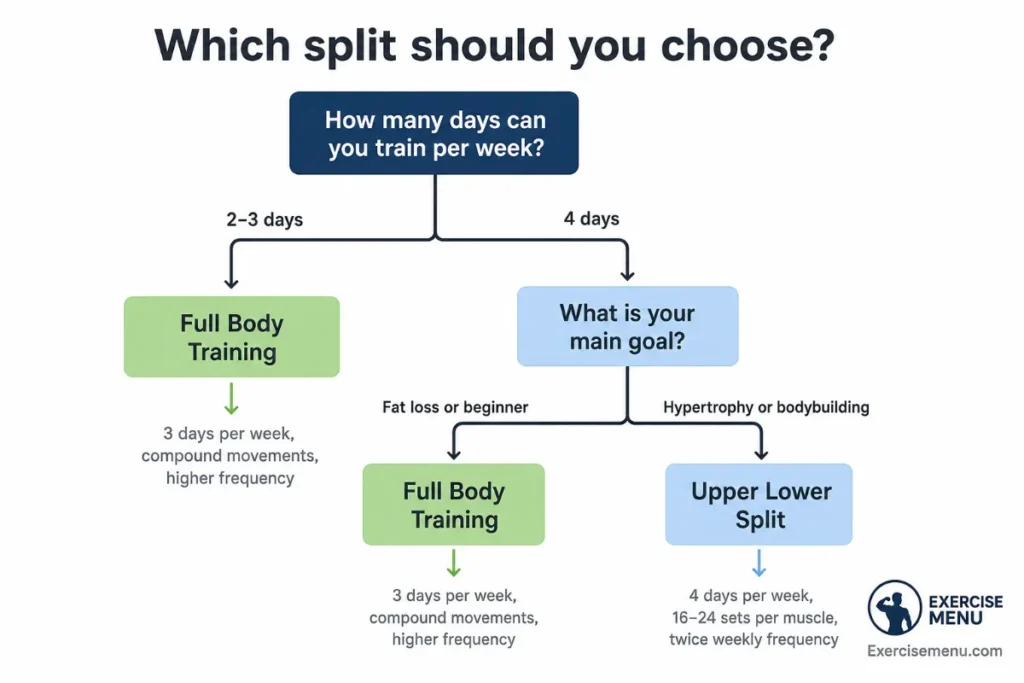
| Training age | Goal | Days available | Best choice |
|---|---|---|---|
| Beginner (0–12 months) | Any | 2–4 | Full body |
| Intermediate (1–3 years) | Fat loss | 3 | Full body |
| Intermediate | Hypertrophy | 4 | Upper lower |
| Intermediate | Bodybuilding | 4 | Upper lower |
| Intermediate | Strength | 3–4 | Either, volume-matched |
| Advanced (3+ years) | Hypertrophy | 4–5 | Upper lower or PPL |
| Athlete, in-season | Performance | 2–3 | Full body |
| Athlete, off-season | Strength/mass | 4 | Upper lower |
| Any | Variable schedule | Unpredictable | Full body |
Find Your Workout Split.
How many days per week can you train?
Schedule deserves more weight than most people give it. Upper lower works when all four sessions happen. Miss a lower day and that muscle group is undertrained for the entire week. Full body is resilient, miss one session and every muscle has still trained at least once. If your weeks are consistently unpredictable, full body’s structure fits your life better regardless of goal.
Commit to whichever split you choose for a minimum of 8–12 weeks before evaluating results. Switching before that window closes means neither program gets a fair test.
What does a week of upper lower vs full body training actually look like?
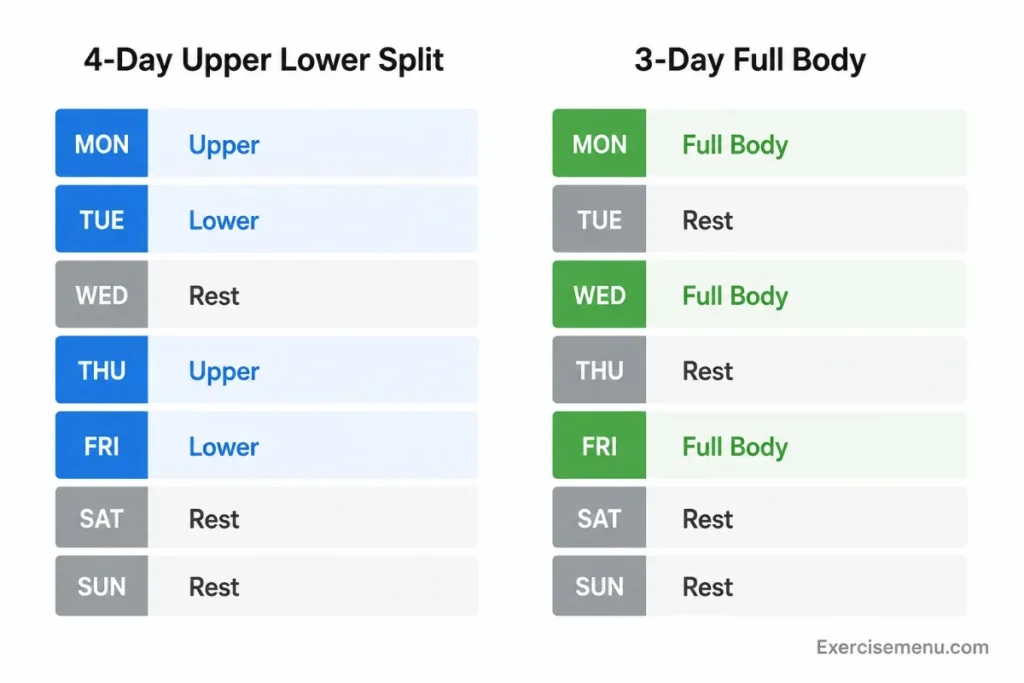
A 4-day upper lower week and a 3-day full body week look very different in terms of session structure, exercise selection, and where volume lands — here’s a direct comparison of both.
4-day upper lower split (intermediate)
Upper A — strength focus
- Barbell bench press — 4 sets × 5–7 reps
- Weighted pull-ups — 4 sets × 5–7 reps
- Dumbbell overhead press — 3 sets × 8–10 reps
- Seated cable row — 3 sets × 8–10 reps
Lower A — strength focus
- Barbell back squat — 4 sets × 5–7 reps
- Romanian deadlift — 4 sets × 6–8 reps
- Leg press — 3 sets × 10–12 reps
- Lying leg curl — 3 sets × 10–12 reps
Upper B — hypertrophy focus
- Incline dumbbell press — 4 sets × 8–12 reps
- Single-arm dumbbell row — 4 sets × 10–12 reps
- Arnold press — 3 sets × 10–12 reps
- Tricep pushdown — 3 sets × 12–15 reps
Lower B — hypertrophy focus
- Conventional deadlift — 4 sets × 5–6 reps
- Bulgarian split squat — 3 sets × 10–12 reps per leg
- Hip thrust — 3 sets × 10–12 reps
- Leg extension — 3 sets × 12–15 reps
Weekly chest volume: approximately 14–16 working sets. Weekly quad volume: approximately 16–20 working sets — within the productive hypertrophy range for intermediates.
3-day full body program (beginner to intermediate)
Day 1
- Barbell squat — 3 sets × 6–8 reps
- Bench press — 3 sets × 8–10 reps
- Bent-over row — 3 sets × 8–10 reps
- Dumbbell overhead press — 2 sets × 10–12 reps
Day 2
- Conventional deadlift — 3 sets × 5–6 reps
- Incline dumbbell press — 3 sets × 10–12 reps
- Lat pulldown — 3 sets × 10–12 reps
- Walking lunges — 2 sets × 10 reps per leg
Day 3
- Goblet squat — 3 sets × 8–10 reps
- Cable row — 3 sets × 10–12 reps
- Hip thrust — 3 sets × 12 reps
- Tricep pushdown — 2 sets × 12–15 reps
Weekly chest volume: 8–10 working sets. Weekly quad volume: 8–11 working sets. Right for beginners and intermediates running a cut — at the lower end of what an intermediate in a dedicated gaining phase needs.
Rest 48 hours between all sessions.
Frequently asked questions
Is upper lower split better for weight loss?
No. Full body training burns more calories per session and prevents the NEAT suppression that concentrated leg-day soreness causes during a deficit.
Can a beginner do an upper lower split?
Yes, but full body produces better results in the first 6–12 months. Beginners benefit more from higher movement frequency than from higher per-session volume.
Is 3 days a week enough with full body training?
Yes, for beginners and intermediates when sets are taken close to failure. Research shows comparable gains between 3-day and 4-day programs when weekly volume is matched.
What’s the best split for bodybuilding?
Upper lower for intermediates — it allows 16–24 weekly sets per muscle with adequate recovery. Advanced lifters often progress to PPL for higher volumes.
How long should I follow a workout split before changing it?
At least 8–12 weeks. Real muscular adaptation takes longer than most people stay patient enough to find out.
What is the best training split for athletes?
Full body 2–3 times per week during the season. Off-season, upper lower becomes viable when sport-specific volume drops and strength building becomes the priority.
How many days a week should I work out?
Three to four days per week is sufficient for most people. Beginners get strong results from 3-day full body training. Intermediates targeting muscle growth benefit from 4 days using an upper lower split. Beyond four days, returns diminish unless volume per session is carefully managed.

1 Comment
Pingback: Hypertrophy vs Strength: Which to Pick (2026 ACSM Update)