

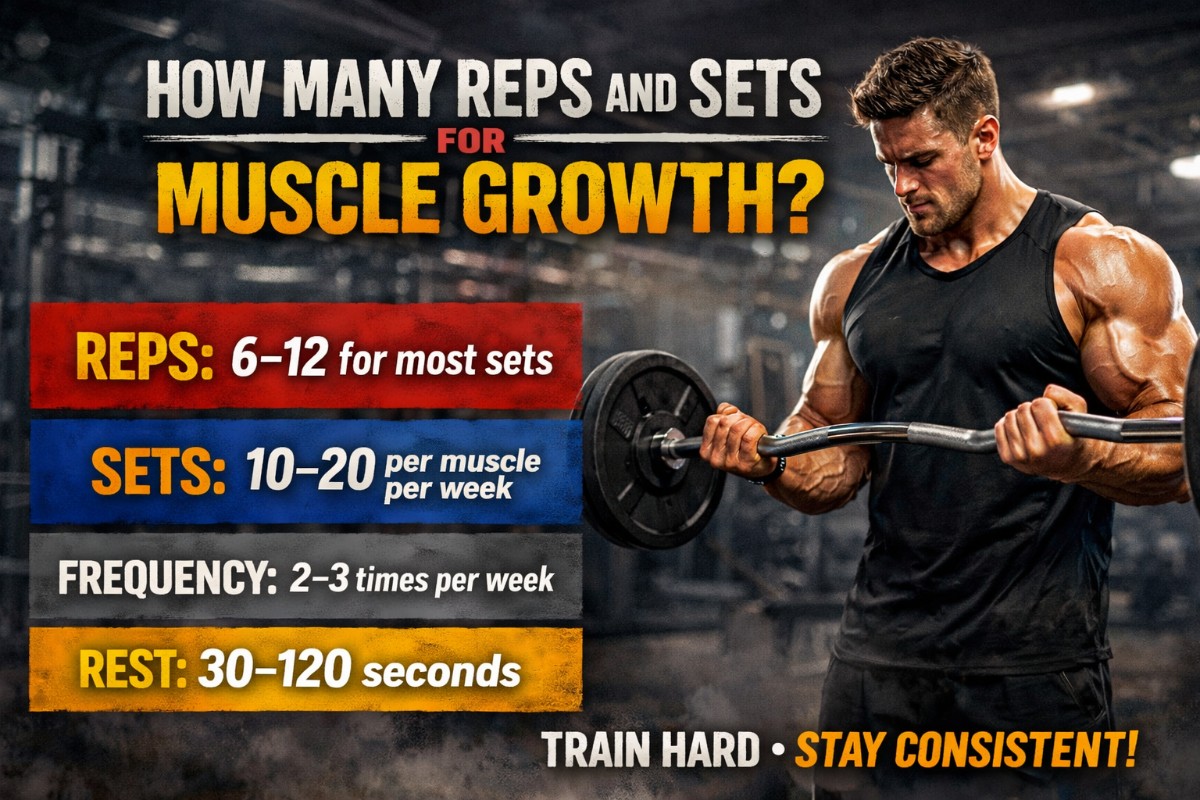
Quick Answer To build muscle, perform 6–12 reps per set at 65–80% of your one-rep max. Accumulate 10–20 hard sets per muscle group per week across 2–3 sessions. Keep working sets at RPE 7–9. Rest 2–3 minutes after compounds, 60–90 seconds after isolations. Add reps or weight every 1–2 weeks.
The advice to do 3 sets of 10 isn’t wrong. It’s just incomplete. How many reps and sets you need for muscle growth depends on the weight you use, how close each set gets to failure, how many total sets each muscle gets across the week, and whether you’re actually progressing over time.
This guide covers how to combine those variables to build muscle through resistance training. Everything here is about hypertrophy specifically — not strength, endurance, or fat loss. If you’re still learning the basics, start with our guide on what reps and sets are.
About the Author — Sadia Baloch Certified fitness trainer with 7+ years of coaching experience, 257+ clients trained, and a 95% client satisfaction rate. Sadia specializes in strength training and hypertrophy programming for beginner through advanced lifters.
- Quick Reference Table
- What Is the Best Rep Range for Muscle Growth?
- How Many Sets Per Muscle Group Per Week?
- How Hard Should Each Set Be? (RPE and RIR)
- How Often Should You Train Each Muscle Group?
- How to Choose Your Starting Weight?
- How to Progress Over Time?
- How Long Should You Rest Between Sets for Hypertrophy?
- Sample 4-Week Hypertrophy Program
- Hypertrophy Mistakes That Stall Your Progress
- Frequently Asked Questions
- Your Action Plan
Quick Reference Table
| Variable | Recommendation |
|---|---|
| Reps per set | 6–12 (most exercises) |
| Load | 65–80% of 1RM |
| Working sets per muscle/week | 10–20 |
| Sets per muscle per session | 3–8 |
| Training frequency | 2–3× per muscle per week |
| Intensity (RPE) | 7–9 (1–3 reps short of failure) |
| Rest — compounds | 2–3 minutes |
| Rest — isolations | 60–90 seconds |
| Progression | Add reps first, then weight |
What Is the Best Rep Range for Muscle Growth?
The 6–12 rep range is the most practical range for building muscle across most exercises.
A 2017 meta-analysis by Brad Schoenfeld et al. (Journal of Strength and Conditioning Research) compared low-load and high-load resistance training across multiple studies. Both produced comparable hypertrophy when participants trained close to failure. But moderate loads (6–12 reps) hit the practical sweet spot — sets last long enough to generate meaningful metabolic stress while the load is heavy enough to recruit your largest, most growth-prone muscle fibers from the first rep.
Heavier loads (1–5 reps) create high mechanical tension but sets end too fast for metabolite buildup, and you need more total sets to match the training volume. Lighter loads (20–30 reps) create metabolic stress but cardiovascular fatigue often limits the set before the target muscle is genuinely spent.
Rep Ranges by Exercise Type
Not every exercise works best in the same rep range. The right range depends on the movement pattern, joint stress, and where the exercise creates the most tension.
| Exercise Type | Examples | Rep Range | Why |
|---|---|---|---|
| Heavy barbell compounds | Squat, deadlift, barbell row | 5–8 | Multi-joint movements that handle heavy loads well. Higher reps increase lower-back fatigue and form breakdown before target muscles are spent. |
| Moderate compounds | Bench press, overhead press, pull-ups, leg press | 8–12 | Stable patterns where the target muscle is the limiting factor. Form holds through moderate rep counts. |
| Isolation exercises | Curls, lateral raises, leg extensions, tricep pushdowns | 10–15 | Higher reps keep tension on the muscle belly rather than shifting it to tendons. Joint-friendly. |
| Cable and machine work | Cable flyes, machine rows, hack squat | 12–20 | Continuous tension through full range of motion. Even lighter loads create strong metabolic stress. |
A single workout might use 4×6 on barbell squats, 3×10 on Romanian deadlifts, and 3×15 on leg extensions. Three different rep ranges, each matched to the exercise.
How Many Sets Per Muscle Group Per Week?
Aim for 10–20 working sets per muscle group per week. Start near 10. Add 1–2 sets each week until performance or recovery drops, then pull back. Keep each session to 3–8 hard sets per muscle — after 8–10 sets for the same muscle in one workout, set quality falls off and you start accumulating junk volume.
If your weekly target is 16 sets, split it across 2–3 sessions rather than one marathon day.
Weekly Volume by Muscle Group
Not every muscle group responds to the same weekly set count. Larger muscles with more motor units generally need — and tolerate — more volume than smaller ones. These ranges apply to intermediate lifters (1–3 years of training). Beginners start at the low end; advanced lifters may push toward the high end during accumulation phases.
| Muscle Group | Weekly Working Sets | Notes |
|---|---|---|
| Quads | 12–20 | Tolerate high volume. Respond well to both heavy compounds and machine isolation. |
| Back (lats + upper back) | 12–20 | Rows and pull-ups hit different portions. Count both. |
| Chest | 10–16 | Responds well to moderate volume. Most lifters don’t need more than 16 sets. |
| Shoulders (side + rear delts) | 10–16 | Front delts get indirect volume from pressing. Side and rear delts need direct work. |
| Hamstrings | 10–14 | Get indirect volume from compounds. Romanian deadlifts and leg curls cover most needs. |
| Biceps | 8–12 | Get indirect volume from rows and pull-ups. Direct work adds but doesn’t need to be excessive. |
| Triceps | 8–12 | Get indirect volume from pressing. 2–3 direct exercises per week is usually enough. |
| Calves | 10–16 | Stubborn for most people. Higher frequency (3–4×/week) with moderate volume per session works better than one large session. |
| Glutes | 10–16 | Squats and hip hinges cover most of it. Add hip thrusts or lunges if glute growth is a priority. |
These numbers represent working sets only — warm-up sets don’t count. Most people overestimate their weekly volume because they’re including warm-up work.
For a complete breakdown by training level, see our guide on how many sets per muscle group per week.
How Hard Should Each Set Be? (RPE and RIR)
Most of your working sets should sit at RPE 7–9 — meaning 1–3 reps short of failure.
A 2023 systematic review by Refalo et al. (Sports Medicine) found that stopping 1–3 reps short of failure produces comparable hypertrophy to training all the way to failure, with less accumulated fatigue and better performance on subsequent sets. The reps closest to failure — sometimes called effective reps — are where the majority of the growth stimulus comes from. You need to get close enough that those reps happen, but not so close that recovery suffers.
| RPE | RIR | What It Feels Like | When to Use It |
|---|---|---|---|
| 10 | 0 | Absolute failure. Nothing left. | Last set of an isolation exercise, occasionally. |
| 9 | 1 | One more rep was there, but only one. | Top sets on compound lifts. |
| 8 | 2 | Hard, but two clean reps left in the tank. | Majority of your working sets. |
| 7 | 3 | Challenging but controlled. | Early sets, first week of a new block, volume days. |
| 6 | 4+ | Moderate effort. | Warm-ups, technique work, deload week. |
In practice: if your program says 3×10 at RPE 8, pick a weight you could handle for 12 reps and stop at 10. Two reps stay in the tank. You’re working hard enough to build muscle without burying yourself for the next exercise.
If you’re new to autoregulation, start with RIR. Our RPE vs RIR comparison breaks down both systems and which one suits beginners better. After every set, write down how many more reps you could’ve done with clean form. Track this for 4–6 weeks and you’ll develop a reliable internal gauge.
How Often Should You Train Each Muscle Group?
Train each muscle 2–3 times per week.
A 2016 meta-analysis by Schoenfeld, Ogborn, and Krieger (Sports Medicine) found that hitting each muscle at least twice per week produced more growth than once-per-week training — even with the same total weekly volume.
The reason comes down to muscle protein synthesis. In trained lifters, protein synthesis stays elevated for roughly 24–48 hours after a session. Training a muscle once a week means the growth signal is active for 2 days and dormant for 5. Training it twice cuts that dormant window in half.
Common splits:
- Upper/lower (4 days): Each muscle hit 2× per week.
- Push/pull/legs (6 days): Each muscle hit 2×. More per-session volume capacity.
- Full body (3 days): Each muscle hit 3×. Best for spreading high weekly volumes across sessions.
How to Choose Your Starting Weight?
- Pick your target rep range (say, 8–12).
- Choose a weight you think you can lift for at least 8 controlled reps.
- Stop the set when you reach approximately 2–3 RIR.
- If you hit 15 reps with several still available, the weight was too light. If you only managed 5 controlled reps, it was too heavy.
- Adjust next set or next session based on the result.
The last rep should look similar to the first, even if it moves slower. End the set when you can’t maintain proper range of motion or technique.
How to Progress Over Time?
Use double progression: increase reps within a defined range, then increase the weight. For other methods of adding challenge over time, see our guide on progressive overload without adding weight.
| Session | Weight | Reps (3 sets) | What Happened |
|---|---|---|---|
| 1 | 60 kg | 10, 9, 8 | Started at bottom of 8–12 range |
| 2 | 60 kg | 10, 10, 9 | Added reps on sets 2 and 3 |
| 3 | 60 kg | 11, 10, 10 | Progressing |
| 4 | 60 kg | 12, 12, 11 | Approaching top of range |
| 5 | 60 kg | 12, 12, 12 | Hit top of range on all sets |
| 6 | 62.5 kg | 9, 8, 8 | Weight increased, reps dropped back to bottom |
Reps climb, then weight jumps and reps reset. You progress through both volume and load without guessing whether to add weight this week or next.
Don’t add weight, reps, and sets all at once. Change one variable and see how your body responds.
How Long Should You Rest Between Sets for Hypertrophy?
Rest 2–3 minutes after compound exercises and 60–90 seconds after isolations.
A 2016 study by Schoenfeld et al. (Journal of Strength and Conditioning Research) compared 1-minute and 3-minute rest intervals in resistance-trained men. The longer-rest group gained more strength and showed greater increases in muscle thickness. Longer rest lets you maintain heavier loads and better rep quality across sets — which adds up to more productive total work for hypertrophy.
Isolations are different. They use lighter loads, cause less systemic fatigue, and benefit from the metabolic stress that shorter rest windows create. Keeping rest at 60–90 seconds on curls, lateral raises, and extensions maintains that metabolic environment without sacrificing set quality.
You don’t need to watch the clock rigidly. Rest longer after heavy squats and rows if needed. Resume when your breathing, concentration, and target muscles are ready for another quality set.
Sample 4-Week Hypertrophy Program
This uses daily undulating periodization (DUP) across an upper/lower split. Volume increases each week with a deload in week 4.
Upper Body — Monday (Heavy) & Thursday (Moderate)
| Exercise | Monday | Thursday | Weekly Progression |
|---|---|---|---|
| Barbell Bench Press | 4×6 RPE 8 | 3×10 RPE 8 | +1 rep/set each week |
| Barbell Row | 4×6 RPE 8 | 3×10 RPE 8 | +1 rep/set each week |
| Overhead Press | 3×8 RPE 8 | 3×12 RPE 7 | +1 rep/set each week |
| Weighted Pull-ups | 3×6 RPE 8 | 3×10 RPE 8 | +1 rep/set each week |
| Incline DB Curl | — | 3×12 RPE 8 | Add 1 set in week 3 |
| Overhead Tricep Ext | — | 3×12 RPE 8 | Add 1 set in week 3 |
| Lateral Raise | 3×12 RPE 8 | 3×15 RPE 7 | +2 reps on Thurs by wk 3 |
Lower Body — Tuesday (Moderate) & Friday (Heavy)
| Exercise | Tuesday | Friday | Weekly Progression |
|---|---|---|---|
| Barbell Squat | 3×10 RPE 8 | 4×6 RPE 8 | +1 rep/set each week |
| Romanian Deadlift | 3×10 RPE 8 | 3×8 RPE 8 | +1 rep/set each week |
| Leg Press | 3×12 RPE 8 | — | +1 rep/set each week |
| Seated Leg Curl | 3×12 RPE 8 | 3×10 RPE 8 | +1 rep/set each week |
| Leg Extension | 3×15 RPE 7 | 3×12 RPE 8 | Myo-reps on last set wk 3 |
| Standing Calf Raise | 4×12 RPE 8 | 4×15 RPE 7 | +1 set each week |
Week 4: Deload
Cut all sets in half. Keep the same exercises and frequency. Drop intensity to RPE 6–7. You’ll often feel stronger in week 5 than you did at the end of week 3.
Hypertrophy Mistakes That Stall Your Progress
Ego lifting on isolations. Swinging heavy curls with full-body momentum trains everything except the target muscle. Pick a weight you can control through the full range of motion.
Using the same reps and load for months. If every rep range and load has been identical for 12 weeks, your body stopped adapting around week 4. Vary your rep ranges across training blocks.
Cutting range of motion short. Half-squats, bounced bench presses, partial curls. You’re skipping the stretched portion of the rep — which is where the growth stimulus is strongest.
Performing every set too easily. Completing 12 reps with 8 reps still available is a fundamentally different stimulus than 12 reps at 2 RIR. Your sets need to be genuinely challenging.
Ignoring muscle-group volume differences. Doing 10 sets per week for every muscle group means your quads are probably undertrained and your biceps are getting more direct work than they need. Adjust volume based on the muscle, not a blanket number.
Frequently Asked Questions
Is 3 sets of 12 enough to build muscle?
For beginners, yes — if the weight is heavy enough that the last 2–3 reps require genuine effort. That’s 36 total reps per exercise per session, which falls within a productive volume range for newer lifters. Intermediate and advanced lifters typically need 4–5 sets per exercise or additional exercises for the same muscle group to keep progressing.
How long does it take to see muscle growth?
Most people notice visible changes after 8–12 weeks of consistent training. Measurable hypertrophy (detectable by ultrasound) can occur in as little as 3–4 weeks, but it won’t be visible in the mirror yet. Beginners see faster visible changes than advanced lifters because the rate of muscle gain slows with training experience.
Can you build muscle with high reps (20–30)?
Yes, if you take those sets close to failure. Schoenfeld’s 2017 meta-analysis showed comparable hypertrophy between low-load and high-load training when both groups trained to failure. The practical drawback is that high-rep sets create more cardiovascular fatigue, often limiting the set before the target muscle is fully worked. For most people, 6–12 reps is more time-efficient for the same result.
Does the speed of each rep matter for muscle growth?
Controlling the lowering phase for at least 2 seconds increases time under tension and recruits more motor units. A practical guideline: lower for 2–3 seconds, lift for 1–2 seconds, don’t bounce. Very slow tempos (5+ seconds per phase) force lighter loads without a clear growth advantage.
Should I train a muscle group that’s still sore?
Usually, yes. Delayed-onset muscle soreness (DOMS) reflects novelty, not incomplete recovery. Your muscles can produce near-full force even when sore, and training through mild-to-moderate soreness often helps it resolve faster. Take an extra rest day only if soreness limits your range of motion or drops your working weights by more than 20%.
Can bodyweight exercises build muscle?
Yes, up to a point. Push-ups, pull-ups, dips, and split squats build meaningful muscle in beginners and intermediates. The challenge is progressive overload — once you can do 25+ reps comfortably, the load is too light to drive efficient growth. Use harder variations (archer push-ups, pistol squats), add external resistance, or manipulate tempo to stay in a productive rep range.
Can women use the same rep ranges for muscle growth?
Yes. Skeletal muscle physiology does not differ between sexes in a way that changes optimal rep ranges. Women tend to recover faster between sets and can often handle higher relative training volumes per session. For a full breakdown, see our guide on reps and sets for women.
Why do my reps decrease from set to set?
Fatigue. A result like 12, 10, and 9 reps across three sets is completely normal and still represents three productive sets. If your reps drop sharply (12 → 7 → 4), you’re either resting too little, pushing the first set too hard, or using too much weight. A drop of 1–2 reps per set is expected.
Your Action Plan
- Train each muscle 2–3× per week (upper/lower, push/pull/legs, or full body)
- Use 6–12 reps on most exercises — match rep range to exercise type
- Accumulate 10–20 working sets per muscle per week, adjusted by muscle group — 3–8 per session
- Keep most sets at RPE 7–9 (1–3 reps short of failure)
- Rest 2–3 minutes on compounds, 60–90 seconds on isolations
- Build muscle over time with double progression: add reps first, then add weight
Sources
- Schoenfeld BJ, Grgic J, Ogborn D, Krieger JW. Strength and Hypertrophy Adaptations Between Low- vs. High-Load Resistance Training. J Strength Cond Res. 2017. PubMed 28834797
- Schoenfeld BJ, Ogborn D, Krieger JW. Effects of Resistance Training Frequency on Measures of Muscle Hypertrophy. Sports Med. 2016. PubMed 27102172
- Schoenfeld BJ, Pope ZK, Benik FM, et al. Longer Interset Rest Periods Enhance Muscle Strength and Hypertrophy in Resistance-Trained Men. J Strength Cond Res. 2016. PubMed 26605807
- Refalo MC, Helms ER, Trexler ET, et al. Influence of Resistance Training Proximity-to-Failure on Skeletal Muscle Hypertrophy: A Systematic Review with Meta-analysis. Sports Med. 2023. PubMed 36334240

4 Comments
Pingback: Is Lamb Healthy? Nutrition Facts, Benefits, and Best Cuts
Pingback: Dumbbell RDL: Form, Muscles Worked, and Benefits
Pingback: How to Deadlift for Beginners Without Hurting Your Back
Pingback: Cable Chest Exercises: 10 Best Moves and a Full Workout