

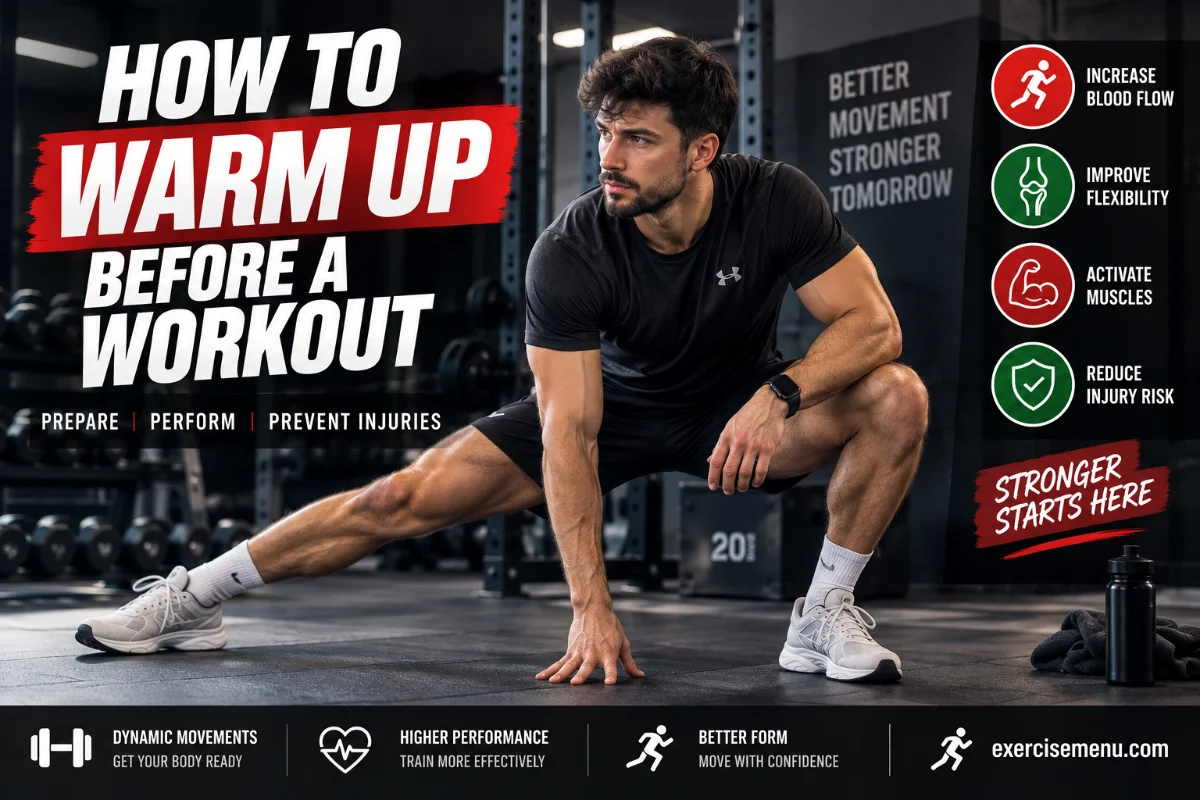
Quick Answer: A proper warm-up before strength training has three phases: raise your body temperature with 3 to 5 minutes of light cardio, activate the muscles you’re about to train with targeted exercises, then prime the movement pattern with light sets of the actual lift. The whole process takes 8 to 12 minutes and directly improves performance on your first working set.
The most common warm-up in most gyms is five minutes on the bike, a few arm circles, and then loading the bar. It’s better than nothing, but it skips the two steps that actually make your working sets feel stronger: activating the specific muscles you’re about to use and priming the movement pattern you’re about to load.
A good warm-up is not filler before the “real” workout. It Is the setup that determines whether your first working set feels sharp or sluggish. When the warm-up is structured correctly, the first heavy set feels like the third or fourth rep instead of a cold, grinding surprise.
Why Warming Up Before Strength Training Matters?
Warming up raises muscle temperature, increases blood flow to the tissues you’re about to load, and prepares your nervous system to recruit motor units efficiently. A 2025 systematic review published in Sports found that dynamic warm-ups and neuromuscular activation protocols consistently improved strength and speed performance while reducing injury risk across both youth and adult athletes.
Cold muscles are stiffer, produce less force, and tear more easily under load. Warm muscles are more elastic, generate force faster, and tolerate higher loads before failing. The difference between a “good day” and a “bad day” in the gym often comes down to how well you prepared before the first set.
The Three Phases of an Effective Warm-Up
Every warm-up for strength training should move through three phases in order. Skipping any one of them leaves a gap.
| Phase | Purpose | Duration | Examples |
|---|---|---|---|
| 1. Raise | Increase core temperature and blood flow | 3-5 minutes | Light rowing, cycling, brisk walk, jumping jacks |
| 2. Activate | Fire up the specific muscles for today’s workout | 2-4 minutes | Banded glute bridges, lateral band walks, face pulls, dead bugs |
| 3. Prime | Rehearse the main lift with light weight | 2-3 minutes | Empty barbell or light sets of the first exercise |
Phase 1: Raise Your Body Temperature
Three to five minutes of low-intensity cardio. The rowing machine is the best option for full-body training days because it moves the upper and lower body simultaneously. A stationary bike works for lower body days. Jumping jacks or a brisk walk work if no equipment is available.
The goal is a light sweat and a slightly elevated heart rate. If you’re breathing hard or your legs feel tired, you’ve done too much. This is preparation, not conditioning.
Phase 2: Activate the Muscles You’re About to Train
This is the step most people skip, and it’s the one that makes the first working set feel noticeably different.
Activation exercises fire up the specific muscles that will be the primary movers in your session. They use light resistance or bodyweight to engage muscles that tend to stay dormant until forced to work, like the glutes during squats or the rear delts during rows.
For lower body days:
- Banded glute bridges: 2 sets of 12. Squeeze at the top for 2 seconds.
- Banded lateral walks: 15 steps per direction. Keep tension constant.
- Bodyweight squats: 10 reps with a 2-second pause at the bottom.
For upper body days:
- Band pull-aparts: 2 sets of 15. Focus on squeezing the shoulder blades.
- Face pulls (light band or cable): 2 sets of 12. External rotation at the top.
- Push-ups: 10 reps at a controlled pace.
For full body days: Pick one lower body activation exercise and one upper body activation exercise. Dead bugs (2 sets of 8 per side) cover core activation for either.
Phase 3: Prime the Movement Pattern
Before your first working set, perform 2 to 3 progressively heavier sets of the actual exercise you’re about to train. This primes the exact movement pattern, connective tissue, and neural pathways for the load ahead.
For a detailed breakdown of how to structure these ramp-up sets, including percentages and rep counts for squat, bench, and deadlift, the warm-up sets vs working sets guide covers the full approach.
A Sample Warm-Up Before Squats
Here’s what the three phases look like in practice for a squat session.
Phase 1 (3 minutes): Light rowing or brisk walk.
Phase 2 (3 minutes):
- Banded glute bridges: 2 sets of 10, with a 3-second squeeze at the top
- Bodyweight goblet squat hold: 2 sets of 15 seconds at the bottom position, pressing elbows inside knees
Phase 3 (3 minutes): 2 to 3 progressively heavier sets of the squat, building from an empty bar to just below your working weight. The warm-up sets guide has the full ramp-up structure with specific percentages for squat, bench, and deadlift.
Begin working sets.
Total warm-up time: roughly 9 minutes. Your first working set should feel noticeably better than it would without the activation step.
Should You Stretch Before Lifting?
This is one of the most debated topics in training, and the answer has changed over the last decade.
Static stretching (holding a stretch for 30+ seconds): Research shows that static stretches held for more than 60 seconds before strength training can reduce maximal force output. A 2024 meta-analysis revisiting the stretch-induced force deficit found that static stretching produced small but significant performance reductions when compared to alternative warm-up methods.
However, the same research also found that short-duration static stretches (under 30 seconds) did not significantly reduce strength or power. If you have a specific tight spot, like restricted ankle dorsiflexion before squatting, a brief targeted stretch of 20 to 30 seconds will improve your positioning without hurting your performance.
Dynamic stretching (moving through range of motion): Leg swings, arm circles, hip circles, walking lunges. These are part of your warm-up, not a separate stretching session. Dynamic movement through a full range of motion improves joint mobility and muscle elasticity without the force deficit that prolonged static holds can cause.
The practical rule: Dynamic movement before lifting. Save longer static stretches for after the session or on rest days.
Common Warm-Up Mistakes
Spending 15 to 20 minutes on cardio. A warm-up is not a conditioning session. Extended cardio before strength training pre-fatigues your legs and depletes glycogen before you’ve done a single working set. Three to five minutes is enough.
Skipping activation and going straight to the bar. An empty barbell tests the movement pattern, but it doesn’t fire up the muscles that stabilize and drive the lift. Glute bridges before squats and band pull-aparts before pressing take two minutes and make the first heavy set feel fundamentally different.
Using the same warm-up for every workout. Your lower body day needs hip and glute activation. Your upper body day needs shoulder and scapular activation. A generic warm-up that ignores what you’re about to train misses the point of Phase 2 entirely.
Static stretching every muscle before training. Stretching muscles that aren’t tight wastes time and can reduce force output. Stretch only what is limiting your positioning in the exercises you’re about to perform.
What If You Only Have 3 Minutes?
Sometimes the schedule is tight. A shortened warm-up still beats no warm-up.
60 seconds: Jumping jacks or high knees to raise heart rate. 60 seconds: One activation exercise for the primary muscle group of the day (glute bridges for lower, band pull-aparts for upper). 60 seconds: One set of the main exercise at 50% working weight, 5 controlled reps.
This covers all three phases in compressed form. It’s not ideal, but it’s enough to prevent a cold first set and reduce injury risk.
Frequently Asked Questions
How long should a warm-up take before lifting weights?
Eight to twelve minutes covers all three phases without cutting into training time. Heavier sessions (squatting or deadlifting near maximal loads) benefit from a slightly longer ramp-up with more progressive sets. Lighter accessory work after your main lifts rarely needs additional warm-up because the body is already prepared.
Do I need to warm up before every exercise in my session?
No. Warm up fully before the first compound lift. Exercises that follow using the same muscle groups are already covered. If the second exercise targets a completely different area (squats followed by bench press), one to two light sets of the new exercise are enough to transition.
Is foam rolling a good warm-up?
Foam rolling can help reduce perceived stiffness in specific areas, but it does not raise body temperature or activate muscles. If you use it, treat it as a pre-warm-up step for tight spots, then move through the three phases as normal. It should not replace the warm-up.
Can I warm up at home before going to the gym?
If you train within 10 to 15 minutes of leaving home, a quick Phase 1 and Phase 2 at home (jumping jacks, activation exercises) can save time at the gym. You would still need to do Phase 3 (progressive barbell sets) once you arrive since it requires the actual equipment. If the gap between home and gym is longer than 15 minutes, your body temperature drops and the warm-up benefit fades.
Should my warm-up change as I get older?
The three phases stay the same, but the duration of each phase often increases. Joints and connective tissue take longer to reach working temperature in adults over 40. Adding an extra minute to Phase 1 and an extra set to Phase 2 accounts for this without changing the overall structure.
Your Next Step
Before your next session, try the three-phase approach: raise, activate, prime. Compare how your first working set feels to how it felt last time with your usual warm-up. That difference is the warm-up working. Once you feel it, skipping activation becomes impossible.

2 Comments
Pingback: How to Bench Press? Setup, Descent, and Press
Pingback: How to Use a Cable Machine (And Read the Weight Right)