

Quick Answer: The push pull legs (PPL) split divides training into three sessions — push (chest, shoulders, triceps), pull (back, biceps, rear delts), and legs (quads, hamstrings, glutes, calves). It works as a 3-day routine for beginners moving on from full-body training and a 5- or 6-day routine for intermediate to advanced lifters. The split builds muscle by training each group with focused volume while keeping recovery between sessions intact.
Most lifters already know which muscles get trained on push, pull, and legs days. What they usually don’t realize is why the order of those days matters so much, when 3 days per week actually works better than 6, and why intermediate lifters often make faster gains than beginners on the same split.
Here’s exactly what you’ll get in this guide: the right training frequency for your level, the smartest day sequence, complete workouts with sets and reps, and the key programming decisions that decide whether you build muscle or just accumulate fatigue.
- What Is the Push Pull Legs Split?
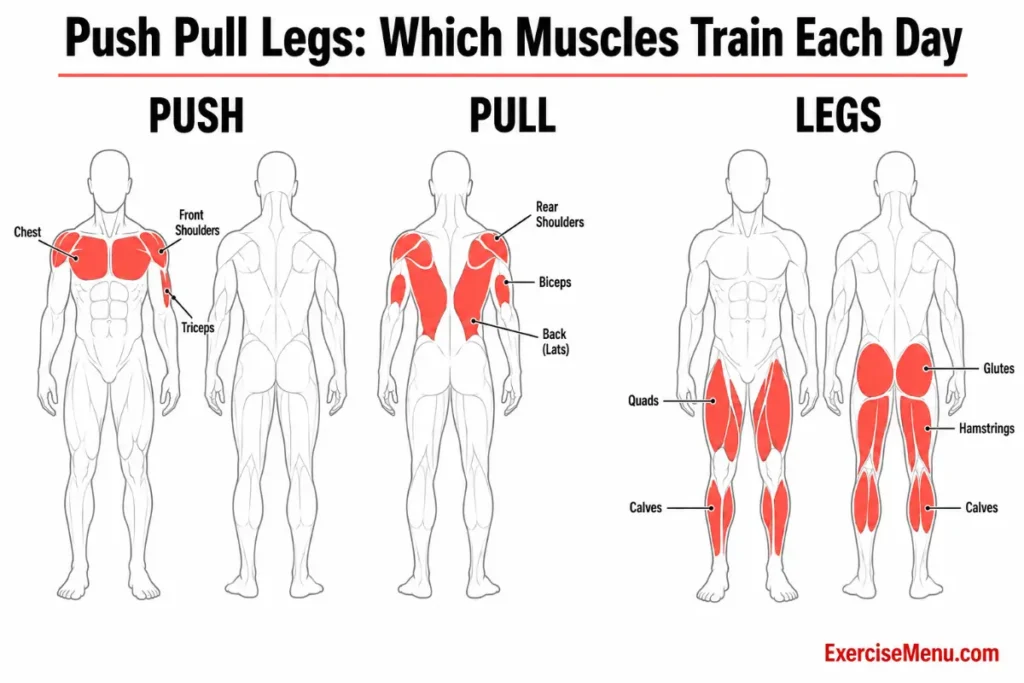
- What Does Each Day Train?
- What Are the Best Exercises for Each PPL Day?
- How Many Days a Week Is Push Pull Legs?
- What Order Should the Days Go In?
- Who Should Use the Push Pull Legs Split?
- Is Push Pull Legs Good for Muscle Gain and Weight Loss?
- Push Pull Legs vs Full Body vs Upper/Lower
- How to Progress on Push Pull Legs Without Stalling
- Frequently Asked Questions
What Is the Push Pull Legs Split?
The Push Pull Legs split groups your training by movement patterns instead of individual body parts. It breaks your week into three types of sessions:
- Push days focus on pressing movements — chest, shoulders, and triceps.
- Pull days focus on pulling movements — back, biceps, and rear delts.
- Legs days train the entire lower body — quads, hamstrings, glutes, and calves.
The biggest advantage of PPL is how it handles recovery. Because each session trains completely different muscle groups, you don’t hit the same muscles on back-to-back days. This smart structure is what lets you run the program anywhere from 3 days to 6 days per week without running into the recovery problems you see in most other splits.
What Does Each Day Train?
| Day | Primary Muscles | Main Exercises |
|---|---|---|
| Push | Chest, anterior delts, triceps | Bench press, overhead press, incline press, lateral raises, tricep pushdowns |
| Pull | Lats, rhomboids, traps, rear delts, biceps | Pull-ups, barbell rows, lat pulldown, face pulls, bicep curls |
| Legs | Quads, hamstrings, glutes, calves | Squats, Romanian deadlifts, leg press, hip thrusts, calf raises |
Push day starts with a heavy compound press — bench or overhead — followed by accessory pressing and isolation work for the side delts and triceps.
Pull day starts with a heavy compound pull — barbell row or pull-up — followed by vertical or horizontal pulling variations, rear delt work, and biceps.
Leg day starts with either a heavy squat or a hip hinge like the Romanian deadlift, followed by accessory work for the quads, hamstrings, and calves.
What about abs? The core gets significant indirect work from heavy compound lifts — squats, deadlifts, overhead press. If you want direct ab training, add 2-3 sets of hanging leg raises or cable crunches at the end of any session. There’s no dedicated “ab day” in PPL — it doesn’t need one.
What Are the Best Exercises for Each PPL Day?
Each day below includes a complete workout exercises, sets, reps, and rest periods — ready to run.
Push Day — Chest, Shoulders, Triceps
| Exercise | Sets | Reps | Rest |
|---|---|---|---|
| Barbell Bench Press | 4 | 4-6 | 3 min |
| Incline Dumbbell Press | 3 | 8-10 | 90 sec |
| Overhead Press (DB or BB) | 3 | 8-10 | 90 sec |
| Lateral Raise | 3 | 12-15 | 60 sec |
| Tricep Pushdown (cable or band) | 3 | 10-12 | 60 sec |
The bench press comes first because it requires the most neural drive and the heaviest load — structuring the session around that demand keeps every set at its most productive.
Pull Day — Back, Biceps, Rear Delts
| Exercise | Sets | Reps | Rest |
|---|---|---|---|
| Barbell Row (or Pull-Up) | 4 | 4-6 | 3 min |
| Lat Pulldown | 3 | 8-10 | 90 sec |
| Seated Cable Row | 3 | 8-10 | 90 sec |
| Face Pull | 3 | 12-15 | 60 sec |
| EZ-Bar Curl | 3 | 10-12 | 60 sec |
Pull day follows the same structure heaviest compound first, isolation work last. Face pulls serve a structural role beyond rear delts: they counterbalance the internal rotation stress that accumulates from heavy pressing across the week.
Legs Day — Quads, Hamstrings, Glutes, Calves
| Exercise | Sets | Reps | Rest |
|---|---|---|---|
| Back Squat | 4 | 4-6 | 3 min |
| Romanian Deadlift | 3 | 8-10 | 2 min |
| Leg Press | 3 | 10-12 | 90 sec |
| Hip Thrust | 3 | 10-12 | 90 sec |
| Standing Calf Raise | 4 | 12-15 | 60 sec |
Squat first, hip hinge second. Both load the lower back, but the squat is heavier and requires more CNS output it belongs at the start of the session when freshness is highest.
Rep ranges and effort explained: The 4-6 rep range on primary lifts builds the strength base. The 8-12 range on secondary work drives hypertrophy. The 12-15 range on isolation exercises maximises the metabolic stimulus that isolation work is designed to produce. Running all three ranges within a single PPL session covers what a one-dimensional rep scheme misses.
On effort: every working set should finish with 0-2 reps in reserve (RIR) meaning you could have done 1-2 more reps with clean form before hitting failure. Sets that finish with 5+ reps in the tank aren’t producing enough stimulus to drive adaptation.
How Many Days a Week Is Push Pull Legs?
PPL scales from 3 to 6 days depending on training experience and recovery capacity.
| Frequency | Structure | Best For |
|---|---|---|
| 3-day | Push / Pull / Legs, one cycle per week | Beginners transitioning from full-body, limited schedule |
| 4-day | PPL + one additional upper or lower session | Building toward 5-day without full frequency demand |
| 5-day (PPL) | Push / Pull / Legs / Push / Pull | Intermediates wanting higher upper body volume |
| 5-day (PPLUL) | Push / Pull / Legs / Upper / Lower | Intermediates wanting each muscle group twice weekly with an extra rest day vs 6-day |
| 6-day | Push / Pull / Legs / Push / Pull / Legs | Intermediate to advanced — each muscle group twice weekly |
The 5-day PPLUL (Push/Pull/Legs/Upper/Lower) structure has become a popular alternative to 6-day PPL. It hits each muscle group twice per week — the same as 6-day — but builds in one more rest day, which most lifters find easier to recover from without sacrificing frequency.
If legs are a weak point, PPLUL is particularly useful because the dedicated Lower day gives them a second focused session that the 5-day PPL format doesn’t.
3-day PPL trains each muscle once per week. This is appropriate when you’re new to the split or returning to training after time off. Each muscle group needs 48-72 hours between sessions for full recovery — 3-day PPL respects that window while keeping total weekly load manageable.
6-day PPL trains each muscle twice per week. Higher frequency helps distribute weekly volume across more sessions, which keeps per-session fatigue lower and form cleaner. A December 2025 meta-regression by Pelland et al., published in Sports Medicine, found that when total weekly volume is equated, frequency’s independent effect on hypertrophy is modest — what matters most is hitting sufficient total sets per muscle per week.
Higher frequency makes that volume easier to accumulate without overloading individual sessions, but it isn’t a magic multiplier on its own. Higher frequency is only productive when recovery supports it. Sleep, nutrition, and total weekly stress all determine whether 6 days builds muscle or accumulates fatigue. If any of those variables are compromised, 4 or 5 days typically produces faster progress than 6.
What Order Should the Days Go In?
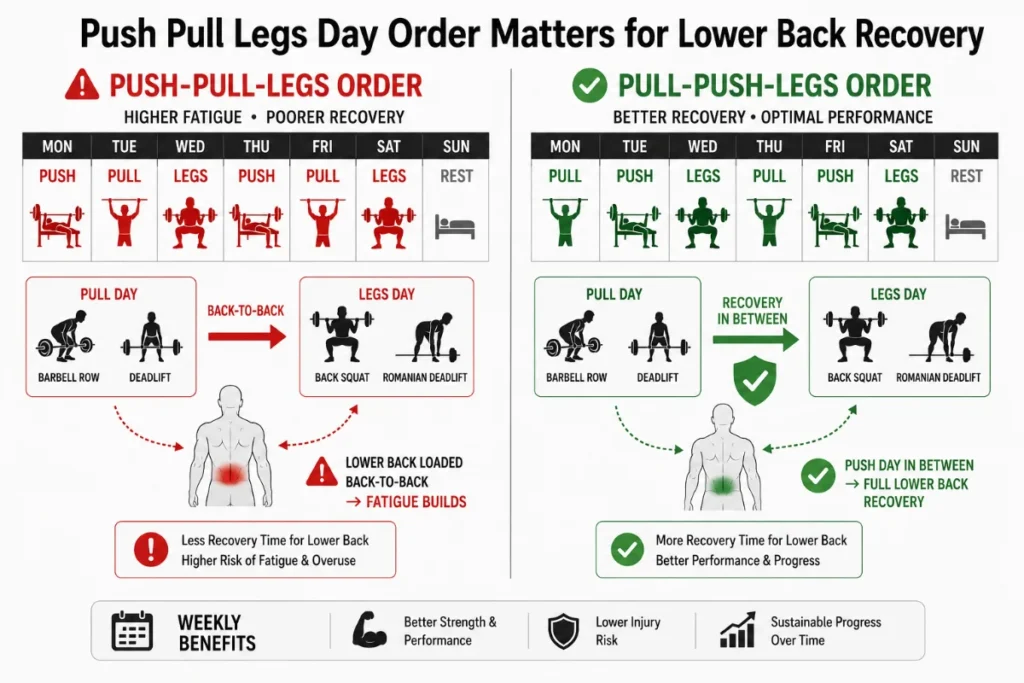
The traditional Push-Pull-Legs order is not always the optimal sequence. Pull-Push-Legs often works better, and the reason is structural.
In a standard Push-Pull-Legs week, pull day and legs day fall back to back. Heavy barbell rows and deadlifts on pull day load the lower back significantly. Squats and Romanian deadlifts the following day load it again before recovery is complete. For most lifters, that overlap is the first place fatigue starts accumulating in the week.
Switching to Pull-Push-Legs puts a push day between the two highest spinal-loading sessions. The lower back gets a full recovery day before heavy leg work — which is why many experienced lifters end up switching to this order.
For 6-day PPL, two valid structures exist:
Synchronous: Push, Pull, Legs, Push, Pull, Legs, Rest — six consecutive training days, one rest day. Simple and predictable but requires strong recovery.
Asynchronous: Push, Pull, Legs, Rest, Push, Pull, Legs, Rest — rest day after each complete cycle. Better recovery between cycles, suits anyone whose schedule isn’t rigidly week-based.
Getting the sequence wrong means lower back fatigue carries into leg day before recovery is complete — a pattern that compounds across the week.
Who Should Use the Push Pull Legs Split?
PPL suits intermediate lifters who have built a foundation of movement quality on simpler splits. It is not the right starting point for absolute beginners.
Good fit for PPL:
- Lifters with 3+ months of consistent training on full-body or upper/lower programs
- Anyone whose primary goal is hypertrophy or body composition
- Lifters who can train 3 or more days per week consistently
- Anyone who has plateaued on lower-frequency training and needs more weekly volume
Not the right fit:
- Absolute beginners still learning compound movement patterns — start with full-body training first
- Anyone with limited recovery from high stress, poor sleep, or low calorie intake
- Lifters who can only train 1-2 days per week — full body is more efficient at that frequency
- Anyone in a strength peaking phase where 3-5 minute rest periods on a single primary lift produce better outcomes than PPL’s volume-focused structure
PPL is popular on social media, which is why beginners often pick it first. The split itself isn’t the issue — the timing is. Three full-body sessions per week for the first 8-12 weeks builds the base PPL is designed to expand on.
Find Your Workout Split
How many days per week can you train?
Is Push Pull Legs Good for Muscle Gain and Weight Loss?
For muscle gain — yes, directly. For weight loss — indirectly.
PPL allows higher weekly volume per muscle group than full-body training while still respecting the 48-72 hour recovery window between sessions targeting the same muscles. Higher volume drives hypertrophy when progressive overload is applied consistently. The split itself doesn’t build muscle — the load, reps, and effort within each session do.
For weight loss, PPL contributes to fat loss by preserving and building lean muscle mass, which raises resting metabolic rate. A higher metabolic rate means more calories burned at rest. But weight loss is driven by calorie deficit, not training split — PPL is a tool that supports a deficit, not a substitute for one.
Anyone choosing PPL specifically for fat loss should pair it with structured nutrition. The split alone, without a calorie deficit, produces strength and muscle gains but minimal weight loss.
Push Pull Legs vs Full Body vs Upper/Lower
The right split depends on training experience and weekly frequency, not which one is theoretically superior.
| Split | Days Per Week | Best For | Limitation |
|---|---|---|---|
| Full body | 3 | Beginners, low-frequency training, building movement quality | Limited volume per muscle per session |
| Upper/Lower | 4 | Intermediate lifters wanting more volume than full body | Less specific than PPL for advanced hypertrophy |
| Push/Pull/Legs | 5-6 | Intermediate to advanced lifters wanting maximum volume | Recovery demands at 6 days require structured rest and nutrition |
Full body wins on low-frequency schedules because every session trains every muscle group — three full-body sessions per week train each muscle three times. PPL at 3 days per week trains each muscle only once.
Upper/lower fits the middle. Four sessions per week give intermediate lifters double the frequency of 3-day PPL while staying simpler than muscle-group separation.
PPL wins when training frequency reaches 5 or 6 days. That’s where muscle-group separation becomes necessary to avoid overlapping fatigue and where higher weekly volume per muscle becomes the primary driver of results.
How to Progress on Push Pull Legs Without Stalling
When PPL stops producing results, the split is rarely the cause. How the program is run is where most stalls originate.
Apply progressive overload to every primary lift. Add weight, reps, or sets to the main compound movement each week — bench press, barbell row, squat. Without that progression, the body adapts and stops responding.
Avoid junk volume. Adding more exercises or sets without intent isn’t progress — it’s accumulated fatigue. If you’ve added six isolation movements to push day and your bench press hasn’t increased in two months, the extra volume is hurting recovery rather than helping growth. Cut any isolation work that doesn’t directly address a specific weak point.
Use the right rest periods. Heavy compound lifts at 4-6 reps need 2-3 minutes between sets. Cutting that short means every subsequent set runs on partial recovery — less neural output, less load, less stimulus. Isolation work at 10-15 reps can use 60-90 seconds because the neurological demand is lower.
Warm up properly. Start each session with 2-3 ramp-up sets on the first compound movement before loading your working weight. Cold muscles under maximal loads are where most avoidable injuries happen.
Deload every 6-10 weeks. A planned reduction in training volume — typically one week at 50-60% of normal load — allows accumulated fatigue to clear. Progress resumes from a recovered baseline rather than grinding through stalled lifts. Skipping deloads is the second most common reason intermediate lifters stop progressing on PPL.
Track every session. Without a record of last week’s weight and reps, progressive overload becomes guesswork. A notebook or basic app — exercise, weight, sets, reps, perceived effort — is enough.
When progress on PPL stalls despite correct programming, the issue is usually recovery — sleep, nutrition, and total life stress. A different program won’t fix a recovery problem.
Frequently Asked Questions
How long should each PPL workout be?
60-75 minutes including warm-up. Past 75 minutes, session quality drops and fatigue accumulates faster than adaptation. If sessions consistently run longer, exercise selection is too broad — cut one isolation movement per day.
What is the difference between PPL and bro split?
PPL groups muscles by movement pattern — push, pull, legs — training each muscle 1-2 times per week. Bro splits dedicate an entire session to one muscle group, training each muscle once per week with a full week between sessions.
How long does it take to see results on push pull legs?
Strength gains appear in 4-6 weeks. Visible muscle changes typically emerge at 8-12 weeks, depending on training history, nutrition, and recovery. Beginners see faster early strength gains; visible body changes follow the same timeline regardless of experience level.
Can I miss a PPL workout and still progress?
Yes. A missed session has minimal impact on long-term progress. Skip the missed workout and continue with the next scheduled session — don’t try to double up, which compresses recovery and degrades both sessions.
Can women do push pull legs?
Yes. The split is built around movement patterns and muscle groups, neither of which changes based on sex. The same frequency, volume, and progression principles apply.
Why isn’t push pull legs working for me?
Track your main lifts for 6-8 weeks. If bench, row, and squat aren’t increasing, the issue is in the progression section above — not the split itself.
