

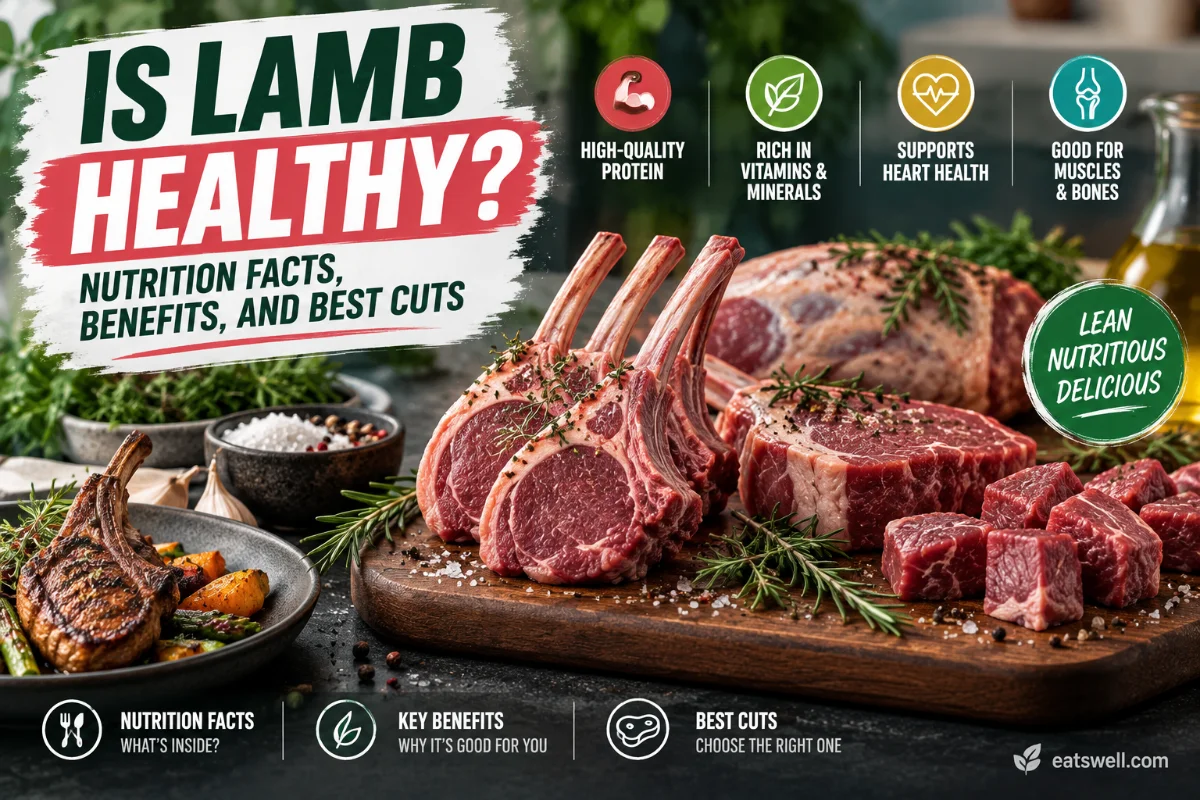
Quick Answer: Lamb is a nutrient-dense red meat that provides complete protein, heme iron, zinc, and vitamin B12 in a single serving. It also contains conjugated linoleic acid and L-carnosine, compounds found in higher amounts in lamb than in most other meats. Two to three portions per week (within the WCRF guideline of 350–500 g cooked red meat weekly) fits most healthy diets.
Lamb dominates Mediterranean and Middle Eastern cooking but sits on the margins in most American and British kitchens. That disconnect creates confusion: some people treat it like any other red meat to avoid, while others see it as one of the more nutrient-rich protein sources available.
Both camps have a point, and the honest answer depends on how much you eat, which cuts you pick, and how you cook them. Here’s what the nutrition data and current research support.
What Does Lamb Contain? Full Nutrition Breakdown
A 100 g (3.5 oz) serving of roasted lamb leg provides these values, per USDA FoodData Central:
| Nutrient | Per 100 g (roasted leg) |
|---|---|
| Calories | 258 kcal |
| Protein | 25.6 g |
| Total Fat | 16.5 g |
| Saturated Fat | 6.9 g |
| Monounsaturated Fat | 7.0 g |
| Polyunsaturated Fat | 1.2 g |
| Carbohydrates | 0 g |
| Vitamin B12 | ~2.5 µg (104% DV) |
| Zinc | 4.5 mg (41% DV) |
| Selenium | 26 µg (47% DV) |
| Iron (heme) | 1.9 mg (11% DV) |
| Niacin (B3) | 6.1 mg (38% DV) |
| Phosphorus | 188 mg (15% DV) |
A single serving covers your entire daily B12 need — a vitamin critical for red blood cell formation and neurological function that’s absent from plant foods.
The iron deserves specific attention. Lamb provides heme iron, the form absorbed at 15–35% efficiency compared to 2–20% for the non-heme iron in plants. A 2025 review in ACS Omega confirmed that heme iron bypasses most of the dietary inhibitors (phytates, polyphenols) that reduce non-heme iron absorption, making meat one of the most reliable dietary sources for maintaining iron status (Dietary Heme Iron Review, 2025).
Around 40% of lamb’s fat is monounsaturated — the same type found in olive oil. That does not cancel the saturated fat, but the overall fat profile is more mixed than the “red meat = bad fat” shorthand suggests.
How Fat Content Varies by Cut?
Not all lamb is created equal. Cut selection changes the nutritional math:
| Cut (per 100 g, cooked) | Calories | Protein | Total Fat | Saturated Fat |
|---|---|---|---|---|
| Leg (lean only) | ~190 kcal | 28 g | 8 g | 3 g |
| Loin chop (lean only) | ~214 kcal | 30 g | 10 g | 4 g |
| Shoulder (lean + fat) | ~274 kcal | 22 g | 20 g | 8 g |
| Ribs (lean + fat) | ~358 kcal | 22 g | 29 g | 13 g |
Leg and loin are the leanest options. Ribs carry almost four times the saturated fat of trimmed leg. If you’re watching calories or fat intake, this table matters more than any general statement about whether lamb is “healthy” or not.
What Sets Lamb Apart from Other Meats?
Several bioactive compounds appear in lamb at levels that differ from chicken, pork, or even beef.
Conjugated Linoleic Acid (CLA)
Lamb contains more CLA per gram than either beef or pork. CLA is a naturally occurring trans fat — distinct from the synthetic kind in processed food, produced during digestion in ruminant animals.
A 2022 dose-response meta-analysis in the British Journal of Nutrition examined 39 randomized controlled trials and found that CLA supplementation produced small but statistically significant reductions in body mass and BMI in adults. However, data from the highest-quality trials failed to confirm fat-mass reduction specifically (Haghighat et al., 2022, British Journal of Nutrition).
Worth noting: those trials used supplement doses far above what you’d get from food. The CLA from a lamb serving is a nutritional bonus, not a fat-loss tool.
L-Carnosine
Red meat is the primary dietary source of L-carnosine, a dipeptide formed from beta-alanine and histidine. Lamb provides approximately 400 mg per 100 g. on par with beef and well above poultry.
Carnosine acts as an intracellular pH buffer in skeletal muscle, which is why beta-alanine supplements (carnosine’s precursor) are popular among athletes. A 2024 systematic review and meta-analysis in Nutrition Reviews found that carnosine supplementation reduced depression scores and improved quality-of-life measures in pooled analysis of 18 RCTs (Kabthymer et al., 2024). Separate research links muscle carnosine to reduced fatigue during high-intensity exercise.
Creatine, Taurine, and Glutathione
Lamb is also a source of creatine (an energy substrate for muscle contraction), taurine (an amino acid that supports cardiovascular and muscle function), and glutathione (a key intracellular antioxidant). These compounds are present in most meats but are worth flagging because they’re entirely absent from plant foods, which explains some of the performance and recovery differences observed between omnivorous and vegan diets.
Omega-3 Fatty Acids (Grass-Fed Lamb Specifically)
A 2024 dietary intervention trial at Queen’s University Belfast found that consuming three portions of grass-finished lamb per week for four weeks measurably improved blood plasma omega-3 levels compared to concentrate-finished lamb (ClinicalTrials.gov: NCT06607354). Sheep naturally graze on grass rich in alpha-linolenic acid (ALA), an omega-3 precursor. Grain finishing dilutes this advantage.
Lamb won’t replace salmon as an omega-3 source, but grass-fed lamb contributes more than most land-based proteins.
How Does Lamb Fit a Training Diet?
If you build meals around training, lamb offers some specific advantages over chicken breast or whey shakes.
Protein quality and leucine. Lamb is a complete protein with all nine essential amino acids. Its leucine content — the amino acid most directly responsible for triggering muscle protein synthesis, makes it a strong option for meals supporting muscle growth.
Iron for endurance. Even subclinical iron deficiency, levels too low for a formal anaemia diagnosis but low enough to affect performance, can increase fatigue and reduce aerobic capacity. Lamb’s heme iron is one of the most efficient dietary correctives.
Calorie density. For someone in a surplus who needs higher calories, lamb’s fat content is a feature. For someone tracking for fat loss, choosing leg over ribs and measuring portions keeps calories in check.
Portion Guidance by Goal
| Goal | Suggested Portion | Frequency | Notes |
|---|---|---|---|
| Muscle gain / bulking | 150–200 g cooked | 2–3× per week | Pair with a carb source for glycogen support |
| Fat loss / cutting | 85–120 g cooked (leg or loin) | 1–2× per week | Trim visible fat; pair with vegetables |
| General health | 100–150 g cooked | 2–3× per week | Stay within 350–500 g total red meat weekly |
The third column references the World Cancer Research Fund (WCRF) recommendation to keep total cooked red meat intake between 350–500 g per week — roughly three moderate portions (WCRF Cancer Prevention Recommendations).
What Are the Risks of Eating Lamb?
No nutritional breakdown is honest without this section. Lamb is red meat, and the trade-offs are real.
Cancer Classification
The International Agency for Research on Cancer (IARC) classifies red meat as Group 2A — “probably carcinogenic to humans” — based on evidence linking regular consumption to colorectal cancer (IARC Monographs, Vol. 114, 2015). This applies to all red meat, not lamb specifically.
Two pieces of context that matter: the risk is dose-dependent, most relevant at high daily intakes rather than occasional servings. And cooking method plays a large role. Heterocyclic amines (HCAs) and polycyclic aromatic hydrocarbons (PAHs) — the compounds most strongly tied to cancer, form when meat is charred, grilled at extreme heat, or smoked. Roasting, braising, and stewing produce far fewer of these compounds.
Saturated Fat and Cardiovascular Risk
A 100 g serving of untrimmed lamb contains roughly 7 g of saturated fat. Elevated saturated fat intake can raise LDL cholesterol, and a large body of evidence from randomized trials and Mendelian randomization studies confirms that high LDL is a causal risk factor for cardiovascular disease (Ference et al., 2017, European Heart Journal).
But cut and preparation modify this substantially. A 2012 study in The Journal of Nutrition found that lean red meat consumed within a Mediterranean-style diet, alongside vegetables, legumes, fish, and olive oil — did not worsen blood lipid profiles compared to a fish-and-white-meat control group (Roussell et al., 2012). The broader dietary pattern matters as much as the individual food.
Who Should Be Cautious?
- People with diagnosed cardiovascular disease or elevated LDL should follow their physician’s guidance on red meat frequency.
- Those with gout may need to limit lamb, its purine content can elevate uric acid levels.
- People on kidney-restricted diets may need to moderate protein and phosphorus intake from all animal sources, including lamb.
Healthiest Ways to Cook Lamb
Cooking method affects lamb’s health profile as much as the cut you buy.
Lower-risk methods: Roasting at moderate temperatures (160–180°C / 325–350°F), braising, slow-cooking, and stewing. These produce minimal HCAs and preserve moisture.
Higher-risk methods: Grilling over open flame, pan-frying at high heat until charred, and smoking. These generate the highest levels of HCAs and PAHs.
Practical tips to reduce risk:
- Marinate before grilling, acidic marinades (lemon juice, vinegar, yogurt) can reduce HCA formation by up to 90%, per research cited by the American Institute for Cancer Research.
- Flip frequently on the grill to prevent charring on any one side.
- Use a meat thermometer: 63°C (145°F) internal temperature with a 3-minute rest for whole cuts meets the USDA food safety standard without overcooking.
Grass-Fed vs. Grain-Fed Lamb: Does It Matter?
The difference is smaller for lamb than for beef, sheep eat more grass by default than feedlot cattle, but it still shows up in the data.
Grass-fed lamb tends to deliver more omega-3, more CLA, and slightly more vitamin E than grain-finished lamb. The 2024 Queen’s University Belfast trial cited earlier specifically measured improved plasma omega-3 from grass-finished lamb consumption over four weeks.
If you have access to grass-fed or pasture-raised lamb and the budget allows, it’s the nutritionally stronger option. If not, conventionally raised lamb still provides the core benefits, protein, iron, B12, zinc, at equivalent levels.
Frequently Asked Questions
Is lamb healthier than chicken?
Lamb delivers more iron, B12, zinc, CLA, and creatine than chicken breast. Chicken is leaner and lower in saturated fat. The better choice depends on what your diet is short on, if you’re already iron-replete and watching saturated fat, chicken wins on those metrics. If your iron or B12 is low, lamb has the edge.
Is lamb healthier than beef?
Nutritionally, they’re close. Lamb contains more CLA and slightly more omega-3 (especially grass-fed), while beef provides more zinc per serving. Cut selection and cooking method create bigger differences than the animal itself.
Can I eat lamb every day?
The WCRF recommends capping total red meat at 350–500 g of cooked weight per week. Daily consumption at standard portions would push you above that range, moving into the intake levels where the observational cancer and cardiovascular risk data becomes more relevant.
Is lamb safe during pregnancy?
Thoroughly cooked lamb is safe and supplies iron and B12, two nutrients commonly needed during pregnancy. Avoid undercooked or raw preparations (like tartare or kibbeh nayyeh) because of toxoplasmosis risk.
Does lamb cause inflammation?
Moderate lamb intake within a varied diet has not been shown to raise systemic inflammatory markers in healthy people. The inflammation link in red meat research is strongest for heavily processed products (bacon, sausage, deli meats) and for overcooking, not for moderate whole-meat consumption.
Is lamb good for iron deficiency?
Lamb is one of the best food sources of heme iron, which is absorbed at 15–35% efficiency compared to 2–20% for plant-based non-heme iron. For people with iron-deficiency anaemia or dropping ferritin levels, regular lamb intake alongside vitamin C-rich foods is a practical dietary strategy to complement medical treatment.
