


Quick Answer: Build every session in the same order, dynamic warm-up, compound lifts, accessory work, then cooldown. That order holds at any level; only the sets, reps, and rest change with your goal. Strength uses low reps and long rest, muscle growth sits in the middle, and fat loss uses higher reps with short rest.
A structured workout is a session built in a set order — warm-up, main compound lifts, accessory work, and cooldown with sets, reps, and rest chosen for one goal. The order stays fixed at every level; only the numbers change as you get stronger.
To structure a workout, you follow one order every session and adjust the numbers to your goal. Warm up, hit your hardest compound lifts first, add accessory work, then cool down. That sequence holds whether you train for muscle, strength, or fat loss.
This guide walks each stage in order, what it does, how long it takes, and how sets, reps, and rest shift with your goal, then shows the structure filled into a full sample session.
- What Should Every Workout Include?
- How to Structure a Workout Based on Your Goal?
- What Order Should Your Exercises Go In?
- How Long Should Each Part of Your Workout Take?
- How Many Days Per Week Should You Train?
- How to Structure a Workout as a Beginner?
- What Does a Structured Session Look Like?
- How Structure Changes as You Progress?
- Frequently Asked Questions
What Should Every Workout Include?
A complete workout moves through five stages: a dynamic warm-up, compound movements, isolation and accessory work, managed rest, and a cooldown. Each stage sets up the next, so skipping one weakens the rest.
Dynamic Warm-Up
Spend 5–10 minutes on movement that matches the session: light cardio plus mobility for the joints you’re about to load, then build toward your working weight with a few warm-up sets. A warm-up primes your nervous system so your first heavy set isn’t your coldest.
Compound Movements First
Squats, deadlifts, presses, and rows go first, while you’re fresh. These multi-joint lifts move the most weight and demand the most coordination, so they earn your best energy before fatigue sets in.
Isolation and Accessory Work
Single-joint moves — curls, lateral raises, leg curls — follow the compounds and target muscles the big lifts under-work. Supersets fit well here, not on heavy compound sets.
Rest Periods
Rest matches your goal, not the clock on the wall. Heavy strength sets need 3–5 minutes; muscle-growth sets 60–90 seconds; higher-rep fat-loss work 30–60 seconds. Cutting rest short on heavy sets costs you reps and quality.
Cooldown
Close with about 5 minutes of easy stretching while your muscles are warm. It brings your heart rate down and starts the shift into recovery.
How to Structure a Workout Based on Your Goal?
The structure stays the same; the variables change. Match your rep range, rest, and intensity to the goal, if you’re still mapping how reps and sets line up with each goal, start there.
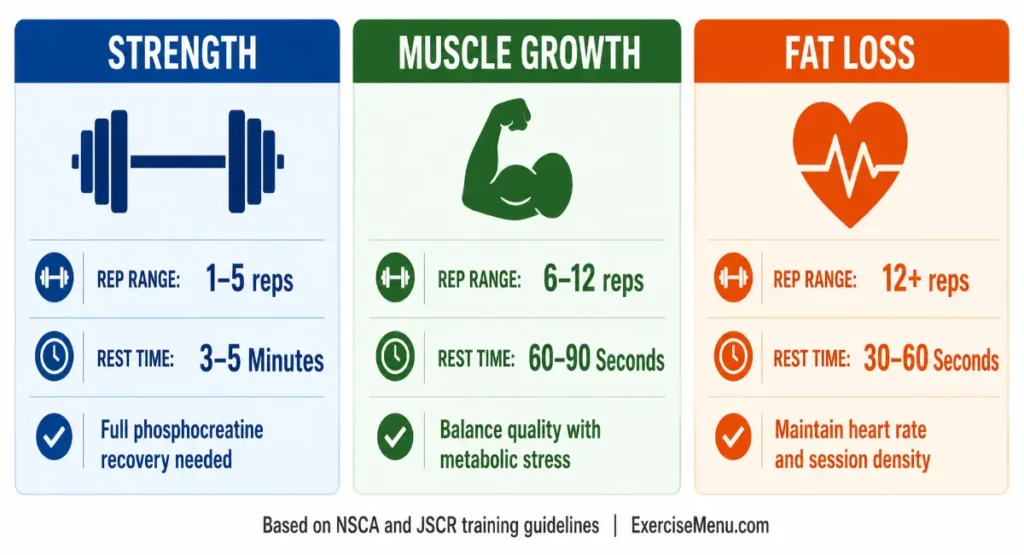
| Goal | Rep range | Sets | Rest |
| Muscle growth | 6–12 | 3–4 | 60–90 sec |
| Strength | 1–5 | 3–5 | 3–5 min |
| Fat loss | 10–15+ | 2–4 | 30–60 sec / supersets |
Load matters as much as rep count. Strength work runs heavy — around 80–90% of your one-rep max; muscle growth sits near 65–80%; fat-loss and endurance work stays below 65%. If you don’t know your max, estimate it before loading heavy.
What Order Should Your Exercises Go In?
Train in order of priority: hardest and most demanding first, smallest and simplest last. Lifts performed earliest in a session show the greatest strength gains, so whatever matters most that day leads (Nunes et al., 2021). Compound before isolation, large muscles before small, free weights before machines.
How Long Should Each Part of Your Workout Take?
A full session lands between 45 and 65 minutes. Here’s where the time goes:
| Component | Time |
| Dynamic warm-up | 5–10 min |
| Compound movements | 20–30 min |
| Isolation / accessory | 15–20 min |
| Cooldown | 5 min |
| Total | 45–65 min |
Tight on time? Trim accessory work first and keep the compounds — the same logic scales down to a 30-minute workout.
How Many Days Per Week Should You Train?
Three days is a solid start — full-body sessions with a rest day between each. Four days suits an upper/lower split; five to six days fits push/pull/legs. More days only help if you recover from the ones you already do.
As you add training days, you add weekly volume — the total hard sets each muscle gets across the week — which is the main lever for growth once your form is solid. Keep those sets productive rather than piling on junk volume; the per-muscle targets live in the guide on sets and reps for muscle growth. Spread them across the week with a planned weekly workout schedule.
How to Structure a Workout as a Beginner?
As a beginner, keep it simple: three full-body days a week, compound lifts only, three sets of 8–10 reps with about two minutes’ rest. Master the movement before the load, and add a little weight or one rep each week through progressive overload. For exact starting numbers, see how many reps and sets a beginner should do.
What Does a Structured Session Look Like?
Here’s the five-stage template filled into one full-body session. Swap the lifts for your own, keep the order, and set the numbers to your goal from the table above. For sessions already built this way, by goal and training days, see our workout plans.
| Part / Exercise | Sets | Reps | Rest | Role |
| Dynamic warm-up | — | 5–10 min | — | Prime joints + CNS |
| Back Squat | 3 | 6–8 | 2–3 min | Compound — first |
| Bench Press | 3 | 6–8 | 2–3 min | Compound |
| Barbell Row | 3 | 8–10 | 2 min | Compound |
| Dumbbell Lunge | 3 | 10–12 | 60–90 s | Accessory |
| Lateral Raise | 2–3 | 12–15 | 45–60 s | Isolation — last |
| Cooldown stretch | — | 5 min | — | Start recovery |
How Structure Changes as You Progress?
Early on, full-body sessions and steady progressive overload drive most of your gains. As you advance, you add volume, move to more specific splits like push/pull/legs or an upper/lower split, bring in more isolation work, and schedule a deload week to manage accumulated fatigue. Each piece here, form, splits, recovery, and nutrition, has a detailed guide in our workout guides hub.
Frequently Asked Questions
What should every workout start with?
A 5–10 minute dynamic warm-up — light cardio plus mobility for the joints you’ll load, then a few ramp-up sets toward your working weight.
Should I do cardio before or after weights?
Whether you do cardio before or after weights depends on your goal — after, if building muscle or strength, so your heavy lifts get your freshest energy.
What’s the best structure for a beginner?
Three full-body sessions a week, compound lifts only, three sets of 8–10 reps with two minutes’ rest.
How do I know my structure is right?
Compounds come first, rest is matched to your goal, and you’re adding weight or reps over time. If all three hold, the structure works.
What’s a good 30-minute workout?
A short warm-up, two or three compound lifts, and a quick cooldown — cut isolation work first.
How does structure change as I get stronger?
You add volume, move to more specific splits, include more isolation work, and plan deloads.
Disclaimer: If you have an existing injury or medical condition, check with your doctor before starting a new program.

1 Comment
Pingback: A Complete Bowling Workout Routine (With Weekly Schedule)