

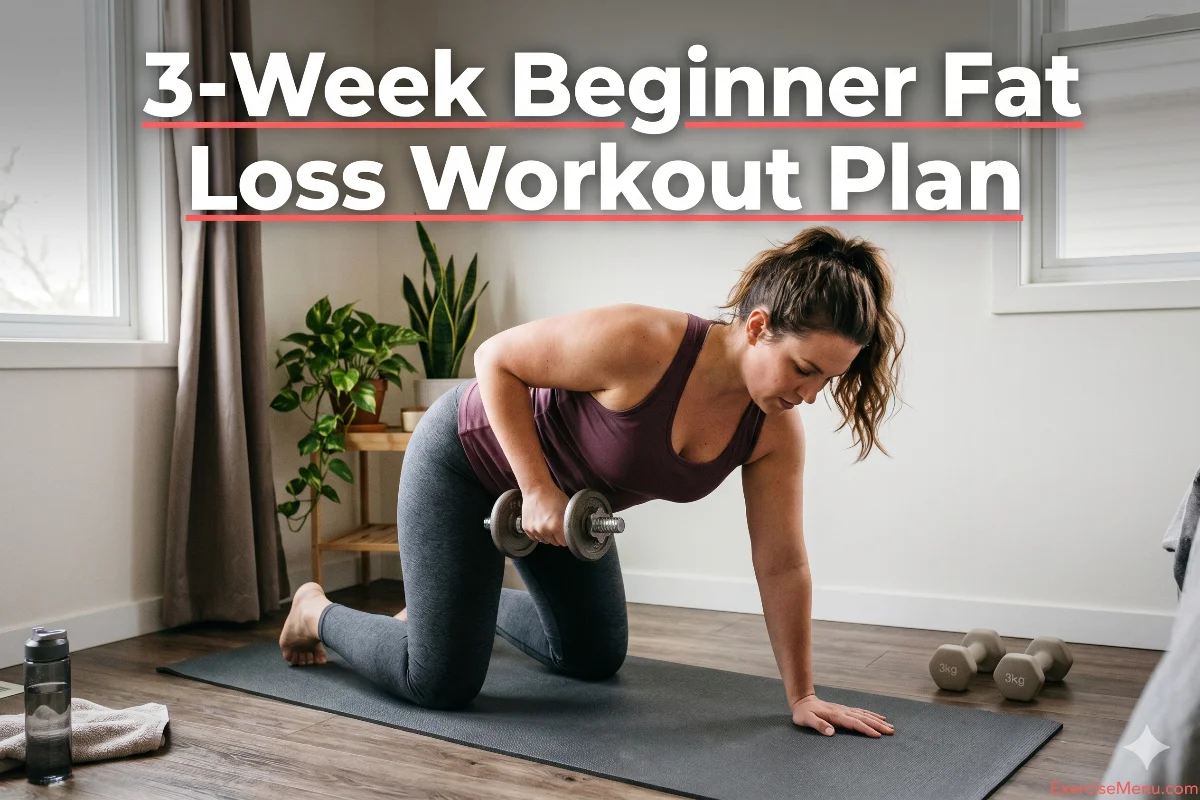
Quick Answer: This 3-week plan uses a 5-day Upper/Lower split — light dumbbells or resistance bands, no gym required. Train upper body twice, lower body twice, and one optional full-body/core session, with two rest days. Each week adds reps or effort, not random new exercises. Three weeks is enough to build the habit and see your numbers move, without demanding a commitment most beginners can’t sustain yet.
Most beginner workout plans throw too much at you in week one. New exercises every session, no clear way to track progress, no real answer for whether it’s actually working. Three weeks gives you enough time to build a real habit and see your lifts improve, without the weight of a 12-week commitment before you’ve even started.
This plan is built for home training — light dumbbells, resistance bands, or just bodyweight. No commercial gym equipment assumed.
Each session below takes 30-40 minutes including a warm-up. Before every workout, spend 5 minutes on light movement marching in place, arm circles, bodyweight squats to raise your body temperature before adding load. Cold muscles under resistance are where most beginner strains happen, and skipping this step is one of the easiest mistakes to avoid.
A note on resistance bands: when a table below lists a dumbbell weight, a medium-resistance band gets you a comparable level of challenge for that same exercise — there’s no need to match the exact pound number.
- Will Lifting Weights Make You Bulky?
- How Is This 3-Week Plan Structured?
- What Equipment Do You Actually Need?
- What Does Each Workout Look Like?
- Why Strength Training (Not Just Cardio) for Fat Loss?
- Week-by-Week — What Changes Each Week?
- Why Might the Scale Not Move in Week 1?
- What Should You Do After Week 3?
- Frequently Asked Questions
- Ready for a Plan Built Around You?
Will Lifting Weights Make You Bulky?
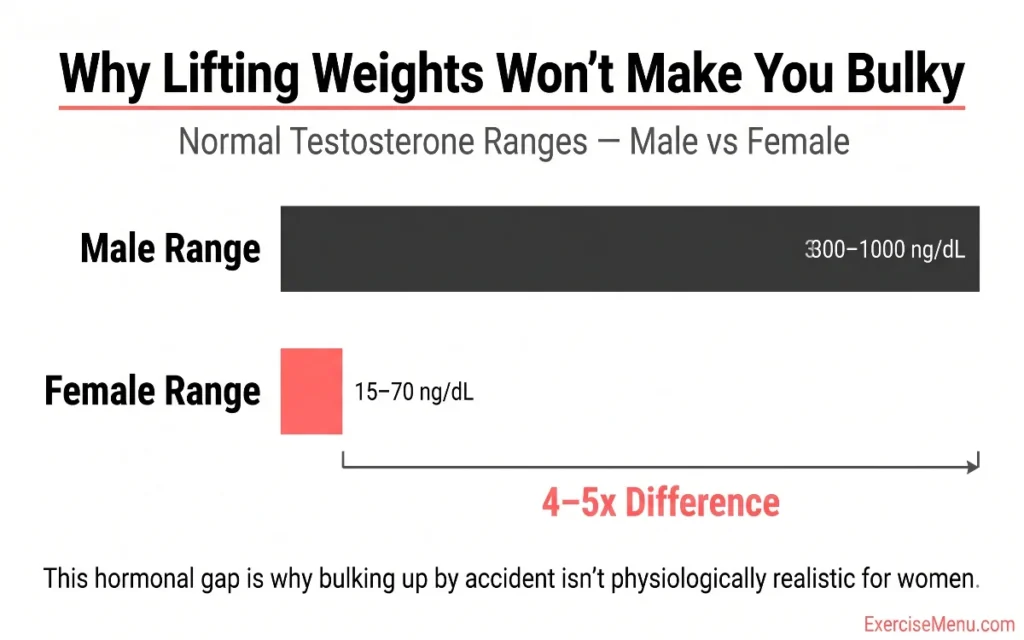
No. Building visibly large muscle requires testosterone levels women don’t have at anywhere near the amount men do — research comparing healthy adult testosterone ranges has found the lower limit of the normal male range sits roughly four to five times higher than the upper limit of the normal female range.
Higher estrogen levels in women also favor fat storage over the kind of rapid muscle growth testosterone drives. That hormonal difference, combined with the specific high-volume training and calorie surplus bodybuilders structure their entire programmes around, means a few weeks of dumbbell training simply doesn’t produce “bulky.”
What strength training actually does for fat loss is build lean muscle, which raises how many calories your body burns at rest. More muscle combined with less fat covering it is what creates visible definition and shape. That’s the “toned” look most women are actually describing when they say they don’t want to get bulky: shape from muscle, visibility from lower body fat, without the muscle itself being large.
How Is This 3-Week Plan Structured?
Five training days, split between upper body and lower body, with two rest days. Saturday’s session is optional — add it once Monday through Friday feel manageable, not from week one if four days already feels like enough.
| Day | Focus |
|---|---|
| Monday | Upper Body |
| Tuesday | Lower Body |
| Wednesday | Rest |
| Thursday | Upper Body |
| Friday | Lower Body |
| Saturday | Full Body + Core (optional) |
| Sunday | Rest |
Training each muscle group twice a week — rather than once — produces better hypertrophy results at the same total weekly volume. That’s why upper and lower body each appear twice before the week resets. Saturday’s full-body session is lighter than the other four days; it adds a small amount of extra volume without creating the kind of fatigue a beginner can’t recover from.
Rest days mean no structured training, not necessarily sitting still — a walk or light housework is fine. Each muscle group needs 48 hours to repair before training it again, which is what the rest days protect.
What Equipment Do You Actually Need?
A pair of light dumbbells — 5 to 10 lbs to start — covers most of this plan. Resistance bands work as a substitute for nearly every exercise here, and bodyweight alone is enough to complete the lower body and core sessions if you have neither.
If you have no equipment at all, upper body still works — swap the chest press for push-ups (knee push-ups if a full push-up isn’t there yet), the row for a doorframe row using your bodyweight as resistance, and the shoulder press for pike push-ups against a wall or low surface. Even a couple of filled water bottles or cans from the kitchen work as makeshift dumbbells until you can get real ones.
You do not need to buy heavier weights before starting. Light dumbbells, taken close to muscular fatigue with enough reps, build strength and burn calories just as effectively for a beginner as heavier weights do — the difference only matters once your current weights stop being challenging, which usually isn’t in week one.
The compound movements in this plan — squats, rows, presses — work multiple muscle groups at once, which is what makes light weight still produce real results for someone just starting out.
What Does Each Workout Look Like?
Monday & Thursday — Upper Body
| Exercise | Sets | Reps | Starting Weight |
|---|---|---|---|
| Dumbbell or Band Chest Press | 3 | 10-12 | 5-8 lbs each |
| Single-Arm Row (dumbbell or band) | 3 | 10-12 each side | 5-10 lbs |
| Dumbbell Shoulder Press | 2 | 12 | 3-5 lbs each |
| Bicep Curl | 2 | 12 | 5-8 lbs each |
| Triceps Kickback | 2 | 12 | 3-5 lbs each |
Tuesday & Friday — Lower Body
| Exercise | Sets | Reps | Starting Weight |
|---|---|---|---|
| Bodyweight or Goblet Squat | 3 | 12-15 | Bodyweight, or 8-12 lbs held at chest |
| Glute Bridge | 3 | 12-15 | Bodyweight |
| Reverse Lunge | 2 | 10-12 each leg | Bodyweight, or 5-8 lbs each hand |
| Standing Calf Raise | 2 | 15-20 | Bodyweight |
Saturday — Full Body + Core (optional)
| Exercise | Sets | Reps | Starting Weight |
|---|---|---|---|
| Bodyweight Squat to Press | 2 | 12 | Bodyweight, or 3-5 lbs each |
| Bent-Over Row | 2 | 12 | 5-8 lbs each |
| Plank | 2 | 30-40 sec | Bodyweight |
| Bicycle Crunch | 2 | 15 each side | Bodyweight |
Rest 60-75 seconds between sets on every session — that window keeps your heart rate elevated for fat loss without cutting recovery so short that form breaks down.
If any exercise causes sharp pain — not muscle fatigue, but joint pain — stop that movement and substitute with a lower-impact version (step-ups instead of lunges, wall push-ups instead of floor push-ups) rather than pushing through it.
Why Strength Training (Not Just Cardio) for Fat Loss?
Cardio burns calories during the session. Strength training keeps burning them after it ends, through what’s called the afterburn effect — your body uses extra energy for hours post-workout to repair the muscle you just trained.
The bigger reason is what strength training protects. A calorie deficit pulls energy from both fat and muscle unless something tells your body the muscle is still needed. Lifting — even with light dumbbells — sends that signal. Cardio alone doesn’t.
Two people losing the identical amount of weight on the scale can end up looking nothing alike. One preserves muscle and looks leaner and more defined. The other loses muscle along with the fat and ends up lighter but soft-looking — sometimes called “skinny fat.”
Protein intake matters here too. Without enough protein, your body has less material to repair and hold onto muscle even while training correctly — aim for a source of protein at most meals across the day rather than loading it all into one.
For the specific rep ranges that work best for fat loss and why, how many reps and sets for fat loss breaks down the research behind the numbers used in this plan.
Week-by-Week — What Changes Each Week?
Week 1: Focus entirely on learning the movements. Pick a weight where the last 2-3 reps of each set genuinely challenge you, but your form stays clean through every rep. This week is about consistency, not intensity.
Week 2: Add one rep per set wherever you can while keeping the same weight. If every set hits the top of its rep range with control, that’s your cue the weight is ready to increase slightly next week.
Week 3: Push your effort closer to the edge — the last set of each exercise can go to 1-2 reps in reserve instead of 2-3. Progressive overload is what separates a plan that keeps working from one that stalls by week four, and this is where it starts.
Track your weights and reps every session, even just in your phone’s notes app — write down the exercise, the weight used, and how many reps you completed at that weight. Without that record, you’re guessing at progress instead of seeing it.
Energy levels naturally dip a few days before and during your period for most women, driven by hormonal shifts. If a session feels noticeably harder during that window, drop to the lower end of the rep range or skip the optional Saturday session rather than forcing the same effort — this isn’t a sign of weakness or a reason to stop, just a normal fluctuation to work around.
Why Might the Scale Not Move in Week 1?
Most beginners who quit in the first ten days do it for this exact reason — and it has nothing to do with whether the plan is working.
Starting a new training program causes your muscles to retain extra water as part of the repair process, plus a temporary increase in stored glycogen (the form your body stores carbohydrate in). Both of these add weight on the scale that has nothing to do with fat. It’s common to see the number go up slightly in week one before it starts trending down in weeks two and three.
If your weight holds steady or even ticks up in the first week despite training consistently and eating in a deficit, that’s expected — not a sign to change anything.
What Should You Do After Week 3?
Completing all three weeks with reasonable consistency opens up two directions from here.
Repeat the cycle at a slightly higher level. Increase the weight on your main lifts by a small amount and run the same three-week structure again. This works well if you’re still seeing weekly progress and don’t feel like changing anything yet.
Move to a longer, more structured plan. Once the basic movements feel comfortable and three weeks of consistency is behind you, a 4 or 5-day plan with a longer progression window — built specifically around your current numbers — typically produces faster results than repeating a beginner template indefinitely.
Either path works, as long as training stays consistent and the nutrition side — your calorie deficit — stays in place alongside it. The workout decides what you keep. The deficit decides how much fat comes off.
Frequently Asked Questions
How many days a week should a beginner woman work out for fat loss?
Four to five days works well for most beginners — enough frequency to see progress without the burnout risk that comes from daily training in week one. This plan uses five, with two full rest days built in.
When should I increase the weight I’m lifting?
Once you can complete every set at the top of the rep range with clean form and the last 2-3 reps still feel hard rather than easy — that’s your signal to add a small amount of weight, not before.
Do I need cardio on top of this plan?
Not required, but optional. Adding two to three 20-30 minute walks per week supports the calorie deficit without adding training stress your body isn’t ready to recover from yet.
How much weight should I expect to lose in 3 weeks?
A safe, sustainable rate is 1-2 lbs per week once water retention settles after week one — so roughly 2-4 lbs total is a realistic, healthy range for three weeks, assuming nutrition is also in a deficit.
What if I miss a workout day?
Skip it and continue with the next scheduled session. Don’t try to combine two workouts into one — that adds more fatigue than your recovery can handle and increases injury risk for no extra benefit.
Ready for a Plan Built Around You?
This plan works as a starting point, but everyone’s body, schedule, and starting point are different. Get a version built specifically around yours — with ongoing support.
