

Quick Answer: A 30-minute workout follows this sequence: 5 minutes dynamic warm-up, 20 minutes compound movements, 5 minutes cooldown. The 20-minute training block changes based on your goal muscle growth, strength, and fat loss each require a different approach to rest periods and exercise selection.
Walking into the gym with 30 minutes and no plan produces 30 minutes of wasted effort. The problem for most people isn’t time it’s that they either skip structure entirely or try to compress a 60-minute session without adjusting anything. Neither works.
Thirty minutes with the right structure, matched to a specific goal, is enough to build muscle, develop strength, or drive fat loss consistently. What that structure looks like in practice is what this guide covers.
How Should You Break Down a 30-Minute Workout?
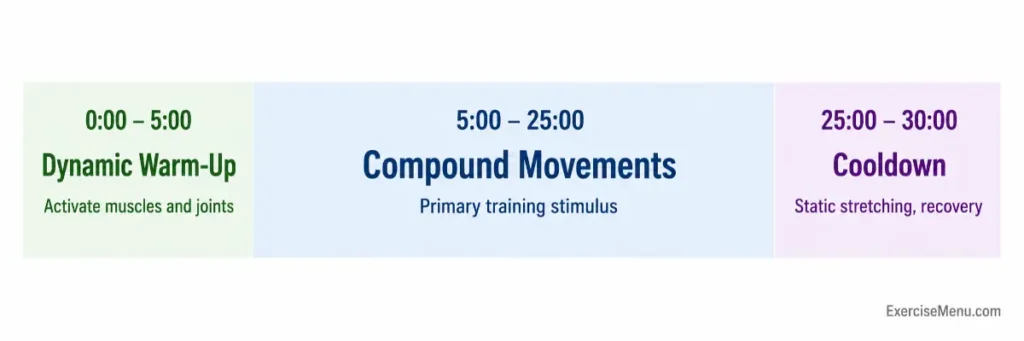
| Phase | Time | Purpose |
|---|---|---|
| Dynamic warm-up | 0:00 – 5:00 | Raise core temperature, activate neuromuscular pathways |
| Compound movements | 5:00 – 25:00 | Primary training stimulus |
| Cooldown | 25:00 – 30:00 | Lower heart rate, static stretching |
Five minutes handles a complete dynamic warm-up when it’s focused 4 to 5 movements, 30 to 45 seconds each, covering the patterns the session will demand. The 20-minute block gets the bulk of the time because that’s where training stimulus is generated. The cooldown is five minutes, not zero — skipping it increases next-day soreness and slows recovery between sessions.
Isolation work bicep curls, lateral raises, tricep extensions — doesn’t appear in this structure. At 30 minutes, completing compound movements with adequate rest leaves no room for isolation exercises done properly. Isolation gets cut first, always. For a full session where isolation work does have a place, the complete workout structure guide covers exactly where it fits and why.
What Should You Do in Each Phase?
Minutes 0–5: Dynamic Warm-Up
Static stretching before lifting reduces force output. A dynamic warm-up raises core temperature, increases blood flow to working muscles, and activates the neuromuscular pathways compound work requires.
Four to five movements, 30–45 seconds each:
- Leg swings — forward and lateral
- Hip circles
- Arm rotations
- Bodyweight squats
- Push-up to downward dog
This phase also sets up warm-up sets the ramp-up sets done with progressively lighter loads before your working weight on each compound exercise. These happen within the 20-minute training block, before the first working set of each lift. Any mobility or activation work glute bridges, band walks — fits here, not as a separate phase.
Minutes 5–25: Compound Movements
Two to three compound exercises squat, deadlift, bench press, row, overhead press. How many fit into 20 minutes depends on rest periods, which vary by goal. That breakdown is in the next section.
Minutes 25–30: Cooldown
Three to four static stretches, 30 seconds each, targeting the muscles worked. Muscles are warm post-training passive lengthening here is both safer and more effective than before the session.
How Should You Structure 30 Minutes Based on Your Goal?
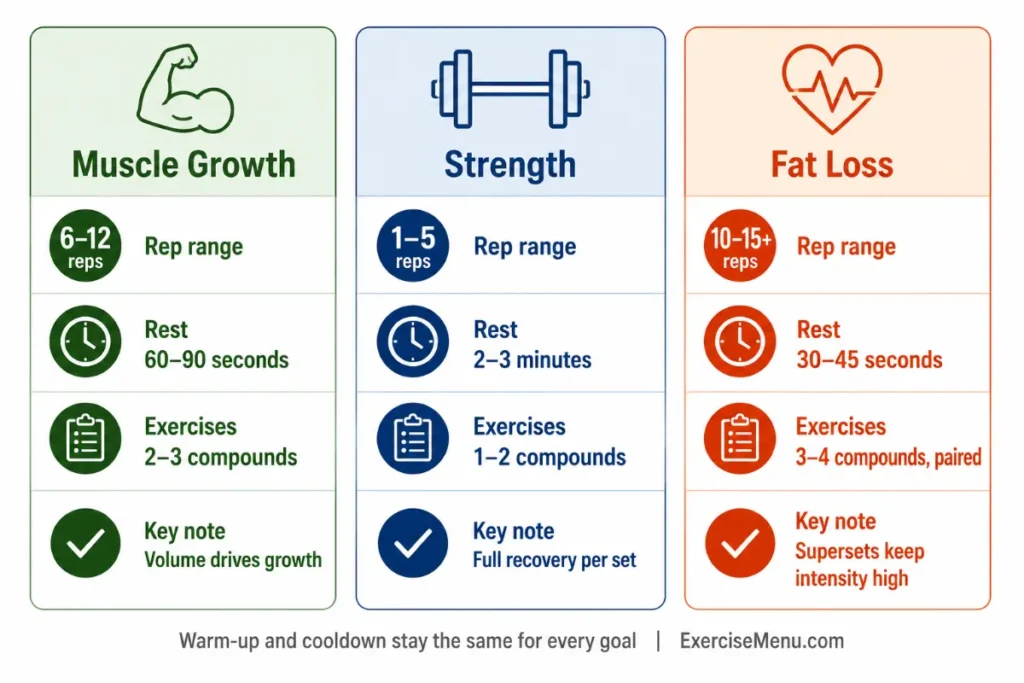
The warm-up and cooldown stay constant. The 20-minute training block changes based on what you’re training for and this is what most 30-minute workout content misses entirely.
Muscle Growth
Muscle growth responds to training volume enough total sets across a moderate rep range to create the mechanical tension and metabolic stress that drives hypertrophy.
- Rep range: 6–12
- Sets per exercise: 3
- Rest between sets: 60–90 seconds
- Exercises that fit: 2–3 compound movements
At 60–90 seconds rest, three sets of a compound exercise takes roughly 6–8 minutes. Two exercises fit comfortably within 20 minutes. Three are possible if rest stays at the lower end.
Understanding how rep ranges interact with training goals determines whether the session generates the right stimulus or simply produces fatigue without meaningful adaptation.
Strength
Strength requires longer rest the phosphocreatine system needs full recovery between heavy sets to produce maximum force output. Shortening rest periods on strength work reduces the quality of every subsequent set.
- Rep range: 1–5
- Sets per exercise: 3–5
- Rest between sets: 2–3 minutes
- Exercises that fit: 1–2 compound movements
One primary lift squat, deadlift, bench press, or overhead press with its warm-up sets fills the 20-minute block at this rest length. A second exercise is possible only if rest is kept at the lower end and the second movement is significantly less demanding than the first.
Fat Loss
Fat loss sessions prioritize training density more total work in less time, maintaining elevated heart rate throughout.
- Rep range: 10–15+
- Rest: 30–45 seconds, or structured supersets
- Exercises that fit: 3–4 compound movements, paired
Pairing opposing muscle groups in supersets squats followed by rows, bench press followed by Romanian deadlifts lets one muscle group recover while the other works. This keeps intensity high without extending session length.
Circuit training fits here specifically cycling through exercises with minimal rest keeps heart rate elevated and maximizes caloric output within the 30-minute window. It works for fat loss and conditioning. For muscle growth and strength, it doesn’t — according to the American College of Sports Medicine, adequate rest between sets is a requirement for both hypertrophy and maximal strength development.
Cutting rest to circuit-training levels during a strength session reduces mechanical tension per set — the primary driver of muscle growth without producing the adaptation that justifies the fatigue. According to research on excess post-exercise oxygen consumption, high-intensity exercise elevates calorie burn for hours after a session ends. Dense, short-rest training maximizes this effect within a 30-minute window.
Research consistently shows that performing aerobic exercise before resistance training reduces force output on compound lifts placing cardio first compromises the quality of every strength set that follows.
What Should You Cut When You Have Less Than 30 Minutes?
Cut first: Isolation work already absent from the structure, but remove anything added.
Cut second: One set per exercise. Drop from 3 sets to 2. Volume decreases but the training stimulus remains.
Cut third: One exercise entirely. Keep the most demanding compound movement and drop the secondary one.
Never cut: The warm-up. Skipping it on a compressed session increases injury risk significantly. Five minutes of dynamic movement stays regardless of time available.
Shorten, don’t eliminate: The cooldown. Two to three minutes of basic stretching is enough when time is genuinely short.
How to Structure a 30-Minute Workout at Home?
The 5-20-5 structure applies without equipment. Exercise selection changes compound bodyweight movements replace barbell lifts but the framework stays identical.
Dynamic warm-up (5 min): Leg swings, hip circles, bodyweight squats, arm rotations.
Training block (20 min) — muscle growth example:
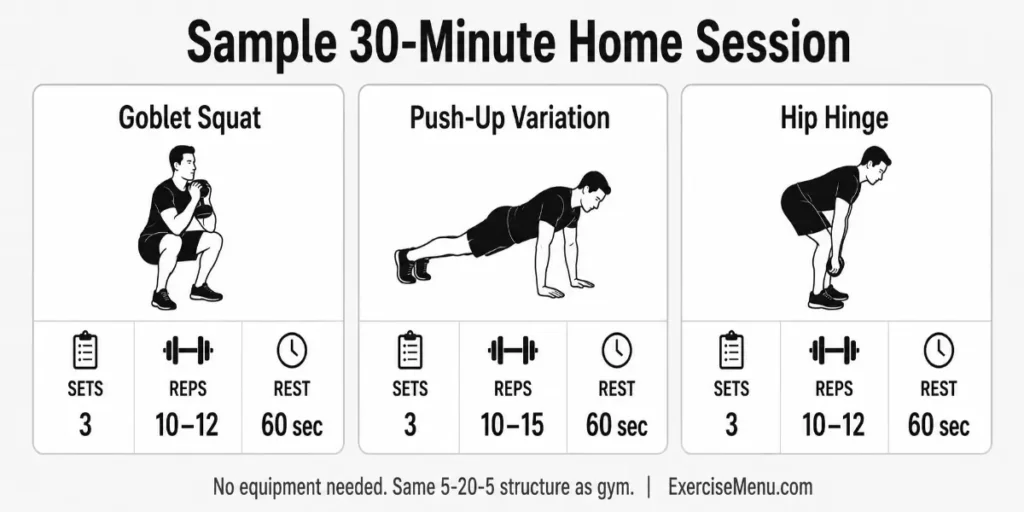
| Exercise | Sets | Reps | Rest |
|---|---|---|---|
| Bodyweight squat or goblet squat | 3 | 10–12 | 60 sec |
| Push-up variation | 3 | 10–15 | 60 sec |
| Hip hinge (single-leg or resistance band) | 3 | 10–12 | 60 sec |
Cooldown (5 min): Hip flexors, hamstrings, chest, lats 30 seconds each.
Progressive overload applies here the same way it does in a gym. Adding reps, slowing tempo, pausing at the bottom of each rep, or adding a resistance band all increase the training stimulus without needing additional weight. A home session that applies progressive overload consistently outperforms a gym session that doesn’t.
Frequently Asked Questions
Is 30 minutes enough to build muscle?
Yes compound movements, adequate rest for the goal, and consistent progressive overload session to session.
What should I do in 30 minutes at the gym?
Warm-up 5 minutes, 2–3 compound movements for 20 minutes matched to your goal, cooldown 5 minutes. Plan the exercises before walking in.
Can I do a full body workout in 30 minutes?
Yes squat, push, pull. Three compound movements cover all major muscle groups within the time.
Is a 30-minute workout effective for beginners?
Yes 3 sets of 8–10 reps on 2–3 compound movements fits comfortably within 30 minutes and is the right starting structure for beginners.
Should I do cardio in a 30-minute workout?
Only for fat loss, and after the resistance training cardio before compound lifts reduces the force output available for the lifts.
How do I make the most of 30 minutes at the gym?
Know the exercises, sets, and rest periods before starting. Time lost between exercises deciding what to do next is where short sessions fall apart.
