


Quick Answer: Start by deciding how many days you can realistically train 3, 4, or 5. Match that number to a split: full body for 3 days, upper/lower for 4, push/pull/legs for 5–6. Place rest days after your heaviest sessions, not randomly. That structure is the schedule.
Training without a weekly structure produces inconsistent results sessions happen randomly, rest days get skipped, and hard sessions stack back to back until fatigue forces a break. The schedule is what prevents that.
A weekly workout schedule removes the daily decision of what to do. It tells you what happens Monday, what happens Wednesday, and where recovery fits so that Friday’s session is actually productive.
- How Many Days a Week Should You Work Out?
- Which Training Split Fits Your Schedule and Goal?
- What Does a Sample Weekly Workout Schedule Look Like?
- Where Should Rest Days Go in Your Week?
- How to Fit Cardio Into Your Training Week?
- How Does Your Schedule Change as You Progress?
- Frequently Asked Questions
How Many Days a Week Should You Work Out?
Three to five days per week covers the range for most people, from beginners building consistency to intermediate lifters adding volume.
According to the Physical Activity Guidelines from the World Health Organization, adults need at least 150 minutes of moderate-intensity aerobic activity per week, plus two days of muscle-strengthening work. Three structured training sessions per week meets both requirements when programmed correctly.
3 days — Full-body sessions. Every major muscle group trained each session. Built-in recovery between every workout. The most practical starting point for most people and the most forgiving schedule when life gets in the way.
4 days — Upper/lower split. More volume per muscle group than full body, with upper and lower body sessions alternating. Suits anyone who has trained consistently for 3+ months and wants to increase weekly training stimulus.
5–6 days — Push/pull/legs. Each session targets a specific muscle group category. High weekly frequency means recovery management becomes critical consecutive hard sessions without adequate rest stall progress faster than training less.
📖 Related Reading: How to Structure a Workout. Complete Guide
Which Training Split Fits Your Schedule and Goal?
The split you choose should match both how many days you have and what you’re training for.
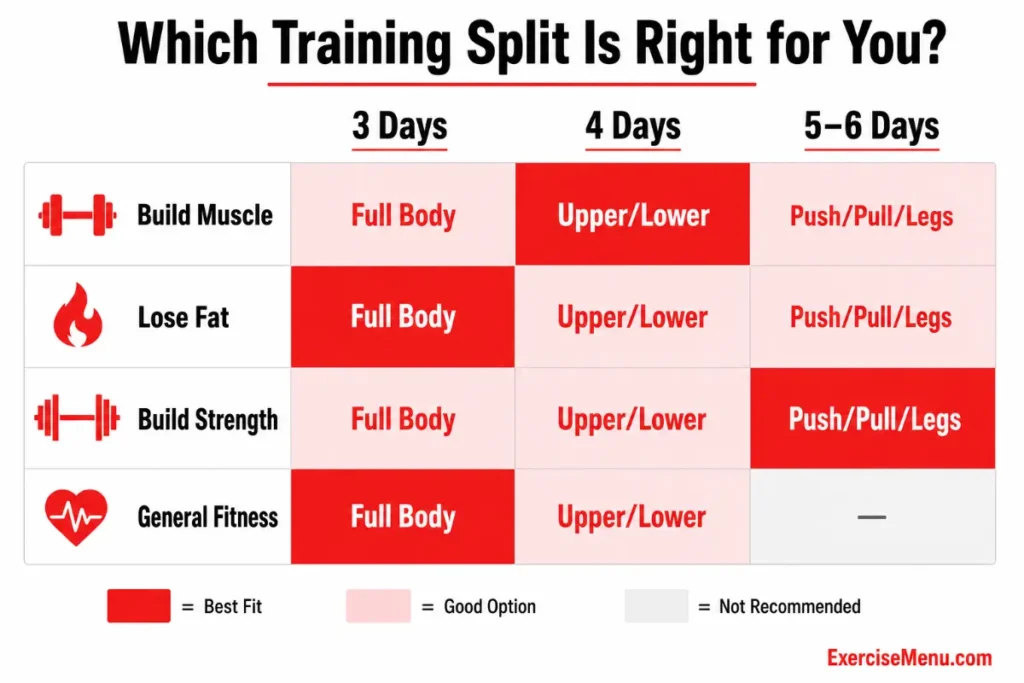
Full body training on 3 days works because each muscle group gets trained three times per week at moderate volume enough frequency to drive adaptation without accumulating excessive fatigue. How reps and sets are distributed across those sessions determines whether the stimulus is sufficient for your goal.
Upper/lower splits on 4 days allow more exercises per muscle group per session and more specific programming upper days for pressing and pulling, lower days for squat and hip hinge patterns.
Push/pull/legs at 5–6 days per week only works when recovery is deliberately programmed. The sessions are shorter and more focused, but the weekly load is high. Without proper rest day placement, this frequency produces fatigue faster than fitness.
Find Your Workout Split
How many days per week can you train?
What Does a Sample Weekly Workout Schedule Look Like?
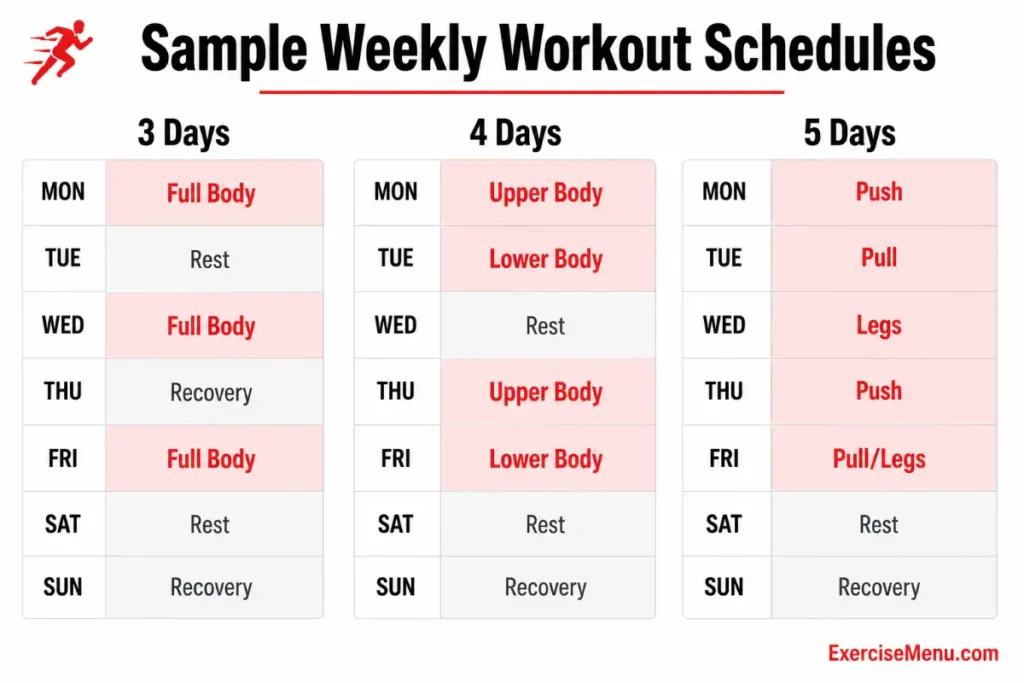
The day labels are placeholders — the order matters, the specific days don’t.
3-Day Full Body Schedule
| Day | Session | Focus |
|---|---|---|
| Monday | Full body | Squat, horizontal push, horizontal pull |
| Wednesday | Full body | Hip hinge, vertical push, vertical pull |
| Friday | Full body | Squat variation, accessory upper, core |
| Tue/Thu/Sat/Sun | Rest or active recovery | — |
4-Day Upper/Lower Schedule
| Day | Session | Focus |
|---|---|---|
| Monday | Upper body | Bench press, rows, overhead press, pull-ups |
| Tuesday | Lower body | Squat, Romanian deadlift, leg press |
| Thursday | Upper body | Incline press, cable rows, arms, rear delts |
| Friday | Lower body | Deadlift, Bulgarian split squat, leg curl |
| Wed/Sat/Sun | Rest or active recovery | — |
5-Day Push/Pull/Legs Schedule
| Day | Session | Focus |
|---|---|---|
| Monday | Push | Chest, shoulders, triceps |
| Tuesday | Pull | Back, biceps, rear delts |
| Wednesday | Legs | Quads, hamstrings, glutes |
| Thursday | Push | Variation of Monday |
| Friday | Pull or Legs | Alternate based on recovery |
| Sat/Sun | Rest | — |
Where Should Rest Days Go in Your Week?
Rest days belong after your heaviest sessions not wherever is left over in the week.
Muscle protein synthesis peaks in the 24–48 hours after a resistance session, according to research published in the Journal of Physiology. Placing another hard session during that window doesn’t accelerate recovery — it competes with it. The body is repairing tissue; adding more damage before that process completes means neither session produces its full adaptation.
Heavy compound sessions deadlifts, squats, heavy pressing also place significant demand on the central nervous system, not just the muscles. CNS fatigue shows up as weights feeling heavier than they should at familiar loads, slower bar speed, and flat motivation. A rest day after a heavy session addresses both muscular and neurological recovery simultaneously.
Can you train on consecutive days?
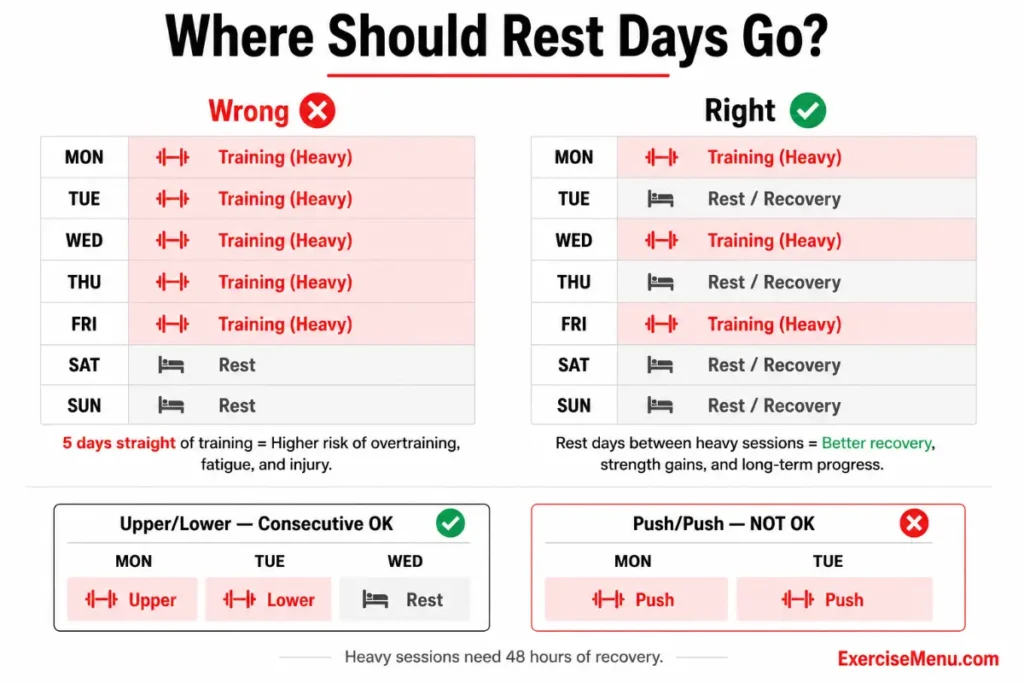
Yes — but it depends on what those sessions are. Upper body Monday followed by lower body Tuesday works because different muscle groups recover while the other trains. Push Monday followed by push Tuesday doesn’t work the same muscles are under load two days in a row with insufficient recovery between.
The upper/lower split is built on this principle. Two consecutive days are possible because the sessions don’t overlap in primary muscle groups. The 4-day upper/lower example above places upper and lower on consecutive days for exactly this reason.
For rest day options between sessions, the difference between complete rest and active recovery comes down to what type of fatigue you’re managing muscular soreness responds well to light movement, CNS fatigue requires complete rest.
How to Fit Cardio Into Your Training Week?
Cardio placement within the week follows the same logic as strength session placement — what comes before affects what comes after.
Steady-state cardio at low intensity a 20–30 minute walk, easy cycling — can be placed on the same day as lifting without meaningful interference. Keep it after the resistance work, not before, to preserve force output for the lifts.
High-intensity cardio — HIIT, sprint intervals — creates significant fatigue and elevates AMPK activity, which transiently suppresses the anabolic signaling that drives muscle adaptation. Placing HIIT on the same day as heavy resistance training compromises both sessions. The better placement is on a separate day, or at minimum several hours apart. Whether cardio goes before or after weights on the same day changes the outcome depending on your goal.
Practical cardio placement by schedule:
- 3-day schedule: Cardio on off days Tuesday, Thursday, or Saturday. Low-to-moderate intensity. Keeps total training days at 5–6 without adding to resistance session length.
- 4-day schedule: Cardio on Wednesday rest day or as a short finisher after upper body sessions. Avoid heavy cardio the day before lower body sessions.
- 5-day schedule: Cardio fits on the weekend rest day or as a short session after pull or push days. Avoid stacking HIIT before or after leg sessions.
How Does Your Schedule Change as You Progress?
The schedule that works in month one stops being optimal by month four.
Beginners make rapid progress on 3 full-body sessions per week because the neuromuscular system is adapting to the movements themselves motor patterns, coordination, and basic strength all improve simultaneously. The same 3-day structure after 3–4 months produces diminishing returns because neural adaptation has plateaued and volume needs to increase to drive further progress.
The natural progression is from full body → upper/lower → push/pull/legs as training age increases. Each step adds more volume per muscle group per session and more session specificity. Progressive overload adding load, reps, or sets over time is what drives adaptation within any schedule. When overload stalls consistently, increasing session frequency or changing the split is the structural response.
Every 10–12 weeks, a planned reduction in training volume a deload week — allows accumulated fatigue to clear. Progress resumes from a recovered baseline rather than grinding through fatigue that has been building for months. This isn’t optional at higher training frequencies; it’s part of the schedule structure.
Frequently Asked Questions
How many days a week should I work out to see results?
Three days per week produces measurable results for most beginners. Frequency matters less than consistency and progressive overload — three hard, well-recovered sessions outperform five mediocre ones every time.
Can I work out 3 days a week and build muscle?
Yes. Three full-body sessions per week, each built around compound movements with progressive overload, provides enough stimulus for consistent muscle growth.
Should I do cardio on rest days?
Low-intensity cardio walking, easy cycling is appropriate on rest days and supports recovery by improving circulation. High-intensity cardio on rest days between heavy lifting sessions adds fatigue that compromises the next training session.
What is the 3-2-1 workout rule?
The 3-2-1 rule is a weekly training framework: 3 days of strength training, 2 days of cardio, 1 day of flexibility or mobility work, with the remaining day as complete rest.
What do I do if I miss a workout?
Skip it and continue with the next scheduled session. Don’t try to make it up by doubling sessions that compresses recovery and degrades session quality. A missed workout has minimal impact on long-term progress; a compressed recovery period does.
How often should I change my workout schedule?
The split itself doesn’t need to change frequently. What changes is the load and volume within each session that’s progressive overload. Changing the schedule structure every 10–12 weeks, or when progress has genuinely stalled, is a reasonable timeframe.
