

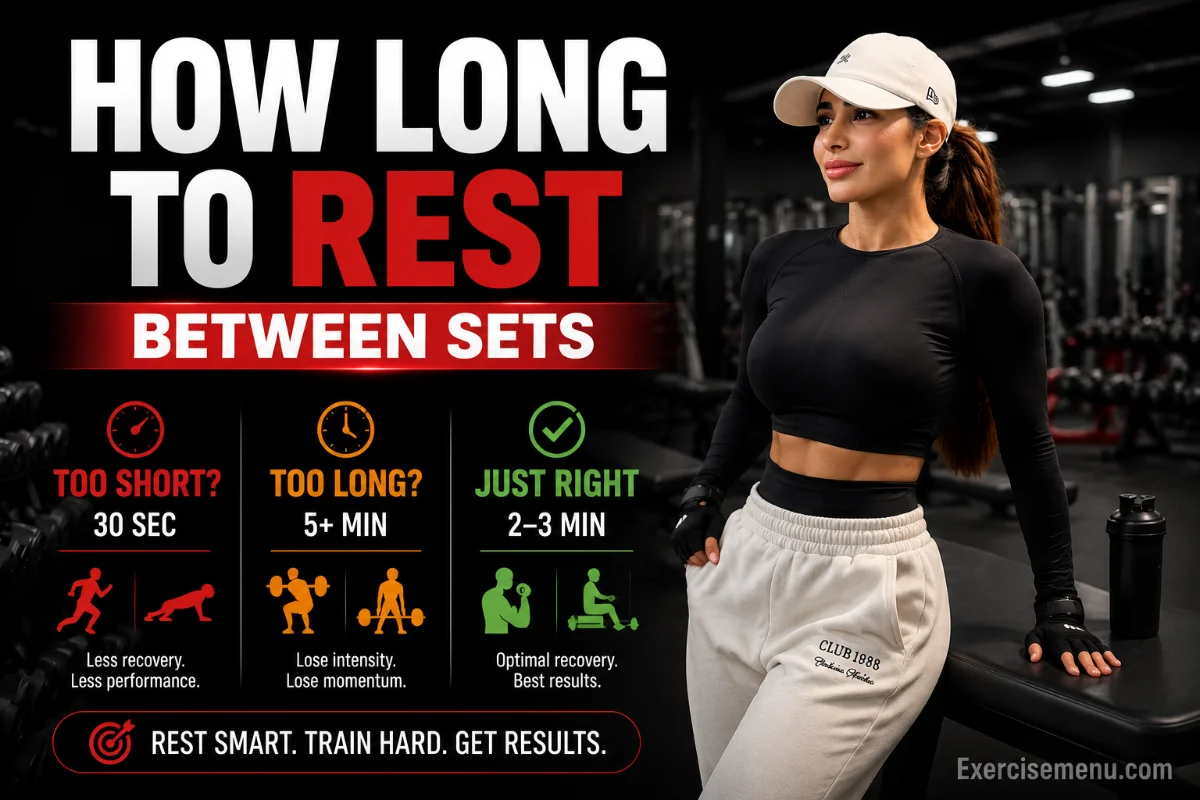
Quick Answer: Rest 3–5 minutes for strength, 2–3 minutes for muscle growth, and 30–60 seconds for endurance. Compound lifts need longer rest than isolation exercises. A 2024 meta-analysis confirmed that resting under 60 seconds reduces hypertrophy compared to longer rest.
The number of reps and sets you perform only tells half the story. The other half — how long you rest between those sets — decides whether your next set builds muscle, builds strength, or just builds fatigue.
Most gym-goers either rush through rest or sit on their phone for six minutes between curls. Both approaches leave results on the table. The right rest interval depends on your goal, the exercise you’re doing, and a few personal factors most people never consider.
- How Long Should You Rest Between Sets for Strength?
- How Long Should You Rest Between Sets for Muscle Growth?
- How Long Should You Rest Between Sets for Endurance?
- Should You Rest Longer for Compound Exercises?
- Does Resting Too Long Between Sets Kill Gains?
- What Changes How Long You Need to Rest?
- Short on Time? How to Rest Less Without Losing Muscle
- 5 Rest Period Mistakes That Cost You Gains
- FAQ's
- Conclusion
How Long Should You Rest Between Sets for Strength?
Rest 3–5 minutes between sets when training for strength. Heavy loads in the 1–6 rep range deplete your phosphocreatine stores and stress your central nervous system. Without full recovery, force production drops set to set less weight moved, less strength gained.
Your muscles run on a fuel called ATP during maximal lifts. The phosphocreatine system replenishes ATP stores, but it needs roughly 3 minutes to restore them to about 95%. Cut that to 1 minute and you start the next set at roughly 50–60% capacity.
You’ll feel it the bar moves slower, your reps drop, and the weight that felt manageable two minutes ago now pins you. A review of 35 studies in Sports Medicine found that resting 3–5 minutes between sets produced greater increases in absolute strength compared to shorter rest intervals (De Salles et al., 2009).
Heavy compound lifts squats, deadlifts, bench press, overhead press also tax your central nervous system. These movements recruit high-threshold motor units, particularly fast-twitch muscle fibers, which generate the most force but also need the most recovery time. After an all-out set of heavy squats, those motor units need 3–5 minutes before they can fire at full capacity again.
One detail worth noting: 3 minutes and 5 minutes are not interchangeable. A set of 5 reps at 85% of your max depletes you differently than a 1-rep max attempt. For sets of 4–6 reps, 3 minutes is usually enough. For true 1–3 rep maxes, 4–5 minutes is justified. Match your rest to your rep range not just to “strength” as a blanket label.
Cutting rest short on strength days is one of the most common reasons lifters plateau. If you can’t maintain your working weight across all prescribed sets, inadequate rest is often the cause. Strength depends on progressive overload and progressive overload requires maintaining or increasing load. You can’t do that on a half-recharged nervous system.
There’s also an injury angle. Heavy lifts performed under fatigue lead to form breakdown — the exact moment when strains, tweaks, and disc issues happen. Full rest between heavy sets isn’t just a performance choice. It’s a safety one.
How Long Should You Rest Between Sets for Muscle Growth?
Rest 2–3 minutes between sets for hypertrophy — not the 30–90 seconds that older guidelines recommended. A 2024 Bayesian meta-analysis by Singer et al. analyzed nine studies and found that resting over 60 seconds produces a small but measurable hypertrophy advantage over shorter rest periods (Singer et al., 2024, Frontiers in Sports and Active Living).
The old recommendation was built on a flawed premise. Shorter rest intervals trigger a temporary spike in growth hormone, and for years the assumption was that more growth hormone meant more muscle. It doesn’t.
Those hormonal spikes are too brief and too small to drive long-term muscle growth. The real driver of hypertrophy is mechanical tension the force your muscles produce against a challenging load, sustained across enough time under tension to trigger adaptation.
Schoenfeld et al. confirmed this in a 2016 study published in the Journal of Strength and Conditioning Research. Resistance-trained men who rested 3 minutes between sets gained more muscle thickness in their quadriceps and triceps than the group resting just 1 minute over the same 8-week program with the same exercises and sets. The reason: the 3-minute group completed more total reps at the same weight because they were better recovered for each set.
That last point matters more than the rest numbers. When total reps are equated same weight, same total reps rest interval length becomes largely irrelevant for hypertrophy. The advantage of longer rest isn’t magical.
It preserves your rep quality so you accumulate more training volume per set without even trying. And if your rest is so short that reps drop sharply in later sets, those sets may turn into junk volume work that creates fatigue without producing enough mechanical tension to stimulate growth.
One number doesn’t fit every exercise. The 2–3 minute recommendation applies to compound hypertrophy work squats, presses, rows. Smaller isolation movements recover faster and need less rest. The breakdown by exercise category is covered in the section below. For rep and set guidance, see our guide on muscle growth programming.
How Long Should You Rest Between Sets for Endurance?
Rest 30–60 seconds between sets for muscular endurance. Short rest is the training stimulus — it forces your muscles to contract under incomplete recovery, which builds fatigue resistance over time.
With rest this brief, your phosphocreatine system doesn’t fully recharge. Energy production shifts toward the glycolytic and oxidative pathways and training these systems is the entire point of endurance programming. High-rep sets (15+) with minimal rest teach your muscles to sustain output when fuel is running low.
This applies to circuit training and HIIT as well, where rest intervals may drop to 15–30 seconds between stations. These formats combine muscular endurance with cardiovascular demand in a single session.
One common mistake: resting 30 seconds between heavy barbell sets and calling it “endurance training.” That’s not endurance work it’s just under-recovered strength work. Endurance rest periods pair with lighter loads and higher reps. If your goal is to build muscle or strength, short rest on heavy sets does the opposite of what you want.
Should You Rest Longer for Compound Exercises?
Yes. Compound exercises recruit more total muscle mass and place heavier demand on your nervous system than isolation movements. A heavy set of squats depletes far more ATP and generates more systemic fatigue than a set of bicep curls. Your rest should reflect that difference.
Most guides tell you “compounds need more rest” and stop there. A better way to think about it:
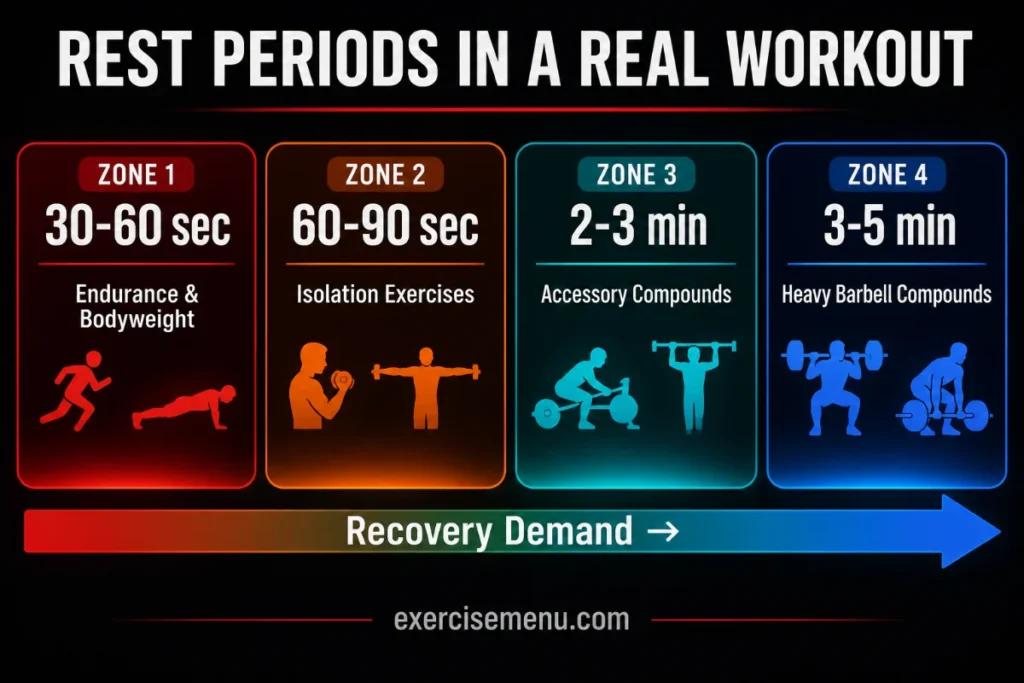
| Exercise Category | Examples | Rest Period |
|---|---|---|
| Heavy barbell compounds | Squat, deadlift, bench press, overhead press | 3–5 min |
| Accessory compounds | Rows, lunges, pull-ups, dips | 2–3 min |
| Isolation exercises | Curls, extensions, lateral raises, flyes | 60–90 sec |
| Bodyweight / core | Push-ups, planks, crunches | 30–60 sec |
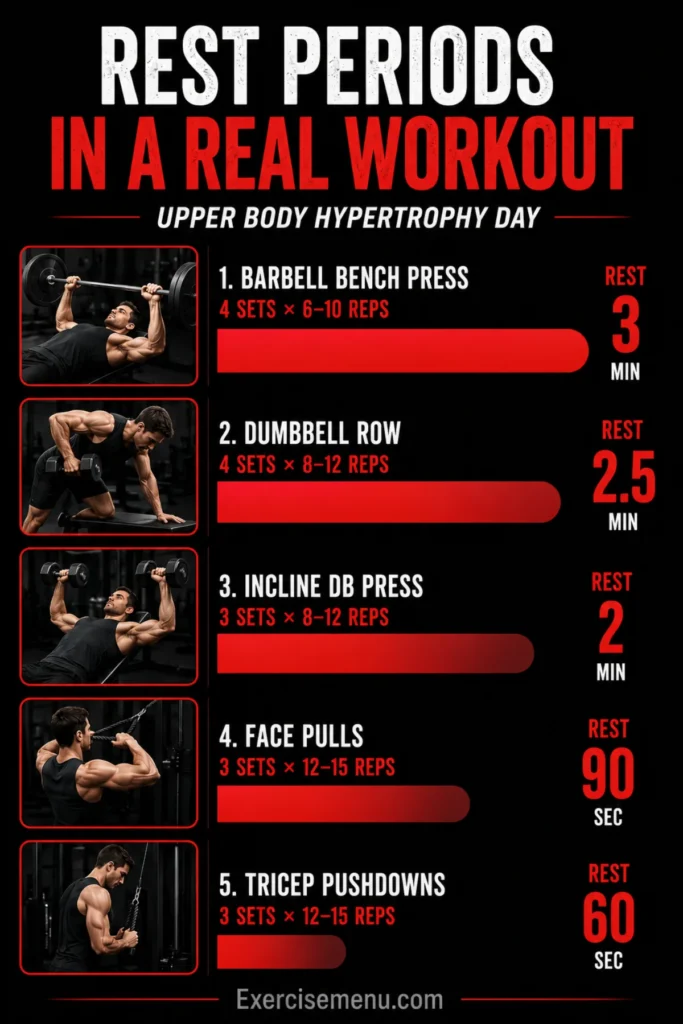
Here’s what this looks like in a real session an upper body hypertrophy day with rest matched to each exercise:
| Exercise | Sets × Reps | Rest |
|---|---|---|
| Barbell bench press | 4 × 6–8 | 3 min |
| Dumbbell row | 3 × 8–10 | 2.5 min |
| Incline dumbbell press | 3 × 10–12 | 2 min |
| Face pulls | 3 × 12–15 | 90 sec |
| Tricep pushdowns | 3 × 12–15 | 60 sec |
Notice how rest shortens as exercises move from heavy compounds to lighter isolation work. The bench press gets the longest rest because it produces the most fatigue. Tricep pushdowns get the shortest because the muscle is small and recovers fast.
This tiering matters because someone resting 90 seconds between heavy squats AND 90 seconds between bicep curls is under-recovering on squats and over-resting on curls. Both cost results.
Legs typically need more rest than upper body at the same relative intensity. Quadriceps, glutes, and hamstrings are the largest muscle groups in your body a heavy squat or deadlift creates systemic fatigue that a heavy bench press doesn’t match. If your squat performance drops off sharply after the first set, adding 30–60 seconds of rest often fixes it.
Supersets work because they exploit this principle. Pair non-competing muscles bench press with rows, squats with pull-ups and each muscle gets 2–3 minutes of effective rest while you’re working the other. Total rest per muscle stays high; total session time drops.
Does Resting Too Long Between Sets Kill Gains?
No. No study has found that resting “too long” reduces muscle growth or strength gains. The pump fades after 3–4 minutes but the pump is a temporary fluid response, not the stimulus that builds muscle. Mechanical tension is.
The real risk of very long rest on moderate-load hypertrophy days is practical, not physiological. Sessions stretch past 90 minutes, focus fades, muscles cool down, and total volume often drops not because your body can’t handle it, but because motivation runs out and later exercises get cut short.
For most people training in 60–75 minute windows, 2–3 minutes is the practical sweet spot for hypertrophy work it preserves rep quality without inflating your session. For strength with heavy singles and doubles, 4–5 minutes carries zero downsides. Powerlifters routinely rest 5–8 minutes between max-effort sets. The only cost is time.
What Changes How Long You Need to Rest?
Your goal and exercise type set the baseline, but four factors shift your real-world rest needs on any given day.
Training Phase
Not every training block demands the same rest. During an accumulation phase moderate loads, higher volume 2–3 minutes between compound sets handles the job. During an intensification or peaking phase heavy loads, lower reps rest extends to 4–5 minutes because force demands are higher and CNS fatigue accumulates faster.
During a deload week, loads drop to 40–60% of normal. Rest can shorten to 60–90 seconds without performance consequences because the stimulus is deliberately reduced.
Caloric Deficit vs Surplus
Recovery capacity drops in a caloric deficit. Glycogen stores are lower, CNS recovery slows, and accumulated fatigue builds faster across a session. If you’re cutting, err toward the longer end of your recommended rest range rather than the shorter end. Rushing through sets during a deficit accelerates performance drop-off and increases the chance of losing strength and muscle.
In a caloric surplus, recovery runs faster. You can often operate at the shorter end of the range and still maintain set quality.
Sleep and Stress
Poor sleep directly impairs neural recovery and glycogen replenishment. A bad night of sleep is a legitimate reason to add 30–60 extra seconds of rest on compound lifts. You’ll notice the difference sets that normally feel manageable will grind harder than expected.
Chronic stress keeps cortisol elevated, which reduces your capacity to recover between sets. If you’re going through a high-stress period, slightly longer rest periods protect your training quality.
Age
Muscle recovery slows with age. Lifters over 50 benefit from adding 30–60 seconds to standard rest recommendations, especially on heavy compound movements. The ACSM recommends that older adults prioritize controlled movement and adequate recovery to maintain muscle mass and bone density (ACSM Position Stand, 2009). For specific programming guidance, see our guide on reps and sets for adults over 50.
Short on Time? How to Rest Less Without Losing Muscle
If you can’t afford 3-minute rests between every exercise, don’t just cut rest and accept fewer reps. That trades muscle growth for speed a bad deal. Instead, use strategies that keep total training volume the same in less time.
Rest-pause / myo reps — Perform one hard set close to failure, then take 20–30 second micro-rests followed by short sets of 3–5 reps until you hit your target total reps. Research shows equivalent hypertrophy when total reps match, and the whole sequence takes roughly half the time of traditional sets with full rest. This approach is covered in detail in our guide on Rest-Pause Sets.
Supersets with non-competing muscles — Pair bench press with rows, or squats with pull-ups. Each muscle gets its full 2–3 minutes of effective rest while you’re working the other. Session time drops by 30–40% without sacrificing volume for either muscle group.
Prioritize compounds, shorten isolation rest — Keep full 3-minute rest on your 1–2 main compound lifts. Cut rest to 60 seconds only on accessories and isolation work at the end of the session. Compounds produce the largest growth stimulus and suffer the most from inadequate recovery. Isolation movements handle shorter rest with minimal performance loss.
Don’t reverse this cutting compound rest and padding isolation rest is backwards. It costs the most where it matters the most.
5 Rest Period Mistakes That Cost You Gains
- One default rest time for your entire workout. A set of heavy deadlifts and a set of lateral raises don’t create the same fatigue. Using a single rest interval for both means you’re either under-recovering on the hard exercises or wasting time on the easy ones.
- Timing rest from re-racking. Start your timer when your last rep ends, not when you finish putting the dumbbells down and walking to the water fountain. The difference can add 30–45 seconds of untracked rest — inconsistent session to session.
- Going by feel without experience. Auto-regulation works well for lifters who know their body after years of training. For your first 6+ months, use a timer. “I felt ready” often means “my breathing slowed down” which happens before your ATP stores or nervous system have recovered. Learning to use RPE vs RIR scales takes time and structured practice.
- Scrolling your phone between sets. It extends rest unpredictably, breaks mental focus, and cools your muscles down. A 2-minute rest turns into 4 minutes without you noticing. If you use your phone as a timer, start the countdown and lock the screen.
- Counting warm-up set rest as working set rest. Warm-up sets at 40–50% of your working weight need 30–60 seconds of rest just enough to set up the next load. Working sets need goal-appropriate rest. Treating them the same inflates your total session time without adding any training stimulus.
FAQ’s
Is 30 seconds enough rest between sets?
Only for endurance or circuit-style training with light loads. For strength or hypertrophy, 30 seconds cuts your reps too sharply. The 2024 Singer meta-analysis found that rest under 60 seconds consistently reduced muscle growth outcomes compared to longer rest.
How long should beginners rest between sets?
90–120 seconds for the first 2–3 months. Beginners don’t lift heavy enough to fully deplete ATP stores, so 3–5 minutes isn’t necessary. As loads increase over time, extend rest to match goal-specific recommendations.
Should I use a timer or go by feel?
Use a timer for at least your first 6–12 months of consistent training. Most people underestimate how long 2–3 minutes feels and start their next set too early. Once you can consistently predict your readiness and your performance stays stable across sets, you can shift to auto-regulation — starting your next set when you feel genuinely ready to match your previous output.
Does rest between sets matter for fat loss?
Not directly. Fat loss comes from a caloric deficit managed through diet. In the gym, your job is to preserve muscle by maintaining load and volume. Cutting rest to “burn more calories” leads to lighter weights and fewer reps, which risks losing muscle. For rep and set guidance during a cut, see our guide on reps and sets for fat loss.
Does rest time change if I train fasted vs after eating?
Training fasted means lower glycogen availability, which can reduce your tolerance for high-volume work and delay recovery between sets. If you train fasted, add 15–30 seconds to your rest on compound lifts. If you’ve eaten 1–2 hours before training, standard rest recommendations apply.
Can I do something useful during rest periods?
Light mobility work or mental rehearsal of your next set’s form cues — both help. Avoid exercises that fatigue stabilizers needed for your next set, and avoid your phone. Stay focused on the session.
Conclusion
Rest periods are one of the most underused training variables. Set them based on your goal and exercise type: 3–5 minutes for strength, 2–3 minutes for hypertrophy, 30–60 seconds for endurance — and adjust up or down based on your training phase, recovery quality, and time constraints. Start timing your rest today. The difference shows up in your next workout.
“If you have an existing injury or medical condition, check with your doctor before starting a new training program.“

1 Comment
Pingback: High Reps vs Low Reps: Which Builds More Muscle?