

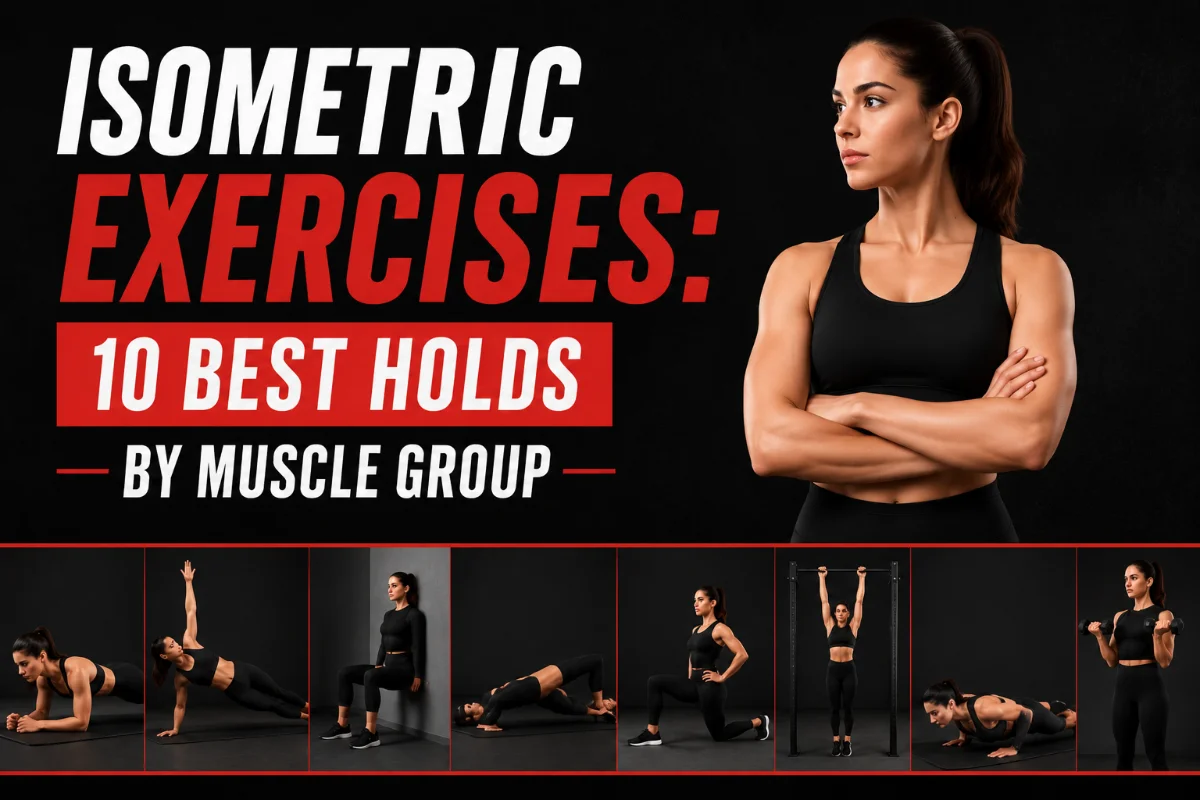
Quick Answer: Isometric exercises are static holds where your muscles produce force without changing length, the opposite of isotonic movements like squats or curls. Planks, wall sits, and glute bridges are common examples. Hold for 10–60 seconds per set. Research shows isometrics build strength, improve joint stability, and lower resting blood pressure.
If you have ever held a plank, paused at the bottom of a squat, or pressed your palms together as hard as you could, you have done an isometric exercise. Your muscles were working, but nothing moved. No reps, no range of motion, just tension in a fixed position.
This guide covers what isometric exercises are, why they work, who benefits most from them, 10 of the best ones organized by muscle group, and how to fit them into a program you are already running.
- What Are Isometric Exercises?
- 10 Best Isometric Exercises by Muscle Group
- How Long to Hold and How Many Sets?
- Why Isometric Exercises Work?
- Who Should Do Isometric Exercises?
- Isometric vs Isotonic Exercises
- How to Add Isometrics to Your Existing Program
- When Isometric Exercises Are the Wrong Choice
- How to Make Isometric Exercises Harder Over Time
- FAQ's
What Are Isometric Exercises?
An isometric exercise is a static hold where a muscle produces force without changing length and without any visible joint movement. Unlike concentric contractions, where muscles shorten to lift a weight, or eccentric contractions, where muscles lengthen under load, an isometric contraction keeps everything still. The muscle fires, but the joint stays locked in one position.
The simplest test: is the joint moving? If the muscle is working but the joint angle stays fixed, the contraction is isometric. Holding a plank is isometric. Doing a push-up is not — the push-up includes concentric (pressing up) and eccentric (lowering down) phases, with a brief isometric moment at the top and bottom.
Here is how all three contraction types compare:
| Isometric | Concentric | Eccentric | |
|---|---|---|---|
| What happens | Muscle contracts at a fixed length | Muscle shortens under load | Muscle lengthens under load |
| Joint movement | None | Yes — joint angle decreases | Yes — joint angle increases |
| Example | Holding a wall sit | Standing up from a squat | Lowering into a squat |
| Best for | Stability, rehab, tendon health, blood pressure | Strength, power, hypertrophy | Muscle growth, eccentric strength |
Two types of isometric contractions exist. Yielding isometrics involve holding a position against gravity or an external load — wall sits, plank holds, dead hangs. These are the most common and make up the exercises below. Overcoming isometrics involve pushing or pulling against an immovable object with maximum effort, pressing into a door frame, pulling a barbell pinned by safety catches, or pushing your palms together in front of your chest. Overcoming isometrics build peak force at a specific joint angle and are less common in general fitness programs.
Real-life isometrics happen more often than most people realize. Holding a heavy grocery bag at your side, carrying a child on your hip, bracing your core to stay upright on a moving train — all isometric. With the concept clear, here are 10 holds you can start using today.
10 Best Isometric Exercises by Muscle Group
These 10 exercises cover your core, lower body, and upper body. Each one lists the muscles it targets, how to do it, how long to hold, and one way to make it harder when the base version gets easy.
One rule for all holds: breathe. The most common mistake during isometric exercises is holding your breath. This spikes blood pressure and causes dizziness. Breathe steadily through every hold. Inhale through the nose, exhale through the mouth, never stop breathing.
Core
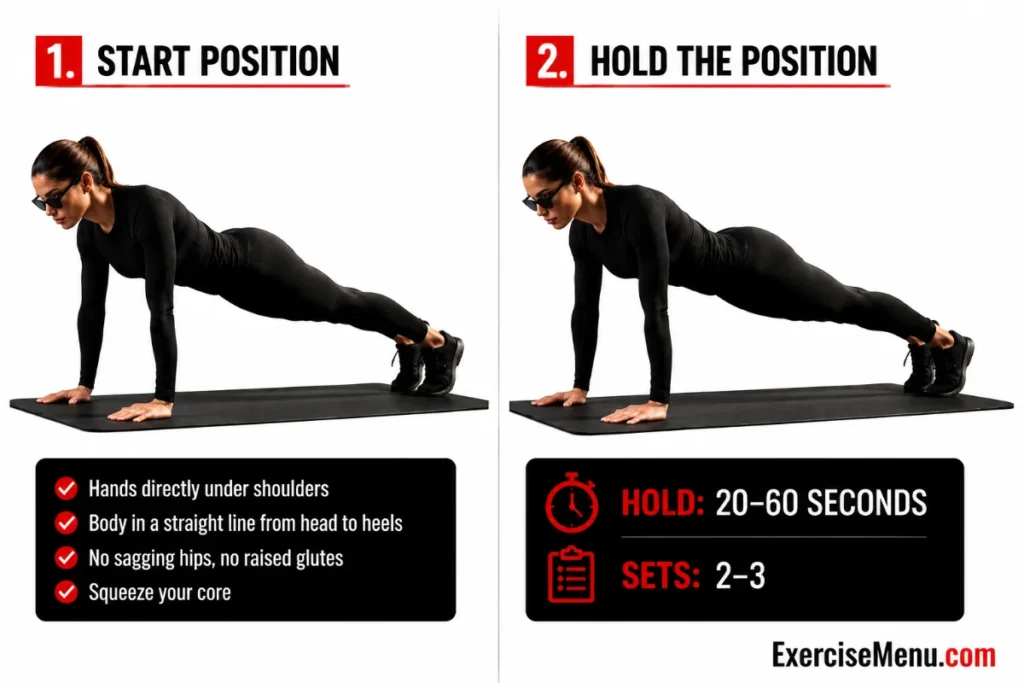
1. High Plank
Targets: core, shoulders, glutes
Start in a push-up position with hands directly under shoulders. Keep your body in a straight line from head to heels. No sagging hips, no raised glutes. Squeeze your core and hold.
Hold: 20–60 seconds | Sets: 2–3
Progression: lift one foot off the floor to add an anti-rotation challenge.
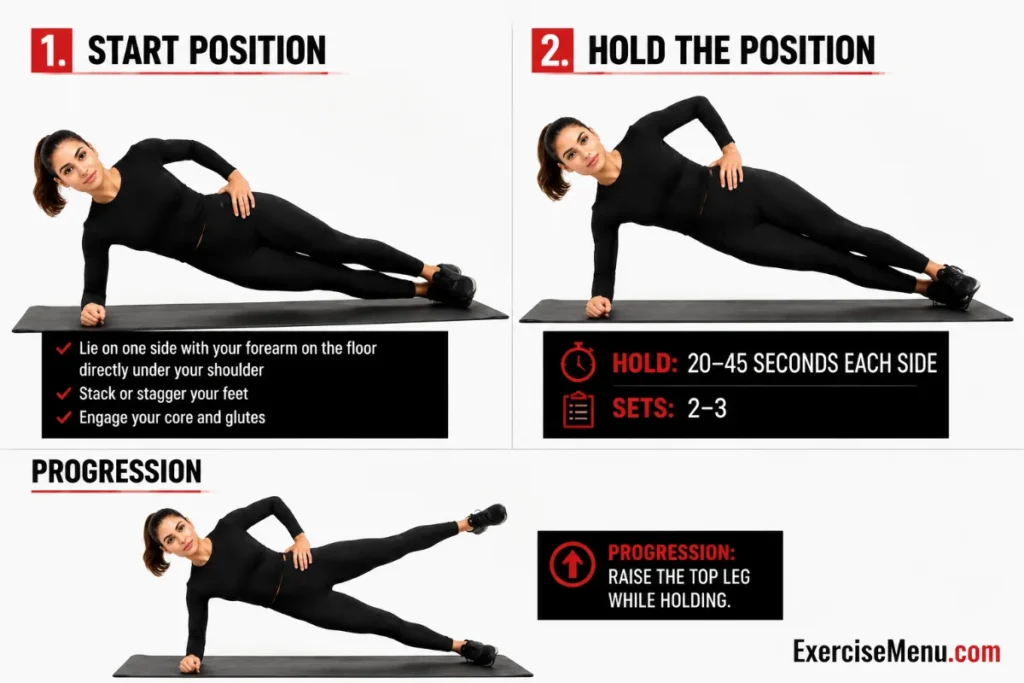
2. Side Plank
Targets: obliques, hip stabilizers, shoulders
Lie on one side with your forearm on the floor directly under your shoulder. Stack or stagger your feet. Lift your hips until your body forms a straight diagonal line. Hold without letting your hips drop.
Hold: 20–45 seconds each side | Sets: 2–3
Progression: raise the top leg while holding.
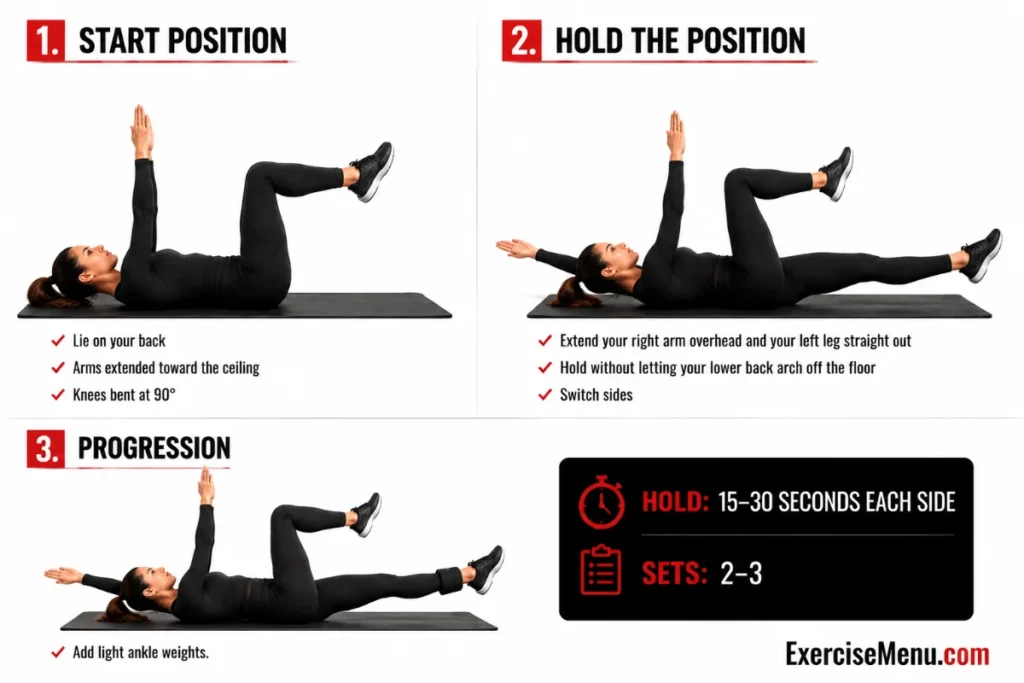
3. Dead Bug Hold
Targets: deep core (transverse abdominis), hip flexors
Lie on your back with arms extended toward the ceiling and knees bent at 90°. Press your lower back flat into the floor. Extend your right arm overhead and your left leg straight out, then hold without letting your lower back arch off the floor. Switch sides.
Hold: 15–30 seconds each side | Sets: 2–3
Progression: add light ankle weights.
Lower Body
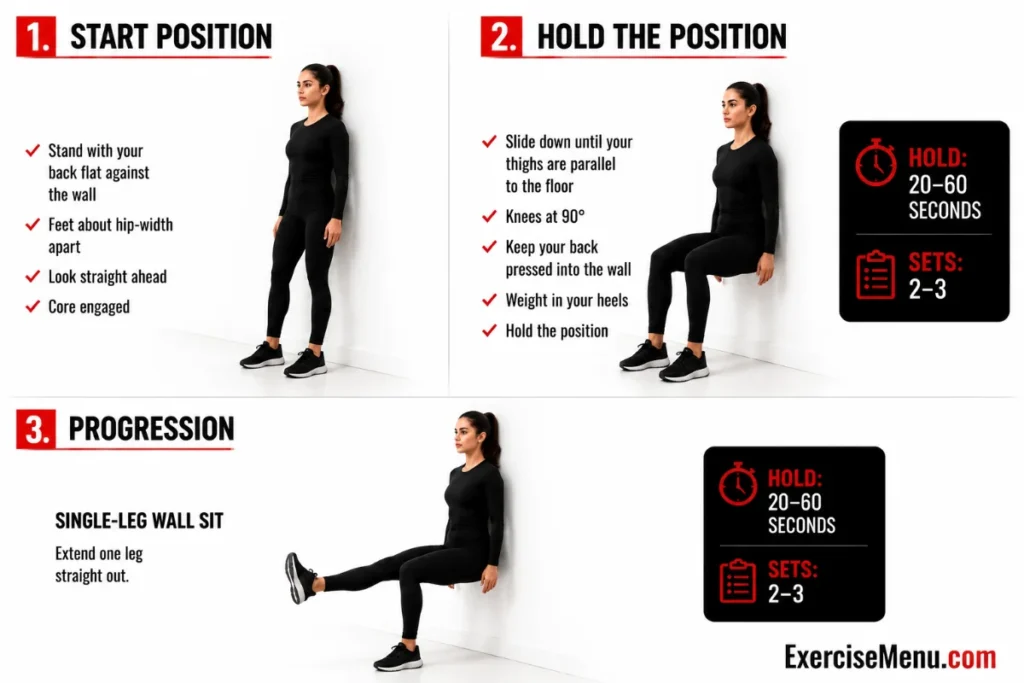
4. Wall Sit
Targets: quads, glutes, hamstrings
Stand with your back flat against a wall. Slide down until your thighs are parallel to the floor and your knees are at 90°. Keep your back pressed into the wall, weight in your heels, and hold.
Hold: 20–60 seconds | Sets: 2–3
Progression: single-leg wall sit (extend one leg straight out).
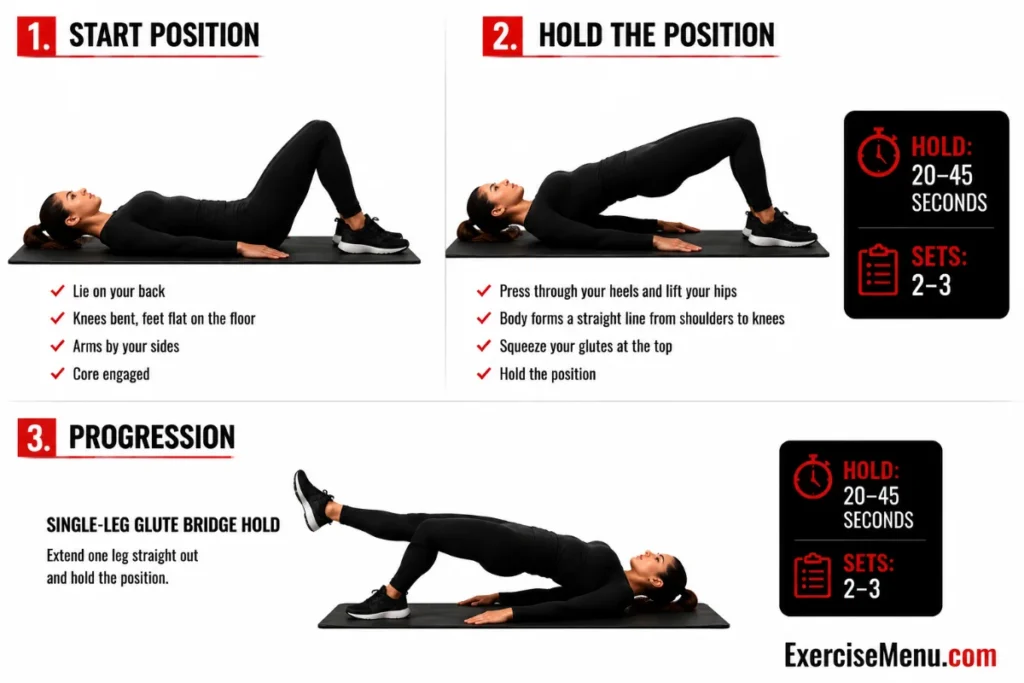
5. Glute Bridge Hold
Targets: glutes, hamstrings, lower back
Lie on your back with knees bent and feet flat on the floor. Press through your heels and lift your hips until your body forms a straight line from shoulders to knees. Squeeze your glutes at the top and hold.
Hold: 20–45 seconds | Sets: 2–3
Progression: single-leg glute bridge hold.
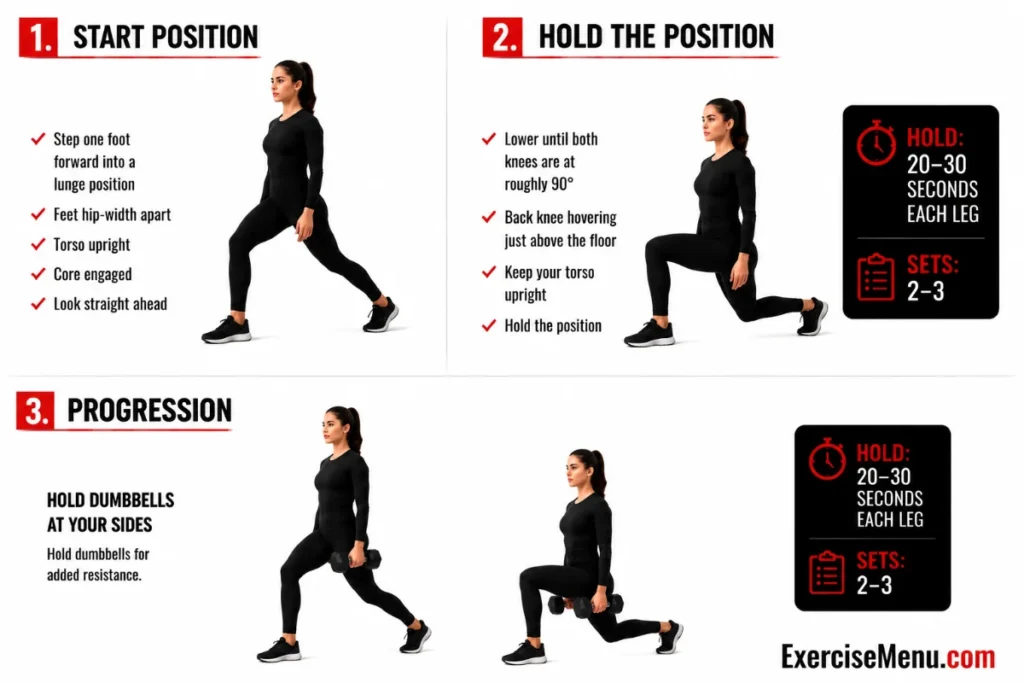
6. Split Squat Hold
Targets: quads, glutes, hip stability
Step one foot forward into a lunge position. Lower until both knees are at roughly 90°, back knee hovering just above the floor. Keep your torso upright and hold.
Hold: 20–30 seconds each leg | Sets: 2–3
Progression: hold dumbbells at your sides.
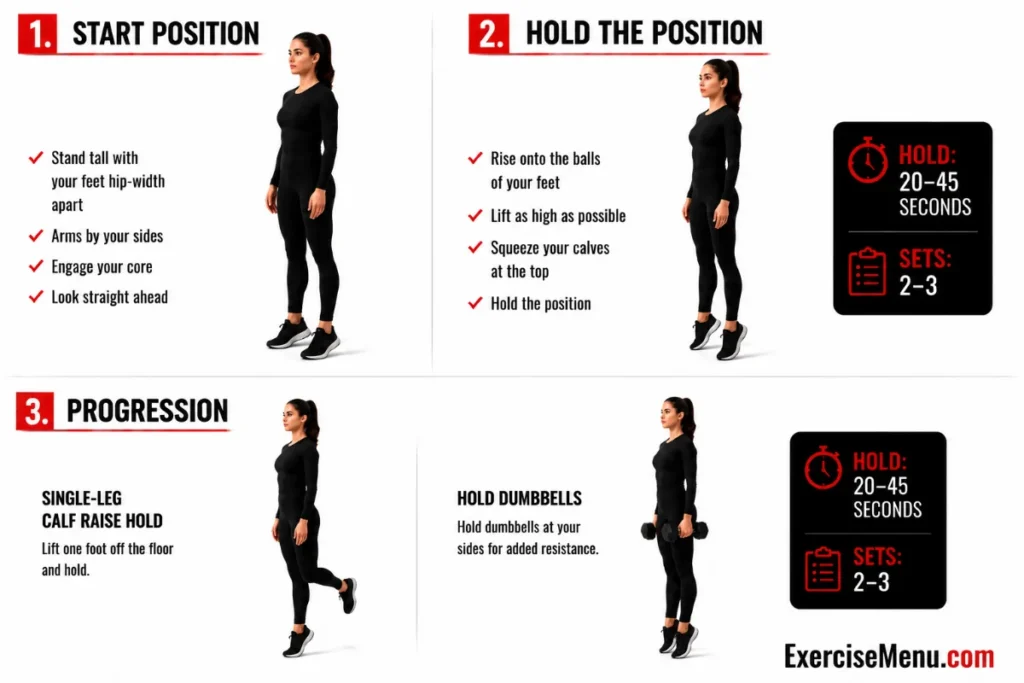
7. Calf Raise Hold
Targets: calves (gastrocnemius, soleus)
Stand with feet hip-width apart. Rise onto the balls of your feet as high as possible. Hold at the top.
Hold: 20–45 seconds | Sets: 2–3
Progression: single-leg calf raise hold or hold dumbbells.
Upper Body
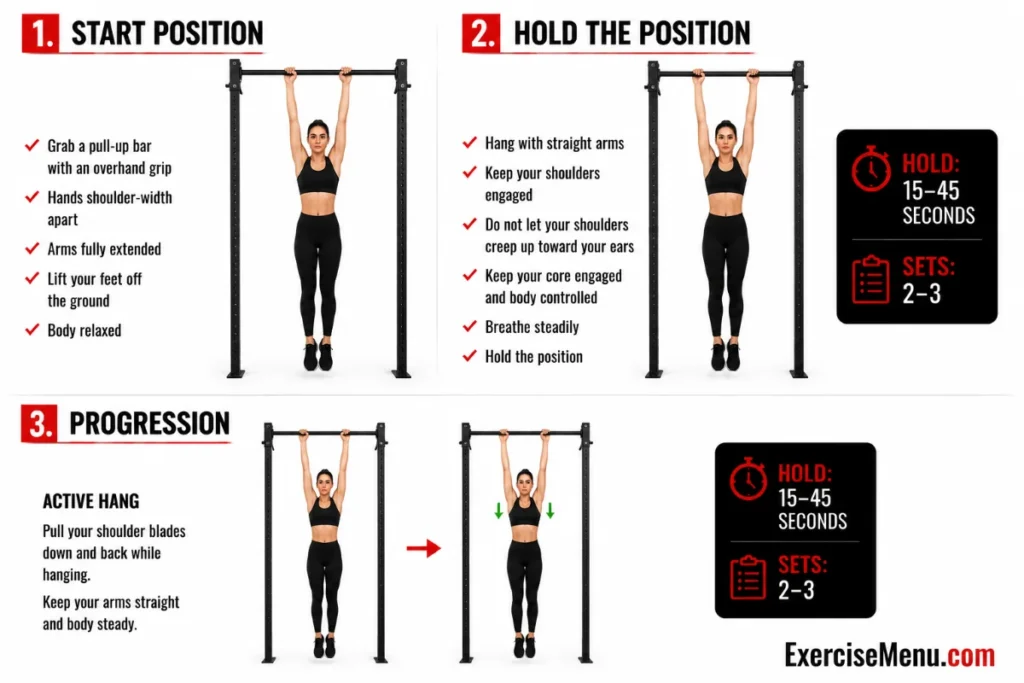
8. Dead Hang
Targets: grip, forearms, shoulders, lats
Grab a pull-up bar with an overhand grip, hands shoulder-width apart. Lift your feet off the ground and hang with straight arms. Keep your shoulders engaged and do not let them creep up toward your ears.
Hold: 15–45 seconds | Sets: 2–3
Progression: active hang (pull shoulder blades down and back while hanging).
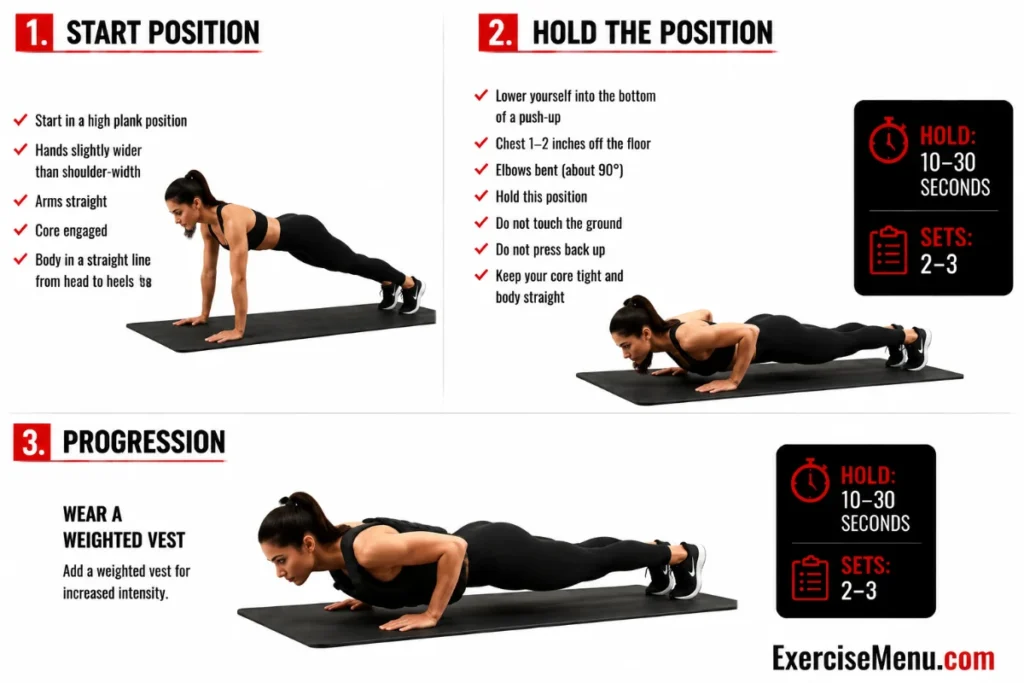
9. Push-Up Hold (Bottom Position)
Targets: chest, shoulders, triceps
Lower yourself into the bottom of a push-up with your chest 1–2 inches off the floor and elbows bent. Hold this position without touching the ground or pressing back up.
Hold: 10–30 seconds | Sets: 2–3
Progression: wear a weighted vest.
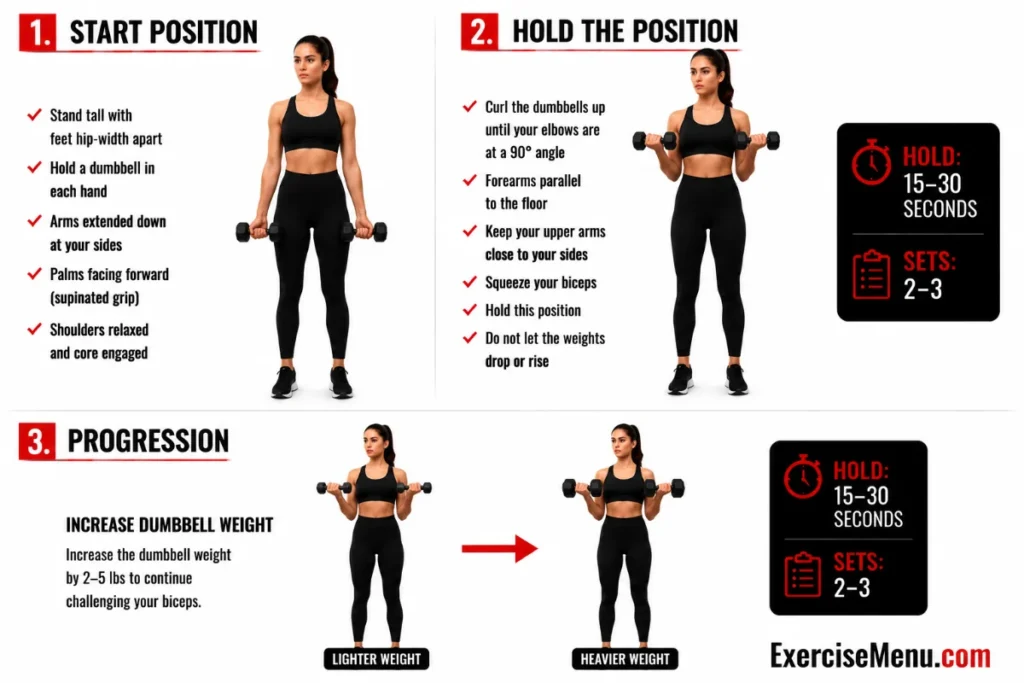
10. Isometric Bicep Curl Hold
Targets: biceps
Hold a dumbbell in each hand. Curl the weights to a 90° elbow angle so your forearms are parallel to the floor. Hold this position without letting the weights drop or rise.
Hold: 15–30 seconds | Sets: 2–3
Progression: increase dumbbell weight by 2–5 lbs.
How Long to Hold and How Many Sets?
Programming isometrics differs from dynamic exercises because hold time replaces rep count. Your reps and sets approach changes when the muscle never moves through a range of motion.
| Goal | Hold Time | Sets | Rest | Frequency |
|---|---|---|---|---|
| Beginners / endurance | 15–30 sec | 2–3 | 30–45 sec | Daily |
| Strength | 10–20 sec at max effort | 3–5 | 60–90 sec | 3x/week |
| Rehab / tendon loading | 30–45 sec at moderate effort | 3–4 | 60 sec | Daily |
| Blood pressure (Edwards protocol) | 4 × 2-min wall sits | 4 | 2 min between | 3x/week |
The blood pressure protocol comes from the Edwards et al. 2023 meta-analysis — the largest study of its kind, covering 270 randomized controlled trials with 15,827 participants. The American Heart Association also recognizes isometric exercise as a viable non-drug approach for hypertension management, making wall sits one of the few exercises with institutional backing for blood pressure reduction.
Now that you know the exercises and how to program them, it helps to understand why these static holds produce results, and where the evidence is strongest.
Why Isometric Exercises Work?
Isometric exercises build strength by forcing muscles to produce sustained force at a fixed position. They strengthen tendons and joints with minimal impact, require no equipment, and reduce resting blood pressure more than any other exercise modality tested in large-scale research.
Strength without movement. When full range of motion is painful, restricted, or unavailable, after surgery, during a flare-up, or in a small space with no equipment, isometric holds let you maintain and build strength around the affected joint without aggravating it.
Joint stability and tendon health. Isometric loading stresses connective tissue with low joint strain. Physical therapists prescribe isometric holds for patellar tendinopathy, knee osteoarthritis, and post-surgical recovery because the static contraction stimulates tendon adaptation without the impact of dynamic movement.
A 2019 systematic review by Oranchuk et al. in the International Journal of Sports Medicine confirmed that isometric training improves tendon stiffness and produces strength gains comparable to dynamic training in certain contexts.
A 2015 clinical trial by Rio et al. in the Clinical Journal of Sport Medicine found that isometric contractions reduced patellar tendon pain more than isotonic exercises during in-season athletic training, one reason physical therapists use isometric holds as a first step in tendinopathy rehab.
Blood pressure reduction. The Edwards et al. 2023 meta-analysis in the British Journal of Sports Medicine found that isometric exercise reduced resting systolic blood pressure by 8.24 mmHg and diastolic by 4.0 mmHg, more than aerobic exercise, HIIT, or dynamic resistance training. Wall sits ranked as the single most effective exercise subtype for systolic reduction.
Bone density and arthritis. Isometric loading can improve bone mineral density and reduce joint pain for people with arthritis, since the joint stays still during the contraction. No shearing forces, no impact, no repeated flexion — just sustained tension that strengthens the muscles supporting the joint.
Core activation. The core works isometrically in most real-life situations, resisting movement, not creating it. Bracing while carrying a load, stabilizing your spine during a squat, holding your posture on an uneven surface. Isometric core exercises like planks train this pattern directly, building strength through time under tension without relying on crunches or sit-ups.
Accessible to all fitness levels. No equipment, any space, scalable from 10-second beginner holds to loaded 60-second advanced variations. Isometrics work for a post-surgical patient and an experienced athlete in the same session. The only variable that changes is intensity.
That accessibility raises a practical question, who benefits most, and what specific problem does isometric training solve for each group?
Who Should Do Isometric Exercises?
Isometric training fits different people for different reasons. Knowing where you fall helps you use the exercises above more effectively.
Beginners building baseline strength. If push-ups, squats, or lunges feel too demanding, isometric holds teach your muscles to produce force in stable positions first. A wall sit builds quad strength before you need to control a full squat through its range of motion.
Rehab patients. Post-surgical recovery (ACL reconstruction, rotator cuff repair) and tendon issues (patellar tendinopathy, Achilles irritation) respond well to isometric loading because the joint stays still while the surrounding muscles strengthen.
People with arthritis or osteoporosis. Low-impact isometric holds build strength and bone density around affected joints without the flexion, extension, or impact that triggers pain.
Desk workers and travelers. No equipment, no gym, no space required. A plank, wall sit, and glute bridge in a hotel room or home office takes under 10 minutes and maintains strength between full training sessions.
Experienced lifters hitting plateaus. If a squat stalls at parallel or a bench press sticks 3 inches off the chest, holding that exact position under load builds strength at the specific angle where progressive overload has stalled.
People managing high blood pressure. The Edwards wall sit protocol (4 × 2-minute holds, 3x/week) is the most effective isometric method tested for reducing resting blood pressure.
If you already train with dynamic movements, you might wonder how isometrics compare to the isotonic exercises that make up most training programs — and whether one type is better than the other.
Isometric vs Isotonic Exercises
Isotonic exercises move a joint through a range of motion under load — squats, curls, bench presses, pull-ups. The muscle shortens (concentric phase) and lengthens (eccentric phase) during each rep. Isometric exercises eliminate the movement and hold a fixed position instead.
| Factor | Isometric | Isotonic |
|---|---|---|
| Joint movement | None — fixed position | Full range of motion |
| Best for | Stability, rehab, tendon health, blood pressure | Hypertrophy, power, athletic performance |
| Equipment needed | None (bodyweight sufficient) | Usually required (barbells, dumbbells, machines) |
| Injury risk | Low — no impact, no momentum | Low to moderate — form-dependent |
| Strength transfer | Angle-specific (~20° carryover) | Full range of motion |
| Example | Wall sit (hold at 90°) | Barbell squat (full depth to lockout) |
Neither type replaces the other. Isotonic training builds strength across a full range of motion and drives more muscle growth. Isometric training fills gaps — joint stability, tendon conditioning, rehab, and blood pressure management, that isotonic movements do not address as directly. The strongest programs combine both.
Since most people reading this already follow a dynamic training program, the next question is where isometrics fit alongside what you are already doing.
How to Add Isometrics to Your Existing Program
Most people searching for isometric exercises already train with dynamic movements. The question is where isometrics fit alongside what you are already doing.
1. Paused reps. Add a 2–3 second hold at the hardest point of any lift. Bottom of a squat, bottom of a bench press, top of a pull-up. Every rep becomes partially isometric without changing your program structure.
2. Isometric finishers. After your last working set for a muscle group, do one 30–60 second hold to failure. Wall sit after squats. Plank after deadlifts. Dead hang after pull-ups. This adds targeted volume without adding reps or load.
3. Weak point holds. If a lift stalls at a specific point, hold that exact position with load for 15–20 seconds. Squat stalls at parallel? Hold at parallel. Bench press stalls 3 inches off your chest? Hold there. This builds strength at the exact angle where progressive overload has hit a wall.
4. Active recovery days. A low-intensity circuit keeps muscles active on rest days without creating fatigue that delays recovery.
5. Sample isometric-only circuit. If you want a standalone session, this 12-minute circuit covers the full body:
| Exercise | Hold Time | Rest |
|---|---|---|
| High plank | 30 sec | — |
| Wall sit | 30 sec | — |
| Glute bridge hold | 30 sec | — |
| Dead hang | 20 sec | — |
| Side plank (left) | 20 sec | — |
| Side plank (right) | 20 sec | 60 sec |
Complete 3 rounds. Rest 60 seconds between rounds. Total time: ~12 minutes.
This works as a warm-up before lifting, a standalone session on rest days, or a travel workout when no equipment is available.
When Isometric Exercises Are the Wrong Choice
Isometrics are a tool, not a complete training system. Knowing their limits prevents wasted effort.
Strength gains are angle-specific. Holding a squat at 90° makes you stronger at 90°, not at the bottom or the top. Research shows roughly 20% carryover to nearby joint angles, but full-range strength requires training multiple positions or using dynamic exercises.
No power or speed development. Isometrics have no velocity component. Sprinting, jumping, and throwing depend on concentric force at high speed. Isometric holds do not train this quality.
Limited hypertrophy. Isometrics can stimulate some muscle growth, but dynamic training with full eccentric and concentric phases produces greater hypertrophy when volume is matched. A 2017 meta-analysis by Schoenfeld et al. in the Journal of Strength and Conditioning Research confirmed that concentric and eccentric contractions drive more muscle growth than isometric contractions at equivalent training volumes.
For a full breakdown of how eccentric and concentric contractions differ in force production, hypertrophy pathways, and when to emphasize each, the contraction types guide covers both. Treat isometrics as a supplement to your lifting, not a substitute.
Temporary blood pressure spike during holds. While long-term isometric training lowers resting blood pressure, individual holds temporarily raise it during the contraction. Anyone with uncontrolled hypertension should get medical clearance before starting isometric training.
These limitations do not reduce the value of isometric exercises — they define where isometrics fit. Used alongside dynamic training, they fill specific gaps that reps and sets alone cannot address.
How to Make Isometric Exercises Harder Over Time
Three progression levers, applied one at a time:
1. Increase hold time. 15 seconds → 30 → 45 → 60. The simplest method and the right starting point for beginners.
2. Add external load. Hold dumbbells during a wall sit. Wear a weighted vest for planks. Use a heavier weight for isometric curl holds. Adding load keeps the hold time in the 15–30 second range while increasing the strength stimulus.
3. Change the stance or angle. Two legs → one leg. Wider stance → narrower. Higher position → deeper (shallower wall sit → thighs parallel). Each change increases difficulty without adding equipment.
Once you can hold a position for 60 seconds with clean form, the hold is building endurance, not strength. Move to one of the three progressions above to keep the stimulus productive.
FAQ’s
Is yoga considered isometric training?
Many yoga poses include isometric holds, but yoga combines flexibility, breathing, and flow. It has a strong isometric component without being purely isometric training.
Are isometric exercises safe during pregnancy?
Some are, with modifications. Avoid prolonged holds that spike blood pressure or compress the abdomen. Glute bridges, modified side planks, and short wall sits are generally safe, so check with your doctor first.
Why do muscles shake during isometric holds?
Motor units fatigue and your nervous system rapidly cycles between different fibers to maintain the contraction. It signals effort, not injury. The shaking decreases as isometric endurance improves.
Do isometric exercises burn calories?
Less per session than dynamic exercises because less muscle mass moves through range of motion. They support fat loss indirectly by preserving muscle during a deficit, but are not an efficient primary calorie-burning tool.
Can I do isometric exercises every day?
Low-to-moderate effort isometrics (planks, wall sits at submaximal effort) can be done daily. High-effort holds at max contraction or with heavy load should follow a 3x/week schedule with rest days between to allow tendon and muscle recovery.
How do isometric exercises help with knee pain?
Isometric quad contractions (like wall sits at a comfortable angle) load the patellar tendon without the shearing forces of full-range knee bends. This reduces pain during the hold and builds tendon tolerance over weeks, which is why physical therapists use them as a first step in patellar tendinopathy rehab.
Can isometric exercises build muscle mass?
To a limited degree. Isometric holds can stimulate some hypertrophy, but concentric and eccentric contractions through a full range of motion produce greater muscle growth at matched training volumes. Use isometrics for strength, stability, and tendon health — and pair them with dynamic lifting for muscle size.
Are isometric exercises good for arthritis?
Isometric holds strengthen the muscles surrounding affected joints without requiring the joint to move through a range of motion. This reduces pain during exercise and builds the muscular support that protects arthritic joints during daily activities. Wall sits, glute bridges, and gentle isometric quad contractions are common starting points for people with knee or hip arthritis , consult a physical therapist for personalized guidance.
FITNESS DISCLAIMER
Isometric holds temporarily raise blood pressure during the contraction. If you have uncontrolled hypertension, cardiovascular issues, or are pregnant, consult your doctor before adding isometric exercises to your program.
