

Table of Contents
- Key Takeaways
- What Is the Difference Between Fast Twitch and Slow Twitch Muscle Fibers?
- The 3 Muscle Fiber Types Explained
- How to Find Your Dominant Fiber Type — No Biopsy Needed
- How to Train Fast Twitch Muscle Fibers?
- How to Train Slow Twitch Muscle Fibers
- Which Muscles Are Fast or Slow Twitch in Your Body?
- Do Fast Twitch Muscles Grow Bigger Than Slow Twitch?
- Does Cardio Kill Fast Twitch Muscles?
- Can You Change Your Muscle Fiber Type?
- How Aging Affects Your Muscle Fiber Types
- Frequently asked questions
- Conclusion
Key Takeaways
- Your muscles contain two main fiber types — slow twitch (Type I) and fast twitch (Type II) — and your ratio of each is largely genetic.
- Fast twitch fibers produce more force but fatigue fast. Slow twitch fibers produce less force but sustain effort longer.
- Different muscles in your body have different fiber ratios — training them all the same way produces uneven results.
- You can test your dominant fiber type at home using the 80% 1RM rep test — no biopsy needed.
- You cannot fully convert slow twitch to fast twitch — but you can train both effectively once you know what you have.
What Is the Difference Between Fast Twitch and Slow Twitch Muscle Fibers?
Your muscles are made of individual fibers. Not all fibers work the same way. Some contract quickly and produce a lot of force — those are fast twitch. Others contract slowly but sustain effort much longer — those are slow twitch.
Every muscle contains a mix of both. The proportion you have of each type is largely genetic and directly influences how your body responds to training, how quickly you fatigue, and which rep ranges produce the best results for you.
| Slow Twitch (Type I) | Fast Twitch (Type IIa) | Fast Twitch (Type IIx) | |
|---|---|---|---|
| Contraction speed | Slow | Fast | Very fast |
| Force production | Low | High | Very high |
| Fatigue resistance | Very high | Moderate | Very low |
| Primary fuel | Oxygen (aerobic) | Mixed | Glycogen (anaerobic) |
| Mitochondria density | High | Medium | Low |
| Best rep range | 15-30+ | 8-15 | 1-6 |
| Growth potential | Moderate | High | High |
| Best for | Endurance | Muscle building | Power and strength |
The 3 Muscle Fiber Types Explained
Type I — Slow Twitch
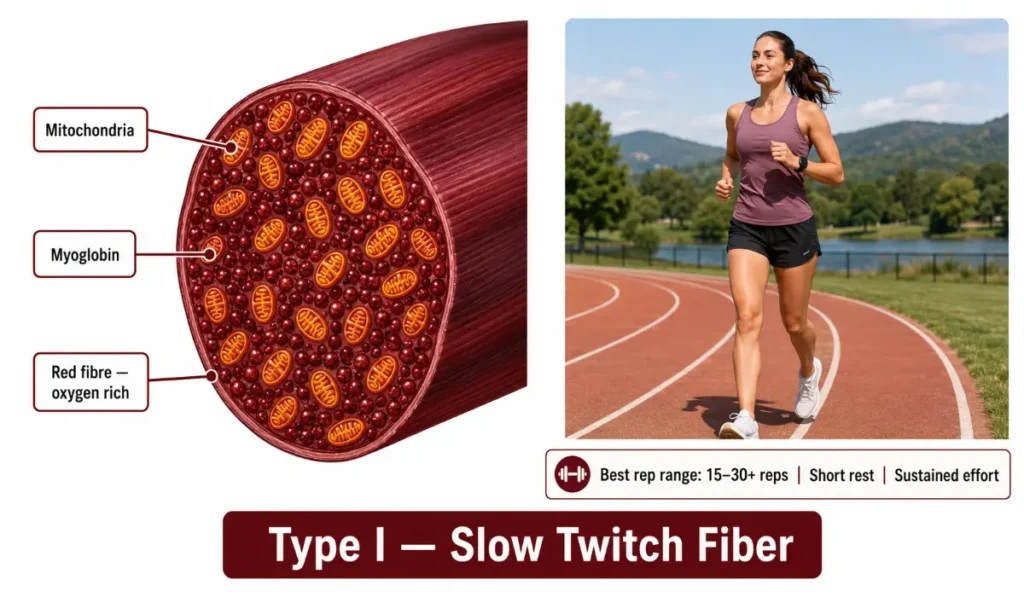
Slow twitch fibers run on oxygen. They are rich in mitochondria and myoglobin — the protein that gives them their red colour and allows them to store and use oxygen efficiently. This makes them extremely fatigue-resistant.
They are recruited first in any movement and dominate during sustained, low-intensity activities — walking, jogging, cycling, posture maintenance. Your soleus muscle, which keeps you upright all day, is roughly 80% slow twitch in most people.
Training them: Higher reps (15-30+), shorter rest, longer time under tension. Slow twitch fibers respond to volume and sustained effort — not maximal loading.
Type 2a — Hybrid Fast Twitch
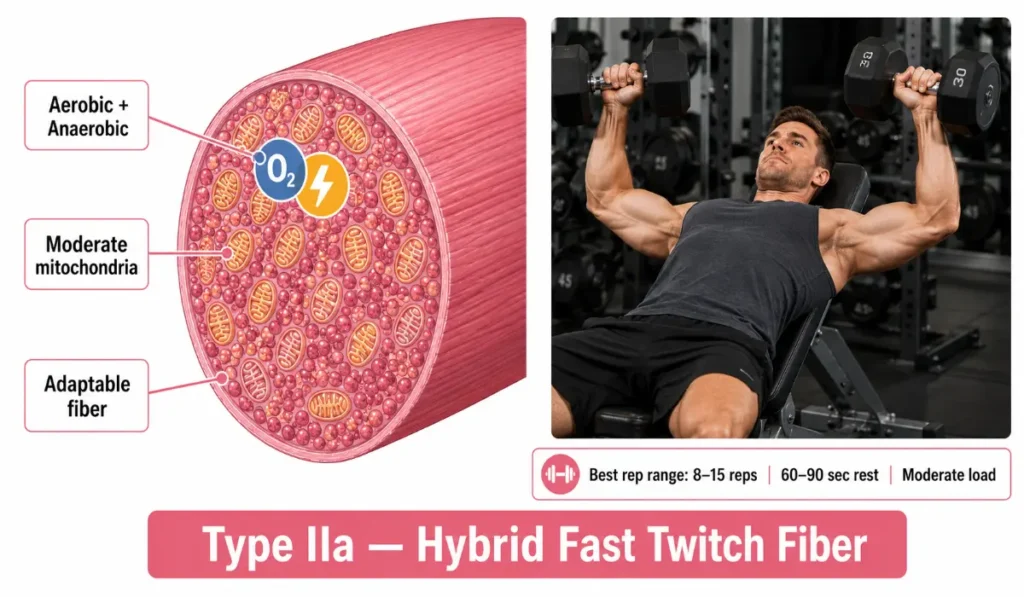
Type IIa fibers use both aerobic and anaerobic pathways, making them the most adaptable fiber type. They produce significantly more force than slow twitch fibers but can sustain effort longer than pure fast twitch.
These fibers dominate the 8-15 rep range under meaningful load. They have high growth potential and are the primary target of most hypertrophy training. When you are doing sets of 10 with challenging weight, you are primarily working Type IIa fibers.
Training them: Moderate load, 8-15 reps, 60-90 seconds rest. This is the most productive range for muscle building in most people.
Type 3 — Pure Fast Twitch
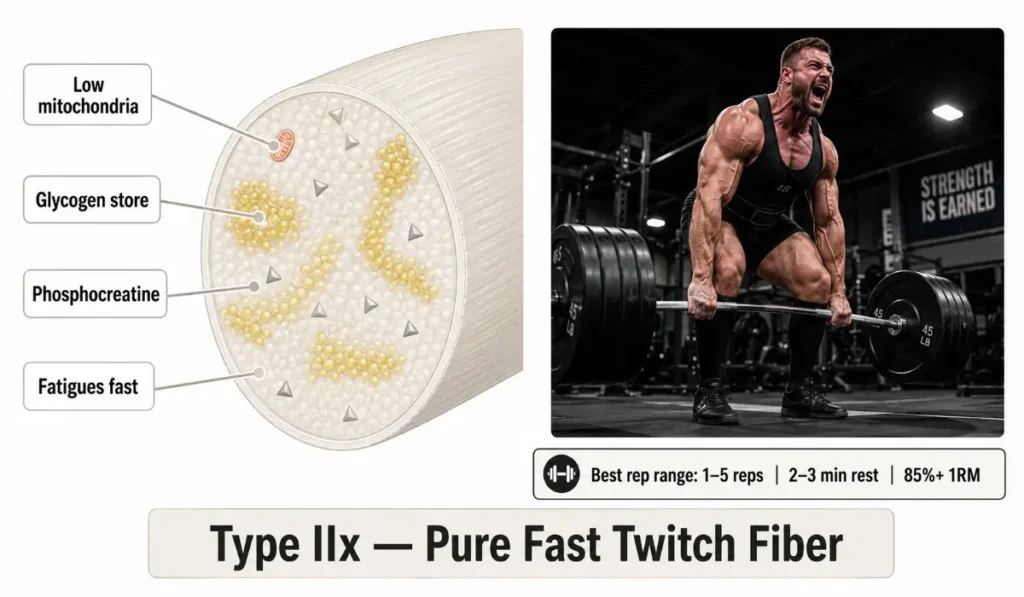
Type IIx fibers generate maximum force in minimum time. They rely entirely on anaerobic metabolism — burning through phosphocreatine and glycogen rapidly — which is why they fatigue within seconds.
These fibers are recruited when the load is heavy enough or the movement explosive enough that Type I and IIa fibers alone cannot handle the demand.
Training them: Heavy loads (85%+ 1RM) or explosive movements at low reps (1-5). Full recovery between sets — 2-3 minutes minimum.
How to Find Your Dominant Fiber Type — No Biopsy Needed
The only 100% accurate method is a muscle biopsy. That is not practical. The best gym-based alternative is the 80% 1RM rep test — supported by research published in PMC confirming that people with a higher proportion of slow twitch fibers consistently complete more reps at 80% 1RM.
How to run it:
- Pick a compound lift targeting the muscle you want to test — squat for quads, bench for chest/triceps, Romanian deadlift for hamstrings.
- Establish your 1RM — the maximum weight you can lift for one clean rep.
- Load the bar to 80% of that number.
- Perform as many clean reps as possible to technical failure.
- Count your reps:
| Reps at 80% 1RM | What it means | Best rep range for you |
|---|---|---|
| Fewer than 7 | Fast twitch dominant | 3-8 reps, heavy loads |
| 8-12 | Mixed fiber type | Alternate 6-10 and 12-15 rep blocks |
| 13 or more | Slow twitch dominant | 12-25 reps, moderate load |
Important: Test each muscle separately. Your quad result will not tell you about your chest. Fiber type distribution varies across your body — you can be fast twitch dominant in your upper body and slow twitch dominant in your legs.
How to Train Fast Twitch Muscle Fibers?
Fast twitch fibers need heavy loads or explosive movement to be recruited. Moderate weight and controlled tempo will not activate them effectively.
Best exercises:
- Barbell squat, deadlift, bench press at heavy loads
- Box jumps, broad jumps, depth jumps
- Medicine ball slams and throws
- Sprint intervals
- Olympic lifts — power clean, clean and press
- Kettlebell swings
| Goal | Sets | Reps | Load | Rest |
|---|---|---|---|---|
| Maximum power | 4-5 | 1-5 | 85-95% 1RM | 3-5 minutes |
| Strength + fast twitch hypertrophy | 4-5 | 3-8 | 75-85% 1RM | 2-3 minutes |
| Explosive conditioning | 3-4 | 5-8 | Light, max speed | 2 minutes |
The rule with fast twitch training: if the bar is not moving fast, the stimulus is wrong. Fast twitch fibers are recruited through intent to move explosively — even when the load is heavy and bar speed is slow, you must be trying to accelerate it. That intent is what drives fast twitch recruitment.
How to Train Slow Twitch Muscle Fibers
Slow twitch fibers respond to volume, sustained tension, and metabolic stress — not maximal loading. Going heavier does not make this training more effective. Getting more reps under control does.
Best exercises:
- Distance running, cycling, rowing
- High-rep resistance training with controlled tempo
- Isometric holds — wall sit, plank, static lunge hold
- Slow tempo goblet squats, banded hip hinges
- Single-leg balance work
- Eccentric-focused movements with a slow lowering phase
| Goal | Sets | Reps | Load | Rest |
|---|---|---|---|---|
| Endurance | 2-3 | 20-30+ | Below 70% 1RM | 30-45 seconds |
| Slow twitch hypertrophy | 3-4 | 15-25 | 60-70% 1RM | 45-60 seconds |
| Metabolic conditioning | 3 | Timed 45-60 sec | Light-moderate | 30 seconds |
Time under tension matters here more than rep count. A set of 15 reps done in 12 seconds is not the same stimulus as 15 reps done over 30 seconds. Slow the eccentric phase to 3-4 seconds per rep. That extended tension is exactly what slow twitch fibers respond to.
Which Muscles Are Fast or Slow Twitch in Your Body?
| Muscle | Approximate fiber type | Practical implication |
|---|---|---|
| Soleus (deep calf) | ~80% slow twitch | High reps, time under tension |
| Gastrocnemius (outer calf) | ~50-55% fast twitch | Mix of rep ranges |
| Quadriceps (vastus lateralis) | ~50/50 average — wide individual range | Test individually |
| Hamstrings | ~50-65% fast twitch | Responds well to heavier loading |
| Glutes | ~50/50 | Responds across wide rep range |
| Deltoids | ~60-65% slow twitch | High frequency, moderate reps |
| Pectorals | ~60% fast twitch | Heavier pressing produces better results |
| Latissimus dorsi | ~55% slow twitch | Volume-based pulling |
| Biceps | ~50/50 | Mixed approach works |
| Triceps | ~60-67% fast twitch | Lower reps, heavier loading |
These are population averages. Your individual distribution can differ — especially in quads, hamstrings, and glutes. The 80% test gives you your personal number.
The reason this matters: clients doing 4×20 on tricep pushdowns and wondering why their arms are not growing are fighting their fiber type. Triceps lean fast twitch. They respond to heavier pressing work — weighted dips, close-grip bench, skull crushers in the 6-10 range. Switch the approach and the muscle responds.
Do Fast Twitch Muscles Grow Bigger Than Slow Twitch?
Yes — fast twitch fibers have a larger cross-sectional area and higher growth ceiling. They produce more force and respond more dramatically to resistance training in terms of size.
That does not mean slow twitch fibers do not grow. They do — but they need higher volume and longer time under tension to hypertrophy, while fast twitch fibers respond to heavier loads at lower reps.
Research by Schoenfeld et al. confirms that a wide rep range — roughly 6 to 35 reps — can produce comparable hypertrophy when sets are taken close to failure. What matters most is effort and proximity to failure — not the specific rep number.
If maximum muscle size is your goal, train across multiple rep ranges. Heavy sets of 4-8 target fast twitch. Sets of 12-20 target slow twitch and Type IIa. Both contribute to total muscle development.
Does Cardio Kill Fast Twitch Muscles?
This is one of the most common questions — and the answer is more nuanced than the gym myth suggests.
Excessive endurance training without resistance training can shift Type IIa fibers toward more slow twitch behavior over time. If you are running high mileage weekly and doing no heavy lifting, your body will adapt by making fibers more oxidative. Some fast twitch capacity will reduce.
Moderate cardio alongside resistance training does not kill fast twitch fibers. It improves your cardiovascular system without compromising fiber distribution in any meaningful way.
The practical rule: if maintaining or building fast twitch capacity matters to you, keep heavy resistance training as the priority. Two to three sessions per week of heavy compound lifting protects your fast twitch fibers regardless of how much cardio you do alongside it.
Can You Change Your Muscle Fiber Type?
Partially — and this is important to understand correctly.
What training can change: The most reliable shift is from Type IIx to Type IIa. Both resistance training and endurance training push pure fast twitch fibers toward hybrid characteristics within weeks of consistent training. This is normal and happens in almost everyone who trains regularly.
What training cannot change: True conversion between slow twitch (Type I) and fast twitch (Type II) fibers is not well supported in humans. According to a 2021 review published in PMC on fiber type transitions, current evidence does not confirm significant Type I to Type II conversion through normal training. Your genetic baseline is largely fixed.
Two genes directly shape your fiber type distribution:
ACTN3 — codes for alpha-actinin-3, a structural protein found almost exclusively in fast twitch fibers. According to MedlinePlus Genetics, people with two copies of the X variant produce none of this protein and tend toward higher slow twitch proportion. This variant appears more frequently in elite endurance athletes.
ACE — influences skeletal muscle function alongside blood pressure regulation. The D allele is associated with greater fast twitch proportion and power output. The I allele is associated with better aerobic endurance capacity.
These genes set your starting point. They do not determine your ceiling.
How Aging Affects Your Muscle Fiber Types
Fast twitch fibers — particularly Type IIx — decline faster with age than slow twitch fibers. For most people, muscle mass peaks around age 30 then declines at roughly 3-8% per decade — a condition called sarcopenia. Fast twitch fibers lead that decline. The neural connections to these fibers also degenerate, which is why explosive power decreases faster than endurance capacity as people age.
Fast twitch fibers are the ones that help you react quickly — catching yourself before a fall, generating force in a moment of sudden demand. Losing them is not just an aesthetic concern — it is a functional one.
What to do: Keep heavy, explosive resistance training in your programme after 40. Two sessions per week of heavy compound lifting above 70% of your 1RM is enough to slow the decline significantly. You do not need to train like an athlete — but you do need to regularly challenge these fibers to maintain the neural connections that keep them active.
This matters even more for women after menopause, when estrogen decline accelerates both muscle and bone loss beyond what aging alone causes. Our guide on why aging women need high-intensity exercise breaks down the research and a structured plan to start.
Frequently asked questions
What is the difference between fast twitch and slow twitch muscle fibers?
Fast twitch fibers contract quickly and produce high force but fatigue rapidly. Slow twitch fibers contract slowly, produce lower force, and are highly resistant to fatigue. Fast twitch fibers rely on anaerobic energy — glycogen and phosphocreatine. Slow twitch fibers run on oxygen through aerobic metabolism. Every muscle contains both — the ratio varies by muscle and by individual.
How do I know if I have more fast or slow twitch fibers?
Run the 80% 1RM rep test: load a compound lift to 80% of your one-rep max and perform as many clean reps as possible. Fewer than 7 reps suggests fast twitch dominance. 13 or more suggests slow twitch dominance. 8-12 indicates a mixed profile. Test each major muscle group separately as your distribution varies across your body.
Is it better to have more fast twitch or slow twitch fibers?
Neither is better — they serve different purposes. Fast twitch fibers produce more power and have a higher ceiling for muscle size. Slow twitch fibers enable sustained effort and recover faster between sets. The best training programmes develop both, regardless of your dominant type.
Do fast twitch muscles look bigger?
Fast twitch fibers have a larger cross-sectional area than slow twitch fibers, which means muscles with a high fast twitch proportion tend to look fuller and develop visible size more readily. This is part of why powerlifters and sprinters often carry significant muscle mass without training specifically for hypertrophy.
Can endurance training make you lose fast twitch muscles?
Excessive endurance training without resistance training can push Type IIa fibers toward slow twitch behavior over time. Moderate cardio alongside regular resistance training does not meaningfully reduce fast twitch capacity. Keep heavy lifting as a consistent part of your programme.
What percentage of fast twitch fibers do elite sprinters have?
Elite sprinters typically have 70-80% fast twitch fibers in their primary muscles — particularly the quadriceps and hamstrings. This is largely genetic. The average untrained person sits closer to a 50/50 split across most muscle groups.
Which muscles are mostly slow twitch?
The soleus is roughly 80% slow twitch in most people. The deltoids are approximately 60-65% slow twitch due to their role in constant stabilisation. The latissimus dorsi leans slightly slow twitch. These muscles respond better to higher rep ranges and more training volume.
Which muscles are mostly fast twitch?
The triceps are approximately 60-67% fast twitch, the pectorals around 60% fast twitch, and the hamstrings 50-65% fast twitch. These muscles respond better to heavier loading and lower rep ranges. Training triceps with endless high-rep pushdowns and neglecting heavy pressing is one of the most common reasons arm development stalls.
Can beginners ignore fiber type and just train normally?
Yes — in the first 6-12 months, almost any consistent progressive programme produces results regardless of fiber type. Neural adaptations dominate early progress. Fiber type becomes more relevant once you have built a training base and want to optimise your programme for your specific response pattern.
Does fiber type affect how many reps you should do?
Directly yes. A slow twitch dominant person builds more muscle doing 12-20 rep work. A fast twitch dominant person responds better to 3-8 rep ranges. Training across multiple rep ranges ensures you stimulate both fiber populations. For a full breakdown, see our reps and sets for muscle growth guide.
Conclusion
Your fiber type ratio influences how you respond to training — but it does not limit what you can achieve.
Fast twitch fibers need heavy loads or explosive movements. Slow twitch fibers need volume, sustained tension, and shorter rest. Most muscles need both, delivered across different rep ranges over time.
Run the 80% test on your main lifts. Find out where your muscles actually sit. Build your programme from that information — and stop wondering why generic rep range advice is not producing the results you expected.
To get your personalised rep ranges based on your training goal, use the Exercise Menu Rep Range Recommender.
