


- What Is Circuit Training?
- Circuit Training vs. Straight Sets
- Circuit Training vs. HIIT
- Types of Circuit Training
- Benefits of Circuit Training
- Who Is Circuit Training Good For?
- Circuit Training Limitations
- How to Build a Circuit Training Workout?
- How to Apply Progressive Overload?
- Sample Circuit Training Workouts
- Common Mistakes
- How Often Should You Do Circuit Training?
- Frequently Asked Questions
What Is Circuit Training?
Circuit training is a workout format where you move through a series of exercises back to back with minimal rest, targeting different muscle groups in each round.
You pick 6 to 10 exercises, perform them one after another with minimal rest between each, and once you’ve done all of them — that’s one circuit. Rest 60 to 90 seconds, then go again. Most sessions run 2 to 4 rounds.
What makes it work is the exercise rotation. Each station targets a different muscle group, so while your legs are working on squats, your upper body is recovering. That’s how your heart rate stays elevated without any single muscle group giving out halfway through.
A basic example:
- Squats
- Push-ups
- Dumbbell row
- Plank
- Jumping jacks
That’s one circuit. Three rounds of that is a complete workout. The format was developed in 1953 by R.E. Morgan and G.T. Anderson at the University of Leeds — their research showed it could build strength and cardiovascular endurance in the same session, which is why it’s been a staple in gyms and sport conditioning ever since.
Circuit Training vs. Straight Sets
Straight sets mean you do a set, rest 60 to 90 seconds, do another set of the same exercise, rest again. One exercise at a time, with full recovery between each set. You might spend 50 minutes working through four exercises.
Circuit training skips that rest. Instead of waiting between sets of the same exercise, you move straight to a different one. Your heart rate doesn’t drop, you cover more ground, and you’re done faster.
| Circuit Training | Straight Sets | |
|---|---|---|
| Rest between exercises | Minimal or none | 60–180 seconds |
| Heart rate | Stays elevated | Drops between sets |
| Session length | 20–40 minutes | 45–75 minutes |
| Strength gains | Moderate | Higher |
| Cardio benefit | High | Low |
| Best for | Conditioning, fat loss, endurance | Maximal strength, hypertrophy |
If your goal is a bigger squat or deadlift, straight sets with adequate rest will get you there faster. Circuit training is the better tool for conditioning, fat loss, and full-body work when you’re short on time.
For a clear breakdown of how reps and sets function across both formats, the reps and sets guide covers it in detail.
Circuit Training vs. HIIT
These get mixed up constantly — they’re not the same thing.
HIIT (High-Intensity Interval Training) works on intensity. You go all-out for a short burst — usually 80 to 90% of your maximum effort — rest, then repeat. It’s typically done on one cardio modality: a bike, treadmill, or rower.
Circuit training works on variety. You rotate through different exercises at moderate to high intensity. It’s not about hitting maximum effort on each station — it’s about keeping the body working across multiple muscle groups without stopping.
| Circuit Training | HIIT | |
|---|---|---|
| Intensity | Moderate to high | Very high (80–90% max) |
| Duration | 20–45 minutes | 15–25 minutes |
| Exercise variety | High | Usually one modality |
| Strength component | Yes | Minimal |
| Best for | Full-body conditioning | Cardio, fat burn, VO2max |
You can combine elements of both — adding a 30-second sprint interval between strength stations, for example — but the two are not interchangeable.
Types of Circuit Training
Timed Circuit
Work for a set time at each station — usually 30 to 60 seconds — then move on. Rest can match the work period or be shorter. Most common format, works at every fitness level.
Repetition Circuit
You do a fixed number of reps — usually 8 to 20 — before moving to the next exercise. Better for strength-focused circuits where you want to control the load and feel each rep.
AMRAP Circuit
As Many Reps as Possible. You work for a set time and do as many reps as you can, then try to beat that count in the next round or next session. Tracks progress well and keeps effort honest.
EMOM Circuit
Every Minute on the Minute. At the top of each minute, perform a set number of reps. Whatever time is left in that minute is your rest. Finish faster, rest more.
Competition Circuit
Like a timed circuit, but you’re tracking rep counts and trying to beat them each session. Simple way to measure week-to-week progress.
Strength Circuit
Heavier loads, slower movements — deadlifts, bench press, rows in sequence. Rest periods run 30 to 60 seconds between stations to allow partial recovery before the next compound movement.
Cardio Circuit
Light load or bodyweight, designed to keep heart rate high the whole way through. Jumping jacks, high knees, mountain climbers, burpees. No equipment needed.
Bodyweight Circuit
No equipment. Squats, push-ups, lunges, planks. Works at home, in a hotel room, anywhere.
Benefits of Circuit Training
Saves time. Strength and cardio in one session, 25 to 40 minutes. No separate lifting and cardio days needed.
Improves cardiovascular fitness. Minimal rest means your heart rate stays up the whole session. A 2021 meta-analysis found a 6.3% improvement in VO2max and 2.6% improvement in aerobic performance after consistent circuit training programs.
Builds strength and muscular endurance. The same research found upper body strength increased by 20% and lower body by 23% compared to no exercise.
Burns more calories. Circuit training burns 20 to 30% more calories than traditional resistance sessions of the same length, partly from the session itself and partly from elevated post-exercise oxygen consumption — your metabolism stays higher for hours after you finish.
Works anywhere. Bodyweight, dumbbells, kettlebells, resistance bands, or a full gym — the format adapts to whatever you have.
Who Is Circuit Training Good For?
Beginners — No complicated programming required. Pick exercises, set a timer, go. Bodyweight circuits are enough to produce real results in the first few weeks.
Busy people — 25 to 35 minutes covers a full-body session. No separate cardio day needed.
People trying to lose fat — Resistance and cardio combined in one session means more calories burned during the workout. Research shows circuit training can reduce body fat mass by around 4.3%, with meaningful weight reductions in people who are overweight.
Athletes — Almost every sport uses circuit training for general conditioning. Plyometrics, agility drills, and sport-specific movements can all be built into stations.
Seniors — Scales down easily. Bodyweight-only circuits at lower intensity have shown consistent improvements in muscular endurance and functional strength in older adults.
Circuit Training Limitations
It’s not the right tool for every goal.
Maximal strength. Heavy compound lifts need 2 to 3 minutes of rest between sets. In a circuit, accumulated fatigue caps how heavy you can go. If your goal is a bigger squat or deadlift, dedicated strength sessions will produce better results.
Maximal power. Explosive movements — Olympic lifts, sprint intervals, heavy plyometrics — need full recovery to produce maximum force. Running them back-to-back with minimal rest reduces their effectiveness and raises injury risk.
Advanced hypertrophy. Building significant muscle mass requires high volume per muscle group and adequate rest for each set. Circuits maintain and modestly build muscle but aren’t the primary tool for serious size goals.
Use circuit training as a conditioning method or alongside a strength program — not as a replacement for dedicated strength or hypertrophy training if those are your primary goals.
How to Build a Circuit Training Workout?
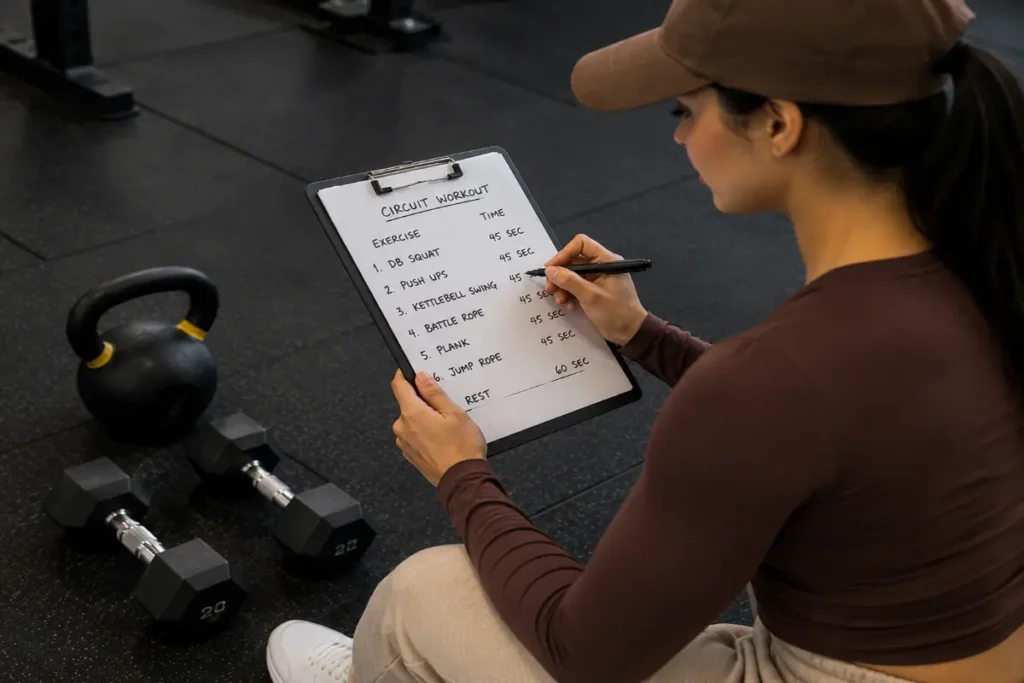
Step 1 — Define Your Goal
Fat loss, general conditioning, muscular endurance, athletic performance — the goal changes your exercise selection, load, rest periods, and number of rounds. Decide this first.
Step 2 — Pick 6 to 10 Exercises
Cover different muscle groups and alternate between them — upper body, lower body, core. Don’t put two lower body exercises back to back. A balanced full-body circuit typically includes:
- 1 to 2 lower body movements (squat, lunge, deadlift)
- 1 to 2 upper body push movements (push-up, shoulder press)
- 1 to 2 upper body pull movements (row, pull-up)
- 1 core movement (plank, hollow hold)
- 1 to 2 cardio movements (jumping jacks, high knees, burpees)
Six to eight stations is the practical sweet spot for a 30 to 40 minute session.
Step 3 — Set Your Work-to-Rest Ratio
The work-to-rest ratio controls intensity. Start at 1:1 — equal work and rest — and adjust from there.
| Level | Work | Rest |
|---|---|---|
| Beginner | 30 seconds | 30 seconds |
| Intermediate | 40 seconds | 20 seconds |
| Advanced | 45–60 seconds | 10–15 seconds |
Rest between full rounds should be 60 to 90 seconds at all levels.
Step 4 — Reps or Time?
Time-based circuits are easier to manage — set a timer and go. Rep-based circuits give you more control over load and effort, and work better when you’re including heavier compound movements. Both produce results. Pick the one that fits your session.
Step 5 — Decide Your Rounds
Two to four rounds is the working range. Beginners start at two. Three rounds is the standard for intermediate trainees. Four rounds with compressed rest is a serious advanced session.
How to Apply Progressive Overload?
The same circuit at the same weight, same rest, same rounds will stop working. Your body adapts fast — usually within two to three weeks. To keep progressing, something has to change.
- Add load — Increase weight at dumbbell or barbell stations
- Cut rest — Shorten rest between exercises or between rounds
- Add reps or time — More reps per station, or longer work intervals
- Add rounds — Move from 2 to 3, or 3 to 4
- Harder variations — Bodyweight squat → goblet squat, push-up → weighted push-up
Change one thing at a time. Changing multiple variables at once makes it impossible to track what’s working.
For stations where you want to push intensity without adding more rounds, techniques like drop sets can extend the effort on a single exercise past the point where a standard set would stop.
Sample Circuit Training Workouts
Beginner — Bodyweight, No Equipment
30 seconds work / 30 seconds rest per exercise. 90 seconds rest between rounds. 2 rounds.
- Bodyweight squats
- Push-ups (knees down if needed)
- Reverse lunges, alternating legs
- Plank hold
- Jumping jacks
- Glute bridge
Total time: ~18 minutes
Intermediate — Dumbbells
40 seconds work / 20 seconds rest per exercise. 60 seconds rest between rounds. 3 rounds.
- Goblet squat
- Dumbbell shoulder press
- Romanian deadlift
- Bent-over dumbbell row
- Reverse lunge
- Push-ups
- Mountain climbers
- Hollow hold
Total time: ~28 minutes
Advanced — Full Gym
45 seconds work / 15 seconds rest per exercise. 60 seconds rest between rounds. 4 rounds.
- Barbell front squat
- Pull-ups
- Dumbbell bench press
- Kettlebell deadlift
- Dumbbell shoulder press
- Barbell bent-over row
- Box jumps
- Battle rope slams
- Plank shoulder taps
Total time: ~35 minutes
Common Mistakes
Going too hard at the start. Two rounds with manageable weights is a real workout. Start there — you can push harder next week. An injury sets you back weeks, not days.
Too heavy a weight. Fatigue builds across stations. The weight that felt fine in round one will feel very different in round three. Pick a load you can control through every round, not just the first.
Skipping the rest between rounds. That rest is part of the program. Cutting it short doesn’t make you tougher — it just makes the next round worse than it needs to be.
Never updating the circuit. Same exercises, same load, same rest every session for months — results stall. Change at least one variable every two to three weeks.
How Often Should You Do Circuit Training?
Two to three times a week. Full-body circuits need 48 hours between sessions — every major muscle group is involved and needs time to recover.
If you’re also doing other training, don’t schedule a circuit the day after heavy legs or a hard upper body session. Two sessions a week is plenty for beginners. Add a third once recovery is consistently feeling complete before the next session.
Frequently Asked Questions
Is circuit training good for weight loss?
Yes. It burns 20 to 30% more calories than standard resistance sessions of the same length, and post-exercise calorie burn stays elevated for hours after the session ends.
Can circuit training build muscle?
It maintains muscle and builds modest amounts, especially for beginners. For significant muscle growth, dedicated strength training will outperform circuits.
How many exercises should be in a circuit?
Six to ten. Seven or eight is the practical sweet spot for a 30 to 40 minute session.
What’s the difference between circuit training and HIIT?
HIIT is intensity-based — short all-out efforts, then recovery. Circuit training is variety-based — different exercises at moderate to high intensity, rotating through muscle groups.
Do I need equipment?
No. Bodyweight circuits are effective, especially for beginners. Equipment adds variety and load as you progress.
