

Quick Answer: The best medicine ball exercises for lower abs are leg raises, reverse crunches, flutter kicks, V-ups, dead bugs, and the hollow hold. All work by driving the hips and legs toward the torso the movement pattern that loads the lower rectus abdominis directly, which standard crunches miss entirely.
What weight to use: Beginners: 2–4 kg | Intermediate: 4–6 kg | Advanced: 6–8 kg
Use a standard medicine ball, not a slam ball. When the ball sits between your feet, start at the lighter end the lever arm is long and hip flexor demand increases sharply with weight.
The lower abs are the hardest part of the core to reach. Most ab exercises flex the upper spine toward the hips, which loads the top of the rectus abdominis and leaves the lower section mostly passive. The exercises below all work the opposite way hips and legs driving toward the torso which is the only movement pattern that puts the lower abs under direct load.
A medicine ball makes each of these harder by adding resistance and extending the lever arm. The result is more work per rep compared to the bodyweight version.
10 Medicine Ball Exercises for Lower Abs
1. Medicine Ball Leg Raises
Muscles worked: Lower rectus abdominis, hip flexors Level: Beginner
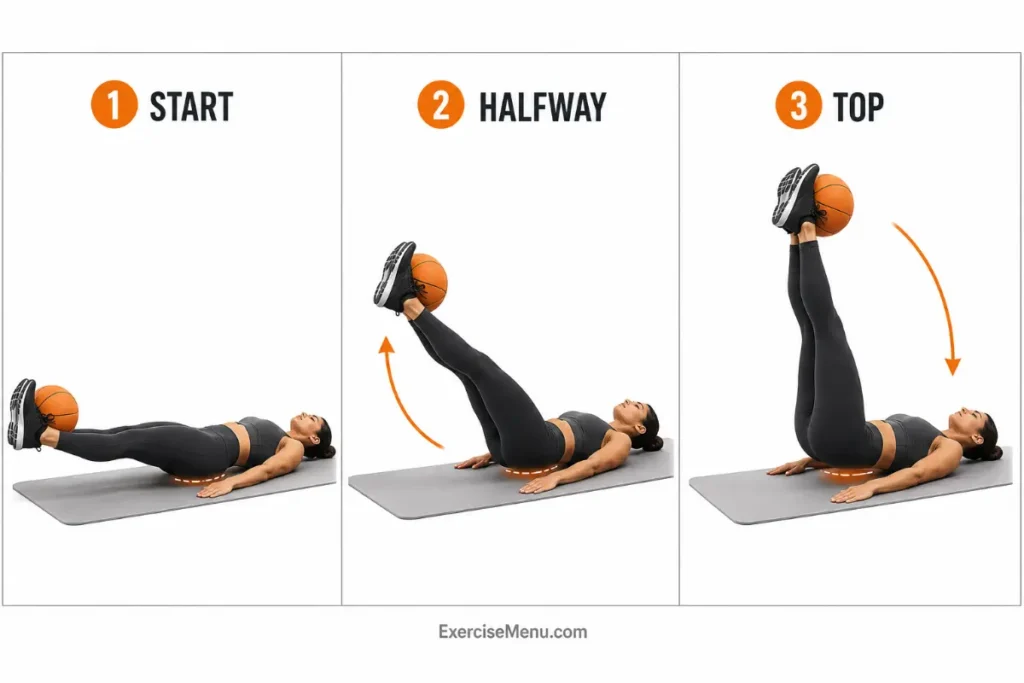
Squeezing the medicine ball between your feet adds resistance without changing the movement the lower abs still do the same job, just harder.
How to do it:
- Lie on your back, arms by your sides or hands tucked under your glutes
- Squeeze the medicine ball between your feet
- Press your lower back into the floor and keep it there
- Raise both legs slowly to 90 degrees
- Lower with control, stopping just before your heels touch the floor
Sets/Reps: 3 × 10–12 Form cue: If your lower back arches, the ball is too heavy. Drop the weight before adding reps.
2. Medicine Ball Reverse Crunch
Muscles worked: Lower rectus abdominis, transverse abdominis Level: Beginner–Intermediate
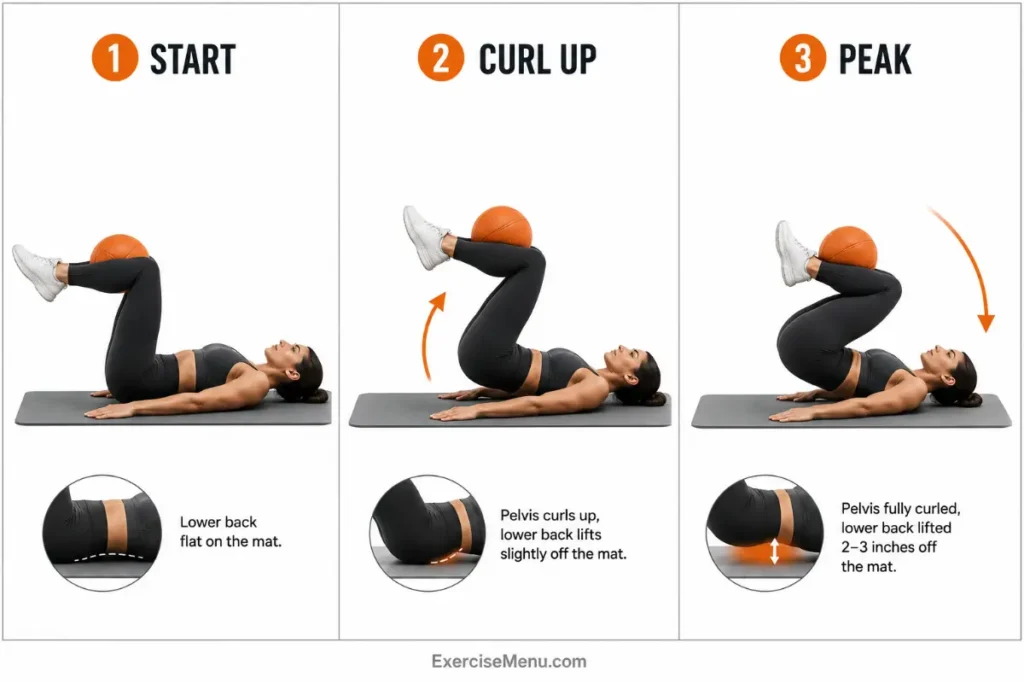
The reverse crunch curls the pelvis toward the chest the opposite of a standard crunch, and the movement the lower abs actually respond to. The ball between the knees stops the hips from swinging and keeps the movement honest.
How to do it:
- Lie on your back, knees bent, feet off the floor, shins parallel to the ground
- Squeeze the medicine ball between your knees
- Flatten your lower back against the floor
- Exhale and curl your pelvis up, bringing your knees toward your chest your lower back lifts slightly at the top
- Lower your hips back down slowly
Sets/Reps: 3 × 12–15 Form cue: Small, deliberate movement. If the legs swing, momentum has taken over.
3. Medicine Ball Flutter Kicks
Muscles worked: Lower rectus abdominis, hip flexors Level: Beginner–Intermediate
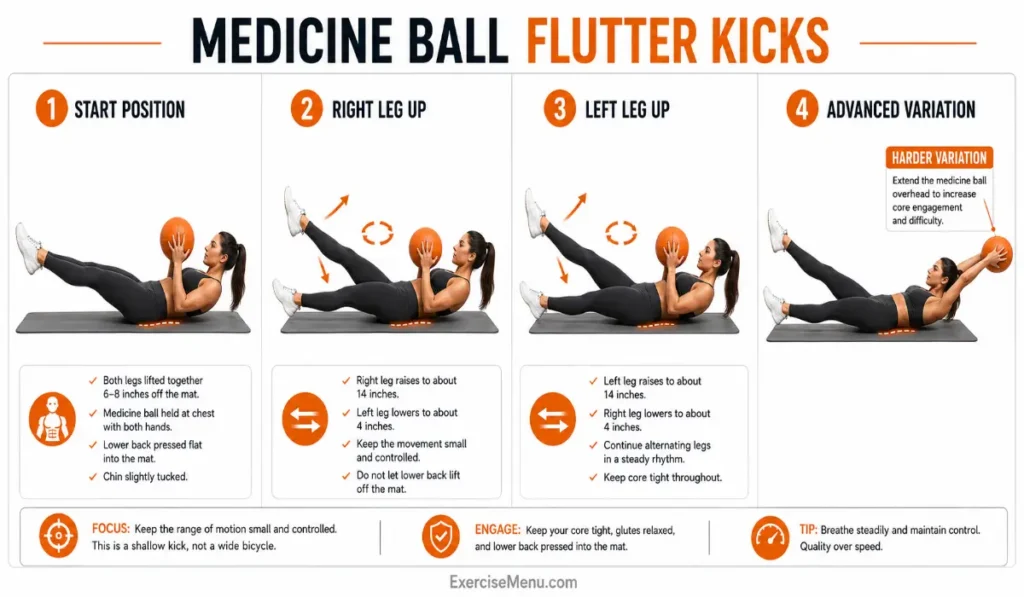
The legs never fully rest during flutter kicks, which keeps the lower abs under continuous load throughout the set. Hold the ball at your chest for the standard version, or extend it overhead to increase difficulty.
How to do it:
- Lie on your back, medicine ball held at your chest
- Lift both legs 6–8 inches off the floor, lower back pressed flat
- Kick your legs alternately up and down in shallow, controlled strokes
- Drive the movement from your hips, not your knees
Sets/Duration: 3 × 30–45 seconds Form cue: Keep the kicks shallow. Wide bicycle-style movement shifts the load off the lower abs.
4. Medicine Ball V-Up
Muscles worked: Rectus abdominis (full), hip flexors Level: Intermediate
Both legs and the torso lift at the same time. Holding the ball overhead adds load through the full range, and passing it to your feet at the top keeps the abs working through the lowering phase.
How to do it:
- Lie on your back, legs straight, medicine ball held overhead with arms extended
- Lift your legs and torso simultaneously, folding at the hips
- Reach the ball toward your feet — or pass it between your hands and ankles
- Lower both back down slowly without touching the floor
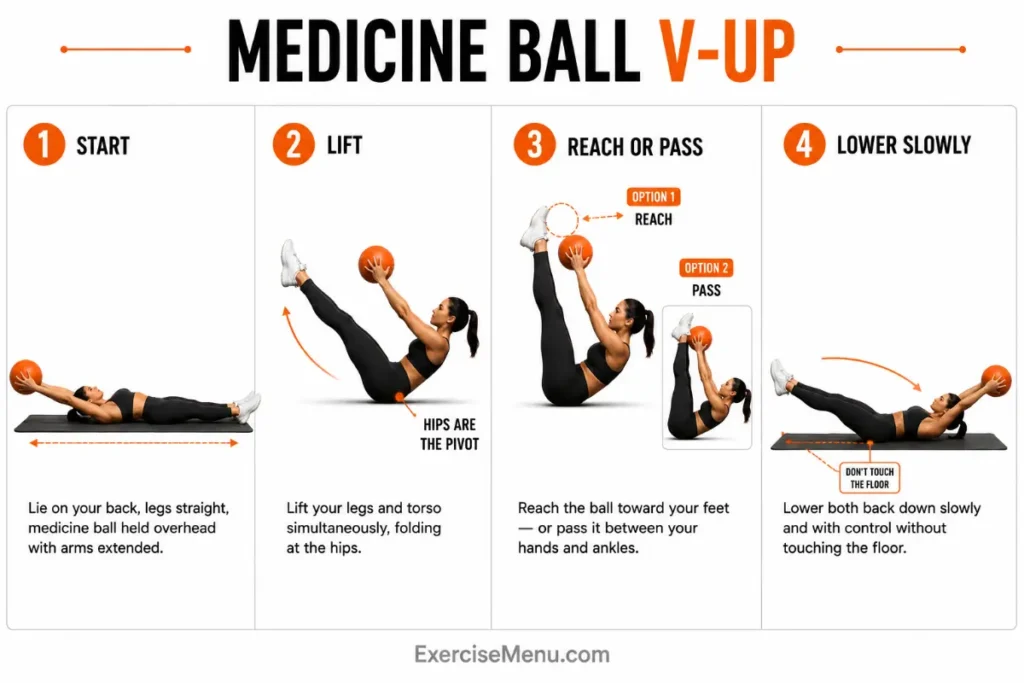
Sets/Reps: 3 × 8–10 Modification: Bend your knees slightly if the straight-leg version is too demanding.
5. Medicine Ball Dead Bug
Muscles worked: Transverse abdominis, lower rectus abdominis Level: Beginner–Intermediate
The dead bug resists spinal extension rather than creating it. A 1996 study by Hodges and Richardson showed the transverse abdominis fires before limb movement to stabilize the spine the dead bug trains that response directly. Pressing the medicine ball overhead increases the demand on that same muscle.
How to do it:
- Lie on your back, knees bent at 90 degrees, shins parallel to the floor
- Press the medicine ball overhead with both hands, arms straight
- Extend your right leg out straight while lowering your left arm overhead
- Lower back stays in contact with the floor the moment it lifts, stop and reset
- Return and switch sides
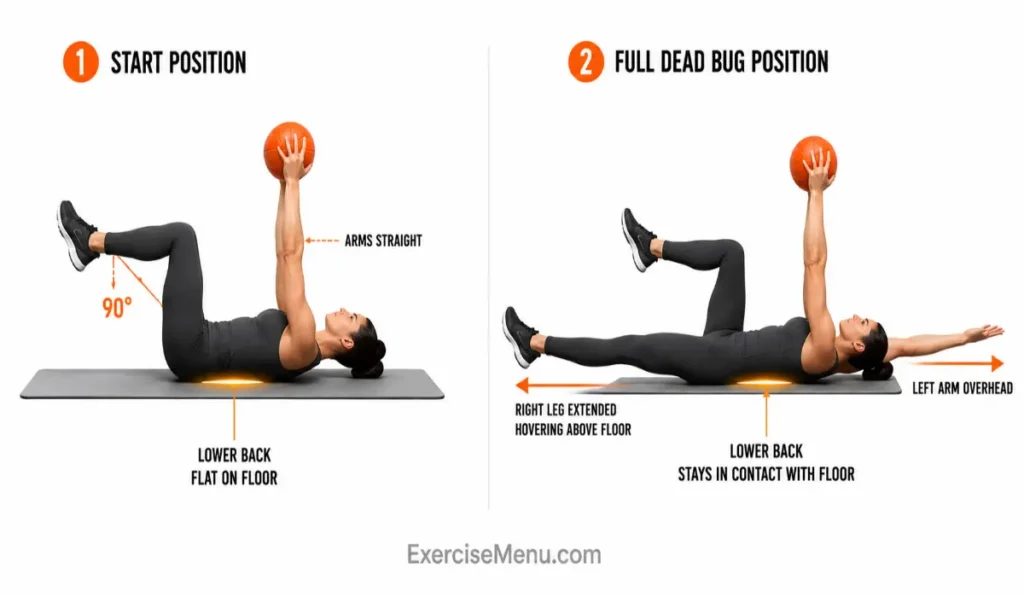
Sets/Reps: 3 × 8–10 per side Form cue: Slow the movement down. Speed breaks lower back contact and removes the abs from the exercise.
6. Medicine Ball Hollow Hold
Muscles worked: Transverse abdominis, lower rectus abdominis Level: Intermediate
No movement just sustained contraction. Holding the ball overhead extends the lever arm, which forces the lower abs to work harder to keep the lower back against the floor.
How to do it:
- Lie on your back, medicine ball held overhead, arms extended
- Press your lower back into the floor
- Lift your shoulders and legs a few inches off the ground
- Hold. Keep breathing don’t hold your breath
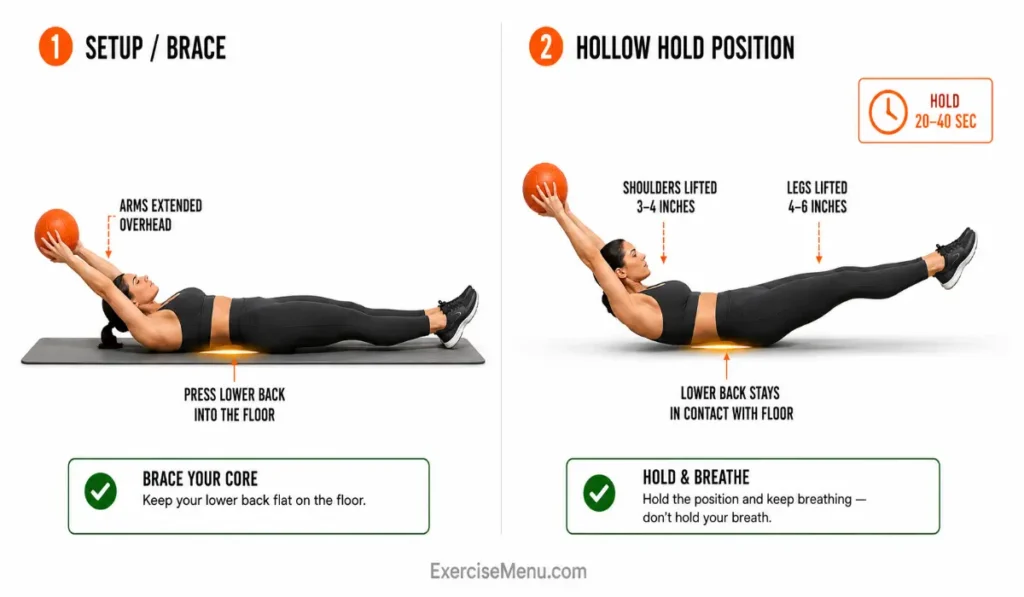
Sets/Duration: 3 × 20–40 seconds Form cue: Lower back lifts? Bend your knees or bring the ball to your chest and work back up from there.
7. Medicine Ball Knee Tuck to Leg Extension
Muscles worked: Lower rectus abdominis, hip flexors, transverse abdominis Level: Intermediate
A reverse crunch combined with a leg extension in one continuous rep the lower abs stay loaded through both phases.
How to do it:
- Lie on your back, medicine ball held at your chest
- Pull both knees toward your chest to 90 degrees
- Extend your legs straight out until parallel to the floor
- Pull the knees back in
- That is one rep
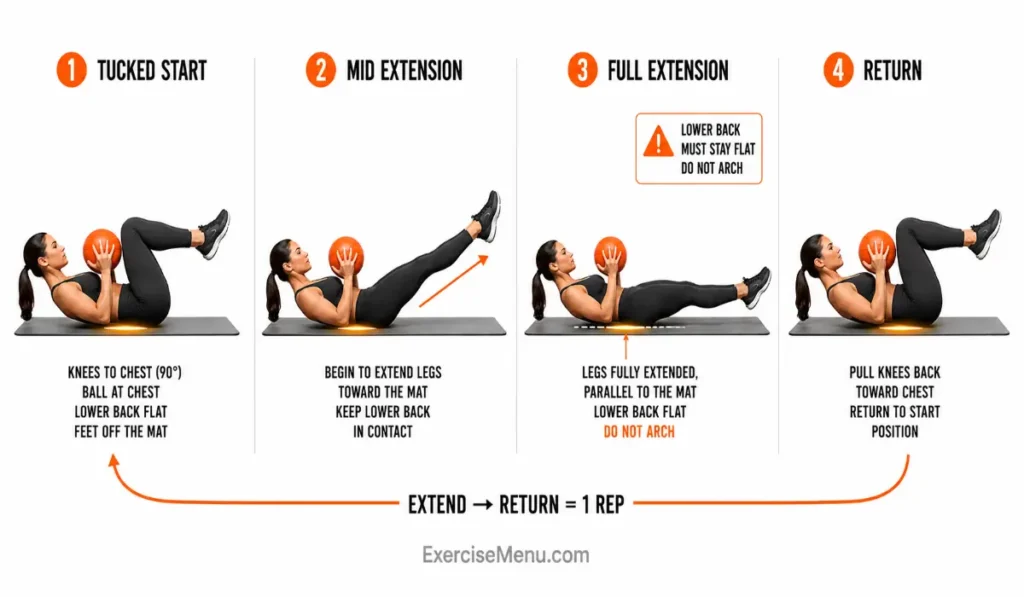
Sets/Reps: 3 × 10–12 Form cue: Only extend as far as your lower back stays flat. Partial range beats full extension with an arched back.
8. Medicine Ball Pass (Hands to Feet)
Muscles worked: Rectus abdominis (full), lower abs Level: Intermediate–Advanced
The lowering phase arms and legs extending back toward the floor is where the lower abs work hardest. The ball pass between hands and feet keeps tension on through the full movement.
How to do it:
- Lie on your back, medicine ball held overhead, arms extended
- Lift your legs and torso together, bring the ball to meet your feet
- Pass the ball to hold between your ankles
- Lower both arms and legs slowly neither touches the floor
- On the next rep, lift back up and pass the ball to your hands
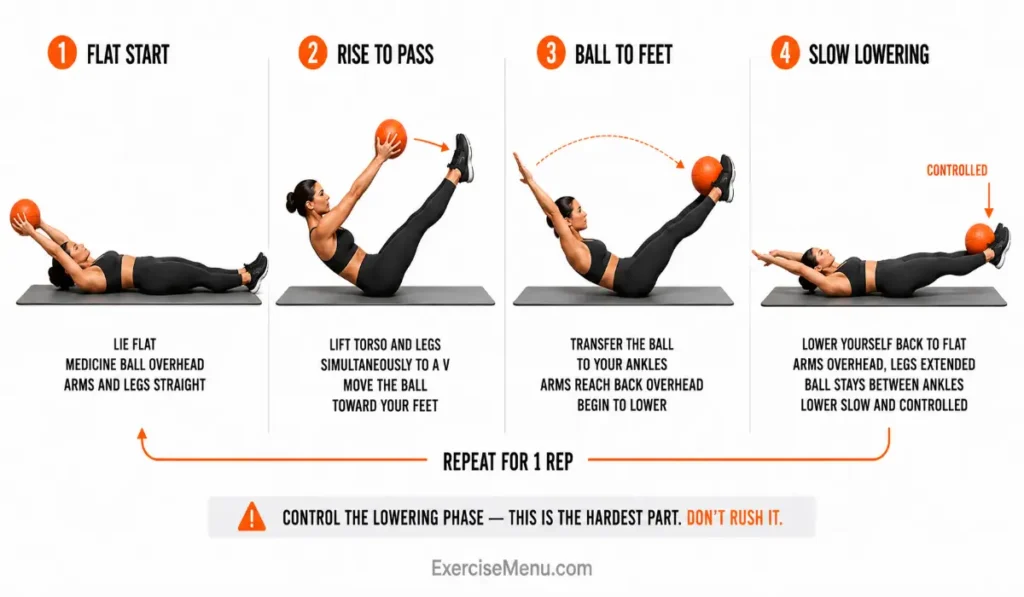
Sets/Reps: 3 × 6–8 Form cue: Most people rush the lowering phase. That’s where the real work is slow it down.
9. Medicine Ball Plank with Knee Drive
Muscles worked: Transverse abdominis, lower rectus abdominis Level: Intermediate
The medicine ball under your hands creates instability a flat floor doesn’t. Your core has to stabilize before the knee drive even starts, which increases transverse abdominis demand throughout the set.
How to do it:
- High plank position, both hands gripping the medicine ball on the floor
- Body in a straight line hips level
- Drive your right knee toward your chest, pause, return
- Alternate sides at a controlled pace
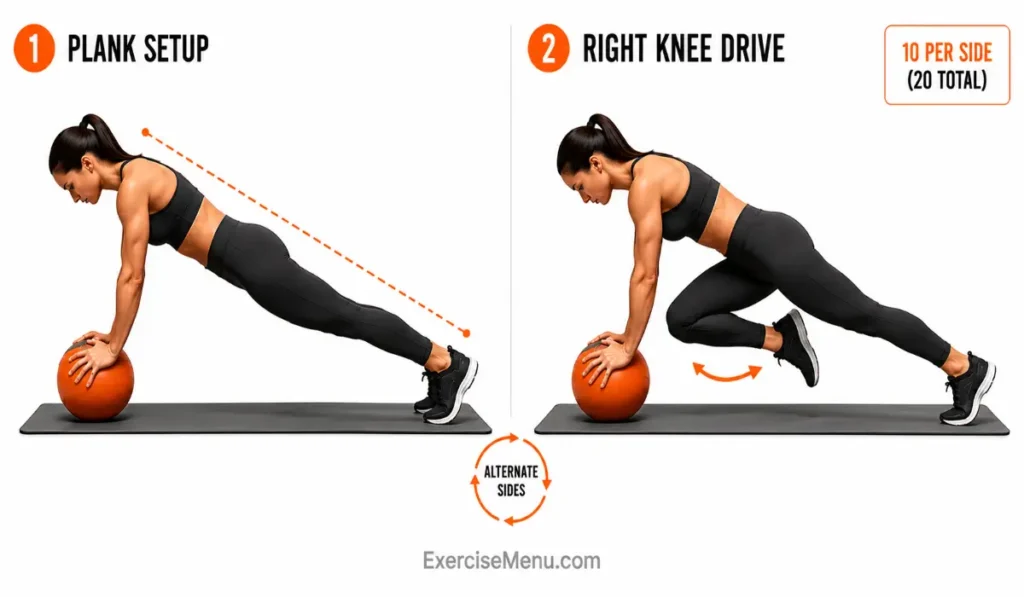
Sets/Reps: 3 × 10 per side Form cue: If your hips rotate or shift, the core isn’t holding reset before the next rep.
10. Medicine Ball Overhead Crunch with Hip Raise
Muscles worked: Upper and lower rectus abdominis, transverse abdominis Level: Advanced
The upper body crunches while the hips lift both ends of the rectus abdominis contract simultaneously. Get the reverse crunch and hollow hold solid before attempting this.
How to do it:
- Lie on your back, knees bent, feet flat, medicine ball held overhead
- Curl your upper back off the floor while pressing your lower back down and raising your hips at the same time
- The ball moves forward as your pelvis tilts up
- Lower with control
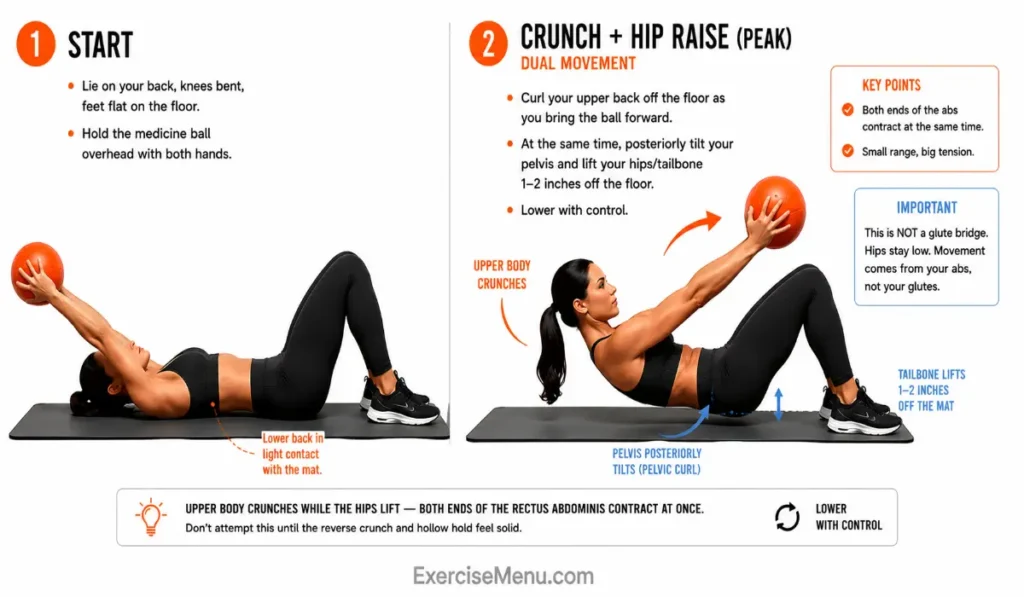
Sets/Reps: 3 × 10–12 Form cue: This isn’t a sit-up. The upper body movement is small both ends of the abs pull inward at the same time, not a swing upright.
10-Minute Lower Abs Workout Circuit
2–3 rounds. Rest 45–60 seconds between rounds.
| Exercise | Reps / Duration |
|---|---|
| Medicine Ball Leg Raises | 10 reps |
| Medicine Ball Reverse Crunch | 12 reps |
| Medicine Ball Flutter Kicks | 30 seconds |
| Medicine Ball Dead Bug | 8 reps per side |
| Medicine Ball Hollow Hold | 20–30 seconds |
Beginners: Run exercises 1–3 only for the first 3–4 weeks. Add exercises 4 and 5 once your lower back stays flat through every rep of the first three.
Use a weight you can control through the full set. If lower back contact breaks mid-circuit, reduce the ball weight. Apply progressive overload by adding one round or stepping up ball weight every 2–3 weeks not both at once.
How Many Times a Week Should You Train Lower Abs?
2–3 times per week, with at least one rest day between sessions. The lower abs are muscle tissue — they need recovery time to adapt and strengthen. According to the American Council on Exercise (ACE), training abs daily does not produce better results and can slow progress by limiting recovery.
Training them 2–3 times per week within a structured program is more effective than daily ab work without rest. If you’re training lower abs 4–5 times a week with no visible improvement, frequency isn’t the problem form is. Check whether your lower back is staying flat during every rep. Lower abs are one piece of core training. The medicine ball ab exercises guide covers upper abs, obliques, and full core stability — all with the same ball. For chest, back, arms, shoulders, and legs, the medicine ball exercises guide covers each muscle group separately.
Frequently Asked Questions
What medicine ball exercises work the lower abs?
Leg raises, reverse crunches, flutter kicks, V-ups, and dead bugs all done with the ball between your feet or knees, or held overhead. The common factor is hips and legs moving toward the torso.
How heavy should a medicine ball be for lower abs?
2–4 kg for beginners, 4–6 kg for intermediate, 6–8 kg for advanced. When the ball goes between your feet, use the lighter end the lever arm is long.
Why can’t I feel my lower abs working?
Your lower back is probably coming off the floor, meaning the hip flexors are taking over. Press it flat, slow the movement down, and exhale at the top of each rep.
Are these exercises suitable for beginners?
Yes. Start with leg raises, reverse crunches, and flutter kicks at 2–4 kg. Focus on keeping your lower back flat before adding weight or moving to V-ups and hollow holds.
How many times a week should I train lower abs?
2–3 times per week with a rest day between sessions.
Will these exercises reduce belly fat?
No. They build lower ab strength and definition. Visible abs require reducing overall body fat that comes from diet and training combined.
