
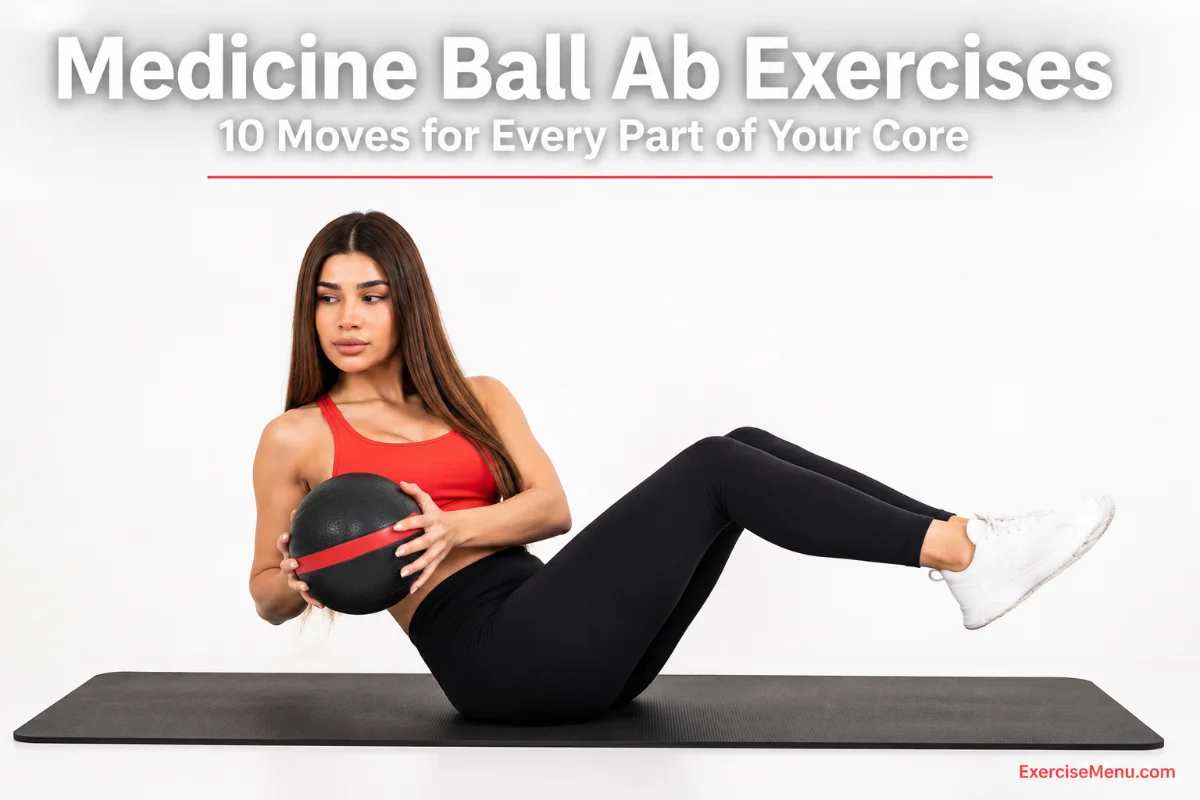
Quick Answer: Medicine ball ab exercises train the core through flexion, rotation, and anti-extension three patterns bodyweight alone can’t cover in one session. The 10 exercises below are organized by muscle group: upper abs, lower abs, obliques, and full core. Use a 4–6 lb ball to start, 8–10 lb once form is solid.
Most ab routines do one thing spinal flexion. Crunches, sit-ups, leg raises all the same movement pattern, repeated in different positions. The problem is your core has four distinct muscle groups, each doing a different job: the rectus abdominis flexes the spine, the obliques rotate and laterally flex it, the transverse abdominis compresses and stabilizes, and the erector spinae extends it. Train only one pattern and the other three stay underdeveloped.
A medicine ball changes that. The weight forces your core to stabilize under load in multiple directions forward and back, through rotation, and against extension. These 10 exercises are organized by muscle group so you know exactly what you’re training with each movement.
- What Makes Medicine Ball Ab Training Different from Regular Core Work?
- What Weight Medicine Ball Should You Use for Ab Exercises?
- Upper Ab Exercises with a Medicine Ball
- Lower Ab Exercises with a Medicine Ball
- Oblique Exercises with a Medicine Ball
- Full Core and Anti-Extension Exercises with a Medicine Ball
- Standing Ab Exercises with a Medicine Ball
- How to Structure Your Medicine Ball Ab Workout
- Can Medicine Ball Ab Exercises Give You Visible Abs?
- Are Medicine Ball Ab Exercises Safe for Back Pain?
- Frequently Asked Questions
What Makes Medicine Ball Ab Training Different from Regular Core Work?
A medicine ball changes the type of stimulus your core receives not just the difficulty.
Bodyweight exercises like planks and crunches train the core in one plane — forward and back (sagittal). A medicine ball introduces rotational and lateral loading, which is how your core actually works in real movement. Throwing, carrying, changing direction — these all require your obliques and transverse abdominis to work alongside the rectus abdominis, not instead of it.
The instability of holding a weighted ball also increases muscle activation compared to the same movement without it. Research published in the Journal of Strength and Conditioning Research confirmed that medicine ball training produces measurable improvements in core strength and functional performance.
A 2025 protocol study published in PMC is currently investigating whether an 8-week medicine ball slam and core training program produces measurable hypertrophy in the transverse abdominis and internal oblique early indicators suggest it does.
What Weight Medicine Ball Should You Use for Ab Exercises?
| Level | Weight (lbs) | Weight (kg) | Ball Type |
|---|---|---|---|
| Beginner | 4–6 lbs | 2–3 kg | Soft rubber or slam ball |
| Intermediate | 8–10 lbs | 4–5 kg | Slam ball |
| Advanced | 10–14 lbs | 5–6 kg+ | Slam ball or dual-grip |
Start lighter than you think necessary. A 6 lb ball held at arm’s length during a Russian twist creates significantly more torque on the spine than it does resting at your chest the distance from the body is what determines difficulty, not just the weight.
Upper Ab Exercises with a Medicine Ball
The upper rectus abdominis — the top portion of the six-pack muscle responds to spinal flexion with resistance overhead or at chest height.
1. Medicine Ball Sit-Up
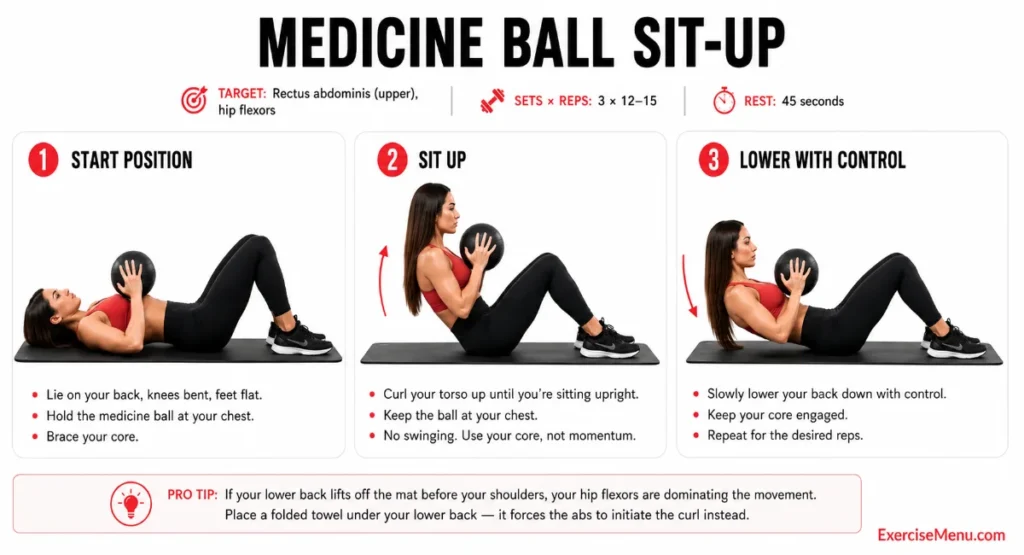
Target: Rectus abdominis (upper), hip flexors
Lie on your back, knees bent, feet flat. Hold the medicine ball at your chest. Brace your core and curl your torso up until you’re sitting upright, then lower with control. The ball stays at chest throughout — don’t swing it for momentum.
Sets × Reps: 3 × 12–15 | Rest: 45 seconds
If your lower back is lifting off the mat before your shoulders, your hip flexors are dominating the movement. Place a folded towel under your lower back it forces the abs to initiate the curl instead.
2. Medicine Ball V-Up
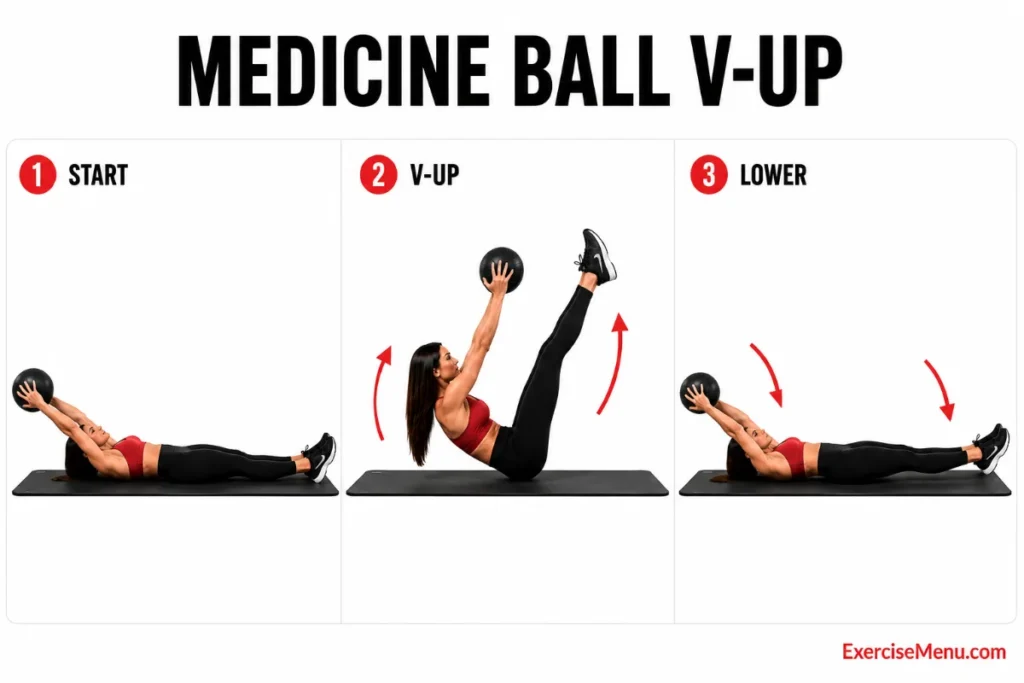
Target: Rectus abdominis (upper and lower simultaneously), hip flexors
Lie flat, arms extended overhead holding the ball, legs straight. In one controlled movement, raise both your legs and your torso simultaneously reaching the ball toward your feet at the top, forming a V shape. Lower both back down together, not separately.
Sets × Reps: 3 × 10–12 | Rest: 45 seconds
This is harder than it looks. If you can’t complete reps with straight legs, bend your knees slightly to reduce the lever arm until you build the required strength.
3. Table Top Crunch with Medicine Ball
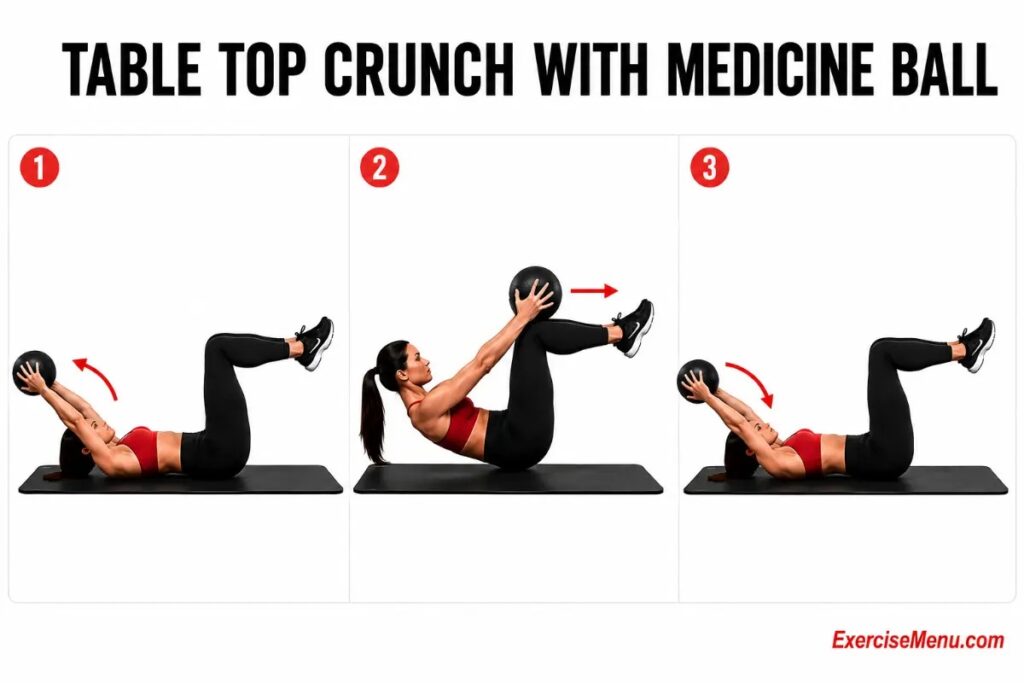
Target: Rectus abdominis (upper), hip flexors
Lie on your back, legs raised and bent at 90 degrees — shins parallel to the floor. Hold the ball overhead with arms extended. Exhale and curl your head, neck, and upper back off the mat, bringing the ball toward your shins. Place the ball on your shins for a moment, then pick it back up as you lower.
Sets × Reps: 3 × 10 | Rest: 45 seconds
The alternating touch-and-lift keeps each rep deliberate. Lower back stays on the mat throughout — if it’s lifting, the range of motion is too aggressive for your current strength level.
Lower Ab Exercises with a Medicine Ball
The lower portion of the rectus abdominis and the hip flexors are trained through movements that involve raising the legs rather than the torso. For a complete breakdown of 10 exercises targeting this specific area, the medicine ball lower abs guide covers the full range of movements.
4. Medicine Ball Leg Raise
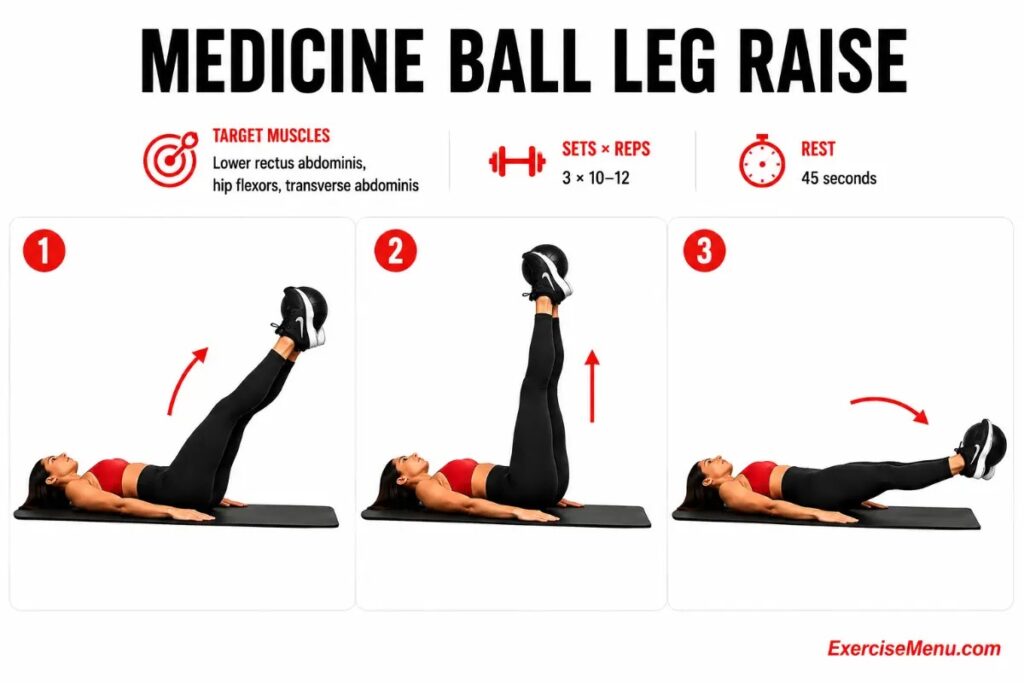
Target: Lower rectus abdominis, hip flexors, transverse abdominis
Lie on your back, arms flat by your sides, medicine ball held between your feet (squeeze your ankles together to grip it). Legs start at 45 degrees off the floor. Raise both legs to 90 degrees, pause, then lower slowly back toward the floor stopping just before they touch. The lower back stays pressed into the mat throughout the entire movement.
Sets × Reps: 3 × 10–12 | Rest: 45 seconds
The closer to the floor your legs are, the harder this becomes. Start at 45 degrees and work toward holding your legs lower as strength improves.
5. Medicine Ball Reverse Crunch
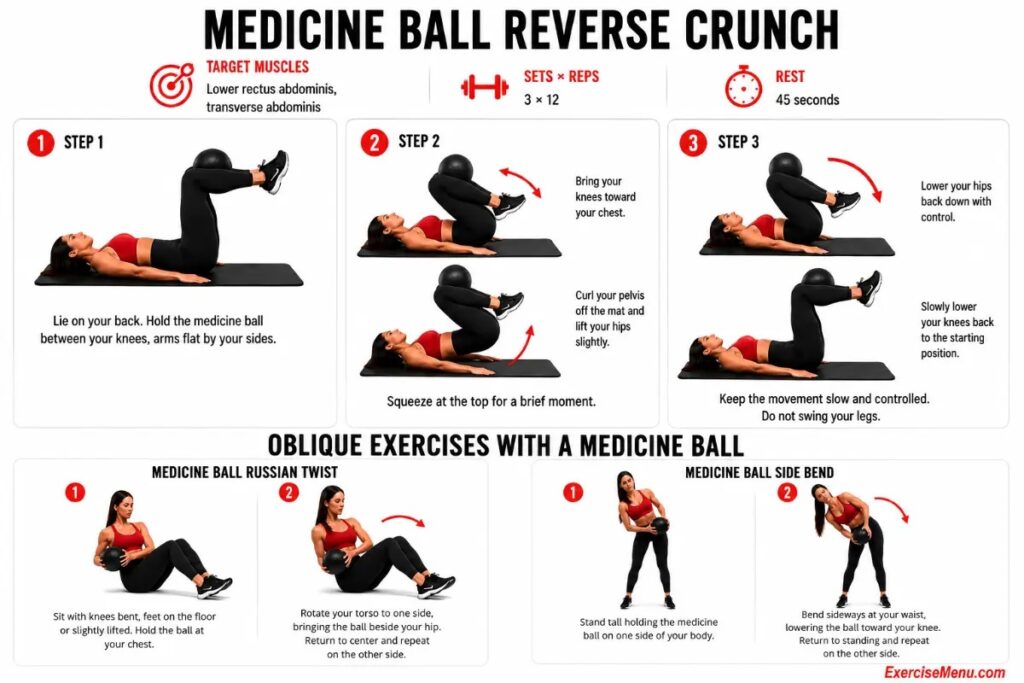
Target: Lower rectus abdominis, transverse abdominis
Lie on your back with the medicine ball held between your knees, arms flat by your sides. Bring your knees toward your chest, then curl your pelvis off the mat your hips should lift slightly at the top. Lower slowly. The movement is small and controlled; it’s not a leg swing.
Sets × Reps: 3 × 12 | Rest: 45 seconds
Oblique Exercises with a Medicine Ball
The internal and external obliques handle rotation and lateral flexion. These two movements train both directly.
6. Medicine Ball Russian Twist
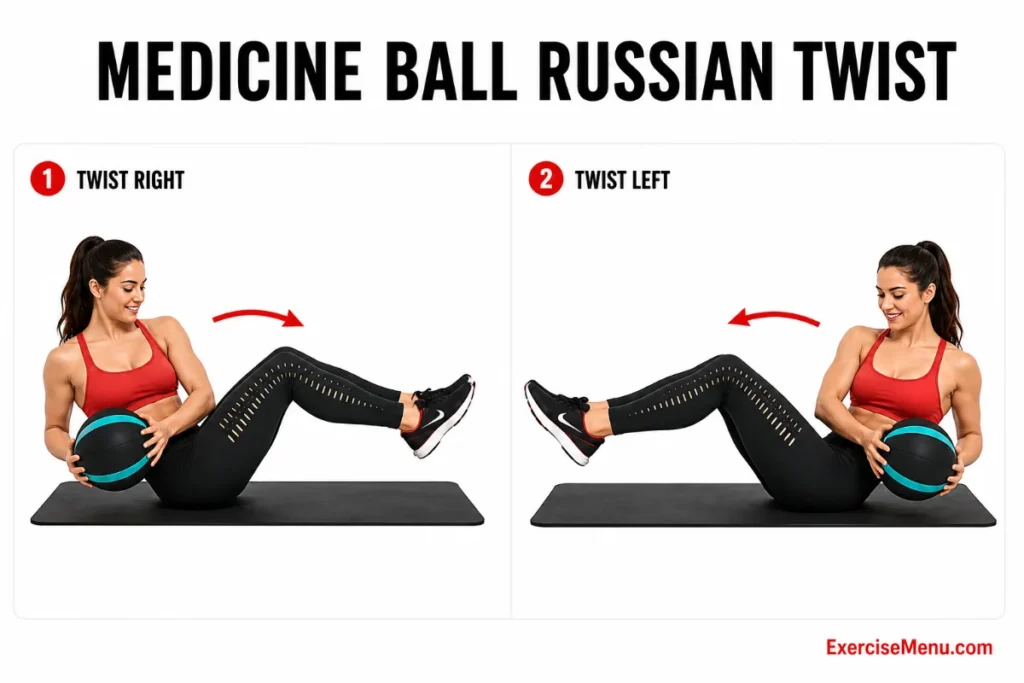
Target: Internal and external obliques, rotational core strength
Sit with knees bent, feet flat or slightly elevated, torso leaned back to approximately 45 degrees. Hold the ball at your chest. Rotate your torso to the right — the ball moves with your chest, not independently then to the left. One right-left cycle equals one rep. The movement comes from your trunk, not your arms.
Sets × Reps: 3 × 12–15 each side | Rest: 45 seconds
Keep your back flat throughout rounding the lumbar spine to chase more rotation shifts the load away from the obliques and into the lower back.
7. Medicine Ball Wood Chop (Standing)
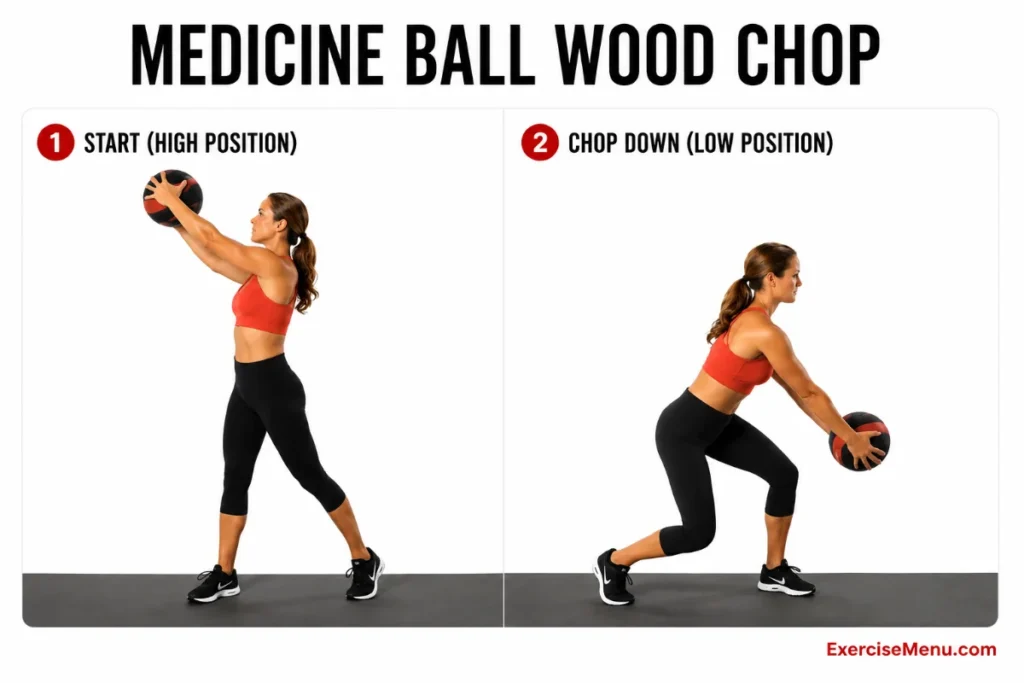
Target: External obliques, internal obliques, transverse abdominis
Stand with feet shoulder-width apart. Hold the ball at shoulder height on your right side. In one diagonal movement, bring the ball down and across your body toward your left knee — rotating from your hips and core, not just your arms. Return to the starting position and complete all reps on one side before switching.
Sets × Reps: 3 × 10 each side | Rest: 45 seconds
This is one of the most effective standing ab exercises with a medicine ball because it trains the obliques through a full functional range the same pattern used in swinging, throwing, and changing direction. The rotation should feel like it starts from the hips, travels through the trunk, and finishes with the arms following.
Full Core and Anti-Extension Exercises with a Medicine Ball
Anti-extension exercises train the core to resist being pulled into a lengthened position — the opposite of the flexion that crunches produce. Stuart McGill’s research on spinal loading consistently identifies this as one of the most important core training qualities for both performance and back health, particularly for anyone who spends long periods sitting.
8. Medicine Ball Plank
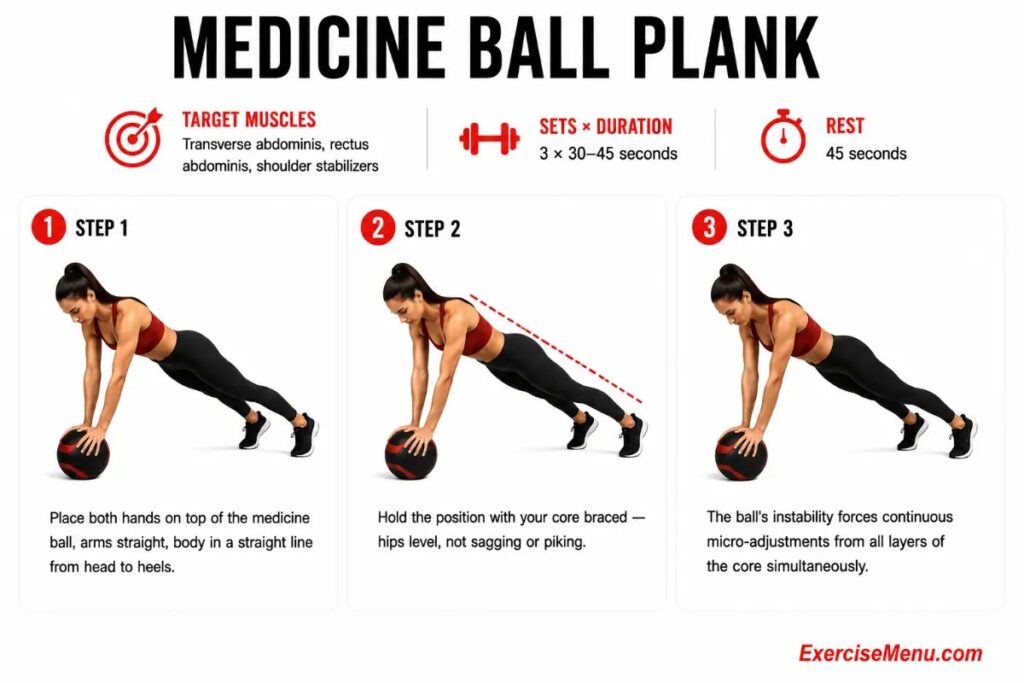
Target: Transverse abdominis, rectus abdominis, shoulder stabilizers
Place both hands on top of the medicine ball, arms straight, body in a straight line from head to heels. Hold the position with your core braced hips level, not sagging or piking. The ball’s instability forces continuous micro-adjustments from all layers of the core simultaneously.
Sets × Duration: 3 × 30–45 seconds | Rest: 45 seconds
Once the standard plank feels stable, add a lateral ball roll — place the ball under your right hand, roll it across to your left hand while keeping your hips completely level, then back. This is one of the most effective anti-rotation progressions with a medicine ball and trains the deep stabilizers harder than the static hold alone.
9. Dead Bug with Medicine Ball Overhead
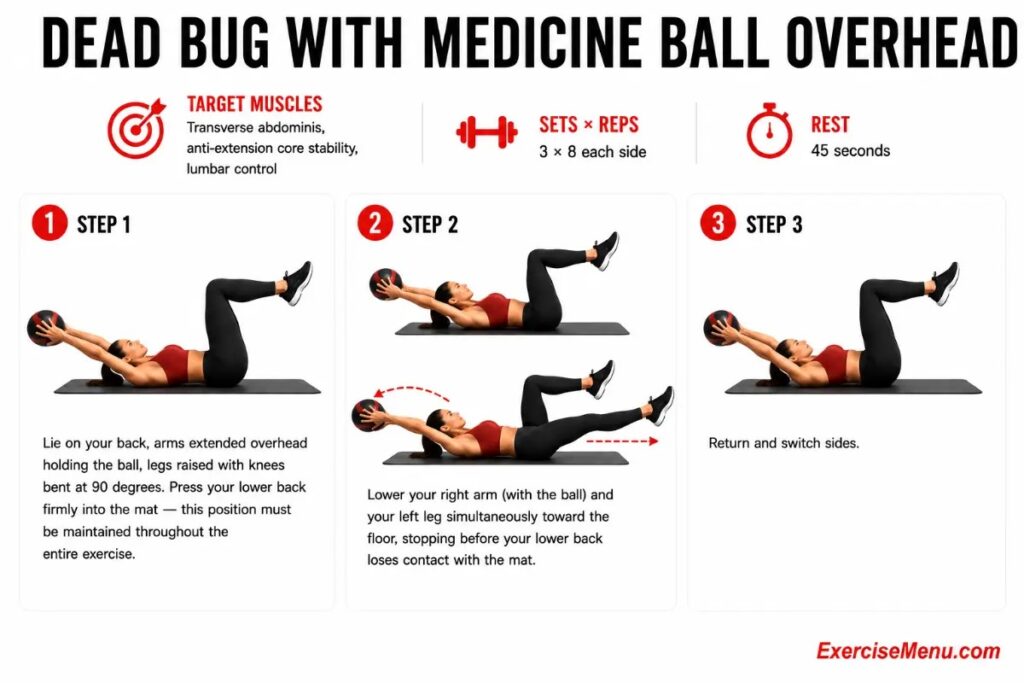
Target: Transverse abdominis, anti-extension core stability, lumbar control
Lie on your back, arms extended overhead holding the ball, legs raised with knees bent at 90 degrees. Press your lower back firmly into the mat this position must be maintained throughout the entire exercise. Lower your right arm (with the ball) and your left leg simultaneously toward the floor, stopping before your lower back loses contact with the mat. Return and switch sides.
Sets × Reps: 3 × 8 each side | Rest: 45 seconds
If your back lifts on the descent, reduce the range of motion rather than letting form break. Most people discover on this exercise that their lower back has been compensating in other movements — the mat contact requirement removes that option entirely.
Standing Ab Exercises with a Medicine Ball
Standing ab exercises challenge the core differently from floor work — there’s no mat to provide feedback on whether the lower back is compensating, and the standing position requires the entire trunk to stabilize against gravity simultaneously.
10. Standing Rotational Slam
Target: Obliques, transverse abdominis, rotational power, explosive core strength
Stand with feet shoulder-width apart, holding a slam ball at hip height on your right side. Load your right hip by rotating slightly, then drive through your hips and rotate aggressively to the left slamming the ball into the floor to your left side. The power comes from the hip rotation, not the arms. Pick up the ball, reset, and repeat in the other direction.
Sets × Reps: 3 × 8 each side | Rest: 60 seconds
This is the most explosive exercise in this list it trains the obliques under load at speed, which is how they function in sport. Keep the knees slightly bent throughout and let the hips initiate the rotation before the arms follow.
How to Structure Your Medicine Ball Ab Workout
These 10 exercises work best as a circuit. Moving from one to the next with short rest keeps intensity up — long rest between isolated sets reduces the training effect for ab work specifically.
Beginner Circuit — 20 minutes
| Exercise | Sets | Rest After |
|---|---|---|
| Medicine Ball Sit-Up | 2 × 12 | 45 sec |
| Medicine Ball Leg Raise | 2 × 10 | 45 sec |
| Russian Twist | 2 × 10 each side | 45 sec |
| Medicine Ball Plank | 2 × 30 sec | 45 sec |
| Dead Bug with Ball | 2 × 6 each side | 45 sec |
Rest 2 minutes between rounds.
Intermediate Circuit — 25 minutes
| Exercise | Sets | Rest After |
|---|---|---|
| Medicine Ball Sit-Up | 3 × 12 | 30 sec |
| Medicine Ball V-Up | 3 × 10 | 30 sec |
| Medicine Ball Leg Raise | 3 × 12 | 30 sec |
| Russian Twist | 3 × 12 each side | 30 sec |
| Wood Chop (standing) | 3 × 10 each side | 30 sec |
| Dead Bug with Ball | 3 × 8 each side | 30 sec |
Rest 90 seconds between rounds.
Advanced Circuit — 30 minutes
Run all 10 exercises as a continuous circuit 3 rounds, 15–20 seconds between exercises, 60 seconds between rounds.
For partner variations of medicine ball core training, including rotational passes and sit-up exchanges that add coordination and accountability to the same movements, the partner medicine ball exercises guide covers 10 partner-specific movements with full circuits. For a complete overview of medicine ball training across every muscle group, the medicine ball exercises guide covers the full cluster — chest, back, arms, shoulders, legs, and core.
Can Medicine Ball Ab Exercises Give You Visible Abs?
These exercises build the muscle. Whether that muscle is visible depends entirely on body fat percentage not how many ab exercises you do.
The rectus abdominis and obliques develop with consistent resistance training — they’ll strengthen and thicken over time. Defined abs typically become visible below 15–17% body fat for women and 10–12% for men, regardless of how developed the underlying muscle is.
Ab exercises done without a calorie deficit will build core strength and improve posture, stability, and athletic performance. But the visible “six-pack” requires the nutrition side — specifically a sustained calorie deficit alongside the training. One without the other produces either an underdeveloped core you can’t see, or a deficit that eats into muscle alongside fat.
Are Medicine Ball Ab Exercises Safe for Back Pain?
It depends on which exercises and what’s causing the pain.
Anti-extension movements Dead Bug, Plank, Bird Dog — are among the most back-friendly core exercises available because they train the core to resist spinal movement rather than produce it. These are the exercises Stuart McGill’s spine research consistently identifies as safest for people with existing lower back issues, specifically because they minimally load the lumbar discs while maximally activating the stabilizing muscles.
Exercises that involve heavy spinal flexion under load — full sit-ups with a heavy ball, Russian twists with excessive range of motion increase lumbar disc compression and are worth modifying or avoiding if you have active back pain.
If back pain is your starting point, begin with the Dead Bug and Medicine Ball Plank from this list, and progress to the other exercises once those feel stable and pain-free.
Frequently Asked Questions
Can beginners do medicine ball ab exercises?
Yes — start with the beginner circuit above. Skip the V-up and standing rotational slam until the simpler movements feel controlled across full sets.
How often should you train abs with a medicine ball?
Two to three sessions per week. Ab muscles recover faster than larger muscle groups, but the obliques and transverse abdominis still need 48 hours between sessions.
Do medicine ball ab exercises really strengthen your core?
Yes — more comprehensively than bodyweight alone because the ball trains flexion, rotation, and anti-extension in one session rather than requiring separate exercises for each.
What are common medicine ball ab workout mistakes?
Going too heavy too soon. Most people underestimate how much a ball held at arm’s length challenges the core — start at the lower end of the weight table and earn the increase.
Can I do these exercises with a partner?
Yes. The rotational pass, sit-up toss, and leg raise with foot hold translate directly.
How heavy should my medicine ball be for ab exercises?
Use the weight table above as a starting point, then adjust down if form breaks before the set ends. The right weight is the heaviest one you can control through every rep — not just the first few.
