

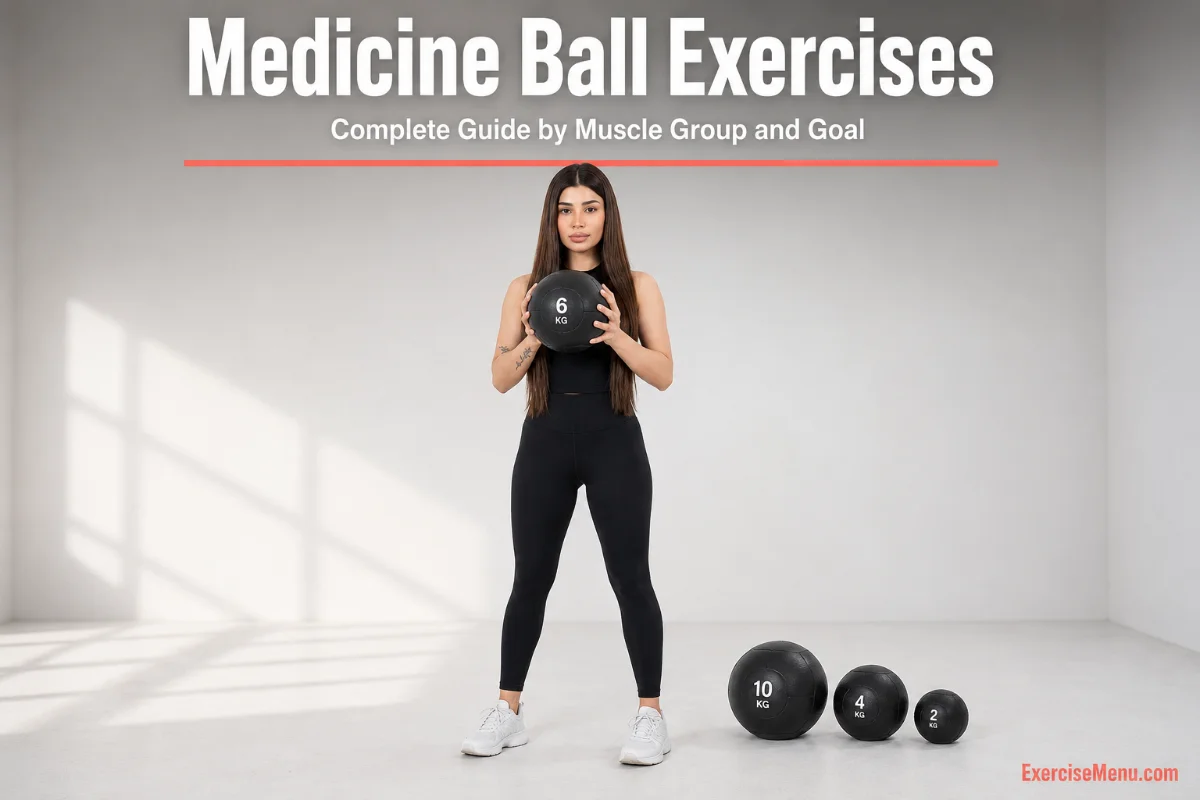
Quick Answer: A medicine ball trains strength, power, and core stability through pressing, throwing, and rotating movements. The guides below cover every muscle group — legs, arms, back, chest, shoulders, abs, and core with 10 exercises each, full circuits, and beginner-to-advanced progression. No gym required.
Most training tools move in straight lines. A medicine ball doesn’t. It can be pressed, slammed, thrown, caught, and rotated — which means it trains the explosive and rotational patterns that barbells and dumbbells structurally can’t replicate.
The guides below are organized by muscle group and by goal. Each covers 10 exercises with step-by-step instructions, sets, reps, and structured circuits.
How to Choose the Right Medicine Ball
| Level | Weight (lbs) | Weight (kg) | Ball Type |
|---|---|---|---|
| Beginner | 4–6 lbs | 2–3 kg | Soft rubber or slam ball |
| Intermediate | 8–10 lbs | 4–5 kg | Sand-filled slam ball |
| Advanced | 10–15 lbs | 5–7 kg | Sand-filled or dual-grip |
Start lighter than you think. A 6 lb ball held at arm’s length during a rotation or overhead slam creates significantly more demand than the same weight at chest height. For partner work and slams, a sand-filled slam ball is the better choice it doesn’t bounce unpredictably and grip stays secure throughout.
Medicine Ball Exercises by Muscle Group
Beginners
The starting point before anything else in this list. Covers 10 foundational movements — goblet squat, chest pass, overhead slam, Russian twist — with a 20-minute ready-to-use circuit. Start here before jumping to muscle-specific guides. Medicine Ball Exercises for Beginners →
Legs
10 exercises targeting the quads, hamstrings, glutes, and calves — goblet squats, reverse lunges, lateral lunges, and single-leg variations. Every movement uses the ball as a counterbalance or load, not just a prop. Medicine Ball Leg Exercises →
Arms
10 exercises targeting the biceps, triceps, and forearms through curl variations, overhead extensions, and pressing movements. The sphere grip changes the demand compared to a dumbbell handle — the forearms work continuously to stabilize it. Medicine Ball Arm Exercises →
Back
10 exercises targeting the lats, rhomboids, traps, and erector spinae. Includes row variations, deadlift patterns, and rotational movements that build both pulling strength and spinal stability — without a cable machine or pull-up bar. Medicine Ball Back Exercises →
Chest
10 exercises for the pectoralis major, anterior deltoid, and triceps — organized from beginner to advanced. Covers floor press, push-up variations, chest throws, and plyometric movements. The neutral grip reduces shoulder strain compared to a barbell. Medicine Ball Chest Exercises →
Shoulders
10 exercises targeting the deltoids, rotator cuff, and scapular stabilizers. Includes overhead pressing, lateral raises, wall throws, and shoulder stability work. The instability of the ball surface makes these more demanding on the stabilizing muscles than the same movements with a dumbbell. Medicine Ball Shoulder Exercises →
Abs and Core
10 exercises organized by muscle group — upper abs, lower abs, obliques, and full core — covering all four abdominal regions in one guide. Includes Russian twists, V-ups, dead bug variations, and standing rotational movements with 3 circuits from beginner to advanced. Medicine Ball Ab Exercises →
Lower Abs
A dedicated guide to the lower rectus abdominis and hip flexors — the area most ab routines underserve. 10 exercises specifically targeting the lower core with form cues and circuits. Medicine Ball Lower Ab Exercises →
Medicine Ball Exercises by Goal
Partner Training
10 exercises designed for two people and one ball — back-to-back rotations, sit-up passes, chest throws, partner leg raises. The partner element adds timing, coordination, and reaction demands that wall training can’t replicate. Includes 3 circuits by level and solo alternatives when a partner isn’t available. Partner Medicine Ball Exercises →
Kids
10 exercises for children under 12, designed for safety and engagement. Covers ball weight by age, supervised circuit format, and movements that build coordination and strength without complex mechanics. Medicine Ball Exercises for Kids →
How to Use Medicine Ball Exercises in Your Training
Medicine ball work fits into a training week three ways depending on your goal.
Standalone session: Use controlled exercises — floor press, rows, squats, shoulder press — in straight sets with 60–90 second rest. Research published in the Journal of Strength and Conditioning Research confirmed 12 weeks of medicine ball training improved muscular power and functional performance measurably compared to standard resistance training alone.
Finisher after strength training: Explosive movements — chest passes, overhead slams, rotational throws — work well as a 10–15 minute finisher after barbell or dumbbell work. Muscles are already warm and the explosive demand recruits fast-twitch fibers at speeds controlled lifting can’t reach.
Conditioning circuit: 6–8 exercises back to back with short rest raises heart rate while still building strength and coordination. A 2025 study in the Journal of Sports Science and Health found medicine ball training produced significant improvements in both muscle strength and dynamic balance in adults without requiring any additional equipment.
Two to three sessions per week is enough. The muscles trained need 48 hours between sessions regardless of the implement used.
Frequently Asked Questions
Can medicine ball exercises replace gym training?
For strength and conditioning — mostly yes. For maximum hypertrophy through progressive overload — no. A fixed-weight medicine ball eventually stops providing enough resistance to drive continued muscle growth.
Is medicine ball training good for weight loss?
It contributes through calorie burn and muscle retention, not directly. A calorie deficit drives fat loss — medicine ball training preserves muscle during that deficit, which improves body composition outcomes.
Can You Use a Medicine Ball to Improve Balance?
Yes — particularly through single-leg variations in leg exercises, unstable push-up positions, and catching unpredictable throws. The shoulder and leg guides both cover balance-specific movements.
Can You Get a Full Body Workout With Just a Medicine Ball?
Yes. The guides in this cluster cover legs, arms, back, chest, shoulders, and core — every major muscle group with circuits that require only a ball and floor space.
Why Do Athletes Use Medicine Balls?
Rotational throws and chest passes develop horizontal force production and fast-twitch power that standard lifting can’t replicate at the same speed directly transferable to blocking, throwing, and changing direction in sport.
Can you train with a medicine ball every day?
Not productively. Fatigue accumulates faster than adaptation when the same muscles train without recovery. The exception is active recovery work — light mobility or coordination drills that don’t load the same muscles trained the day before.
Written by Sadia Baloch — Exercise Menu
Want a Plan Built Around You?
A personalized training plan takes the guesswork out of which exercises to prioritize and how medicine ball work fits into your full week.
Ready to Start?
This plan works as written, but your schedule, experience level, and equipment might be different. Get a version built specifically around yours — with ongoing support.
START MY PLAN
Sadia Baloch is a FISAF-certified fitness trainer who has personally coached hundreds of clients over the past 7 years. She specializes in strength training, fat loss, and workout programming for beginners through intermediate lifters. Every article on ExerciseMenu.com is based on the same methods she uses with her in-person clients daily.