

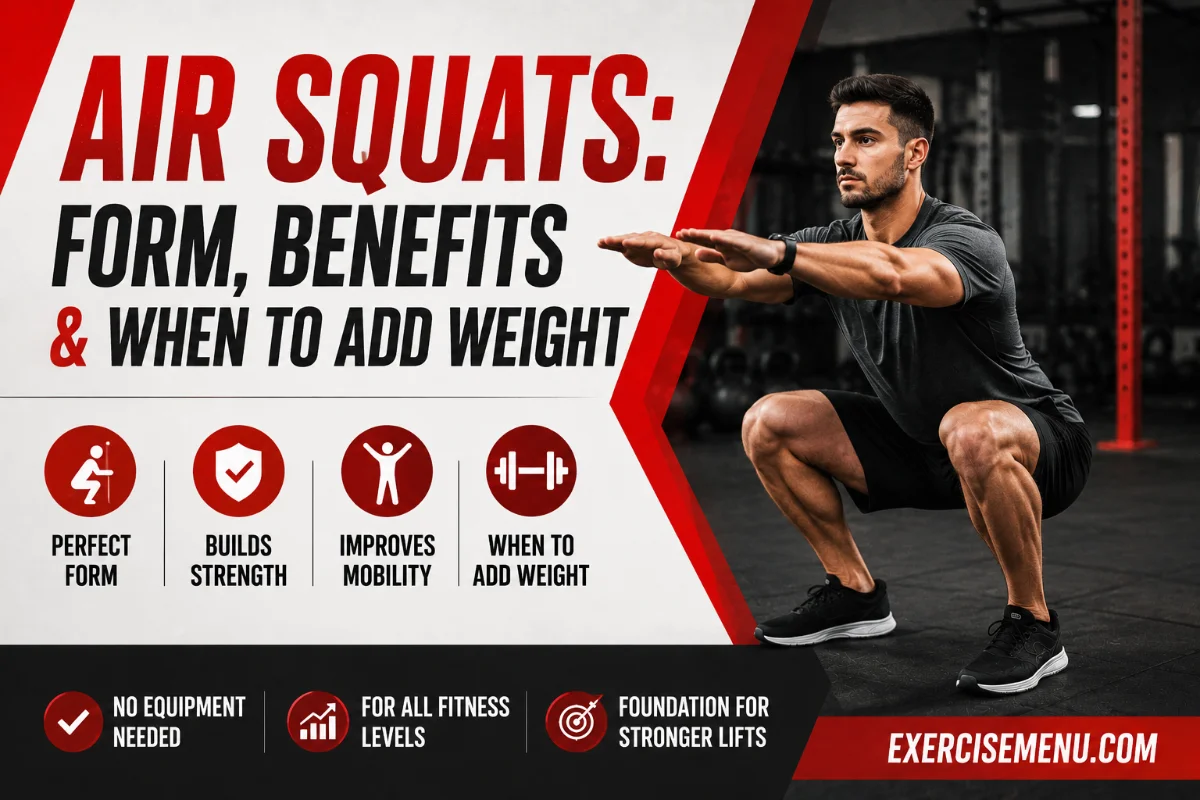
Quick Answer: The air squat is a bodyweight squat performed without equipment. It trains the quadriceps, glutes, hamstrings, adductors and core. Stand with feet shoulder-width apart, squat until your hip crease passes below your knees, then stand. Air squats build foundational strength for beginners and serve as a warm-up or conditioning tool for trained lifters.
The air squat is the simplest squat variation and the starting point for every loaded version that follows. It requires no bar, no rack and no gym. If you are looking for barbell squat technique instead, the front squat vs back squat comparison covers loaded squat differences in detail.
- What Is an Air Squat?
- How to Do an Air Squat?
- Muscles Worked by Air Squats
- Benefits of Air Squats
- Air Squats vs Regular Squats: What Is the Difference?
- Do Air Squats Build Muscle?
- Common Mistakes and How to Fix Them
- How Many Air Squats Should You Do?
- Air Squat Variations
- Who Should Be Careful With Air Squats?
- When to Progress Beyond Air Squats
- Frequently Asked Questions
- The Practical Takeaway
What Is an Air Squat?
An air squat is a squat performed using only your bodyweight for resistance. It is the same movement as a barbell squat, without the bar. The terms “air squat” and “bodyweight squat” mean the same thing.
The name became widely used through CrossFit, where air squats appear in warm-ups, conditioning workouts and benchmark tests. CrossFit’s air squat standards treat it as a foundational movement that every other squat builds from.
How to Do an Air Squat?
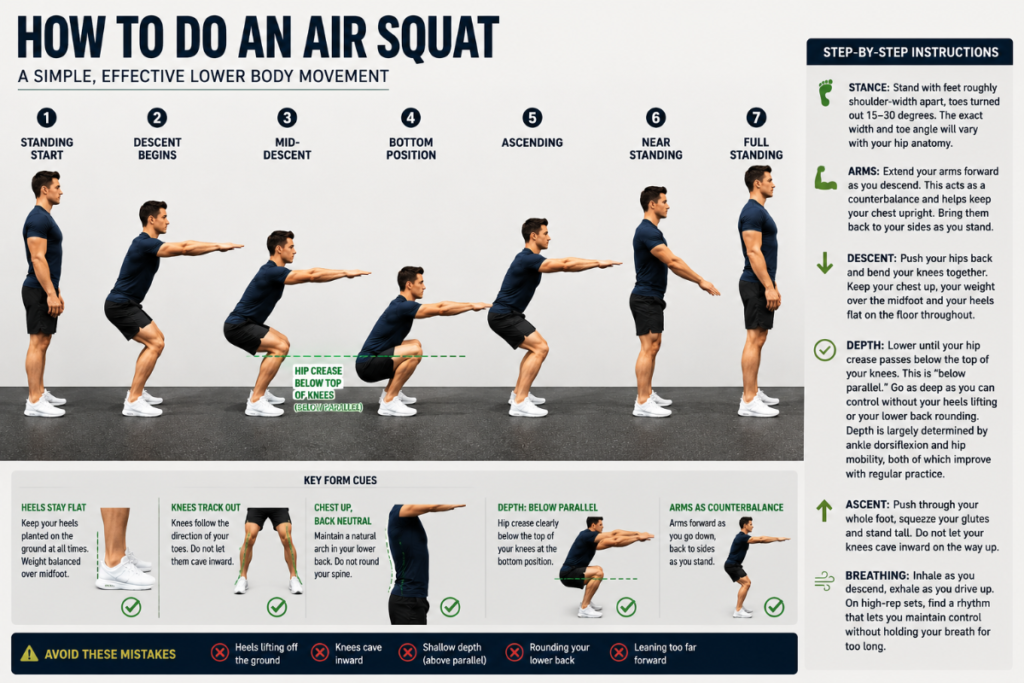
- Stance: Stand with feet roughly shoulder-width apart, toes turned out 15–30 degrees. The exact width and toe angle will vary with your hip anatomy.
- Arms: Extend your arms forward as you descend. This acts as a counterbalance and helps keep your chest upright. Bring them back to your sides as you stand.
- Descent: Push your hips back and bend your knees together. Keep your chest up, your weight over the midfoot and your heels flat on the floor throughout.
- Depth: Lower until your hip crease passes below the top of your knees. This is “below parallel.” Go as deep as you can control without your heels lifting or your lower back rounding. Depth is largely determined by ankle dorsiflexion and hip mobility, both of which improve with regular practice.
- Ascent: Push through your whole foot, squeeze your glutes and stand tall. Do not let your knees cave inward on the way up.
- Breathing: Inhale as you descend, exhale as you drive up. On high-rep sets, find a rhythm that lets you maintain control without holding your breath for too long.
Muscles Worked by Air Squats
The air squat is a compound movement that trains the entire lower body and trunk. The primary and secondary muscles are the same as a barbell squat; the difference is the load, not the pattern.
Quadriceps: The four muscles on the front of the thigh (rectus femoris, vastus lateralis, vastus medialis and vastus intermedius) do most of the work to extend the knee as you stand up. They are the primary mover in every squat variation.
Glutes: The gluteus maximus extends the hip as you rise from the bottom position. The deeper you squat, the more the glutes contribute. The gluteus medius and minimus stabilise the pelvis and help prevent the knees from collapsing inward.
Hamstrings and adductors: The hamstrings (biceps femoris, semitendinosus, semimembranosus) assist hip extension and help control the descent. The adductors on the inner thigh stabilise the knee and contribute more when the stance is wider.
Core, calves and stabilisers: The abdominals and spinal erectors brace the trunk to keep it upright. The calves (gastrocnemius and soleus) help maintain balance, particularly at the bottom of the squat where ankle dorsiflexion is greatest.
Benefits of Air Squats
No equipment needed. You can do air squats anywhere: at home, in a hotel room, in a park or as part of a gym warm-up. No bar, rack or spotter required.
Functional movement. Sitting into a chair, climbing stairs, picking something up from the floor and getting off the ground all use the squat pattern. Training it regularly keeps the movement easy as you age.
Builds the foundation for loaded squats. Learning to squat with bodyweight first builds the balance, depth and motor pattern you need before adding a barbell. Skipping this step is a common reason lifters struggle with form under load.
Improves mobility. Practising full-depth air squats over time increases usable range at the ankles, knees and hips. This carries over directly to barbell squat depth.
Works as conditioning. High-rep air squats raise the heart rate quickly because the leg muscles are large and demand significant oxygen. Sets of 20–50 reps are a simple way to add a cardio element to a strength session.
Safe entry point for older adults and beginners. Air squats allow you to build lower-body strength and confidence with minimal injury risk. For older adults, squatting regularly supports the ability to stand from a chair and maintain independence.
Air Squats vs Regular Squats: What Is the Difference?
The movement pattern is the same. The difference is resistance: air squats use only bodyweight, while regular squats add external load with a barbell, dumbbells or a kettlebell. Neither is better in absolute terms; they serve different purposes.
| Feature | Air squat | Loaded squat (barbell/dumbbell) |
| Resistance | Bodyweight only | External weight added |
| Equipment | None | Barbell, rack, dumbbells or kettlebell |
| Best for | Learning the pattern, warm-up, conditioning, home training | Building maximal strength and muscle mass |
| Strength ceiling | Limited by bodyweight (diminishing returns after beginner phase) | Scalable with progressive overload |
| Injury risk | Low | Higher if technique breaks down under load |
| Muscle growth | Effective for beginners; limited for trained lifters | Effective at all levels with appropriate load |
Do Air Squats Build Muscle?
Yes, but with a clear limitation. For someone new to training, air squats provide a novel stimulus that can build quad and glute size during the first 4–8 weeks. After that, your muscles adapt to your bodyweight and need more resistance to keep growing. This is basic progressive overload — the same principle that applies to every exercise.
For trained lifters, air squats are useful as a warm-up, a conditioning finisher or a recovery-day movement. They will maintain some muscle endurance but will not drive meaningful hypertrophy if your legs are already adapted to heavier loads. To keep building muscle, progress to goblet squats, dumbbell squats or barbell squats.
Common Mistakes and How to Fix Them
| Mistake | Why it matters | Fix |
| Knees caving inward | Reduces glute activation and stresses the knee | Push knees out toward pinky toes throughout the rep |
| Heels lifting off the floor | Shifts load to quads only and reduces balance | Keep weight over midfoot; widen stance or reduce depth temporarily |
| Not squatting deep enough | Limits glute and hamstring contribution | Aim for hip crease below knee; improve ankle and hip mobility over time |
| Excessive forward lean | Turns the squat into a hinge; loads the lower back | Keep chest up and arms forward as a counterbalance |
| Rushing reps | Reduces time under tension and control | Use a 2-second descent; pause briefly at the bottom |
How Many Air Squats Should You Do?
The right number depends on what you are using air squats for. Below is a simple framework by goal.
| Goal | Sets × Reps | Frequency | Notes |
| Warm-up before lifting | 2 × 10–15 | Before each session | Slow and controlled; focus on depth and mobility |
| Beginner strength | 3 × 15–20 | 3 times per week | Add reps or sets each week until 3 × 25 feels comfortable |
| Conditioning / endurance | 3–4 × 25–50 or AMRAP circuits | 2–3 times per week | Higher reps at a steady pace; rest 60–90 seconds between sets |
| 100 a day challenge | Any split across the day | Daily for 2–4 weeks | Builds endurance and habit; diminishing muscle-building returns after the first few weeks |
Once 3 sets of 25 controlled reps feel easy, the air squat is no longer challenging enough to build strength. That is the signal to add resistance or switch to a harder variation. This guide to rep ranges explains how rep targets change with different training goals.
Air Squat Variations
Pause squat: Hold the bottom position for 2–3 seconds before standing. This removes the stretch reflex and makes each rep significantly harder without adding weight.
Tempo squat: Use a 3-second descent, 1-second pause, then stand at normal speed. Increases time under tension and builds control through the weakest part of the range.
Jump squat: Descend into a normal air squat, then explode upward so your feet leave the floor. Land softly with bent knees. Builds lower-body power and raises heart rate quickly. Avoid if you have knee pain on landing.
Sumo air squat: Take a wider-than-shoulder stance with toes turned out further. Shifts more demand to the adductors and glutes while reducing the ankle mobility requirement.
Single-leg progression: Start with split squats (one foot forward, one back), then progress toward a pistol squat over time. This is the most advanced bodyweight squat variation and requires significant strength, balance and ankle mobility.
For a side-by-side comparison of all 17 squat variations across bodyweight, dumbbell, barbell, and machine categories, the full guide covers each one by muscles, difficulty, and goal.
Who Should Be Careful With Air Squats?
Air squats are low-risk for most people, but some situations require modification.
If you have an active knee or hip injury, reduce depth to the pain-free range or use a chair for support. If squatting causes sharp, radiating or persistent pain in any joint, stop and have it assessed by a qualified clinician before continuing.
Older adults or people returning to exercise after a long break can start with chair-assisted squats: stand in front of a sturdy chair, squat down until you lightly touch the seat, then stand back up. This builds confidence and strength with a safety net. As control improves, remove the chair and use a full-depth air squat.
When to Progress Beyond Air Squats
Air squats are a starting point, not a permanent programme. Once you can perform 3 sets of 20–25 controlled, below-parallel reps without losing form, you are ready for more resistance.
Step 1 — Goblet squat: Hold a dumbbell or kettlebell at chest height. This adds load while keeping the upright torso pattern from the air squat. Start with a weight that makes 12–15 reps challenging.
Step 2 — Barbell squat: Once you can goblet squat a meaningful weight (20–25 kg / 45–55 lb) for controlled sets, the barbell is a natural next step. The front squat vs back squat comparison and high bar vs low bar squat guide will help you choose which bar position to start with.
To see how your squat compares to other lifters once you start loading the bar, the average squat weight standards page shows benchmarks by bodyweight, age and experience level.
Frequently Asked Questions
Can You Do Air Squats Every Day?
Yes. Because there is no external load, air squats produce less muscle damage than barbell squats and recovery is faster. Daily air squats are fine for mobility and conditioning. If you feel joint soreness or fatigue that affects form, take a rest day.
Will 100 Air Squats a Day Build Muscle?
In the first few weeks, 100 daily air squats can build some muscle and endurance in the quads and glutes, especially if you are new to training. After that, your muscles adapt and the 100-rep stimulus becomes a conditioning exercise rather than a muscle-building one. To keep growing, add resistance or use harder variations.
How Deep Should You Go on an Air Squat?
Aim for your hip crease to pass below the top of your knees. This is “below parallel” and ensures the glutes and hamstrings contribute fully. If you cannot reach that depth without your heels lifting or your back rounding, work on ankle and hip mobility gradually rather than forcing the position.
Are Air Squats Good for Your Knees?
For most people, yes. Air squats strengthen the muscles around the knee, which can improve joint stability over time. If you have an existing knee condition, start with a reduced range of motion and increase depth as comfort allows. Sharp or worsening knee pain during air squats is a reason to stop and seek assessment, not to push through.
Are Air Squats Better Than Goblet Squats?
They serve different stages. Air squats are the entry point for learning the pattern and training without equipment. Goblet squats add resistance and are better for building strength once air squats feel easy. Use air squats first, then progress to goblet squats when you need more challenge.
Do Air Squats Count as Cardio?
High-rep air squats raise the heart rate significantly because the leg muscles are large and demand heavy oxygen delivery. Sets of 20–50 reps at a steady pace can function as light-to-moderate cardio. They are not a replacement for dedicated cardiovascular training, but they add a conditioning element to any session.
The Practical Takeaway
The air squat is the foundation of every squat variation. Master it first: full depth, heels flat, knees tracking with toes, controlled pace. Use it as a warm-up before barbell work, as a conditioning tool in high-rep circuits, or as your primary leg exercise until you are ready to add load. When 25 clean reps feel easy, progress to goblet squats, then to the barbell.
Fitness Disclaimer: If you have an existing injury or medical condition, check with your doctor before starting a new programme or changing your training. The information in this article is for educational purposes and does not replace individual assessment by a qualified health or fitness professional.

2 Comments
Pingback: Dumbbell Sumo Squat: Form, Muscles & Benefits
Pingback: 17 Types of Squats: Muscles, Difficulty and How to Choose