

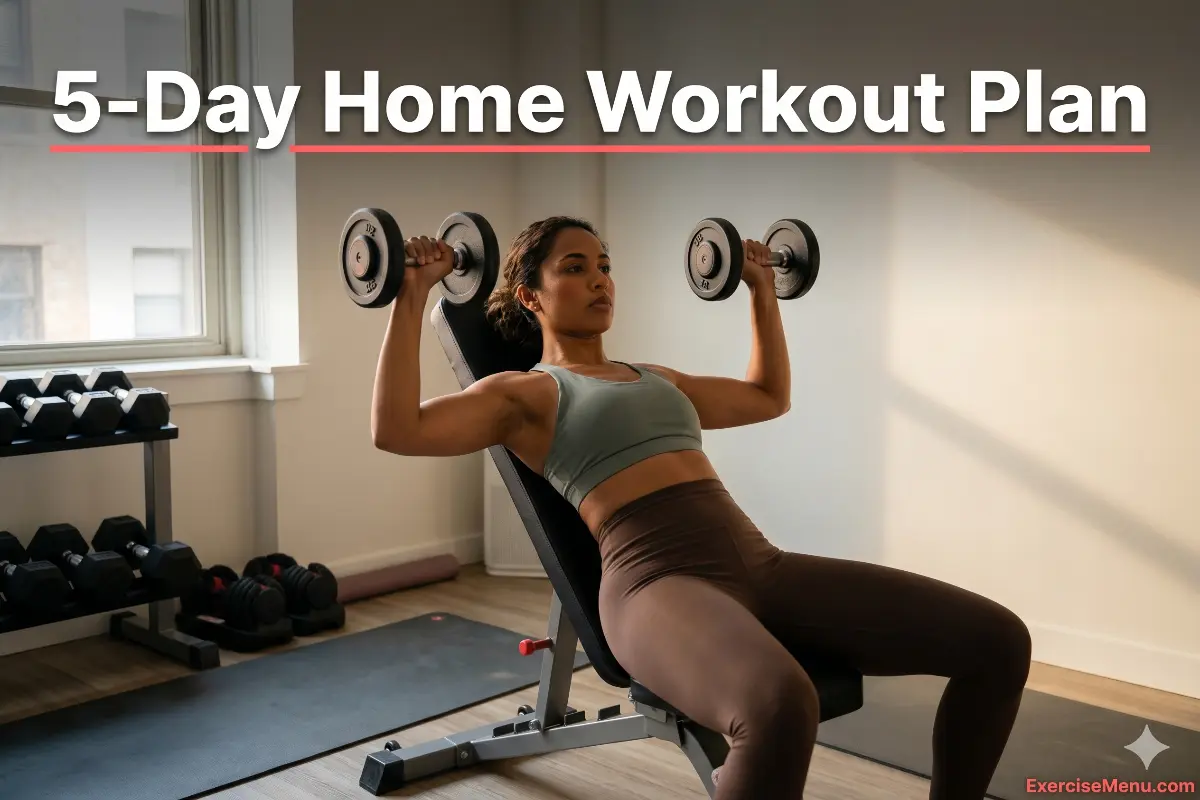
Quick Answer: Train 5 days a week using an Upper/Lower/Push/Pull/Legs split — 3-4 sets of 6-12 reps per exercise, with dumbbells, an adjustable bench, and resistance bands. Rest 60-90 seconds between sets. This structure hits every muscle group twice per week, which research consistently shows builds more muscle than training each muscle once.
Most “5-day workout plan” guides assume a commercial gym — a cable station, a leg press, dumbbells heavy enough to challenge an advanced lifter. That’s not what most people training at home actually have. At home, the plan has to work with a set of adjustable dumbbells, maybe a bench, maybe a few resistance bands.
No cable machines, no leg press, no assumptions about equipment you don’t have — every exercise below uses what a home setup actually has.
How Should You Structure Your 5 Training Days?
Push/Pull/Legs combined with an Upper/Lower split is the most effective 5-day structure for home training, because it hits each muscle group twice per week instead of once.
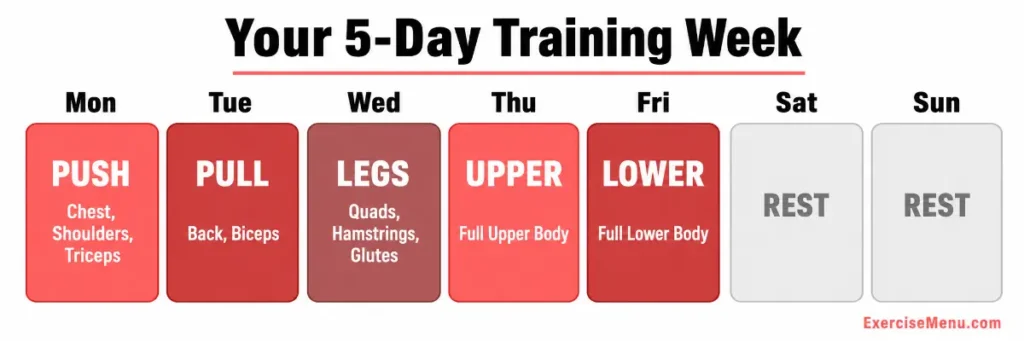
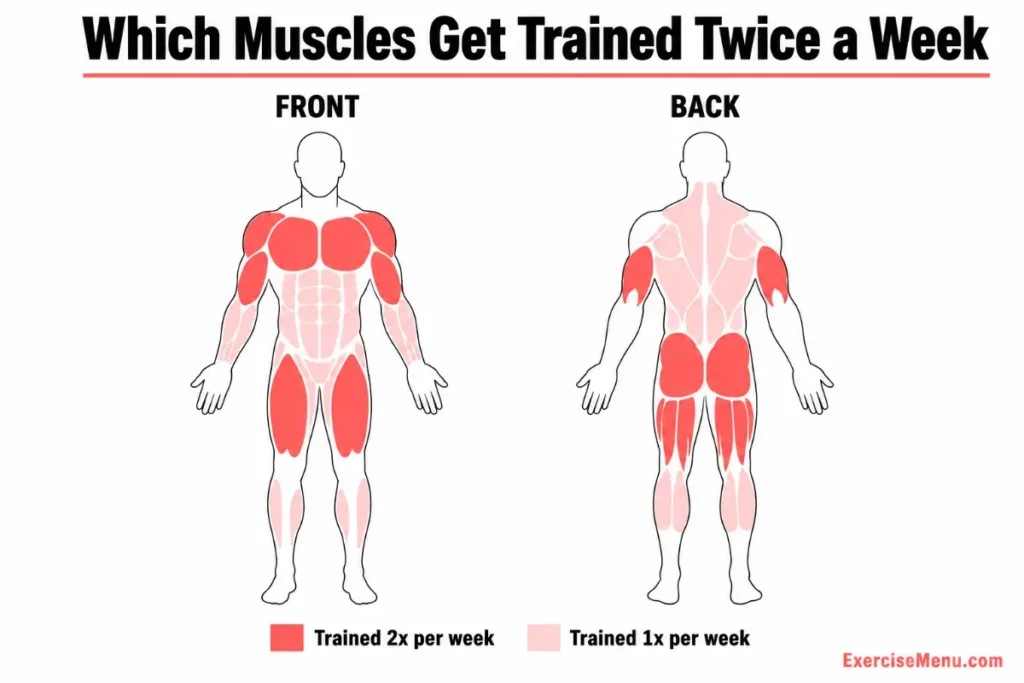
The first three days isolate movement patterns — push, pull, legs. The last two days revisit upper and lower body as a whole, giving every muscle group a second exposure before the week resets. A 2017 meta-analysis published in the Journal of Sports Science found that training a muscle twice per week produces meaningfully more growth than training it once — which is exactly why the second exposure on Day 4 and Day 5 matters more than it might look on paper.
If your week doesn’t allow five consecutive training days, push the rest days to Wednesday and Sunday instead. The order matters less than keeping two non-consecutive rest days somewhere in the week.
What Does Each Day Look Like?
Every session below uses only dumbbells, an adjustable bench, and resistance bands — nothing else.
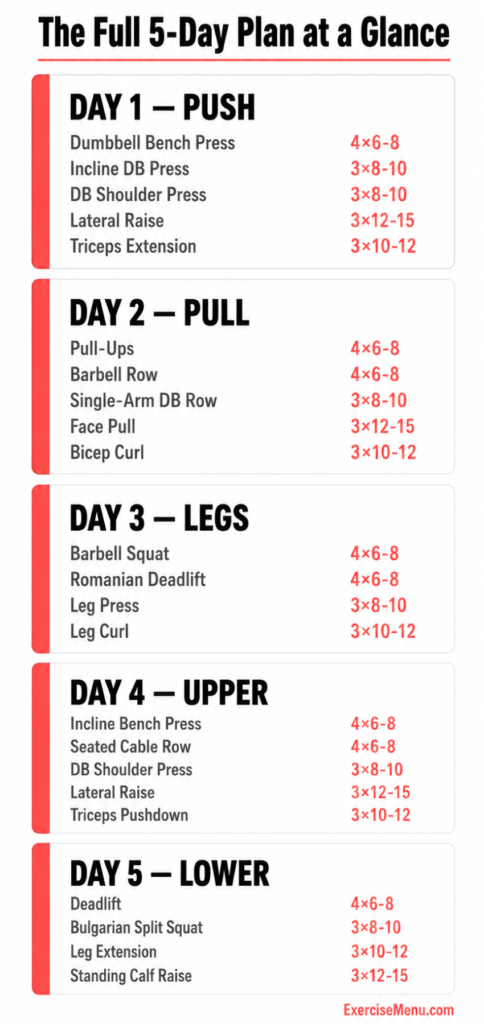
That’s 17-22 working sets per session — enough volume to drive growth without sessions running past 50-60 minutes.
What Equipment Do You Need for This Plan?
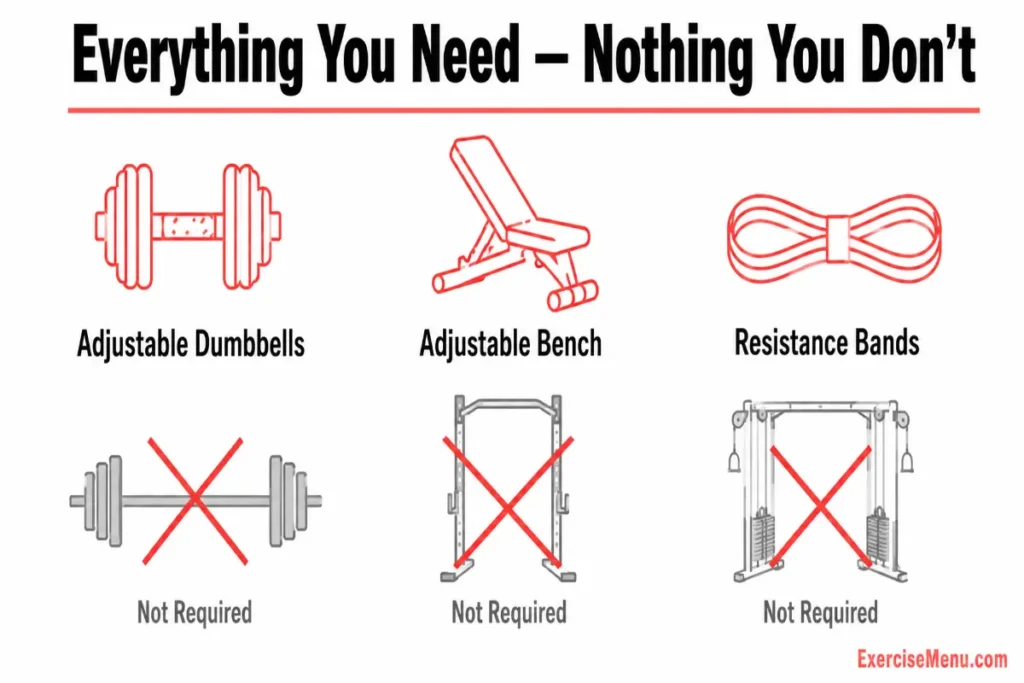
- A set of adjustable dumbbells (or two fixed pairs covering your current working range)
- An adjustable bench, or a sturdy flat surface that works as one
- A set of resistance bands for rows, pulldowns, and face pulls
That’s the full list. No barbell, no power rack, no cable station required. If you have a barbell and plates, you can substitute it into the squat and Romanian deadlift movements, but it isn’t necessary to run this plan effectively.
How Do You Progress Without Adding More Equipment?
Progressive overload doesn’t require buying heavier dumbbells every few weeks — most home gyms have a fixed weight ceiling, and the plan has to work within it.
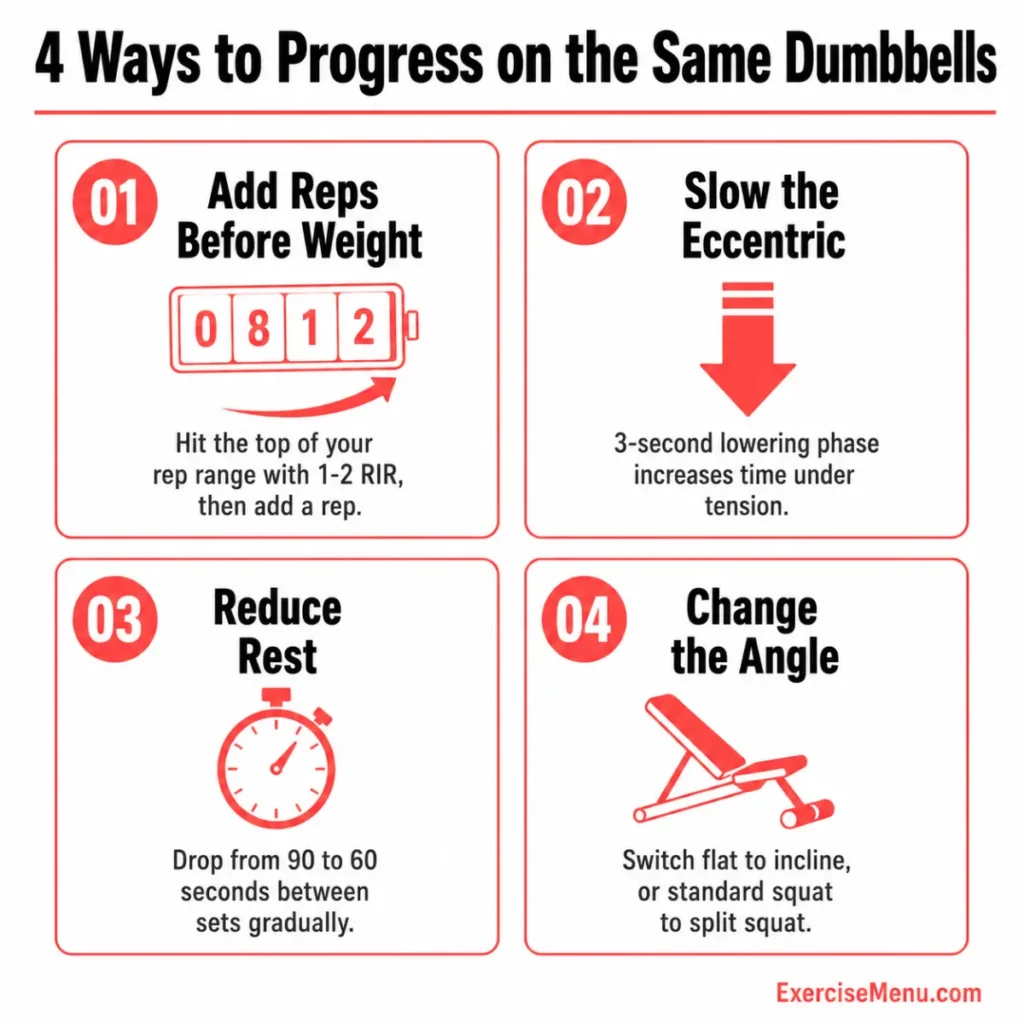
Add reps before adding weight. When you can complete every set at the top of the rep range with 1-2 reps left in reserve, add one rep to each set the following week before increasing load.
Slow the eccentric. A 3-second lowering phase on presses, rows, and squats increases time under tension without needing more weight on the dumbbells.
Reduce rest between sets. Dropping from 90 seconds to 60 seconds over a few weeks increases the metabolic demand of the same weight and reps.
Change the angle, not just the load. Switching from flat to incline press, or standard squat to Bulgarian split squat, creates a new stimulus once your current dumbbells stop being challenging at higher reps.
When your dumbbells genuinely run out of room to progress — typically once you’re hitting 20+ reps with clean form — that’s the point to invest in heavier pairs or a loadable adjustable set.
What Should You Eat to Support This Plan?
Training gives your body a reason to build muscle. Whether it actually does depends largely on what you eat and how much you sleep.
A daily protein intake of 1.6-2.2g per kg of bodyweight supports muscle repair across a 5-day training week — splitting that across 3-4 meals keeps amino acids available throughout the day rather than in one large dose.
This range aligns with the International Society of Sports Nutrition’s position stand on protein intake. A modest calorie surplus of 200-300 calories above maintenance gives your body the energy to build new tissue without excessive fat gain.
Most muscle repair happens during deep sleep — consistently getting under 6 hours undermines recovery regardless of how well the training and nutrition are dialed in.
Is This Plan Also Good for Losing Weight?
Yes — but the result you get from it changes.
Five days of resistance training preserves and builds muscle, which raises resting metabolic rate over time. If your goal is fat loss rather than muscle gain, run this exact plan in a modest calorie deficit instead of a surplus — 300-500 calories below maintenance. The training stays the same; only the calorie target changes.
In a deficit, expect to maintain strength and muscle while losing fat, rather than building significant new muscle at the same time. True recomposition — losing fat and building muscle simultaneously — does happen, but slowly, and works best for beginners or those returning to training after time off.
Frequently Asked Questions
Is a 5-day workout plan too much for a beginner?
For someone with under 6 months of consistent training, yes — a 3-day full-body plan builds the same strength and movement foundation with less recovery demand. Move to this 5-day structure once that base is in place.
Can I do this plan with only dumbbells and no bench?
Yes, with modifications. Replace bench press with floor press, and use single-arm rows supported against a sturdy chair instead of a bench. Squats, lunges, and shoulder presses don’t require a bench at all.
How long should each session take?
45-60 minutes including a brief warm-up. If sessions are consistently running longer, the exercise list is too broad — trim one accessory movement per day rather than rushing through all of them.
What if I can only train 4 days instead of 5?
Drop Day 5 — the plan still works, with every muscle group trained at least once and upper body getting a second session on Day 4.
Do I need a barbell to build real muscle at home?
No. Dumbbells, when loaded heavy enough and taken close to failure, produce comparable strength and hypertrophy outcomes to barbell training for most muscle groups. A barbell adds convenience for very heavy compound lifts, not a requirement for growth
Ready to Start?
This plan works as written, but your schedule, experience level, and equipment might be different. Get a version built specifically around yours — with ongoing support.
START MY PLAN