

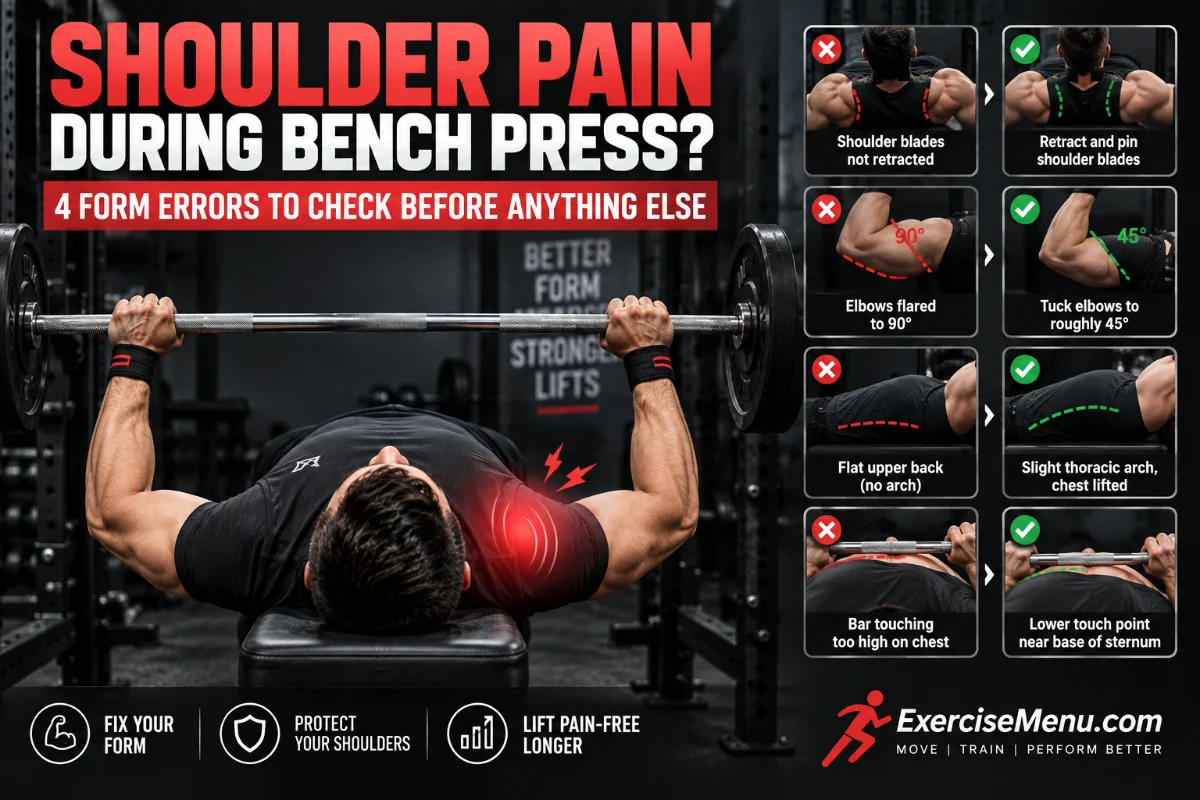
Quick Answer: Most shoulder discomfort during bench press comes from four form errors: losing shoulder blade retraction, flaring elbows to 90 degrees, pressing with a flat back, and touching the bar too high on the chest. Each one shifts stress to the front of the shoulder joint. Fixing the specific error usually resolves the discomfort within a few sessions.
Your shoulder does not hurt because bench pressing is bad for shoulders. It hurts because something in your setup is placing the shoulder joint in a position where it absorbs more stress than it can handle rep after rep.
The front of the shoulder takes the most punishment during a bench press when form breaks down. That’s where the rotator cuff tendons, the biceps tendon, and the joint capsule sit closest together. When your elbows flare wide, your shoulder blades slide apart, or the bar touches too high on your chest, the space between those structures narrows and the compressive load increases. Fix the form error, and the stress reduces.
- Four Form Errors That Stress the Shoulder During Bench Press
- Why Losing Your Shoulder Blade Position Causes Most Bench Press Shoulder Problems?
- What Happens When Your Elbows Flare to 90 Degrees?
- Why Pressing With a Flat Back Puts Your Shoulders at Risk?
- How Bar Path and Touch Point Affect the Shoulder?
- Why Shoulder Discomfort Often Appears Late in a Set?
- A Pre-Bench Shoulder Warm-Up (4 Exercises, 3 Minutes)
- Bench Press Modifications When Discomfort Persists After Form Correction
- When to Stop Benching and See a Professional?
- Frequently Asked Questions
- Your Next Step
Four Form Errors That Stress the Shoulder During Bench Press
| Form Error | Where Stress Concentrates | Fix |
|---|---|---|
| Shoulder blades not retracted | Front of the shoulder joint | Pin blades together before unracking |
| Elbows flared to 90° | Front of shoulder + subacromial area | Tuck elbows to roughly 45° |
| Flat upper back (no arch) | Front of shoulder (internal rotation under load) | Slight thoracic arch, chest lifted |
| Bar touching too high on chest | Front of shoulder (excessive abduction) | Lower touch point near base of sternum |
Noteboom et al. (2024) published the first study in Frontiers in Physiology to measure actual joint forces during bench press technique variations. Their findings confirmed what experienced coaches have taught for years: retracted scapulae combined with a 45-degree elbow angle and a moderate grip width produced the lowest shoulder joint forces. Releasing the scapulae and pressing with 90-degree abduction produced the highest.
Why Losing Your Shoulder Blade Position Causes Most Bench Press Shoulder Problems?
When your shoulder blades are pinched together and pressed into the bench, they create a stable shelf for the shoulder joint to sit on. This position pulls the humeral head (the ball of the upper arm bone) backward and externally rotates the shoulder, keeping the front of the joint open and the rotator cuff tendons in a comfortable position.
When the blades slide apart mid-set, the shoulder rolls forward. That forward roll narrows the space at the front of the joint and puts compressive load on structures that were never meant to bear the full weight of the barbell.
The fix: Before you unrack the bar, grab the bar, pull your shoulder blades together and down as if tucking them into your back pockets. You should feel a tight squeeze between the blades. Hold that squeeze for every rep of every set. The moment you feel the blades loosen, the set is done.
Activation drill before benching: Lie face down on a bench with arms hanging. Pull your shoulder blades together and hold for 5 seconds. Release and repeat 10 times. This fires up the rhomboids and mid-trapezius so the retraction is easier to maintain under load.
What Happens When Your Elbows Flare to 90 Degrees?
Pressing with your elbows perpendicular to your torso maximizes shoulder abduction. Noteboom et al. measured the highest glenohumeral and acromioclavicular joint forces at this angle. At 90 degrees, the shoulder is in its most internally rotated position under load, and the subacromial space narrows with every rep.
Tucking the elbows to roughly 45 degrees from the torso reduces abduction, opens the subacromial space, and distributes the pressing load across the chest, triceps, and front delts more evenly.
The fix: Think “elbows at 45, not 90.” Your upper arms should form a roughly 45-degree angle with your torso at the bottom of each rep, not a T-shape. If you’re used to pressing with flared elbows, the weight will feel harder at first because the triceps contribute more at 45 degrees. Drop the weight by 10 to 15% while you adjust and rebuild from there.
A narrower grip width naturally reduces elbow flare. If tucking your elbows at your current grip width feels forced, bringing your hands in by one to two finger widths often solves the problem without any conscious cueing.
Why Pressing With a Flat Back Puts Your Shoulders at Risk?
Pressing with a completely flat upper back and retracted shoulder blades is a contradiction. The flat surface of the bench pushes the shoulders forward, undermining the retraction you worked to set up. A slight arch in the upper back lifts the chest and keeps the shoulder joint in an externally rotated, safer position throughout the press.
This is not the exaggerated powerlifting arch. It’s 2 to 3 centimeters of thoracic extension, enough that your chest rises above the plane of your shoulders. The lower back does not need to leave the bench.
The fix: With your shoulder blades already retracted (from the setup described above), drive your upper back into the bench. Your chest should rise and your ribcage should point toward the ceiling. Your shoulders sit lower on the bench than your sternum. The arch and the retraction work together: without the arch, the flat bench surface pushes the shoulders forward even when the blades are squeezed.
How Bar Path and Touch Point Affect the Shoulder?
When the bar touches high on the chest, near the clavicle, the elbows are forced into a wider, more abducted position. This replicates the same 90-degree flare pattern that increases shoulder joint forces.
Lowering the touch point to the lower sternum or upper abdomen area allows the elbows to tuck naturally to 45 degrees. The bar path should follow a slight diagonal: it starts directly above the shoulders at lockout and descends to the lower chest.
The fix: On your next warm-up set, pay attention to where the bar makes contact. If it’s above your nipple line, it’s too high. Aim lower, roughly where your sternum meets your upper abs. The diagonal bar path happens naturally when the touch point is correct.
Why Shoulder Discomfort Often Appears Late in a Set?
Your shoulder may feel fine on rep 1 and start hurting on rep 7. The form error isn’t there at the start. It builds as you fatigue.
A 2024 narrative review by Motlagh and Lipps in the Journal of Strength and Conditioning Research examined how muscular fatigue alters shoulder biomechanics during bench press. As the stabilizing muscles around the scapulae and rotator cuff fatigue, shoulder blade retraction loosens, elbows drift wider, and the bar path shifts. The form errors from this article don’t start at rep 1. They creep in at rep 6, 7, or 8 when the stabilizers can no longer hold position.
This explains why your shoulder “only hurts on heavy sets” or “only on the last few reps.” The weight isn’t the problem. The fatigue-driven loss of scapula position is.
The fix: End your bench press sets when you can no longer maintain a tight shoulder blade squeeze. If your blades release before you hit your target reps, the weight is too heavy for that rep range. Using RPE or RIR-based training rather than grinding to absolute failure on bench press protects the shoulder from the reps where form breaks down most.
A Pre-Bench Shoulder Warm-Up (4 Exercises, 3 Minutes)
The form corrections above work better when the shoulder joint is warm and the stabilizing muscles are already firing. These four exercises take three minutes and prepare the exact structures that hold your scapulae in place under load.
1. Band pull-aparts (scapular retraction + external rotation) 2 sets of 15. Squeeze the shoulder blades at the end of each rep.
2. Face pulls with external rotation (rotator cuff activation) 2 sets of 12. Pull to face level, then rotate hands upward so your fists point at the ceiling. This warms up the external rotators that stabilize the shoulder under load.
3. Thoracic extension over foam roller (upper back mobility) Place the foam roller across your upper back. Extend backward over it for 2 to 3 seconds, return. 10 reps. This mobilizes the thoracic spine so the chest-up position is easier to achieve during the press.
4. Light dumbbell press at 40% working weight (movement rehearsal) 8 controlled reps. Focus on maintaining scapula retraction and a 45-degree elbow angle throughout. This warms up the pressing pattern with the corrections already applied.
For a full warm-up guide covering the general preparation that should come before these shoulder-specific exercises, see the warm-up guide.
Bench Press Modifications When Discomfort Persists After Form Correction
If correcting the four form errors above reduces but does not eliminate discomfort, these modifications change the pressing mechanics enough to keep training productive while the shoulder settles.
| Modification | Why It Helps |
|---|---|
| Floor press | The floor limits how far the elbows travel behind the body, reducing end-range shoulder stress |
| Dumbbell bench press | Each arm moves independently, finding its natural shoulder path rather than being locked to a fixed barbell |
| Neutral-grip dumbbell press | Palms face each other, eliminating the internal rotation that a pronated barbell grip creates |
| Pin press or dead press | Bar starts from pins at mid-range, removing the bottom position where shoulder stress peaks |
Use these as temporary replacements, not permanent substitutions. The barbell bench press is the goal. These modifications buy time while form corrections take effect.
When to Stop Benching and See a Professional?
Form corrections resolve most bench-press-related shoulder discomfort. But some symptoms fall outside the scope of technique adjustments.
Stop the session and consult a physiotherapist or sports medicine professional if you notice:
- Sharp pain that increases with every rep instead of settling
- Shoulder gives way or feels unstable under the bar
- Significant swelling in the shoulder area after training
- Inability to raise the arm overhead or behind the back without pain outside of training
- Clicking, catching, or locking that wasn’t present before
- Discomfort that persists for more than 48 hours after benching
If you’ve applied the form corrections from this article and discomfort hasn’t improved within two to three sessions, that’s also worth having assessed. Not every issue is a form issue, and earlier assessment leads to faster resolution.
Frequently Asked Questions
Can tight chest muscles contribute to bench press shoulder discomfort?
Yes. Hours of sitting with rounded shoulders shortens the pecs and pulls the shoulder joint forward into internal rotation. When you lie on a bench in that position, the shoulder starts the press already compromised. Stretching the pecs after bench sessions (doorway stretch, 30 seconds per side) and strengthening the upper back with rows and face pulls help restore the balance over time.
Is shoulder clicking during bench press a problem?
Painless clicking or popping is common and usually harmless. It often comes from tendons gliding over bony prominences. Clicking accompanied by pain, catching, or instability is different and should be assessed by a professional.
Can weak rotator cuff muscles cause bench press shoulder discomfort?
Yes. The rotator cuff stabilizes the humeral head in the socket during pressing. When these muscles are weak relative to the chest, triceps, and front delts, the shoulder relies on passive structures for stability. Face pulls and external rotation work done twice a week address this without needing separate rehab sessions.
Does incline bench press cause more shoulder stress than flat bench?Does incline bench press cause more shoulder stress than flat bench?
Incline pressing shifts more demand to the anterior deltoid and upper pec. For some lifters this increases front-of-shoulder stress, especially above 45 degrees of incline. If flat bench is comfortable but incline causes discomfort, try a 15 to 30 degree incline and apply the same elbow tuck and scapula retraction cues.
How long does bench-press-related shoulder discomfort take to improve after fixing form?
Form-related discomfort typically improves within two to four sessions once the specific error is corrected and load is managed. If the discomfort has been building over weeks or months of poor form, the tissue may be more irritated and could take two to three weeks of corrected form at reduced load to settle fully.
Your Next Step
Grab your phone and film one set of bench press from the side. Check three things: are your shoulder blades squeezed together throughout, are your elbows roughly 45 degrees at the bottom, and does the bar touch below the nipple line? The error you spot is the one to fix first. Give the correction two to three sessions before reassessing.
