


Quick Answer:
Yes. One cup of cottage cheese provides 28g of casein-dominant protein that releases amino acids gradually for hours after eating. A 2018 study in the British Journal of Nutrition found that pre-sleep cottage cheese elevated next-morning resting metabolic rate comparably to a casein supplement — the first study to confirm this with whole food rather than a powder. Cottage cheese is strongest after evening sessions and on rest days.
Greek yogurt, protein shakes, and chicken breast dominate the post-workout conversation. Cottage cheese rarely comes up — despite having a protein profile that outperforms all three in one specific recovery scenario.
The distinction comes down to casein. While whey protein spikes amino acid levels within 60 minutes and drops off, casein forms a gel in the stomach that releases amino acids gradually over several hours. Cottage cheese is roughly 80% casein and 20% whey — giving you both an immediate amino acid rise and a sustained supply that continues working while you sleep or rest.
What Makes Cottage Cheese a Strong Post-Workout Protein?
Cottage cheese delivers 28g of complete protein per cup (226g) with a PDCAAS score of 1.0 — the highest possible rating for protein quality. It hits the 2.5g leucine threshold needed to trigger muscle protein synthesis, which most plant-based protein sources cannot achieve in a single serving.
Cottage Cheese — Per 1 Cup (226g, 2% Milkfat)
- Protein: 28g (80% casein, 20% whey)
- Calories: 183
- Fat: 5.3g
- Carbohydrates: 5.5g
- Leucine: ~2.5g (meets MPS trigger threshold)
- Calcium: 227mg (18% daily value)
- PDCAAS: 1.0 (maximum score)
A 2018 study published in the British Journal of Nutrition tested cottage cheese directly — not casein powder, not dairy blends, but actual cottage cheese consumed 30–60 minutes before sleep. The results showed that whole-food cottage cheese elevated next-morning resting metabolic rate and maintained overnight amino acid availability comparably to a casein supplement.
Most “casein recovery” research uses isolated powders, not real food — this was the first study to confirm that cottage cheese produces equivalent metabolic outcomes. And unlike a powder, cottage cheese delivers additional calcium, B vitamins, and phosphorus alongside the protein.
When Is Cottage Cheese the Best Post-Workout Option?
After evening workouts and before bed — when 4–7 hours of sustained amino acid delivery aligns with your body’s overnight repair cycle. No fast-digesting protein source can match this sustained delivery.
- Evening training sessions (6–9 PM): You eat, then sleep 2–3 hours later. Fast proteins like whey spike and drop before your deepest recovery window. Casein from cottage cheese sustains amino acid levels through the first 4–5 hours of sleep — the period when growth hormone peaks and muscle protein synthesis is most active.
- Rest days: You are not training, but recovery is still happening. A cup of cottage cheese between meals extends amino acid availability without requiring constant eating. The slow digestion means one serving covers a longer gap than whey or eggs.
- When appetite is low: 183 calories for 28g of protein is one of the highest protein-per-calorie ratios of any whole food. For anyone struggling to hit daily protein targets without excess calories, cottage cheese delivers more protein per calorie than almost any other whole food.
When cottage cheese is not the best choice: immediately after a high-intensity morning session when you need rapid amino acid delivery and are eating a full breakfast within 30–60 minutes. In that scenario, eggs or Greek yogurt deliver protein faster because whey-dominant sources reach peak amino acid levels within 60 minutes. For morning-specific options, see our guide on the best post-workout breakfast.
How Does Cottage Cheese Compare to Other Post-Workout Foods?
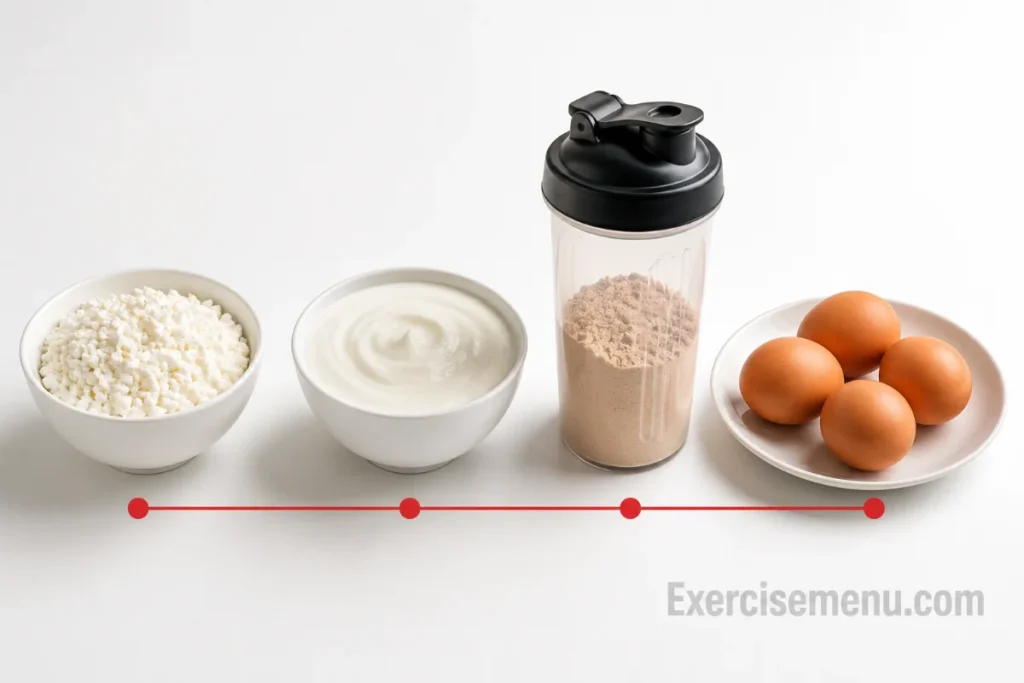
Cottage cheese wins the overnight window; Greek yogurt and whey win the immediate post-workout window; eggs win as part of a complete meal. Their digestion speeds, leucine content, and calorie profiles determine which is best for each scenario.
| Factor | Cottage Cheese (1 cup) | Greek Yogurt (1 cup) | Whey Shake (1 scoop) | Whole Eggs (4 large) |
|---|---|---|---|---|
| Protein | 28g | 20g | 25g | 24g |
| Calories | 183 | 150 | 120 | 280 |
| Leucine | ~2.5g | ~1.8g | ~2.7g | ~2.1g |
| Digestion Speed | Slow (4–7 hrs) | Moderate (2–3 hrs) | Fast (60–90 min) | Moderate (2–3 hrs) |
| Best Timing | Evening / before bed | Any time post-workout | Within 30 min post-workout | Morning / with meals |
| Extra Benefits | Calcium, B12, phosphorus | Probiotics, calcium | Fastest absorption | Choline, vitamin D, healthy fats |
No single protein source is universally best — each one matches a different timing scenario. Choose based on when you are eating relative to your training session, not on which food has more protein per gram.
Should You Choose Low-Fat, Full-Fat, or Fat-Free Cottage Cheese?
Low-fat (2% milkfat) is the most practical post-workout option. It balances protein density with moderate fat — enough to slow digestion without significantly delaying amino acid absorption.
- Low-fat (2%): 28g protein, 183 cal, 5.3g fat per cup. The standard recommendation for post-workout recovery — sufficient fat for satiety, low enough to keep digestion moving.
- Full-fat (4%): 26g protein, 220 cal, 9.5g fat per cup. Better suited for before bed or rest days — the extra fat slows digestion further, which extends amino acid delivery overnight. Not ideal immediately post-workout when faster nutrient uptake is preferred.
- Fat-free (0%): 28g protein, 160 cal, 0g fat per cup. Highest protein-per-calorie ratio. Useful during a fat-loss phase when every calorie counts. Less satiating than the 2% version — you may feel hungrier sooner.
Watch out for flavored cottage cheese. Brands that add fruit or sweeteners can push sugar content to 15–20g per cup — nearly triple the 5.5g in plain varieties. For post-workout recovery, always choose plain and add your own carb source (fruit, honey, or granola) so you control the sugar and carbohydrate amount.
Frequently Asked Questions
Can lactose-intolerant people eat cottage cheese after a workout?
Cottage cheese contains less lactose than milk — roughly 3g per cup compared to 12g in a cup of milk. Many people with mild lactose intolerance tolerate it without issues. Lactase enzyme tablets taken alongside the serving eliminate symptoms for most. If dairy is entirely off the table, Greek yogurt (which is strained and lower in lactose) or a plant-based protein source is the better option.
Can I eat cottage cheese every day after working out?
Yes. Cottage cheese is a whole food with no consumption limit for healthy adults. Eating one cup daily provides 28g of protein and 18% of your daily calcium needs. The only consideration is sodium — one cup contains roughly 700mg, which is 30% of the daily recommended limit. If you are monitoring sodium intake, choose low-sodium varieties or balance with lower-sodium foods at other meals.
How much cottage cheese should I eat after a workout?
One cup (226g) delivers 28g of protein, which falls within the International Society of Sports Nutrition’s recommended 20–40g per meal. Half a cup (14g protein) works as a snack; a full cup works as the protein component of a complete meal. Exceeding one cup in a single sitting adds calories without proportionally increasing muscle protein synthesis.
Does cottage cheese help with weight loss and muscle gain at the same time?
Yes — its protein-per-calorie ratio (28g protein for 183 calories) makes it one of the most efficient protein sources for body recomposition. The casein keeps you fuller for longer, which reduces total calorie intake across the day. Combined with resistance training and adequate total protein (1.6–2.2g per kg body weight), cottage cheese supports muscle retention during a caloric deficit.
What should I mix with cottage cheese after a workout?
Add a carbohydrate source to complete the recovery profile. Sliced banana or berries add 25–30g of carbs. A drizzle of honey adds 15–20g. Granola adds carbs plus crunch. For a savory option, pair with whole grain crackers and cherry tomatoes. The cottage cheese handles protein; the add-on handles glycogen.
Your Next Step
If you train in the evening, replace your post-workout shake with one cup of plain cottage cheese paired with a carb source — fruit, honey, or granola. The casein will sustain amino acid delivery through the full overnight recovery window while whey from the same serving handles the immediate recovery window. For complete post-workout meals organized by training intensity, see our guide on post-workout meal ideas. For the full science behind post-workout nutrition, start with what to eat after a workout.
Want a Nutrition Plan Built Around Your Training?
Generic meal plans don’t account for your training schedule, health history, or goals. Rimsha Shahid — Registered Dietitian, Certified Diabetes Specialist (USA), and Certified Pediatric Nutritionist — builds personalised nutrition plans that work alongside your programme, not against it.
Free initial consultation — no commitment required.
