

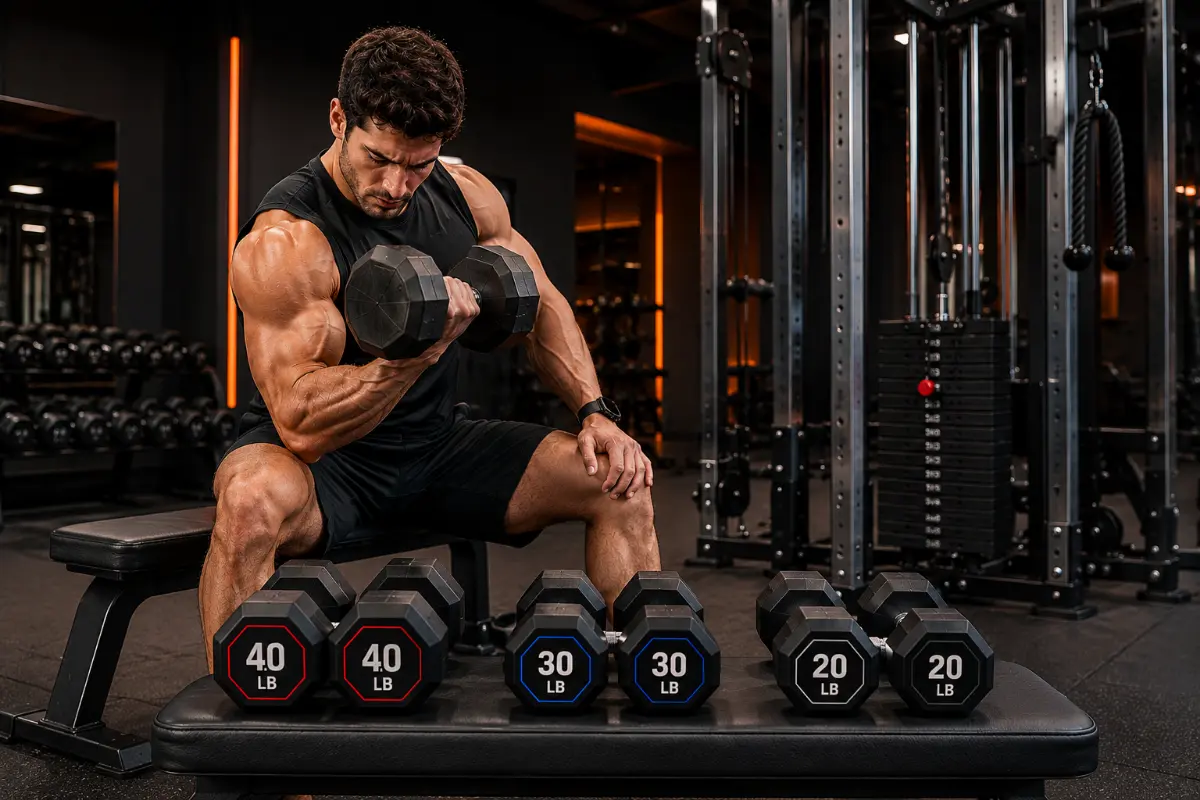
A drop set starts with a weight you take to failure, then you reduce the load by 10–30% and continue repping to failure again, with no rest between drops. One drop set produces comparable muscle growth to three traditional sets in 30–70% less time.
You finish a set of cable curls and your biceps have nothing left. In a normal workout, you’d rest two minutes and do another set at the same weight. A drop set skips the rest, you lower the weight immediately and keep going. Then lower it again. By the time you’re done, the muscle has been pushed past failure multiple times in under 90 seconds.
That’s the trade a drop set makes: less weight, less rest, more accumulated fatigue. Whether that trade helps you depends on which exercises you pick, where in your session you place them, and how many you do per week. Drop sets are one of four advanced set techniques used to intensify training beyond what straight sets can achieve, alongside supersets, pyramid sets, and rest-pause sets.
- How Does a Drop Set Work?
- What Happens Inside Your Muscles During a Drop Set?
- What Does the Research Actually Say About Drop Sets?
- Best Exercises for Drop Sets
- When Should You Use Drop Sets?
- How Do Drop Sets Compare to Supersets and Rest-Pause Sets?
- Drop Set Workout Example
- Frequently Asked Questions
How Does a Drop Set Work?
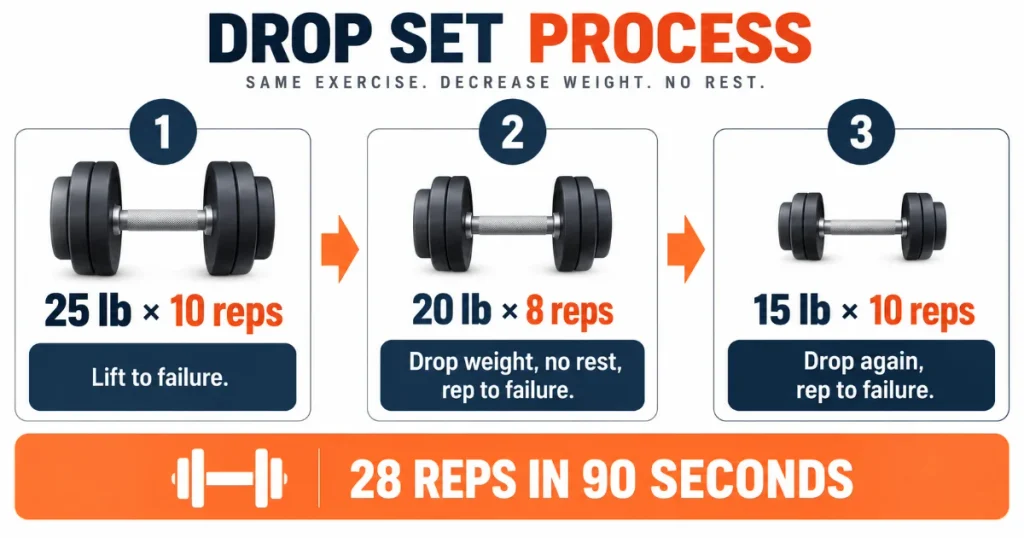
Pick a weight you can lift for 8–12 reps to failure. Complete those reps with clean form until you cannot do another. Without resting, reduce the weight by 10–30% and immediately continue repping to failure. You can drop the weight once (a single drop set) or repeat the process two to three times (a double or triple drop set).
Here’s what a triple drop set looks like on a leg extension:
- 150 lb × 10 reps (failure)
- Drop to 110 lb × 8 reps (failure)
- Drop to 80 lb × 10 reps (failure)
Total: 28 reps across three loads in about 90 seconds. Log it as 150 → 110 → 80 × 10/8/10.
How much weight you drop matters. Less than 10% and you’ll only squeeze out 1–2 extra reps before failing again, not enough to justify the method. More than 30% and the weight becomes light enough that you’re training endurance rather than driving growth. The 10–30% range keeps the load meaningful across all drops.
Drop sets work best on machines and dumbbells where weight changes take seconds. Stripping plates off a barbell mid-set is too slow, by the time the bar is ready, the rest period has turned the drop set into regular straight sets.
You’ll also hear drop sets called “strip sets” (from stripping plates off a barbell) or “descending sets” (from the weight going down). The technique is the same regardless of the name.\
What Is a Mechanical Drop Set?
A mechanical drop set keeps the weight constant and changes the exercise variation instead. You move from a harder version of a movement to an easier one — using the same load throughout.
Example with dumbbells: lateral raises to failure → immediately switch to dumbbell upright rows with the same weight. The upright row shortens the lever arm, giving your side delts a mechanical advantage that lets you keep repping even though they couldn’t complete another lateral raise.
Other mechanical drop set sequences:
- Close-grip bench press → standard bench press → wide-grip bench press (same weight, grip gets wider and easier)
- Pull-ups → chin-ups → neutral grip pull-ups (same body weight, grip shifts to stronger position)
- High incline press → low incline press → flat press (same weight, angle gets progressively easier)
Mechanical drop sets work well when you’re training with limited equipment — you don’t need multiple dumbbells or a pin-loaded machine. One weight, three variations. They also keep mechanical tension higher than loaded drop sets because the weight never decreases. The trade-off: you need to know which variations create a genuine mechanical advantage, not just a different movement pattern.
What Happens Inside Your Muscles During a Drop Set?
Three things occur when you reduce the weight and continue past failure.
Motor units that weren’t working start working. During your first set, your nervous system recruits enough muscle fibers to handle the load. When those fibers fail and you reduce the weight, your body recruits different fibers, ones that were held in reserve, to pick up the work. Over three drops, you activate a broader range of fibers than any single set at one weight could reach.
Metabolic byproducts build up fast. Hydrogen ions and lactate accumulate in the muscle because there’s no rest period for clearance. That deep burn on the second and third drop creates metabolic stress, one of the mechanisms that contributes to muscle growth. It’s a different stimulus from the mechanical tension of heavy straight sets, and the combination of both across a training program is more effective than either alone.
Time under tension extends without you having to count tempo. A traditional set of 10 reps at a controlled pace lasts about 30 seconds. A triple drop set with the same starting weight keeps the muscle loaded for 60–90 seconds continuously. You get the time-under-tension benefit without deliberately slowing your reps down.
What Does the Research Actually Say About Drop Sets?
Two meta-analyses have directly compared drop sets to traditional multi-set training.
Sødal et al. (2023) in Sports Medicine Open reviewed six studies and found no significant difference in muscle hypertrophy between drop sets and traditional sets. The standardized effect size was trivial (0.155), meaning both methods grow muscle at roughly the same rate when total effort is equated.
Coleman et al. (2022) in the International Journal of Strength and Conditioning confirmed the same: comparable strength and hypertrophy outcomes. But drop sets achieved those results in significantly less training time.
A 2026 meta-analysis in Sports Medicine Open built on both earlier reviews and reinforced the finding: drop sets produce similar hypertrophic and strength adaptations as traditional training while requiring less total session time. The distinguishing factor is greater acute metabolic stress and neuromuscular fatigue, which makes recovery management important.
That is the core trade-off. Drop sets do not grow muscle faster than straight sets. They grow muscle in less time. For someone with 40 minutes to train instead of 75, that difference changes what is possible.
One important caveat: the evidence base is growing but still relatively small. The direction is consistent, but individual variation matters, and most studies have not tested beyond 12 weeks.
Best Exercises for Drop Sets
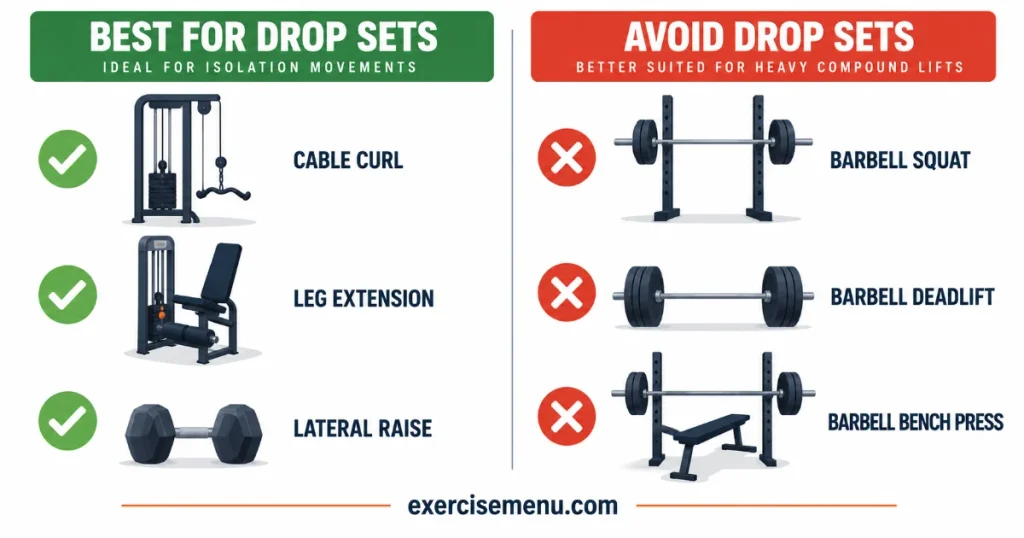
Drop sets work best on exercises where you can change weight in under 2 seconds and where failing safely is built into the equipment.
Cable machines: Cable curls, tricep pushdowns, cable lateral raises, face pulls, cable rows. Pin-loaded weight changes take one second.
Plate-loaded machines: Leg press, leg extension, leg curl, chest press, shoulder press. Strip a plate from each side between drops.
Dumbbells: Lateral raises, dumbbell curls, dumbbell rows, goblet squats. Keep two or three pairs pre-staged on the rack beside you.
Avoid drop sets on: Barbell squats, deadlifts, barbell bench press, overhead press. Stripping plates takes too long, and form breakdown under accumulated failure on compound barbell lifts increases injury risk.
When Should You Use Drop Sets?
Drop sets earn their place under specific conditions. Outside of those, straight sets with full rest and controlled progressive overload remain more effective.
Use them when:
Your goal is hypertrophy and you’re short on time. Drop sets let you complete the equivalent stimulus of three straight sets in under 90 seconds. If your schedule allows 40 minutes instead of 60, replacing the last exercise for a muscle group with a drop set maintains the stimulus without extending the session.
You’ve plateaued on an isolation exercise. If your lateral raises, cable curls, or leg extensions haven’t progressed in 3–4 weeks despite consistent effort, a 4–6 week block of drop sets on that movement can break the stall through a different fatigue pathway.
You want to finish a muscle group. Drop sets work best at the END of your work for a body part, after your heavy straight sets are done. They’re a closer, not an opener.
Skip them when:
Your primary goal is strength. Drop sets reduce load across the set. Maximal strength requires handling heavy weight with full neural recovery between sets. Drop sets trade that recovery for metabolic stress — the opposite of what strength training demands.
You’re doing compound barbell movements. Squats, deadlifts, bench press under drop-set conditions means handling a barbell while grip, bracing, and coordination are degraded from accumulated failure. Use drop sets on machines and isolation exercises where failing safely is built into the equipment.
You’re already doing more than 20 sets per muscle group per week. Drop sets ADD volume. If your training volume is already high, drop sets push total work past what your recovery can handle. The result is accumulated fatigue that masks as a plateau.
How Do Drop Sets Compare to Supersets and Rest-Pause Sets?
All three are advanced set techniques that push training past what straight sets offer. The mechanics and best use cases differ.
Drop sets reduce the weight after failure. You stay on the same exercise. Best for fully exhausting a single muscle group in minimal time.
Supersets pair two different exercises back-to-back. The muscle for Exercise A rests while you perform Exercise B. Best for cutting session time without reducing weight on either exercise. Full comparison in the supersets guide.
Rest-pause sets keep the weight constant, rest 10–20 seconds, then continue with mini-sets. Best for accumulating reps near failure with the same load. Full comparison in the rest-pause guide.
A 2021 study by Enes et al. in Applied Physiology, Nutrition and Metabolism compared rest-pause and drop sets directly against traditional training. Both techniques produced similar hypertrophy outcomes, confirming that the growth stimulus comes from accumulated effort near failure, regardless of which method delivers it. The practical choice comes down to equipment and preference: drop sets need quick weight changes, rest-pause needs nothing but a timer.
| Drop Sets | Supersets | Rest-Pause | |
|---|---|---|---|
| What changes | Weight decreases | Exercise switches | Nothing — same weight, brief rest |
| Target | Single muscle exhaustion | Time efficiency | Maximum effective reps |
| Equipment needed | Machines, dumbbells, plate-loaded | Two stations | Any |
| Time per set | 60–90 seconds | 45–75 seconds | Under 2 minutes |
| Best placed | Last exercise for a muscle group | Assistance work after main lifts | Last set of an accessory |
For a side-by-side breakdown of how drop sets compare to pyramid sets and supersets, see the full technique comparison.
Drop Set Workout Example
This is how drop sets fit into a real session. Heavy straight sets first, drop set as the finisher.
Bicep day closer:
Cable curls: 3 straight sets of 10 reps, 90 sec rest (normal work)
Cable curls drop set (finisher): 25 lb × failure → 20 lb × failure → 15 lb × failure. One round. Session done for biceps.
Leg day closer:
Leg extension: 3 straight sets of 12 reps, 90 sec rest (normal work)
Leg extension drop set (finisher): 150 lb × failure → 110 lb × failure → 80 lb × failure. One round.
Keep drop sets to one exercise per muscle group per session, placed last.
Frequently Asked Questions
Can you do drop sets on barbell exercises?
Technically yes, but the setup defeats the purpose. Stripping plates takes 15–20 seconds even with a partner, long enough that your muscles partially recover between drops. Pin-loaded machines let you change weight in under 2 seconds, which is what makes drop sets effective. If barbells are all you have, mechanical drop sets (changing grip or angle instead of weight) work better.
How many drops should you do in one set?
Two to three. Beyond that, the load becomes light enough that you’re training muscular endurance rather than hypertrophy. Each additional drop also increases recovery cost without proportionally increasing growth stimulus. Three drops at 10–20% reduction each covers the useful range.
Can you do drop sets every workout?
Not for the same muscle group. One to two drop set exercises per muscle group per week is the practical ceiling for most lifters. Drop sets generate higher metabolic stress and muscle damage than straight sets at matched volume, doing them every session for the same muscles outpaces recovery within 2–3 weeks.
Should beginners do drop sets?
Not in the first 3–6 months of training. Beginners build muscle rapidly with straight sets and need to develop consistent form before training to failure repeatedly. Drop sets require you to maintain technique while fatigued across multiple failure points, a skill that takes time to build.
