


Quick Answer: Skipping the gym for two weeks causes minimal muscle loss for most trained individuals. Cardiovascular fitness begins declining around day 10–14, strength stays largely intact, and most losses reverse within one to two weeks of returning to training.
Missing two weeks at the gym is rarely the setback it feels like. Whether it was illness, travel, work, or life getting in the way — the body doesn’t undo months of training in 14 days. What actually happens depends on whether you train primarily for strength or cardio, how long you’ve been training, and what your nutrition and sleep look like during the break.
- What Happens to Your Body Day by Day During a 2-Week Gym Break?
- Will You Lose Muscle and Strength After 2 Weeks Off Gym?
- What Happens to Cardiovascular Fitness After 2 Weeks Off?
- What If You Were Sick During Those 2 Weeks?
- Are There Benefits to Taking 2 Weeks Off Gym?
- Will You Gain Weight If You Stop Going to the Gym for 2 Weeks?
- How to Return to the Gym After 2 Weeks Off
- How Often Should You Take Time Off the Gym?
- Frequently Asked Questions
What Happens to Your Body Day by Day During a 2-Week Gym Break?
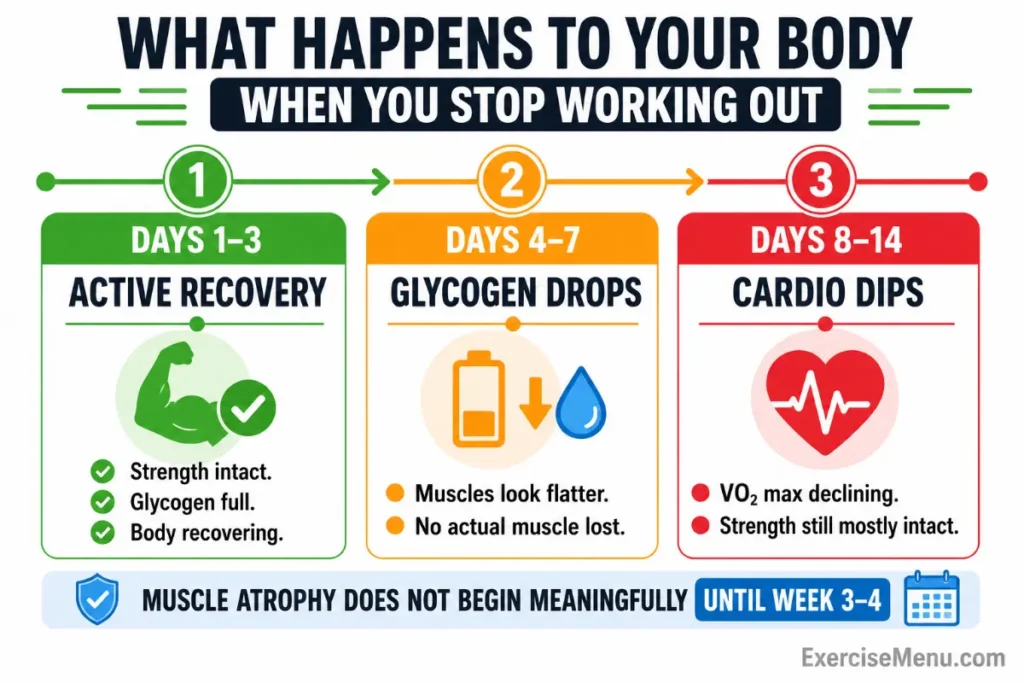
Days 1–3: Nothing significant changes. Muscles still hold glycogen from your last session, neuromuscular pathways stay sharp, and cardiovascular fitness is unchanged. The body is in active recovery — repairing tissue and clearing the fatigue that accumulated during training.
Days 4–7: Muscles may look slightly flatter or softer. This is glycogen depletion, not muscle loss. Without training to deplete and replenish glycogen, muscles lose the water glycogen holds and appear less full. Strength remains unaffected.
Days 8–14: Cardiovascular fitness begins to dip. VO2 max and blood volume start declining around day 10. Anyone who trains cardio-heavy will feel this first. Strength continues to hold — neuromuscular efficiency stays intact through the full two weeks for most trained individuals.
Will You Lose Muscle and Strength After 2 Weeks Off Gym?
No — not in any meaningful sense for either.
Real muscle atrophy requires weeks of complete inactivity combined with low protein intake and often a caloric deficit. Two weeks off gym alone doesn’t create that. What most people notice — a softer, flatter appearance — is glycogen depletion. Glycogen stores water in muscle tissue, so without regular training to cycle those stores, muscles lose fluid and look less full. This reverses within a few sessions of returning.
Strength follows a similar pattern. It’s largely neurological — dependent on how efficiently the nervous system recruits muscle fibers. These neuromuscular adaptations are durable and don’t degrade meaningfully in 14 days. Most research puts the onset of real strength loss at three to four weeks of complete inactivity for trained individuals.
The first session back may feel slightly harder, but that’s the nervous system re-engaging at training intensity and reduced muscle fullness — not actual strength loss. Two to three sessions in, most lifters are back to pre-break performance.
A 2019 study by the American Council on Exercise found that significant fitness adaptations don’t begin to reverse rapidly until around the four-week mark — particularly in newer exercisers. For trained individuals, that timeline extends further.
What Happens to Cardiovascular Fitness After 2 Weeks Off?
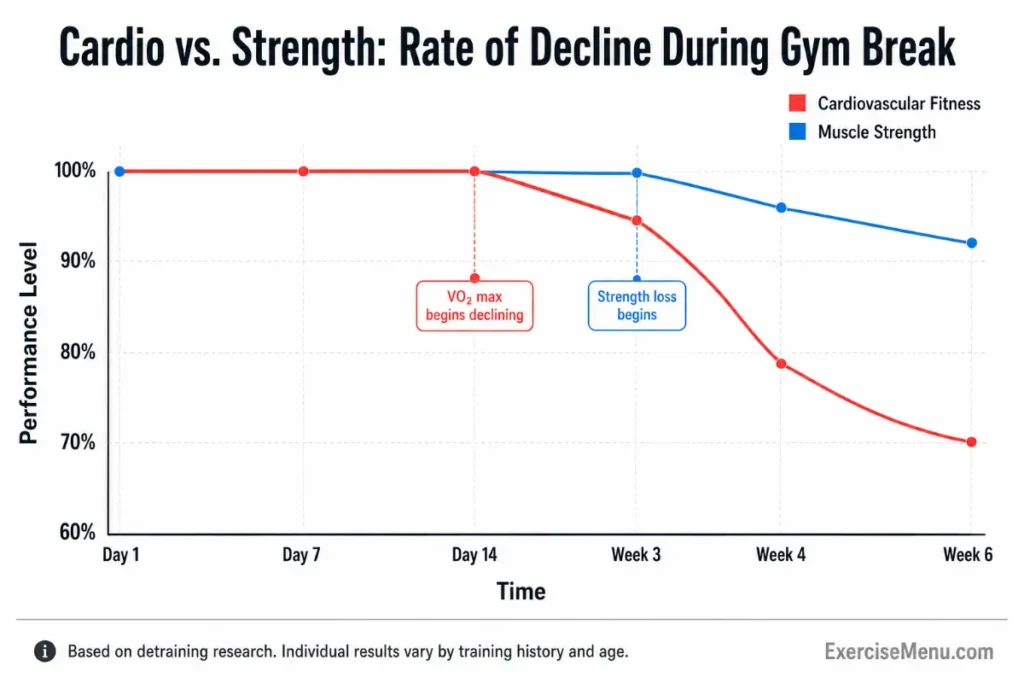
Cardio declines faster than strength — and the gap is significant.
According to research published in Sports Medicine, VO2 max begins declining around the 10 to 14-day mark of inactivity. Blood volume and plasma volume also decrease during this window, reducing how much oxygenated blood the heart delivers per beat. For someone who runs or does HIIT regularly, the first session back after two weeks will feel noticeably harder than it should.
Cardiovascular baseline typically returns within two to three sessions of consistent training.
What If You Were Sick During Those 2 Weeks?
Two weeks off gym while sick produces different outcomes than a planned rest break, and it’s worth understanding why.
During illness — particularly anything involving fever or significant fatigue — the body increases cortisol output to manage the stress response. Sustained elevated cortisol is catabolic, meaning it breaks down muscle tissue to supply amino acids for immune function. This is why protein intake during and after illness matters more than it does during a planned break — the body needs amino acids both to fight infection and rebuild afterward.
Return to the gym only after being symptom-free for 48–72 hours. Start at roughly 50% of pre-illness training volume and build up over the following week rather than returning at full intensity.
Are There Benefits to Taking 2 Weeks Off Gym?
A planned two-week break delivers recovery that a standard one-week deload cannot fully provide.
CNS fatigue builds with hard training and doesn’t always show up as muscle soreness — it shows up as stalled lifts, declining motivation, and slower performance that doesn’t respond to lighter sessions. Two weeks clears this backlog in a way one lighter week doesn’t.
Tendons and ligaments recover more slowly than muscle and rarely get genuine unloaded rest during normal training blocks. An extended break gives connective tissue time to repair microtrauma that accumulates quietly over months of consistent training.
The condition is that nutrition and sleep are maintained during the break. A two-week break with consistent eating and sleep preserves nearly all training gains. One where both collapse compounds the setback beyond what the training pause alone would cause.
Will You Gain Weight If You Stop Going to the Gym for 2 Weeks?
Probably not fat — but the scale may go up slightly from water retention.
Glycogen holds approximately 3 grams of water per gram stored. Without training depleting glycogen regularly, water retention temporarily increases and the scale reflects that. If eating stays roughly consistent with training levels, this normalizes within days and doesn’t represent actual fat gain.
Real fat accumulation requires a sustained caloric surplus. Two weeks of reduced activity doesn’t produce meaningful fat gain unless food intake increases significantly alongside it.
How to Return to the Gym After 2 Weeks Off
Week 1: Reduce volume by 30–40% from your pre-break baseline. Stick to familiar compound movements, leave a few reps in reserve on every set, and expect DOMS to hit harder than usual. That soreness is a response to renewed stimulus — not a measure of how much was lost.
Week 2: Resume progressive overload at your pre-break baseline and add volume incrementally. Most trained lifters are back to pre-break performance by the end of this week.
A few things to avoid on the first session back: don’t test your one-rep max, don’t combine full volume with high intensity on the same day, and don’t skip the warm-up — joints haven’t been under load for two weeks and need gradual preparation. A slight increase in protein intake during the first week supports the elevated muscle protein synthesis that follows a training break.
How Often Should You Take Time Off the Gym?
A planned deload every four to eight weeks is appropriate for anyone training at moderate-to-high intensity four or more days per week. A full two-week break makes sense after a sustained training block of 12 or more weeks, following illness, or when multiple recovery signals appear together: lifts that feel harder than the load justifies, persistent joint or tendon aches that don’t clear with a lighter week, disrupted sleep, and a sustained drop in training motivation.
One lighter week handles mild accumulated fatigue. When those signs persist through a lighter week, two weeks is the more appropriate response.
Frequently Asked Questions
Is 2 weeks off gym too long?
For most trained individuals, no — strength stays largely intact and recovery benefits often improve return performance.
Will I lose all my gains in 2 weeks?
No. Meaningful muscle loss requires several weeks of inactivity combined with low protein intake.
What happens when you skip gym for 2 weeks as a male?
Men may notice an energy and motivation drop around day 10–12 — testosterone levels can begin drifting downward within one to two weeks of stopped training. It reverses quickly once training resumes.
Can 2 weeks off gym actually be good for you?
Yes, particularly after a long hard training block — CNS recovery and connective tissue repair are real benefits.
How long to get back to normal after 2 weeks off gym?
Strength returns within one to two weeks of consistent training. Cardiovascular fitness takes two to three weeks.
How to regain strength quickly after missing gym for 2 weeks?
Reduced volume, compound movements, adequate protein, and progressive overload from the first session back.
Is it okay to take 2 weeks off gym when sick?
Yes — returning too early extends recovery. Wait until symptom-free for 48–72 hours, then return at reduced volume.
