


Quick Answer: A rest day is no exercise at all — the body uses that time for muscle repair, glycogen replenishment, and nervous system recovery. An active recovery day is intentional low-intensity movement that supports recovery without adding training load. CNS fatigue means complete rest. Muscle soreness with normal energy means active recovery.
- Key Takeaways
- What is the difference between a rest day and active recovery?
- What actually happens to your body on a rest day?
- What is active recovery and what does it actually do?
- Active recovery vs passive recovery: what's the difference?
- How to know which one your body actually needs
- What are the best active recovery activities?
- Does running count as active recovery?
- How long should active recovery sessions last?
- How many rest days per week do you need?
- Why sleep determines whether training actually produces results?
- What to eat on rest days and active recovery days?
- How recovery programming changes by training goal?
- Using HRV to make recovery decisions more objective
- How rest days fit into a training week?
- Frequently asked questions
- The bottom line
Key Takeaways
- Active recovery uses low-intensity movement (Zone 1, under 60% max heart rate) to clear blood lactate, reduce soreness, and improve circulation without adding training stress.
- A rest day removes all structured exercise so muscle protein synthesis, glycogen replenishment, and CNS recovery can occur without interference.
- CNS fatigue and muscle soreness are different signals — and they call for different responses. Confusing them slows progress.
- Active recovery sessions should run 20–40 minutes. Past 45 minutes, fatigue starts building rather than clearing.
- Beginners need 2–3 complete rest days per week. Advanced trainees still need at least one full rest day — not a lighter session.
You have a day off from training. You’re sore, a little tired, and deciding whether to do something light or stop entirely.
Most people either do nothing and feel guilty, or push through a light session because movement feels more productive than stillness. Neither is based on what the body is actually signaling — and the wrong choice doesn’t just waste the recovery window. It adds to the fatigue you were trying to clear.
Muscles, the central nervous system, and hormonal balance all recover through different mechanisms on different timelines. Active recovery and rest days each address a different part of that picture. This guide explains what each one does, which signals tell you which one applies, and how to fit both into a real training week.
What is the difference between a rest day and active recovery?
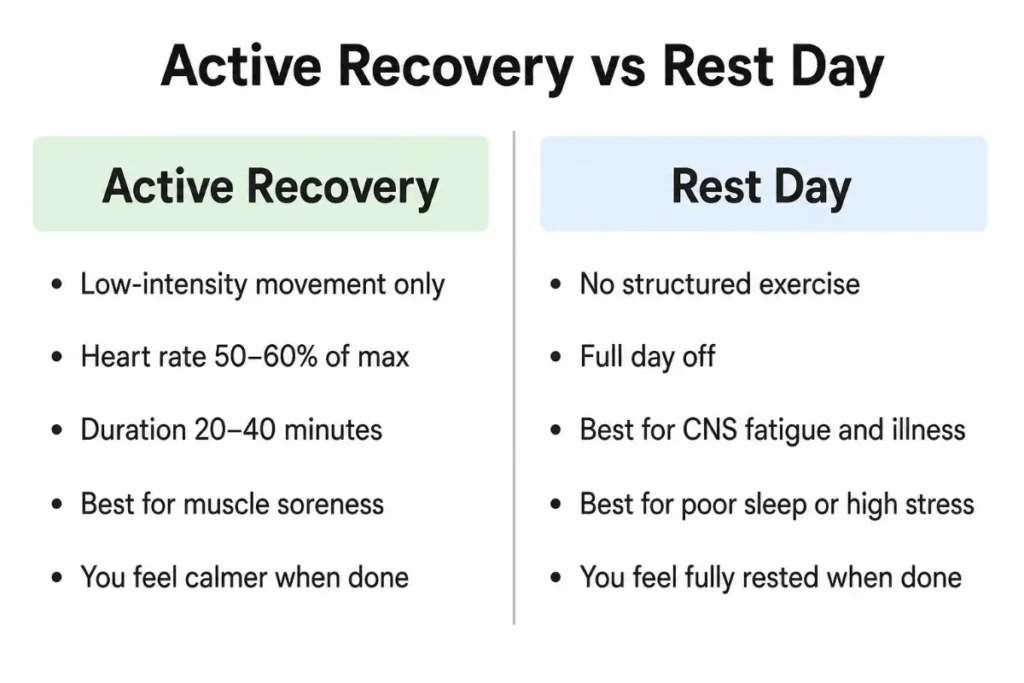
A rest day is the complete removal of training stress — no exercise, no structured loading. The body uses this time for muscle protein synthesis, glycogen replenishment, CNS recovery, and tissue repair.
An active recovery day is intentional low-intensity movement kept in Zone 1 (50–60% of maximum heart rate). It supports recovery without adding training load. The two are not interchangeable.
| Factor | Active Recovery | Rest Day |
|---|---|---|
| Exercise | Yes — low intensity only | None |
| Heart rate | 50–60% of max (Zone 1) | N/A |
| Primary function | Clear blood lactate, reduce DOMS, improve circulation | MPS, glycogen replenishment, CNS recovery |
| Best when | Muscle soreness, normal energy and motivation | CNS fatigue, illness, sleep debt, post-high-volume block |
| Duration | 20–40 minutes | Full day |
| Weekly frequency | 1–3 times | 1–2 times minimum |
| How you feel after | Calmer, looser, less stiff | Fully rested |
What actually happens to your body on a rest day?
Training is the stimulus. Adaptation happens during recovery — not during the session.
Strength, muscle growth, and performance improvements develop in the recovery windows between sessions. Rest days are not gaps in a program. They are part of the program.
Muscle protein synthesis peaks after training stops
Muscle protein synthesis (MPS) — the process that repairs and rebuilds muscle tissue — peaks 24–48 hours after a resistance session. The body is most actively rebuilding during this window. Adding training stress at this point doesn’t speed up repair. It competes with the resources already being directed toward it.
Glycogen replenishes at rest, not during activity
Muscle glycogen is the primary fuel for high-intensity training. It depletes during hard sessions and restores during rest, provided carbohydrate intake is adequate. Training on consistently depleted glycogen shows up as slower lifts, worse conditioning, and effort that feels disproportionate to the load. Most people read this as a plateau. It’s usually a fueling and recovery gap.
CNS recovery is the piece most people miss
The central nervous system governs force production, motor unit recruitment, reaction speed, and coordination. Heavy compound lifts — deadlifts, squats, heavy presses — place neurological demand on the CNS separately from what the muscles experience.
CNS fatigue doesn’t feel like sore legs. It feels like familiar weights are heavier than they should be, bar speed has slowed, reaction time feels off, and drive to train has dropped for several consecutive days without an obvious reason. A walk won’t fix this. Only complete rest does.
Cortisol rebalances during rest
Cortisol rises with training stress as a normal part of the exercise response. When rest is chronically insufficient, it stays elevated — suppressing testosterone and impairing muscle protein synthesis. Rest days are when the hormonal environment rebalances between loading phases.
What is active recovery and what does it actually do?
Active recovery is low-intensity movement at Zone 1 (50–60% of maximum heart rate) that supports recovery without adding training load. It works through mechanisms rest alone doesn’t address.
It clears blood lactate faster than staying still
During high-intensity training, lactic acid accumulates as a byproduct of anaerobic energy production. Low-intensity movement between 30–60% of maximum heart rate improves circulation and accelerates blood lactate removal from muscle tissue. A 2012 study in the Journal of Sports Sciences confirmed active recovery clears blood lactate significantly faster than passive rest after intense exercise.
It reduces soreness perception — not the damage itself
Research published in Frontiers in Physiology (2018) found that active recovery reduces perceived DOMS following high-intensity exercise compared to complete rest. The underlying tissue damage doesn’t resolve faster — but soreness perception drops, which affects how well you perform in the sessions that follow.
It keeps blood and nutrients moving to recovering muscles
Light movement keeps circulation going to muscles — delivering oxygen, amino acids, and glucose — without adding mechanical stress to tissue that’s already recovering. The purpose is delivery, not stimulus.
It shifts the nervous system toward recovery mode
Training drives the nervous system toward sympathetic activation — the state associated with performance and output. Easy movement, slow walking, and deliberate breathing help shift it the other way, toward the state where repair and recovery are prioritized. A session done at the right intensity should leave you calmer and less stiff than when you started, not tired.
The intensity line most people cross without realizing
Heart rate needs to stay under 60% of maximum. Once breathing becomes noticeably harder, the session has crossed from recovery into a low-intensity training stimulus — which is not the same thing. The test: can you hold a full conversation without pausing? If not, you’re going too hard.
Active recovery vs passive recovery: what’s the difference?
Active recovery uses movement. Passive recovery uses no movement at all — recovery happens through rest and external tools.
Most guides fold passive recovery into “rest day” without separating them, but the difference matters when you’re deciding what to actually do on a full rest day.
Passive recovery options
Massage and soft tissue work reduce perceived soreness and improve tissue pliability. A session the evening before a high-demand training day reduces residual stiffness going in.
Cold water immersion at 10–15°C reduces acute inflammation and soreness. A 2016 meta-analysis in the British Journal of Sports Medicine found cold immersion significantly more effective than passive rest for reducing DOMS up to 96 hours after exercise. The evidence-supported duration is 10–15 minutes.
Infrared sauna improves circulation and supports the nervous system shift toward recovery mode. The evidence base is thinner than cold immersion, but consistent soreness reduction is reported, and evening use appears to support sleep quality in some athletes.
Sleep is the most powerful recovery tool available and covered in detail below.
When passive recovery makes more sense than active
- Movement of any kind is aggravating an injury or acute inflammation
- Full-body fatigue makes even easy activity feel effortful
- You’re tapering before competition and energy preservation is the priority
Passive tools can be added on top of rest days — cold immersion after a high-volume block, or a massage session before a demanding training day.
How to know which one your body actually needs
Take a rest day when
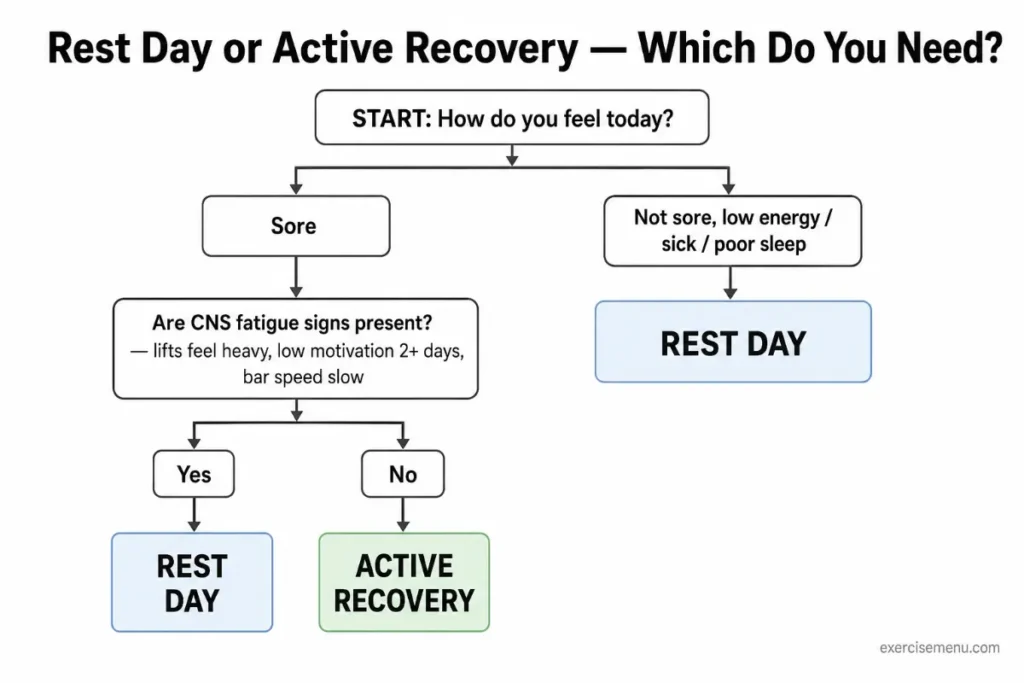
CNS fatigue signals are present. The markers are specific: lifts feel heavier than they should at weights you handle regularly. Bar speed has slowed. Reaction time feels off. Motivation to train has been low for several consecutive days — not just one. CNS fatigue means the nervous system hasn’t recovered from accumulated demand. Even easy movement adds a small neurological load. Only complete rest clears it.
You’re sick. The immune system draws from the same resource pool as muscles and the nervous system. When you’re ill, those resources are already committed. Adding movement — even light movement — takes energy from the immune response. Fever, respiratory symptoms, or significant whole-body fatigue all mean complete rest until you’ve cleared it.
Sleep has been poor for two or more nights. Growth hormone, the primary driver of tissue repair, is released during deep sleep. Multiple nights of disrupted or shortened sleep reduces recovery capacity enough that active recovery produces limited benefit. Under that kind of sleep debt, light movement just adds load to a system that’s already behind.
You’ve just finished a high-volume training block. After a loading cycle of elevated volume, frequency, or intensity, the body needs a genuine reset. This is where a deload week comes in — lighter sessions within a normal week don’t accomplish the same thing.
Choose active recovery when
Muscle soreness is present but CNS signals are normal. DOMS — the deep ache that builds 24–48 hours after training — reflects localized tissue stress. It is not CNS fatigue. If your last session felt strong, motivation is normal, and soreness is specific to the muscles you trained, active recovery is appropriate. Light movement reduces soreness faster than staying still.
Energy and mood are normal. If sleep was adequate, you’re not sick, and focus feels fine, the nervous system has recovered. What’s left is muscular fatigue, which is exactly what active recovery addresses.
The previous session was moderate intensity. Heavy compound work at high volume needs longer recovery before any further loading. A technique session, accessory work, or moderate cardio leaves room for active recovery the next day.
What are the best active recovery activities?

The activity matters less than the intensity it’s done at. Every option that works shares the same goal: improve circulation without creating a training stimulus.
Walking
Walking is the most reliable choice. Research from Sanford Sports Performance confirms 15–20 minutes of easy continuous walking activates the muscle pump — rhythmic contractions that drive lymphatic drainage and nutrient delivery to recovering tissue. Zone 1 happens automatically at a natural walking pace with no effort required to stay there.
Duration: 20–40 minutes standalone. 10–15 minutes as a post-workout cooldown.
Light cycling
Stationary bike or flat outdoor riding promotes lower body circulation without joint impact. Resistance should stay low enough that the legs aren’t working against it. Effective after heavy lower body sessions where walking is uncomfortable.
Duration: 20–30 minutes.
Easy swimming
Water reduces mechanical stress on joints and connective tissue while keeping the body moving — a strong option after heavy strength work where joint loading needs to stay minimal. Pace and stroke should stay relaxed throughout.
Duration: 20–40 minutes.
Gentle yoga and stretching
Easy yoga maintains mobility in the muscles and joints stressed during training while supporting the nervous system shift toward recovery mode. The breathing patterns and slow movement do more for recovery than most people expect.
Hard stretching — pushing into discomfort or the end of range — is not appropriate here. It adds stress to tissue that’s already recovering. The goal is comfortable range, not maximum range.
Duration: 30–45 minutes.
Foam rolling and mobility work
Foam rolling consistently reduces post-exercise soreness and improves tissue pliability. Paired with targeted mobility work for the muscle groups trained the day before, it addresses both tissue restrictions and joint stiffness that build with training volume.
Duration: 15–30 minutes.
What does not qualify as active recovery
These generate training stress regardless of how they’re labeled:
- Heart rate sustained above 60% of maximum
- Any loaded resistance movements
- Sprinting or explosive effort
- HIIT at any intensity
- Hot yoga, power yoga, or fast-flow vinyasa
- Competitive sport or recreational activity at moderate to high effort
Does running count as active recovery?
Running qualifies only when pace is controlled enough to keep heart rate in Zone 1 — under 60% of maximum, fully conversational, for 20–30 minutes maximum.
Most people run too fast. Once heart rate clears 60% of max, the session becomes a low-intensity training stimulus, not recovery — these produce different physiological outcomes. If managing your breathing takes any active effort, the pace is too fast. A genuine recovery run feels almost uncomfortably slow.
The same applies to cycling: resistance low, cadence easy, Zone 1, 20–30 minutes. If it feels like you accomplished something physical, it was too hard.
For anyone who doesn’t run or cycle regularly, walking is more reliable. Zone 1 happens automatically at a natural walking pace.
How long should active recovery sessions last?
| Activity | Post-workout cooldown | Standalone session |
|---|---|---|
| Walking | 10–15 min | 20–40 min |
| Light cycling | 10–15 min | 20–30 min |
| Easy running (Zone 1) | 10–15 min | 20–30 min |
| Easy swimming | 10–20 min | 20–40 min |
| Yoga / gentle stretching | 10–15 min | 30–45 min |
| Foam rolling + mobility | 6–10 min | 15–30 min |
Ortiz et al. (2018) found that 6–10 minutes of active recovery immediately after training is sufficient to meaningfully accelerate blood lactate clearance. For a full active recovery day, 20–40 minutes covers the range supported by the research.
Past 45 minutes, fatigue starts accumulating — especially when intensity has drifted upward. When time is short, 15–20 minutes of easy walking still produces a real benefit.
How many rest days per week do you need?
| Training level | Total off days per week | Minimum complete rest days |
|---|---|---|
| Beginner (0–12 months) | 3–4 days | 2–3 complete rest days |
| Intermediate (1–3 years) | 2–3 days | 1–2 complete rest days |
| Advanced (3+ years) | 1–2 days | 1 complete rest day minimum |
Beginners need the most rest. The neuromuscular system, connective tissue, and recovery capacity are all adapting to training simultaneously. Three well-recovered sessions a week produce more first-year progress than five under-recovered ones.
Intermediate trainees can handle more frequency, but this is when CNS fatigue becomes a real variable. Heavier loads, harder sessions, and insufficient recovery shows up in performance within a week or two. One to two complete rest days, with active recovery filling the remaining off days, is the range that holds up.
Advanced trainees training five to six days per week still need at least one complete rest day every week — not a lighter session, an actual rest day.
Signs recovery is insufficient:
- Strength dropping across multiple consecutive sessions
- Familiar loads feeling heavy for weeks, not just days
- Motivation to train persistently low without a clear reason
- Sleep quality worsening without changes in habits
- Mood shifts that don’t match what’s happening in life
That pattern is accumulated fatigue. More rest fixes it — not a different program.
Why sleep determines whether training actually produces results?
Growth hormone — the hormone primarily responsible for tissue repair and muscle growth — is released during deep sleep. Chronically short or disrupted sleep directly reduces muscle protein synthesis, raises cortisol, and decreases performance. It’s not just about how tired you feel. It determines whether the training stimulus produces adaptation at all.
Training patterns that trace back to sleep quality
When these appear, sleep quality is usually the root cause rather than programming:
- Session quality declining despite adequate rest days → check sleep duration
- RPE higher than usual at familiar loads → check sleep consistency
- Motivation persistently low → elevated cortisol from sleep debt
- Recovery not clearing between sessions → growth hormone deficit from disrupted sleep
Sleep habits that make a measurable difference
- Consistent sleep and wake times including weekends — circadian regularity improves deep sleep
- No screens 30–60 minutes before bed — light exposure delays melatonin onset
- Room temperature around 18–20°C — the body initiates sleep as core temperature drops
- No large meals or alcohol close to bedtime — both disrupt deep sleep architecture
- Two or more nights of poor sleep should be treated as a rest-day trigger
For training adults, 7–9 hours is the evidence-based range. Duration alone isn’t everything — consistent timing and uninterrupted sleep cycles determine how much recovery actually occurs in those hours.
What to eat on rest days and active recovery days?
Keep protein the same as training days
MPS runs at elevated rates for 24–48 hours after a resistance session — meaning it’s actively peaking on your rest day. Cutting protein on off days reduces supply to the repair process the previous session triggered. The target is the same: 1.6–2.2g per kg of bodyweight daily, training day or not.
Don’t cut carbohydrates significantly
Muscle glycogen restores during rest, not during activity. Adequate carbohydrate intake on rest days tops up the fuel stores depleted by training. Cut carbs significantly and you arrive at the next session already behind — a deficit that compounds across the week.
A small calorie reduction is reasonable, a large one is not
Energy expenditure is lower on rest and active recovery days. Reducing intake by 100–200 calories is appropriate. Cutting 500 or more impairs MPS directly — the process depends on adequate energy as well as protein — and chronic under-fueling on rest days produces the same symptoms as overtraining.
Maintain hydration
Hydration underpins every recovery mechanism — nutrient transport, joint lubrication, and waste clearance. Use the Water Intake Calculator to find your daily baseline and hit it on off days the same as on training days.
How recovery programming changes by training goal?
Strength and hypertrophy
Heavy compound training places the highest CNS demand of any training style. After max-effort deadlifts, squats, and presses, complete rest comes first. Active recovery fits between moderate sessions, or as additional off days in a week that already has a full rest day after the hardest session.
Sample weekly structure:
- Day 1: Lower body strength
- Day 2: Upper body strength
- Day 3: Active recovery — walking or mobility work
- Day 4: Lower body volume
- Day 5: Upper body volume
- Day 6: Complete rest
- Day 7: Complete rest
MPS happens during rest, not during movement. Active recovery supports hypertrophy indirectly through better circulation and reduced soreness, but it doesn’t replace what happens to muscle tissue during genuine rest days. The complete programming breakdown — sets, reps, volume targets — is in the muscle growth training guide.
Fat loss
Fat loss phases stall most often because total stress stays too high for too long, not because effort is too low. Months of consistent training produce outcomes that no single intense week can replicate.
A common pattern: training volume gets cut while cardio increases. Weight drops, but muscle goes with it. Three months later, the scale shows progress but body composition doesn’t. How you structure recovery during a cut determines whether weight loss comes from fat or lean tissue. The full framework is in the fat loss training guide.
Active recovery days in a fat loss phase keep daily movement up without adding to the training load the body is already managing.
Sample weekly structure:
- Day 1: Resistance training
- Day 2: Cardio / conditioning
- Day 3: Active recovery — easy walking
- Day 4: Full-body resistance
- Day 5: Cardio or conditioning
- Day 6: Active recovery or unstructured movement
- Day 7: Complete rest
Endurance training
Endurance programs accumulate aerobic volume that builds fatigue quietly — individual sessions feel manageable, but the total compounds across the week. Active recovery days maintain movement and aerobic rhythm without contributing to that load.
For runners and cyclists, active recovery needs to stay well below aerobic development thresholds. Zone 1 is a recovery zone for an endurance athlete, not a training zone. Sessions that drift into Zone 2 degrade the quality of the hard sessions that follow.
Sample weekly structure:
- Day 1: Interval or speed session
- Day 2: Easy aerobic session
- Day 3: Active recovery — Zone 1 walk or easy spin
- Day 4: Tempo or threshold session
- Day 5: Easy aerobic session
- Day 6: Long session
- Day 7: Complete rest
Using HRV to make recovery decisions more objective
Heart Rate Variability (HRV) measures the variation between consecutive heartbeats. Higher variation means the nervous system has recovered. Lower variation signals accumulated fatigue. Most wearables — Garmin, Whoop, Oura Ring, Apple Watch — track it automatically.
What matters is your personal trend, not an absolute number.
- HRV at or above your baseline — nervous system has recovered. Active recovery is appropriate if soreness is present; training is fine if the session is scheduled.
- HRV 10–15% below baseline — nervous system is still under load. Active recovery only.
- HRV more than 15% below baseline — complete rest day. This overrides how motivated you feel.
HRV is most useful when subjective signals are mixed — you feel okay, but something seems off. That’s when the objective reading catches what you’d otherwise miss.
How rest days fit into a training week?
Rest days and active recovery days are scheduling decisions, not whatever’s left over after training is blocked in. A well-built training week places them just as deliberately as the training sessions.
A 3-day full-body program spaces recovery in naturally. A 5 or 6-day split compresses it — which means off days need to go where recovery is actually needed, not wherever is convenient.
Complete rest days belong after the hardest sessions. Active recovery days fit between moderate ones. Stalled progress in consistent trainees is rarely a volume problem. It’s usually a recovery problem. Adding sessions to an under-recovered schedule makes it worse.
For structuring loading blocks, deload timing, and progressive overload across a training year, the deload week guide and reps and sets guide cover the full programming logic.
Frequently asked questions
Is active recovery better than complete rest?
Active recovery works better when muscle soreness is present but CNS function, energy, and motivation are normal. Complete rest is the right call when CNS fatigue markers are present, when you’re sick, when sleep has been consistently poor, or after a high-volume training block.
What counts as active recovery?
Any low-intensity movement that keeps heart rate under 60% of maximum — walking, light cycling, easy swimming, yoga, foam rolling, and mobility work. Noticeably harder breathing or working against meaningful resistance means the session has crossed into training territory.
Should I take a rest day or active recovery day for muscle growth?
Complete rest is more directly valuable. MPS happens predominantly during rest, not during movement. Active recovery supports hypertrophy indirectly but doesn’t replicate what happens to muscle tissue during genuine rest days.
How many rest days per week?
Beginners: 2–3 complete rest days. Intermediate: 1–2. Advanced trainees training 5–6 days: 1 complete rest day minimum. This floor doesn’t drop at any training level.
Can I do active recovery when sick?
No. The immune system draws from the same resource pool as muscles and the nervous system. Movement during illness competes with the immune response. Rest until symptoms resolve.
What’s the difference between active recovery and a deload week?
A deload week is a planned multi-day reduction in volume or intensity — typically a full week after 4–6 weeks of progressive loading. Active recovery is a single-day decision within a normal week. They’re not substitutes for each other.
What’s the difference between active and passive recovery?
Active recovery is low-intensity movement — walking, cycling, yoga. Passive recovery is no movement — massage, cold immersion, sauna, sleep. Both support recovery through different mechanisms and can be combined on rest days.
What should I eat on rest days?
Protein at training-day levels: 1.6–2.2g per kg of bodyweight. Adequate carbohydrates to replenish glycogen. A 100–200 calorie reduction is reasonable. Cutting 500 or more directly impairs the repair processes rest days exist to support.
The bottom line
Rest day or active recovery comes down to what the body is recovering from.
CNS fatigue, illness, sleep debt, and accumulated training volume mean complete rest. Muscle soreness with normal energy and nervous system function means active recovery. Getting this wrong in either direction — training when rest is needed, resting when movement would help — has a cost that compounds across weeks and months.
Recovery is not time away from progress. It’s how training stress becomes adaptation.
Use the Rep Range Recommender to match your training sessions to the right stimulus for your goal — so the rest days and active recovery days around them are actually supporting work that produces a result.
