


Quick Answer: A well-structured workout follows this sequence dynamic warm-up, compound movements, isolation or accessory work, then cooldown. The specific exercises, sets, reps, and rest periods shift depending on your goal, but the underlying order stays consistent regardless of fitness level.
Most people who train without results aren’t choosing the wrong exercises. They’re arranging them wrong bicep curls before rows, 30-second rest between heavy sets, or stepping straight under a barbell with cold muscles. The exercises themselves aren’t the problem. The structure is.
Structure is the session-level decision: what happens first, what happens last, how long you rest between sets, and why each choice matters. A workout plan maps out what you do over weeks and months. Structure determines how each session is organized so that plan actually produces results.
- What Should Every Workout Include?
- How to Structure a Workout Based on Your Goal?
- What Order Should Your Exercises Go In?
- How Long Should Each Part of Your Workout Take?
- How Many Days Per Week Should You Train?
- How to Structure a Workout as a Beginner?
- How Structure Changes as You Progress?
- Frequently Asked Questions
What Should Every Workout Include?
Every session needs four things in this order: a dynamic warm-up, compound movements, isolation or accessory work, and a cooldown. Each piece exists for a specific reason.
Dynamic Warm-Up
Static stretching before lifting reduces force output holding a cold muscle in a stretched position before heavy loading works against you. A dynamic warm-up raises core temperature, increases blood flow to working muscles, and activates the neuromuscular pathways that compound work is about to demand.
Leg swings, hip circles, arm rotations, bodyweight squats movement that mimics what the session requires. Five to ten minutes is enough. This also includes warm-up sets ramp-up sets done with progressively heavier loads before your working weight. General warm-up first, specific warm-up second.
Compound Movements First
Squats, deadlifts, bench press, rows, overhead press these go first in every session. Your central nervous system is freshest at the start. Hormonal response to heavy multi-joint loading is strongest before accumulated fatigue sets in. Stabilizer muscles are unimpaired.
Do three sets of bicep curls before rows and you’ve fatigued the elbow flexors your rows depend on. The rows suffer, the stimulus drops. Large muscle groups before small, higher-skill movements before lower-skill. A deadlift requires more neuromuscular coordination than a leg press it goes first.
Research on exercise order confirms that resistance training sessions should begin with multi-joint, large muscle group movements before progressing to single-joint isolation exercises preserving neuromuscular output for the lifts that demand it most.
Isolation and Accessory Work
After compound movements, isolation exercises target smaller muscles with lower CNS demand bicep curls, lateral raises, tricep extensions, calf raises. These reinforce the work done by compound lifts and address weak points that multi-joint exercises alone don’t fully develop.
Supersets work well here. Pairing a bicep curl with a tricep extension lets one muscle recover while the other works, making accessory work more time-efficient without compromising quality. Applying supersets to heavy compound movements where full recovery is needed between sets is where they become counterproductive.
Rest Periods
Rest periods are a training variable, not dead time. Most people apply the same duration to every exercise which means rest is either too short for what they’re lifting or too long for what they’re trying to achieve.
According to research published in the Journal of Strength and Conditioning Research, longer rest periods of 3–5 minutes between heavy sets produce significantly greater strength and muscle gains compared to shorter rest intervals of 1 minute or less.
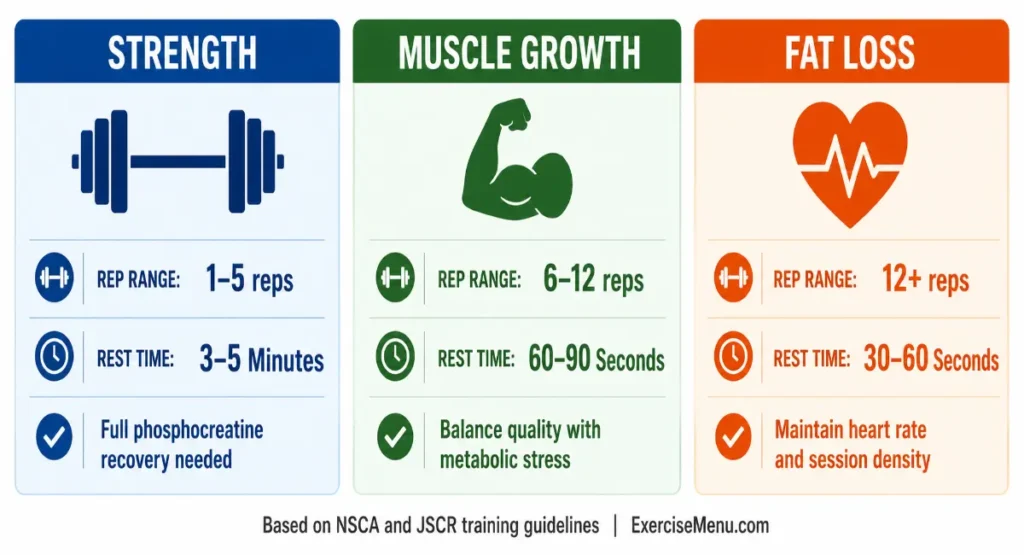
- Strength (1–5 reps): 3–5 minutes. The phosphocreatine system needs full recovery to produce maximum force on the next set.
- Muscle growth (6–12 reps): 60–90 seconds. Enough recovery to maintain quality, short enough to sustain metabolic stress.
- Fat loss or muscular endurance (12+ reps): 30–60 seconds. Shorter rest maintains heart rate and session density.
Cooldown
Five minutes of static stretching at the end of a session reduces heart rate, lowers acute muscle tension, and begins the shift into recovery. Muscles are warm and pliable post-training this is the correct place for passive lengthening, not before the session starts.
How to Structure a Workout Based on Your Goal?
The four components above stay constant. What changes is the rep range, sets, rest periods, and how you prioritize exercise selection within them.
Muscle Growth
Muscle growth responds to training volume total sets and reps per muscle group per session. Sessions prioritize sufficient work across a moderate rep range, with compound movements targeting the primary muscle groups first and isolation work addressing weak points afterward. Chest day means bench press and incline press before cable flyes.
- Rep range: 6–12
- Sets per exercise: 3–4
- Rest: 60–90 seconds
Understanding how reps and sets work within a session determines whether you’re generating the right stimulus or falling short of what’s needed for growth.
Strength
Strength sessions are built around one primary lift per day. Everything else exists to support that lift. The main movement squat, deadlift, bench press, overhead press — goes first and receives the most recovery between sets.
- Rep range: 1–5
- Sets per exercise: 3–5
- Rest: 3–5 minutes between heavy sets
Cutting rest to 90 seconds on a strength-focused session means the next set won’t be a true effort at that load. The long rest is part of the structure.
Fat Loss
Fat loss sessions prioritize training density more total work in less time. Shorter rest periods, higher rep ranges, and pairing exercises so one muscle group recovers while another works.
- Rep range: 10–15+
- Rest: 30–60 seconds, or structured supersets
- Cardio before or after weights directly affects force output on your main lifts for fat loss or muscle goals, weights always come first.
What Order Should Your Exercises Go In?
Compound before isolation. Large muscle group before small. Higher-skill movement before lower-skill.
A Romanian deadlift and a leg extension are both lower-body exercises but one requires full-body coordination and spinal loading, the other is a guided machine movement. Doing the leg extension first reduces what the deadlift can produce.
This applies within splits too. On push pull legs days, heavy pressing variations come before lateral raises on push days, and rows and pull-ups come before curls on pull days. On an upper lower split, the same logic applies start each session with the heaviest compound movement that day calls for.
How Long Should Each Part of Your Workout Take?
| Component | Time |
|---|---|
| Dynamic warm-up | 5–10 minutes |
| Compound movements | 20–30 minutes |
| Isolation / accessory work | 15–20 minutes |
| Cooldown | 5 minutes |
| Total | 45–65 minutes |
When time is short, isolation work is the first thing to cut not the warm-up, not compound movements. A session built around a proper warm-up and two or three well-executed compound lifts produces more than a rushed session that skips the warm-up and crowds in six exercises. Structuring a workout in 30 minutes follows this same principle the components stay intact, the volume gets condensed.
How Many Days Per Week Should You Train?
Training frequency determines how volume is distributed across the week.
- 3 days Full body Each session covers all major muscle groups — compound lower body, compound upper push, compound upper pull, minimal isolation. Recovery is built into the schedule by default. This is the most practical starting point for most people. A weekly workout schedule built around three full-body days gives beginners and intermediate lifters enough frequency to progress without outpacing recovery.
- 4 days Upper/Lower split Upper body and lower body sessions alternate. More volume per muscle group per session than full body, with upper days focused on pressing and pulling movements and lower days on squat and hip hinge patterns. The upper lower split works well for anyone who has built a solid base on full-body training and wants to increase weekly volume per muscle group.
- 5–6 days Push/Pull/Legs Push days cover chest, shoulders, and triceps. Pull days cover back and biceps. Leg days cover quads, hamstrings, and glutes. At this frequency, rest days and active recovery are not optional they are part of the structure. Sessions that consistently feel harder than they should, persistent tendon soreness, or stalling lifts are signs the recovery isn’t keeping pace with the training load.
How to Structure a Workout as a Beginner?
One priority overrides everything else at the start: learn the movement patterns before loading them heavily. Three full-body sessions per week. Each session covers the fundamental patterns squat, hip hinge, horizontal push, horizontal pull, vertical pull.
Three sets of 8–10 reps, 2 minutes rest. Sessions under 60 minutes. Isolation work can wait the first four to six weeks should be almost entirely compound movements.
Here is what a single beginner session looks like in practice:
| Exercise | Sets | Reps | Rest |
|---|---|---|---|
| Squat | 3 | 8–10 | 2 min |
| Bench Press | 3 | 8–10 | 2 min |
| Barbell Row | 3 | 8–10 | 2 min |
Three movements, all compound, all major muscle groups covered. As strength and coordination improve, a hip hinge and a vertical pull get added. Isolation work comes later.
Tracking your workouts from day one matters. Without a record of the previous session’s weight and reps, progressive overload becomes guesswork. A notebook or basic app exercise, weight, sets, reps is enough.
How Structure Changes as You Progress?
The structure that produces results for a beginner stops being optimal after three to four months. Neural adaptations slow, the body needs more specific stress, and the same three-day full-body approach starts producing diminishing returns.
An upper/lower split adds more volume per muscle group per session and more specific exercise selection. Eventually, a push/pull/legs structure for those training five or more days a week. The session-level order stays consistent throughout compounds first, isolation after, rest matched to goal but how training is organized across the week becomes more deliberate.
Frequently Asked Questions
What should every workout start with?
A dynamic warm-up 5 to 10 minutes of movement-based activation before any loaded exercise.
Should I do cardio before or after weights?
After, if the goal involves building muscle or strength. Cardio before resistance training reduces force output on your main lifts.
What is the best workout structure for beginners?
Three full-body sessions per week, compound movements only, 3 sets of 8–10 reps, 2 minutes rest.
How do I know if my workout is structured correctly?
Compound movements come first, rest periods match your goal, and you’re applying progressive overload consistently.
Can I get a good workout in 30 minutes?
Yes warm-up, two or three compound movements, cooldown. Cut isolation work, not the structure itself.
How does workout structure change as I get stronger?
Volume increases, splits become more specific, isolation work plays a larger role, and planned deload periods become part of the long-term structure.

1 Comment
Pingback: A Complete Bowling Workout Routine (With Weekly Schedule)